
How to Publish Your Article

The sequel (or prequel?) to “How to Publish Your Book,” here’s something else they don’t always teach you in graduate school.  As in that earlier post, this is what has worked for me.  Results may vary.

1. How do I know when my article is ready to send out?

GlasssesThe short answer is when it’s in the best possible shape it can be in.

The longer answer is if you’re not sure what that shape looks like, then seek help.  If you’re an assistant professor or adjunct, then seek help from a colleague — at your current or former institution — or from a colleague you’ve met at a conference.  If you’re a graduate student, ask a professor.  Or ask a graduate student who’s already published something.  Have people whose advice you trust — and whose writing you admire — critique the article.  What works?  What doesn’t?  What isn’t clear?  But don’t revise endlessly: Set yourself a deadline for revising it, make the essay as tightly focused and as clearly written as you can, and then send it out.

2. Where do I send my article?
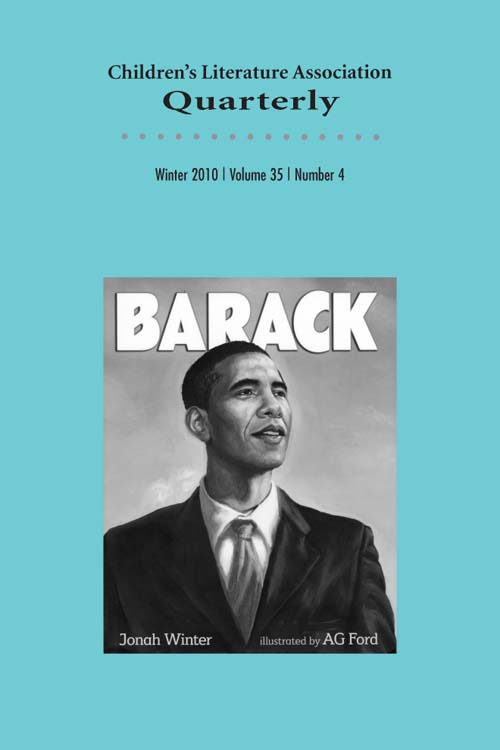
ChLAQ 35.4 (Winter 2010) cover: Winter and Ford's BarackWhat journals cover the subject of your article?  If you’re not sure, you might look at the journals you consulted during your research.  You might also seek advice from someone else in the field — if you’re a graduate student, then perhaps from a professor.  After you’ve a list of possibilities, read some articles in each journal and think about which would be the best fit.  In the field of children’s literature, some journals you might consider include: Children’s Literature, The Lion and the Unicorn, The Children’s Literature Association Quarterly, Children’s Literature in Education, The New Review of Children’s Literature and Librarianship, and Jeunesse (formerly Canadian Children’s Literature).  That’s by no means an exhaustive list.  For a more complete (if decade-old) list, see Wally Hastings and Michael Joseph’s page of Journals that publish articles on children’s literature theory and criticism.

Two other general principles:

  1. Aim high and then settle.  That is, if you think the article can be published in the top journal in your field, then send it there first.  If that journal doesn’t like it, its editors will let you know.  And you can move on to the next one.
  2. Publish widely and well. If this is your second (or third, fourth, etc.) article, consider sending it to a different journal.  It’s a-OK to publish more than one piece in the same journal (especially if it’s a good one), but publishing in more than one place (especially good ones) shows that your work has been approved by multiple venues.

3. What does a cover letter look like?

Nearly all submissions happen on-line, so this is probably a cover email rather than a cover letter.  Here’s my most recent one, sent to American Quarterly on 2 August 2010:

Dear Editors,

I am attaching “Was the Cat in the Hat Black?: Seuss and Race in the 1950s.”  I’m also attaching a document containing images.  I’ve read your guidelines concerning images, and — should the article meet the needs of American Quarterly — I will (of course) send hi-res scans and obtain all necessary permissions.

Should you have any questions about the manuscript (or the images), please don’t hesitate to contact me.  Thank you.

Sincerely yours,

Philip Nel

[followed by full contact info.]

As you can see, the letter is brief and to the point.

4. The journal’s guidelines ask for Chicago citation style. I’ve used MLA style. Do I have to re-format my article?

Yes.  Follow all of the journal’s guidelines, including suggested page length.  It’s not that hard to switch from MLA to Chicago, or Chicago to MLA, or any of the other styles.  It may not be especially exciting work, but it’s simple enough.  Do it.  And you may as well save a copy in your original citation format — just so you have it.

5. I’ve sent it in.  Now what?

First, the journal should acknowledge receipt of your work.  Generally, this happens within a week, perhaps even within a few days.  If a month passes or even a couple of weeks pass without acknowledgment, then follow up.  If more time than that passes, then follow up again.  If you reach six weeks or so and there’s not yet been any acknowledgment, then write again, politely informing the journal that you have decided to submit your article elsewhere.  Each time you correspond, you should include the record of your correspondence — easiest way to do this (in email) is by simply forwarding the earlier one each time, and appending your latest query to the top of the message.

You can, of course, wait longer than six weeks.  Perhaps it’s a very prestigious journal, and you feel it’s worth the wait.  That’s up to you.  But the essay is your intellectual property, and it deserves to be treated with respect.

6. When should I expect to hear from the journal?

American Quarterly 62.3Three to four months after it sends your article out for review.  Some journals take longer, and some are more swift.  On the longer side, American Quarterly now takes 6-8 months just to decide whether to send out the article to reviewers.  On the shorter side, the editor of a special issue is most likely to offer the most prompt response.  Indeed, the fastest way to get published in a journal is through a special issue: it allows you to bypass the journal’s backlog of unpublished articles.

If three months pass, and you’ve not yet heard from the journal, then follow up.  Be polite and brief.

Dear [person at journal],

With apologies for bothering you at a busy time of the term, I thought I would follow up.  Have you any sense of when we might receive readers’ reports on my manuscript?

Thanks in advance for any information you may have.

Best regards,

[your name, contact info., etc.]

The journal will then follow up with the reader(s).  As a reader myself, I find these follow-up emails very helpful.  I get overwhelmed with work, and I use urgency to bump this task up my to-do list.  So, when I get a “where is the reader’s report?” email, I get right on it.

Two related points:

  1. You can withdraw your article. Depending on how tardy the response, you might decide to withdraw your article from consideration.  When?  That depends on how prestigious the journal is and how long you’re willing to wait.  It’s reasonable to expect readers’ reports within three to six months time.  This is your intellectual labor: if the journal isn’t treating it (and thus you) with sufficient respect, then take your submission elsewhere.
  2. One journal at a time. Very important: you must withdraw the article from consideration at Tardy Journal before submitting it to another journal.  You’re not allowed to have the same article under consideration at more than one place.

In case you’re curious: yes, I have withdrawn work and submitted it elsewhere.  In one case, I withdrew work from a proposed essay collection (the editors of which were not responding as swiftly as I’d liked) and submitted it to a journal’s special issue — where, in short order, the essay was published.

So.  Be proactive!

7. I heard back from the journal!  What do I do now?

That all depends on the response.  There are four possible ones.

  1. Accepted.  In this case, express your delight to the editor, make the (presumably minor) editorial and typographical changes you need to make, and do whatever you need to do to prepare the piece for publication.  For example, are there images you wish to include?  If so, start seeking permissions immediately — image permissions can take months to obtain.  And, of course, update the entry on your CV to indicate “Forthcoming,” along with the article’s page length in manuscript form.  And pat yourself on the back.
  2. Accepted with revisions.  Make the revisions.  Cede the point when you can, and hold your ground when you need to.  But do your best to address the readers’ concerns.  Accept the helpful advice with gratitude and respond graciously to the less helpful ones.  Important: Respond only to the content and never to the tone.  Sometimes, a reader’s report can be snarky or sarcastic or even cruel.  This isn’t the norm, but it does happen.  In those cases, remember that your objective is to publish this article.  Viewing an obnoxious reader’s report as an invitation to verbal sparring may be emotionally satisfying for you, but it will not help you achieve your objective.  So: don’t go there.  Be professional.  If you’re worried about your tone, have a friend or colleague read your note before sending.
    • As you make revisions or after you complete them, you might consider creating a separate document in which you sketch a map of your changes.  You don’t have to do this, and it may be that the cover letter will provide you enough space to indicate where changes have been made.  But one thing I’ve done (though I do it much more rarely now than I used to) is indicate how I specifically responded to the reader’s suggestions by pointing out where, in my article, I made the changes.
  3. Revise and resubmit.  If you get this response, you have two choices.  If you feel that the reviewer is completely missing the point, then perhaps this isn’t the journal for you.  Thank the editor, withdraw your piece and submit it elsewhere.  More often than not, though, I’d advise you to pursue the other choice — revise and resubmit.  If the reader has suggested that you revise and resubmit, then he or she sees some potential in your work… but your piece is just not yet where it needs to be.  You will likely have to do some fairly extensive revisions — rewriting sections, throwing parts out, creating new parts.  But you’ll learn something and, in the process, will improve your essay.  See the “Accepted with revisions” guidelines above.
  4. Reject.  Three choices.  If you think the journal is wrong, then send the piece out to a different journal.  Or, first, make a few revisions and then send the piece out a different venue.  The first journal to which I sent “‘Said a Bird in the Midst of a Blitz…’: How World War II Created Dr. Seuss” rejected it — and took its time in doing so.  I then sent the piece to Mosaic, where it appeared in a special issue.  If the essay is important to you, your second option is to revise the piece and then submit it again — either to this journal or to another.  The third option is to put it aside for now.  Work on something else.  Perhaps, in time, you’ll return to this piece, and be able to salvage what’s salvageable.  Perhaps you won’t.  But don’t fret too much about one article.  You’ll write others.  The main thing is that you learn why this one isn’t working so that you don’t repeat those mistakes in other essays.

8. How much do journals pay you?

In the Humanities, they don’t.  If your work appears in an edited collection, then you should expect to receive a copy of the book.  Again, though, getting paid for contributing is rare.  If you’re writing an essay for a reference work, you’re likely to get paid but not get a copy of the book.  That depends: sometimes I’ve been paid for those, and other times I just get a copy of the book.  And “payment” is fairly loosely defined.  “Payment” can be a certain $ amount of books from the publisher’s catalogue.

9. When will it appear in the journal?

As indicated above, if it’s in a special issue, then quite soon — as soon as a couple of months.  But that’s the best-case scenario.  More likely, your essay will not appear for at least a year.  If the journal has a backlog of accepted essays, you may wait for several years.  You can still mark the piece as “Forthcoming” on your CV, of course.

10. Geez.  That seems like a lot of work just to get something published.

Yes, it does.  But, as is the case with many things, the more you do it, the better you get at it.  If this is something you want to achieve, then persist. To quote the Desmond Dekker song, “You can get it if you really want, but you must try, try and try, try and try… you’ll succeed at last.”

21 Comments »

  1. Anne Said,

    January 24, 2011 @ 11:07 am

    Dr. Nel, thank you so much for this post. My fellow humanities graduate students and I all know that publishing is a goal, but haven’t been taught how to even begin the process. For those of us who have been through the process, there is still a lot of useful information here. I’m bookmarking this post and will share it with the other students.

  2. What Do Professors Do All Day? « sarahpark.com Said,

    February 24, 2011 @ 11:27 pm

    [...] counting it as work… and even though I spent a lot of time reading and thinking about “How to Publish Your Article” by Dr. Phil Nel, I didn’t add that time either. Also, since I worked more than 11 [...]

  3. Martin de la Iglesia Said,

    March 20, 2011 @ 4:40 am

    Thank you for this insightful post. However, I’d suggest that there might be more criteria than subject coverage and prestige when it comes to the question “Where do I send my article?”. Such criteria can be highly subjective, of course, but here are some of mine: copyright policy/Open Access, database indexing, author fees, language (English or other?), format (print, e-journal, or hybrid?), look (layout, image quality), duration of review process, mode of review (peer-reviewed?),…

  4. Anna Said,

    August 10, 2011 @ 12:17 am

    Hello! I’m curious – is it possible to publish your article in more than one journal? There are numerous pieces which are anthologized in many different places. Right now I have a journal interested in publishing something that I already had appear in another journal 2 years ago. Is that legal?
    thanks so much!

  5. Philip Nel Said,

    August 10, 2011 @ 12:24 am

    Anna: Generally speaking, no. A journal asks for exclusive rights to a piece. You might enquire if that’s what this journal wants. If it doesn’t mind that the piece has already been published, then you’re in business.

    Typically, an article might be republished as part of an essay collection or a chapter in a monograph. To have one journal republish an article that’s already appeared in another journal is… unusual. There are circumstances under which I could see that occurring. For instance, say, you write an influential article & there’s a special issue of a journal devoted to that article: it runs your article and then responses to it. To offer another parallel (but different) example, Harper’s will often run excerpts of pieces that have appeared elsewhere. That, of course, is a monthly magazine and not a journal.

    But the bottom line is: does this journal care that it’d be publishing an already-published piece? If the journal knows your piece has appeared elsewhere but still wishes to publish it, then — adding a “reprinted from [journal x]” tag — you should be OK to reprint it (after checking your publishing agreement with the original journal).

  6. Anna Said,

    August 10, 2011 @ 12:23 pm

    Thanks so much! That was very helpful!

  7. Debby Said,

    October 18, 2011 @ 1:42 pm

    I sent in an article to a magazine last week. Today one week later I heard back from the managing editor. she stated in her email that they couldn’t accept that article but had requested a new article.

    Does this mean they like my writing style and the way I write? Is this rare that a Managing Editor requests multiple articles? Does this mean I am being considered for acceptance to write for their publication?
    please let me know

  8. Philip Nel Said,

    October 18, 2011 @ 8:44 pm

    Debby: Perhaps I should have given this a better title. I was thinking more about publishing academic articles (of which I’ve published a fair few) than of articles for commercial presses (of which I’ve published very few).

    Based on my limited knowledge of journalism, it sounds to me like you’re reading the Managing Editor’s remarks correctly — they like your writing style but would like you to write something on a different topic, and, yes, they’re now considering accepting your work. BUT, as I say, my experience in this area is limited. You might seek a second opinion!

  9. Arun Said,

    November 2, 2011 @ 12:50 pm

    Hi,
    Very helpful article for novice researchers like me. You covered almost all the possible scenarios after sending out the article to the editor. I am having a curious situation where in the status of the article remains ‘under review’ after 5 months, no comments at all. I have sent several emails to the editor but he has replied to only one of them. It is 2 months since the last reply. I am confused about what to do. Also, what to do if the journal doesn’t acknowledge the withdrawal letter? Will I be legally bound to the submission until they respond?
    Thanks and best wishes
    Arun

  10. Philip Nel Said,

    November 2, 2011 @ 1:15 pm

    Arun: That’s a judgment call on your part. 5 months under review is a long time. If the journal is particularly prestigious, and you’re willing to keep waiting, then keep waiting. For example, I had an article under review at American Quarterly from August 2010 until August 2011 — at that latter date, I learned that it had passed external review, and would be among those discussed by the board at the end of September 2011, after which I would receive a response. It’s now early November and, though I’ve followed up at appropriate intervals, the article’s fate remains uncertain… 15 months after I submitted it. Since I have other work coming out (books, other articles) and American Quarterly is a good journal, I’m being patient for now.

    However, if I were a grad student or a recent Ph.D., I would have pulled my article by now and submitted it elsewhere. When you’re trying to build a CV, waiting for editors of journals (or edited collections) to respond is very frustrating. It might be worth waiting, or it might not. In earlier phases of my career, I would, after six months (or longer), decide to cut my losses, and move on — that is, withdraw the article and submit it elsewhere. I say “or longer” because if I’d had correspondence from the journal, I would wait up to 8 or 9 months. I didn’t have a strict deadline, and still do not have one. So, in your case, I think you could reasonably give the journal a little more time — a month at minimum, but more time if you think that more time is warranted. Then, at that point, pull it and send it elsewhere.

    To answer your final two questions: all you have to do is write and withdraw the piece. You do not need to receive a reply. I’ve withdrawn work twice — both times from an edited collection. In each case, I received no response from the editor. And, in the second case, I took the extra precaution of also mailing (via the postal system) a letter. So, if for any reason the person’s email account were down, the information could still reach said person in the “old-fashioned” way (via post)! I should also add here that each piece I pulled was published — the first in a journal, and the second in a different edited collection.

  11. latifa Said,

    November 9, 2011 @ 8:30 pm

    Hi,
    Thank you very much for this article, i am a PhD student in humanities, I am majoring french and I have been told that the only way to get something published is when it’s in English but my english is limited to the daily conversatio, I have written things in french that I presented or will present in conferences but i don’t know if they will be accepted for publication, also my essays were reviewed by my professors and they suggested so many things that I changed or improved but they never agree in them, one may like it this way the other one will say comletely the opposit and sometimes I feel that I am writing what they want and not what I really want to say, which makes very difficult for me, please let me know what you think?.

  12. N. Sowmia Kumar Said,

    November 17, 2011 @ 12:35 am

    Dear Sir
    I would like to publish some of my papers related to childern and their treatment in India. Is it possible for me to do so and could you please inform me about the journals that publish these papers please. Thanking you

    Sowmia kumar

  13. Roseann Said,

    November 19, 2011 @ 3:00 pm

    Hello Dr. Nel,

    This is such an useful piece, and I keep coming back to it for advice. Thank you!

    I have a dilemma that I was hoping you could help answer. I’m a PhD student. I submitted an essay to an edited collection at the end of July 2011, and still have not heard anything from the editor (except the acknowledgment of receipt). This was an essay developed from a presentation at a conference I attended earlier this year, and so it was a commissioned article, in a sense.

    I suppose it is still too early to withdraw my article? Although I developed and revised the article specifically for the edited collection, I could also envision sending it to a journal. I would really appreciate your opinion on this matter.

    Thanks and regards,
    Roseann

  14. Philip Nel Said,

    November 19, 2011 @ 4:21 pm

    Roseann: Thanks for saying so. Delighted to hear that you find this useful! To answer your question. Given that four months have passed, it seems reasonable to follow up. That is: have they indicated a time frame for when you will be notified? If they haven’t OR if they have and time’s up, then you might inquire (politely, of course) when you might expect to learn whether they think your essay suitable for their collection. The other question to pursue here is whether they have a publisher — which might be phrased in terms of whether any publishers have expressed interest (because that gives the editors a way to acknowledge interest expressed even if they as yet lack contract in hand). If the deadline was end of July, then there’s no reason to expect a contract in hand. However, there is reason to expect that some determination has been made on the suitability (or not) of your piece.

    So, in sum, yes: too early to withdraw the article, but not too early to seek a response from the editors.

    N. Sowmia Kumar: It sounds like you’re interested in Childhood Studies. Rutgers’ Childhood Studies Department has a long list of journals you might look at.

    latifa: Perhaps try for a journal that publishes in French. Jeunesse: Young People, Texts, Cultures publishes articles in French (as well as articles in English.

  15. How to Prepare Your Academic Dossier « sarahpark.com Said,

    December 2, 2011 @ 1:56 am

    [...] There’s a lot more to say about professional/university service, setting goals, doing and publishing research, etc., but that’s another entry for another time. Or, at least for publishing, you can read Phil Nel’s excellent “How to Publish Your Article.” [...]

  16. Ioannis Said,

    December 17, 2011 @ 6:02 pm

    Dear Dr. Nel,

    First of all I would like to thank you for this article. I found the way you have covered the entire academic publishing process very helpful.

    I am an undergraduate music student in England and I would like to know if journal accept articles written by undergraduate students as well. I am asking that because I am interestedto study for a PHD degree later and follow an academic career and therefore having published articls would be helpful for future I think.

    Furthermore I am worried about the writting style of my article. Is it completelly different writting an essay for my undergraduate degree compared to writting an academic article?

    I consider this informarion very helpful for my future and I want to thank you in advance for your answer.

    Regards,
    Ioannis

  17. Philip Nel Said,

    December 17, 2011 @ 6:26 pm

    Loannis: Well, since I’m an English professor, I can’t speak for the field of Music. I can tell you that publishing articles is indeed useful for an academic career, but very few undergraduates publish articles. One reason (in English, at least) is that professionalization tends to happen at the graduate level. Another reason is that, at the graduate level (M.A., Ph.D.), students read more literary criticism and so get a better sense of what an academic article looks like. At the beginning of such an article, for example, the author usually indicates a point of intervention, indicating how his or her particular essay is contributing to the critical conversation.

    Academic journals do publish articles by undergraduates, but it’s a rare undergraduate who can write such an article. (I know that I couldn’t have written such an article as an undergrad!) As for the writing style, read articles published in your field. You might also ask a professor if she or he can recommend a particularly strong article.

    Having said all of that, please also understand that you can wait until graduate school to worry about this. Indeed, most people would expect you to wait until grad school.

  18. ioannis Said,

    December 18, 2011 @ 8:55 pm

    Dear Dr. Nel,

    Thank you very much for your quick response and the helpful guidance you offer.

    Although I am an undergraduate student, I am 24 years old and I already hold one more undergraduate degree in a close field. Furthermore, I am in the last year of my music degree and I have started to worry about my future; this is the reason I want to go as much as I can starting from this year.

    Because of the fact that I have been studying a lot about both fields that I am interested in, I think that I have already created questioning which is very challeging. The think is that I don’t know if there is any standard way of writing academic articles or chapters and I would be grateful if you can refer me to any useful source of information.

    Is always writing an article about proposing new research material? Or can it also be just a presentation of interesting scientific points?

    I am sorry but I didn’t completely understand what you meen whith the term professionalization. Is there any way to learn how to professionalize my way of researching and writing?

    As you may have understood, I don’t like resting and waiting when I have free time to do things that I am interested in. As a first step I read articles written by my tutors and even though I found many of them amazing, there were some which I found very easy to be written. That gave me hope that I could do this as well.

    I hope you can understand my position and give me your always helpful comments.

    Regards,
    ioannis

  19. Philip Nel Said,

    December 18, 2011 @ 9:50 pm

    Ioannis:

    I think you’re better off seeking advice from your tutors or someone in your field. In the field of English, you need to be saying something new — could be you’re examining something via a different theoretical lens, bringing in a heretofore unexplored historical context, proposing an interpretation counter to an accepted or dominant one. For advice on how to make a critical intervention, I recommend Graff & Birkenstein’s They Say, I Say: The Moves That Matter in Academic Writing.

    What do I mean by professionalization? The most succinct way I can answer is to say this: as an undergraduate, you’re a student; as a graduate student (especially a Ph.D. student), you’re an apprentice. The book I just recommended will help with this professionalization process, but so will reading articles by your tutors and others (which I’m glad to hear that you’re doing).

    If you want to try your hand at this, check out They Say, I Say, and then turn to your own work — either take an undergraduate paper and work it into a more academic article, or start writing something new. When you finish, ask a tutor or colleague to take a look (any recommendations for how you could improve?), and to advise you where to send it. Then, revise again, and send.

  20. Anne Said,

    January 22, 2012 @ 2:49 pm

    If you have been asked to submit an article to be a chapter in a book in Spanish, can this same essay be republished in English?

  21. Philip Nel Said,

    January 22, 2012 @ 3:17 pm

    Anne: The short answer is “yes, probably,” but you would want to check with the editors of the book before proceeding. They may want to publish your essay in Spanish prior to its English-language appearance. And, of course, the English-language publication should be informed of the article’s prior appearance in Spanish.

Leave a Comment