Crockett Johnson’s FBI File. Part 1.

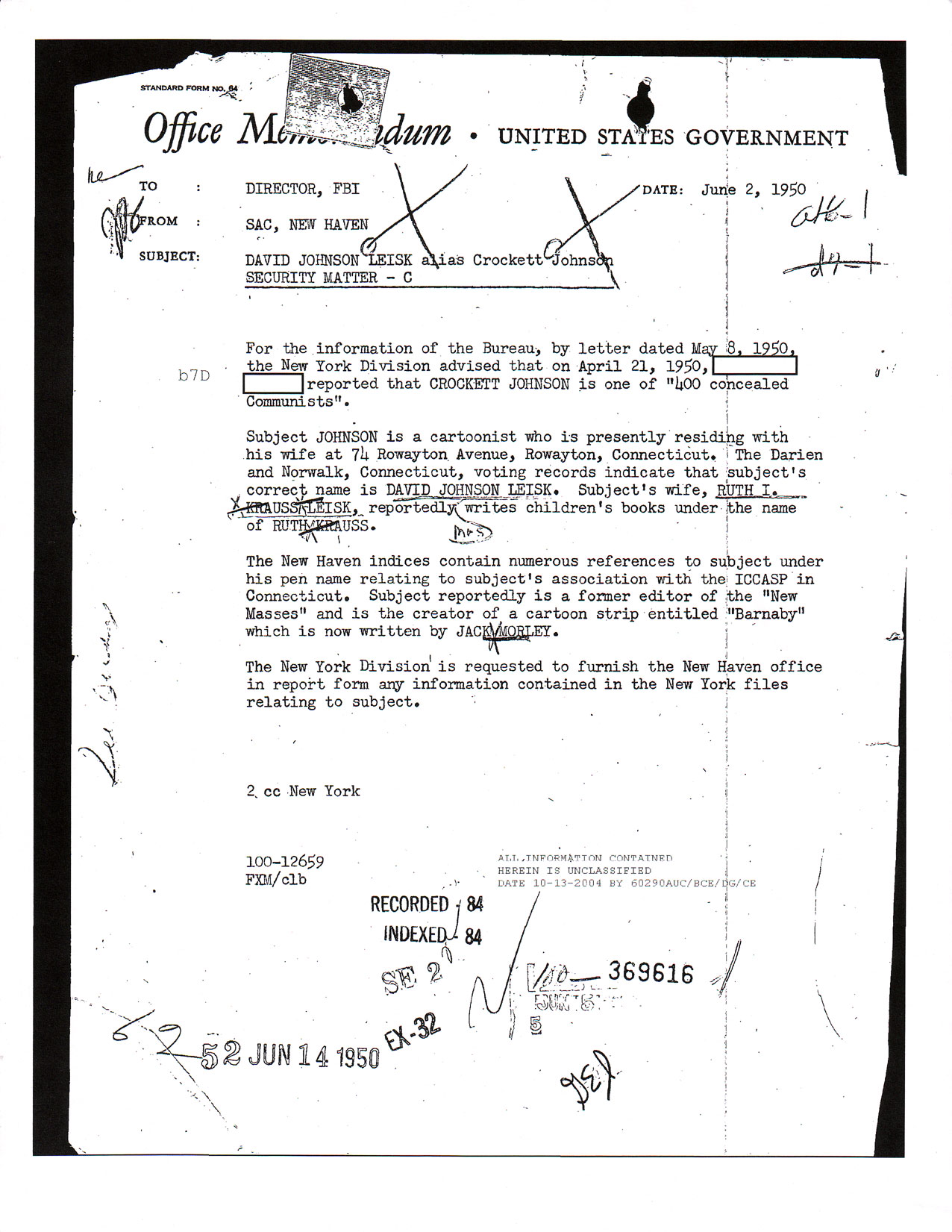
On April 21, 1950, the FBI’s New York Division reported that Crockett Johnson was one of “400 concealed Communists.”  In June, the New Haven office began compiling a file on him.  These are the first 15 pages.  (Clicking on each page will yield a larger image.)

Crockett Johnson's FBI file, page 1

This (above) is one of the less accurate pages in the file.  In 1950, Crockett Johnson was not a “concealed Communist” or even an open one.  Also, Barnaby was never written by Jack Morley.  At this point, Johnson was writing the scripts for Barnaby and providing rather detailed sketches to guide Morley’s art.  So, although the strip’s byline at this point read “Jack Morley and CJ,” it would have been more accurate to credit it to “Crockett Johnson and Jack Morley.”  The page is correct, however, in identifying Ruth I. Krauss as his wife, and noting his association with the Independent Citizens’ Committee of the Arts, Sciences, and Professions (ICCASP).

Crockett Johnson's FBI file, page 2

The claims on this page appear to be accurate.  Johnson was a New Masses editor from 1936 to 1940, attended the Cultural and Scientific Conference for World Peace, supported the American Committee for Spanish Freedom. I don’t know whether the Jefferson School of Social Science considered him for a lecturer, but that strikes me as well within the range of possibility. In Johnson’s case, the FBI was very good at identifying organizations with which he was associated, but rather poor at gauging his loyalty to the country.

Crockett Johnson's FBI file, page 3

I’ve verified most of the claims on this page, and the FBI is accurate.  They fail to note (for example) that the American Committee for Spanish Freedom was supporting the democratically elected government of Spain against the Fascist usurpers — surely the sort of activity that the U.S. government should support.  But it’s true that Johnson supported that group; the Win the Peace Conference; the Cultural and Scientific Conference for World Peace; and Benjamin Davis, a Communist who represented Harlem on the New York City Council from 1943 to 1949.

Crockett Johnson's FBI file, page 4

Again, though their assumptions about his loyalty are off the mark, the FBI has correctly identified Johnson’s political affiliations.  The Daily Worker issues mentioned do provide the information that the file alleges.

Crockett Johnson's FBI file, page 5

The FBI here have done their homework, once more.  Crockett Johnson not only attended William Gropper‘s 47th birthday party (Gropper’s papers, held by Syracuse University, verify that both he and Ruth Krauss were there), but — as noted above — art-edited the Communist weekly New Masses, 1936-1940.

Crockett Johnson's FBI file, page 6

The FBI has here found an entirely different “Ruth Krauss.”  This Ruth Kraus is not the Ruth Krauss married to Crockett Johnson.  Oops.

Crockett Johnson's FBI file, page 7

Informants’ names redacted.  Not all pages in an FBI file contain interesting information.  However, sometimes they forget to redact info. — a later page reveals that professional informant Louis Budenz was one of the people who supplied information impugning Johnson’s loyalty.  Though Budenz was eventually discredited as unreliable, for a few years he made a good living as a government witness.

Crockett Johnson's FBI file, page 8

Except for his party affiliation, this page (above) is accurate.

Crockett Johnson's FBI file, page 9

I can’t verify the $100 donation, but everything else here checks out.

Crockett Johnson's FBI file, page 10

Crockett “is derived from an old family name relating to the subject,” eh?  That’s a new one on me, fellas.  Also, Johnson moved to Connecticut in 1942, not 1941.  But apart from those claims, the above info. appears to check out.

I picture neatly dressed FBI agents surrounded by stacks of radical newsletters, busily compiling lists of alleged offenses.  A rather dull job, but on this page, the G-Men have done fairly well.  That said, I can’t verify each and every claim, and it’s worth noting that they’re doing a lot of “guilt by association.”  Crockett Johnson and [name redacted] were both at an ICCASP meeting; [name redacted] was also active in the Norwalk Communist Party.  The suggestion, then, is that Crockett Johnson may have been also active in the Norwalk Branch of the CP.  I have no evidence that he was, though he was definitely a member of the ICCASP, and I suspect that the FBI is correct in placing him at that meeting, and at other ICCASP events.

Crockett Johnson's FBI file, page 12

As noted previously, the report of Johnson’s affiliations with ICCASP and “Win the Peace” are both accurate.

Crockett Johnson's FBI file, page 13

Johnson did indeed support Henry Wallace and the PCA.  He also appeared at the event for the American Society for Russian Relief.

Crockett Johnson's FBI file, page 14

These items can be verified.  However, as in many of the other items here, the FBI’s interpretation of Johnson’s affiliations is not as strong as their ability to uncover those affiliations (which is quite good).  For example, the Equal Justice for Mrs. Recy Taylor Committee (below) was the inverse of the Scottsboro Boys trial: African-American woman (Taylor) raped, but white perpetrators get off scott free.  Johnson’s support of equal justice under the law is laudatory, and should be read as such.  From the FBI’s point of view, Communists were in the forefront in their support of Civil Rights for African-Americans; so, in their eyes, Johnson’s support of justice for Mrs. Taylor reads as a “red” activity.

Crockett Johnson's FBI file, page 15

As you might expect, I have mixed feelings about “collaborating” with the FBI on my biography of Crockett Johnson and Ruth Krauss (coming this September). On the one hand, Crockett Johnson’s FBI file displays the dangers of unchecked power, and reminds us why the Patriot Act was and is a reckless idea. On the other hand, the file is a wonderful resource and I am grateful for the FBI’s assistance. Though information in FBI files is not always reliable and their allegations about Johnson’s loyalty are false, their tracking of causes he supported is accurate.  I verified everything I could, and the New Haven G-Men tailing Johnson did thorough work.

The entire file runs 114 pages — relatively small, as FBI files go.  If I find the time, I may post other pages.

Crockett Johnson and Ruth Krauss: How an Unlikely Couple Found Love, Dodged the FBI, and Transformed Children’s Literature will be published this fall by the the University Press of Mississippi.

Leave a Comment

Radical Children’s Literature Now! (article)

Children's Literature Association Quarterly 36.4 (Winter 2011): art by Kevin Cornell from Mac Barnett's MustahceSince people have asked to be kept informed, “Radical Children’s Literature Now!”Julia Mickenberg‘s and my article — is out in the latest issue of the Children’s Literature Association Quarterly.  Here are the first two paragraphs and their respective footnotes:

          Focusing on literature for younger children published in the last decade—as well as on the incentives and disincentives for writing, publishing, and distributing this literature—we argue here that children’s literature, as well as being a tool of embourgeoisment, has been and continues to be an important vehicle for ideas that challenge the status quo and promote social justice, environmental stewardship, and greater acceptance of differences. We have looked for works that cast aside many of the traditional assumptions about what is appropriate for children, acknowledge pressing concerns of the day as relevant to children’s lives, and refuse to whitewash difficult truths, but which also display literary and aesthetic quality and recognize the cognitive and emotional capacities of children. Such “radical” children’s literature models and encourages activism by children as well as adults, and exposes unjust uses of power. It addresses the reality that the white, middle-class, all-American norm is a myth. Finally, it suggests that it is impossible and unethical to shut children off from the world outside US borders.1

Neither children nor literature for them can be extricated from politics. By choice or by default, children often get drawn into the “adult” worlds of politics, violence, and power struggles. At the same time, children’s literature, though in some ways marked by greater levels of public scrutiny than literature for adults, historically has been a realm for expressing utopian visions and launching subtle critiques of the existing social order. This is so because [End Page 445] of conventions of children’s literature; practices within publishing, libraries, and schools; the meanings attached to childhood; and because individuals and groups interested in influencing the future recognize the need to influence children.2 Just as the word “radical” derives from the Latin radicalis [forming the root], radical children’s books address the roots of many flawed assumptions about children and childhood, as well as the causes of inequality, injustice, and exploitation around the world. (445-446)

________________

1. According to the 2010 census, 20% of the total child population in the United States lives below the poverty line; 7.5 million children are without health insurance. Sixty-eight percent of American fourth graders are less than proficient in reading, and 34% are below even a basic level. Over 14.5 million children, or nearly one fifth of the child population, have at least one parent who is an immigrant to this country; 43% of those children have parents who are not US citizens. White children are a minority in Arizona, California, Florida, Hawaii, Nevada, New Mexico, Texas, and the District of Columbia (“Children’s Living Arrangements and Characteristics”; Kids Count Data Center).

2. On the traditions of radical children’s literature, see Mickenberg, Learning from the Left; Mickenberg and Nel, Tales for Little Rebels; Reynolds, Radical Children’s Literature; and Lurie, Don’t Tell the Grownups. Also see much of the scholarship of Jack Zipes; for instance, Fairy Tales and the Art of Subversion.

Citation

Julia L. Mickenberg and Philip Nel, “Radical Children’s Literature Now!” Children’s Literature Association Quarterly 36.4 (Winter 2011): 445-473 <http://muse.jhu.edu/journals/childrens_literature_association_quarterly/summary/

v036/36.4.mickenberg01.html>

How to get a copy

If you or an institution to which you have access (likely a college or university library) subscribes to ProjectMuse, the Children’s Literature Association Quarterly would prefer it if you accessed it via that route — it may require you signing in if you’re not physically in (say) the library in question.  But if you can get it that way, please do.  The readership of the Children’s Literature Association Quarterly supports the Children’s Literature Association.  I don’t understand precisely how this works, but the more “hits” an article gets, the more revenue for the association.  (Academics will already know this, but to my non-academic readers: Authors do not get paid for their contributions. Julia and I have no financial stake in you accessing the article via a subscribing institution or otherwise paying for the article yourself.)

If don’t have access to Project Muse or no library near you subscribes to the Children’s Literature Association Quarterly — in sum, if you otherwise cannot obtain a copy — you may contact me directly.  (Email address is at right, beneath “A note on mp3s.”)

Another way to access this information is to watch it.  We delivered an earlier version of “Radical Children’s Literature Now!” (the Francelia Butler Lecture at the 2011 Children’s Literature Association Conference) on June 25th at Hollins (in Roanoke, Virginia).  The video for the “talk” version is below, and on the Children’s Literature Association’s website.

For more information, see the bibliography we handed out to those in attendance.

Related content

Thank you

… to the organizers of the Children’s Literature Association’s Annual Conference (Roanoke, Virginia, June 25, 2011) for inviting us to give this as a keynote (revised and expanded for the article). For sharing their expertise and their time with us, thanks to Katie Horning and the staff of the Children’s Cooperative Book CenterSusan Griffith, Patsy Aldana (of Groundwood Books), Betsy Bird (of the NYPL and Fuse #8), Julie Walker Danielson (of Seven Impossible Things Before Breakfast), George NicholsonMac Barnett, Marcus Ewert, Elizabeth Murphy (of the Austin Public Library‘s Yarborough Branch), Erica Hateley, John M. Gonzalez, Cynthia Levinson, Kelly Halls, Jo Kittinger, Kathleen Manwaring (of Syracuse University Library’s Special Collections), and Ashley Nunn-Smith.

For allowing us to use art from their work in the published version of the article, thanks to Shaun Tan, Molly Bang, Groundwood Books (for Alfonso Ruano’s picture from Antonio Skármeta’s The Composition and Gary Clement’s picture from Thomas King’s A Coyote Solstice Tale), Kids Can Press Ltd. (for Stéphane Jorisch’s illustration from Lewis Carroll’s Jabberwocky), Houghton Mifflin (for the image from Jeanette Winter’s Wangari’s Trees of Peace: A True Story from Africa).  Special thanks to Kevin Cornell, Mac Barnett, and Disney-Hyperion for allowing us to use art from Mustache! for the cover.  Just published (last month), Mustache! is a humorous book with an anti-authoritarian message.  Check it out!

Leave a Comment

Little Rebels, Little Conservatives, and Occupy Wall Street

Tales for Little Rebels, edited by Julia Mickenberg and Philip NelThe headline reads “Occupying children’s minds: ‘Radical children’s literature at Wall Street protests.’”  Featured prominently is Julia Mickenberg’s and my Tales for Little Rebels.  After reading the piece (though, not, I suspect, the book itself), one commenter, writing under the name of “forcerecon2,” worrries that Tales for Little Rebels represents “the indoctrination of our children.”  Coming from the left but also opposing indoctrination, Occupy Wall Street organizer Kelley Wolcott writes in response to the suggestion that children of OWS protesters read Tales for Little Rebels: ”I think that we should provide teaching related services that DO NOT have an agenda, and treat children in a respectful way that allows them to explore their own ideas about what is fair or not fair without imposing an adult agenda.”  Though the stories contained in the book are more sympathetic to Wolcott’s point of view than to forcerecon2′s, both statements convey only a partial understand how literature works.

All children’s literature is political — from Dr. Seuss to The Poky Little Puppy to Left Behind: The Kids.   All stories bear the influence of the world in which they were produced; some display that influence more prominently, and others more successfully mask ideological assumptions.  There are no stories “that DO NOT have an agenda.”   Yet, if children’s literature serves a socializing function, predicting its effectiveness on children is a tricky business.  Child readers might embrace the message, or resist it, or … even forget all about it.

It’s true that Tales for Little Rebels does include some stories written by people who wished young readers to adopt a very specific, often quite sectarian, view of the world.  Caroline Nelson’s “Nature Talks on Economics” — one of the stories that inspired the coverage on The Daily Caller and Fox Nation — does harbor such aspirations.  In that tale, revolutionary chick cries, “Strike down the wall!” and liberates itself from the “egg state.”  A lesson about nature becomes a metaphor for revolution.

However, in and of itself, this story provides little evidence that Tales for Little Rebels is a tool of indoctrination.  First, it’s but one of 44 stories on subjects ranging from peace to the dignity of work, from the power of the imagination to opposing bigotry, from environmental protection to finding strength in organizing — stories that would be quite apropos to the OWS protesters, incidentally.  It would be truly remarkable for one story to manage to indoctrinate those who read it.  Taken in context with other literature or read in a socialist family (as “Nature Talks on Economics” very likely was done, originally), it stands a stronger chance — but only if the child hearing the story identified with the values of his or her parents.

Which brings me to my second point: children are not passive beings, empty receptacles which people can fill with ideas.  They’re certainly affected by the culture in which they live, but they’re also capable of thinking for themselves.  Indeed, we hope that some of the stories in Tales for Little Rebels nurture that kind of critical thinking — Ruth Benedict and Gene Weltfish’s The Races of Mankind, which uses science to challenge racism, or Oscar the Ostrich, in which the birds defeat a would-be fascist by taking their heads out of the sand, and speaking out against him.  Though, of course, children may fail to get these messages.  Tales for Little Rebels includes a scene from Revolt of the Beavers, a play in which beavers liberate Beaverland from a tyrant, and redistribute the wealth.  When an NYU Professor of Psychology interviewed hundreds of child audience members about lessons the play imparted, they told him they learned things like “never to be selfish,” and “beavers have manners just like children.”  Not exactly what (I imagine) the play intended to teach.

That brings me to my third point — a point which I’m going to borrow from Philip Pullman, since he’s far more articulate than I am.  Just because an author intends for readers to receive a certain message from a work, there’s no guarantee that the story will turn out as the author intends:

whatever my intention might have been when I wrote the book, the meaning doesn’t consist only of my intention. The meaning is what emerges from the interaction between the words I put on the page and the readers’ own minds as they read them. If they’re puzzled, the best thing to do is talk about the book with someone else who’s read it, and let meanings emerge from the conversation, democratically.1

And that’s the best message to take away from this conversation — and it’s what I think Wolcott means when she encourages “Treating children with respect and allowing them to explore their own ideas.”

Tales for Little Rebels contains a range of opinions from people on the twentieth-century left.  Though Julia and I expected that most of the stories would resonate with contemporary progressives, we also deliberately included some stories that would not (notably “ABC for Martin,” which we nicknamed “the Communist ABC”).  We didn’t want to whitewash history by excising stories that may be embarrassing to those on the left — so, those stories are in the book, too.  But they’re in there along with introductory material that invites readers to think critically about them.  We didn’t create the book hoping that it would encourage everyone to adopt a particular “party line.”  Rather, we hoped that it would encourage readers of all ages to think, to ask questions, and to understand that the world in which they live is not a given.  People can change it.  They can change it.

_____________________

1. Philip Pullman, “Intention,” Keywords for Children’s Literature, ed. Philip Nel and Lissa Paul (New York University Press, 2011).

Related content (updated 19 Nov. 2011):

Comments (10)

Radical Children’s Literature Now! (video)

Radical Children's Literature Now! -- title slide

On June 25th, Julia Mickenberg and I delivered “Radical Children’s Literature Now!” — the Francelia Butler Lecture at the 2011 Children’s Literature Association Conference in Roanoke, Virginia.  The video for that talk is now on-line.

For more information, see the bibliography we handed out to those in attendance.  Eventually, this lecture will appear on the Children’s Literature Association’s website.

Related content (updated 19 Nov. 2011):

Leave a Comment

Radical Children’s Literature Now!

Many folks who attended Julia Mickenberg’s and my “Radical Children’s Literature Now!” lecture today at the Children’s Literature Association Conference in Roanoke asked: “I didn’t get a handout.  Could I have one?”  Since we only made 200 copies, here is that handout.  (The entire lecture will be on the Children’s Literature Association’s website in the future.)

Radical  Children’s  Literature  Now!

Julia L. Mickenberg and Philip Nel

Francelia Butler Lecture

25 June 2011


BOOKS:

Question Authority

Mac Barnett, Moustache. Illus. Kevin Cornell. Hyperion, 2011.

Tom Tomorrow (pseud. of Dan Perkins), The Very Silly Mayor. IG Publishing, 2009.

Organize

Toby Speed, Brave Potatoes.  Illus. Barry Root.  G.P. Putnam’s Sons, 2000.

Andrea Davis Pinkney, Sit-In: How Four Friends Stood Up By Sitting Down. Illus. Brian Pinkney. Little, Brown and Company, 2010.

Doreen Cronin, Click, Clack Moo: Cows that Type. Illus. Betsy Lewin. Simon & Schuster, 2000.

Sharyll Teneyuca and Carmen Tafolla, That’s Not Fair/No Es Justo!: Emma Tenayuca’s Struggle for Justice/ Le lucha Emma Tenayuca por la justicia. Illus. Terry Ybanez. Wings Press, 2008.

Jacqueline Dembar Greene , Changes for Rebecca. American Girls Collection. Pleasant Company Publications, 2009.

Fight Bigotry

Susan Campbell Bartoletti, They Called Themselves the KKK: The Birth of An American Terrorist Group. Houghton Mifflin, 2010.

Kadir Nelson, We Are the Ship. Hyperion, 2008.

Shaun Tan, The Arrival. 2006. Scholastic, 2007.

Internationalism

Antonio Skarmeta, The Composition, ill. Alfonso Ruano. Groundwood, 2000. A Spanish-language version was published the same year in Venezuela.

Antonio Ramirez and Domi, Napi. Groundwood, 2004

Napi Goes to the Mountain. Groundwood, 2006.

Napi Makes a Village. Groundwood, 2010.

Deborah Ellis, The Breadwinner trilogy:

The Breadwinner. Groundwood, 2001.

Parvana’s Journey. Groundwood, 2002.

Mud City. Groundwood, 2003.

—, Three Wishes: Palestinian and Israeli Children Speak.  Groundwood, 2006.

Anne Laurel Carter, The Shepherd’s Granddaughter. Groundwood, 2008.

Jeanette Winter, Nasreen’s Secret School. Beach Lane, 2009.

—, Librarian of Basra. Harcourt, 2005.

Mohieddin Ellabbad, The Illustrator’s Notebook. 1999. Transl. Sarah Quinn. Groundwood, 2006.

Uri Shulevitz, How I Learned Geography. Farrar Straus Giroux, 2008.

Amy Lee-Tai, A Place Where the Sunflowers Grow. Illus. Felicia Hoshino. Children’s Book Press, 2006.

Peter Sis, The Wall: Growing Up Behind the Iron Curtain. Farrar Straus Giroux, 2007.

James Rumford, Silent Music. Roaring Brook Press, 2008.

Peace

Davide Cali and Serge Bloch, The Enemy: a book about peace. Schwartz & Wade (Random House), 2009.

Nicolas Debon, A Brave Soldier. Groundwood, 2002.

Walter Dean Myers, Patrol. Collages by Ann Grifalconi. HarperCollins, 2002.

Ahmad Akbarpour and Morteza Zahedi, Good Night, Commander. 2005. Translated by Shadi Eskandani and Helen Mixter. Groundwood, 2010.

Lewis Carroll, Jabberwocky. Illus. Stéphane Jorisch. Kids Can Press, 2004.

Environment / Global Climate Change

Lauren Child, Charlie and Lola: We Are Extremely Very Good Recyclers. Dial, 2009.

Lynne Cherry and Gary Braasch, How We Know What We Know About Our Changing Climate: Scientists and Kids Explore Global Warming. Dawn Publications, 2008.

Charise Harper, Just Grace Goes Green. Houghton Mifflin, 2009.

Megan McDonald, Judy Moody Saves The World. Candlewick Press, 2002.

Jennifer Berne, Manfish.  Chronicle Books, 2008.

Dan Yaccarino, The Fantastic Undersea Life of Jacques Cousteau.  Knopf, 2009.

Claire A Nivola, Planting the Trees of Kenya: The Story of Wangari Maathai. Farrar Straus Giroux, 2008.

Jeanette Winter, Wangari’s Trees of Peace.  Harcourt, 2008.

Molly Bang, Nobody Particular: One Woman’s Effort to Save the Bays. Henry Holt and Company, 2000.

Sara Pennypacker, Sparrow Girl. Hyperion, 2009.

Consume Less

Janet S. Wong, The Dumpster Diver. Illus. David Roberts. Candlewick, 2007.

Jonah Winter, Here Comes the Garbage Barge. Illus. Red Nose Studio. Random House, 2010.

Thomas King, A Coyote Solstice Tale. Illus. by Gary Clement. Groundwood, 2009.

Homelessness and Poverty

Avi Slodovnick, The Tooth. Illus. Manon Gauthier. Kane/Miller, 2009.

Vera Williams, Amber Was Brave, Essie Was Smart.  Greenwillow, 2001.

Elisa Amado, Tricycle, illustrated by Alfonso Ruano. Groundwood, 2007.

Gender

Catherine Stier, If I Ran for President. Illus. Lynne Avril. Albert Whitman & Co., 2007.

Lane Smith, Madam President. Hyperion, 2008.

—, John, Paul, George & Ben. Hyperion, 2006.

Kelly DiPucchio, Grace for President. Illus. LeUyen Pham.  Hyperion, 2008.

Chris Van Allsburg, Queen of the Falls. Houghton Mifflin, 2011.

—, Widow’s Broom. Houghton Mifflin, 1992.

David Walliams, The Boy in the Dress. Illus. Quentin Blake. Razorbill/Penguin, 2008.

Harvey Fierstein, The Sissy Duckling. Illus. Henry Cole. Simon & Schuster, 2002.

LGBTQ

Pija Lindenbaum, Mini Mia and Her Darling Uncle. Translated by Elisabeth Kallick Dyssegaard.  R&S Books, 2007.

Leslea Newman, Mommy, Mama, and Me. Tricycle Press, 2009.

—, Daddy, Papa, and Me. Tricycle Press, 2009.

Bobbie Combs, ABC: A Family Alphabet Book. Illus. Desiree Keane & Brian Rappa. Two Lives, 2001.

Cheryl Kilodavis, My Princess Boy. Illus. Suzanne DeSimone. Aladdin, 2009.

Marcus Ewert, 10,000 Dresses. Illus. by Rex Ray. Seven Stories, Press, 2008.

Justin Richardson and Peter Parnell, And Tango Makes Three. Illus. Henry Cole. Simon & Schuster, 2005.

[Sex], Death, Disability, and Mental Illness

Nicholas Allan, Where Willy Went: The Big Story of a Little Sperm. 2004. Red Fox, 2006.

Robie H. Harris and Michael Emberley, It’s Not the Stork!: A Book about Girls, Boys, Babies, Bodies, Familes, and Friends. Candlewick, 2005.

—, It’s Perfectly Normal: Changing Bodies, Growing Up, Sex, and Sexual Health. 15th Anniversary Edition. Candlewick, 2009.

—, It’s So Amazing!: A Book about Eggs, Sperm, Birth, Babies, and Families. Candlewick, 1999.

Pija Lindenbaum, When Owen’s Mom Breathed Fire. Translated by Elisabeth Kallick Dyssegaard.  R&S Books, 2006.

Shaun Tan, The Red Tree. 2001.  Simply Red Books, 2003.

Menena Cottin and Rosana Faría, The Black Book of Colors. Transl. by Elisa Amado. Groundwood, 2008.

Imagine

Allan Ahlberg and Bruce Ingman, The Pencil. Candlewick Press, 2008.

Amy Krouse Rosenthal and Tom Litchenheld, Duck! Rabbit! Chronicle Books, 2009.

Kara LaReau and Scott Magoon, Ugly Fish. Harcourt, 2006.

Jeanne Willis and Tony Ross, Tadpole’s Promise.  Andersen Press, 2003.

Boni Ashburn, Hush, Little Dragon, Illus. Kelly Murphy. Abrams, 2008.

Sylviane Donnio, I’d Really Like to Eat a Child. Illus. Dorothée de Monfried. Transl. Leslie Martin.  Random House, 2007.


AWARDS

  • The Jane Adams Children’s Book Award, established 1953, “given annually to the children’s books published the preceding year that effectively promote the cause of peace, social justice, world community, and the equality of the sexes and all races.”
  • The Pura Belpre Medal honors “a Latino/Latina writer and illustrator whose works best portray, affirm, and celebrate the Latino cultural experience in an outstanding work of literature for children and youth
  • The Coretta Scott King Award, established forty years ago, honors African American authors and illustrator for outstanding inspirational and educational contributions
  • The Stonewall Children’s and Young Adult Literature Award, established just last year by the American Library Association, for LGBTQ books
  • The Schneider Family Book Award honors a  book “that embodies an artistic expression of the disability experience for child and adolescent audiences”
  • The UNESCO Prize is for Children’s and Young People’s Literature in the Service of Tolerance (discontinued in 2003 for budgetary reasons)
  • The Henry Bergh Children’s Book Award “honor[s] books that promote the humane 
ethic of compassion and respect for all living things”
  • The Green Earth Book Award, is given to “authors and illustrators whose books best raise awareness of environmental stewardship, and the beauty of our natural world and the responsibility that we have to protect it”
  • The KIND Children’s Book Award is given by the Humane Society, for “an exceptional children’s book with a humane focus on animals or the environment”
  • The Wilderness Society’s Environment Award for Children’s Literature.
  • USBBY lists Outstanding International Books, and the Cooperative Children’s Book Center’s Choices highlights books on subjects such as Peace and Justice, Labor, Earth and the Environment, (Eco-Reading), Gay and Lesbian Themes and Topics, “Global Reading” (books set in other countries), and Recommended Picture Books Featuring Interracial Families.

THANKS TO: Katie Horning and the staff of the Children’s Cooperative Book Center, Susan Griffith, Patsy Aldana (of Groundwood Books), Betsy Bird (of the NYPL and Fuse #8), Julie Walker Danielson (of Seven Impossible Things Before Breakfast), George Nicholson, Mac Barnett, Marcus Ewert, and Elizabeth Murphy (of the Austin Public Library’s Yarborough Branch).

Related content (updated 19 Nov. 2011):

Comments (10)