Free Pi!

No, Pi cannot be copyrighted, despite what one composer claims.  I had wondered why Michael John Blake’s beautiful YouTube video of “What Pi Sounds Like” had been taken down.  I’d linked to it in my “Happy π Day from Crockett Johnson” post, and then it… disappeared.  Blake explains why below:

Vi Hart has a truly excellent response to Lars Erikson, the composer who filed the claim against Michael Blake.  Check it out:

As Hart notes, Erikson has also written a melody based on Pi — but it’s a different melody.  I am not a legal expert, but I don’t think that Erikson’s claim has any standing: If this were a case of one melody sounding like another, then Mr. Erikson would have precedent.  See for instance, the case of George Harrison’s “My Sweet Lord,” in which Mr. Harrison’s piece was ruled to have borrowed from the Chiffons’ “He’s So Fine,” and Mr. Harrison was ordered to pay royalties to the song’s composer.  (I’ve complied a page of such borrowings — most of which have not resulted in lawsuits — on a blog post inspired by allegations made against Lady Gaga’s “Born This Way”.)

Compare the two Pi songs.  Here is the first movement of Lars Erikson’s Pi Symphony:

NewScientist has re-posted Michael Blake’s original video for “What Pi Sounds Like”:

You can also buy Michael Blake’s “What Pi Sounds Like” on iTunes.  When I listen to these two works, side by side, I find it a bit of a stretch to claim that Blake has somehow plagiarized Erikson’s work.  Yes, they both draw inspiration from 3.1415926535…, but sharing a common influence does not allow us to conclude that one work “stole” from the other.  Honestly, the main conclusion I draw from all of this is that Lars Erikson has the heart of a lawyer, and that Michael John Blake has the heart of an artist.

What do you think?

Comments (5)

Happy π Day from Crockett Johnson

Nine kinds of pie (from Crockett Johnson's Harold and the Purple Crayon)This isn’t the only kind of “pie” that Crockett Johnson was interested in.  In addition to “all nine kinds of pie that Harold likes best,” Johnson also drew inspiration from π (3.14159265…) — the ratio of a circle’s circumference to its diameter.

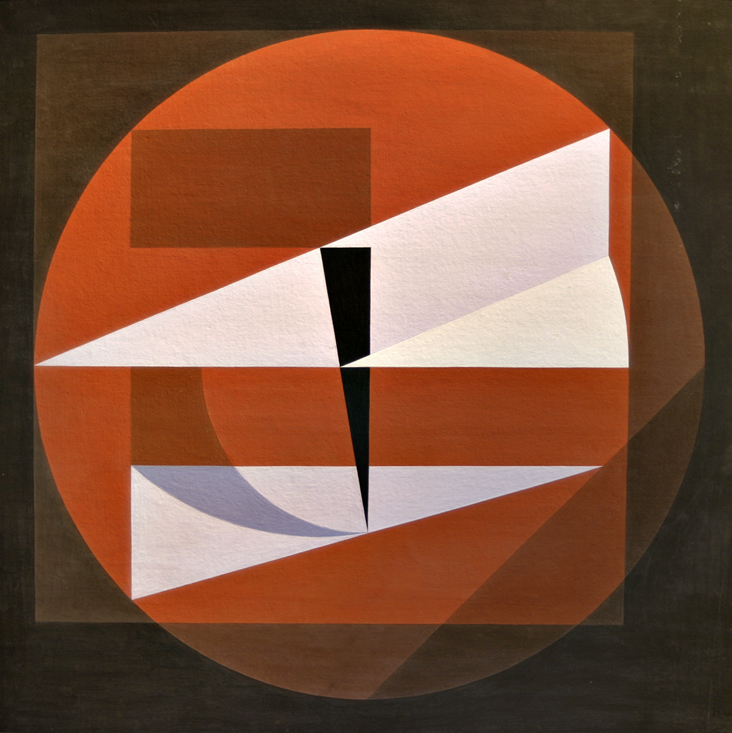
In early 1968, he began the project of “squaring the circle,” constructing a square with the same area as a circle — but using only a straight-edge and a compass to do so.  This is impossible, but he was either unaware of this fact or undeterred by it.  Not a trained mathematician, Johnson worked his way towards the answer visually.  He painted solutions, testing different theories on his canvas (which was actually mortarboard — canvas intimidated him).

By the middle of the year, he had arrived at a solution:

Crockett Johnson, Squared Circle (1968)

He painted two versions of this.  The other can be found at the Smithsonian’s on-line exhibit, Mathematical Paintings of Crockett Johnson.  I recommend you visit its site for a more complete explanation of the mathematics behind the painting.

Johnson next wrote up an algebraic formula, and sought the opinion of professional mathematicians.  Finally, in 1970, the Mathematical Gazette published his first mathematical theorem, “A geometrical look at √π”:

Crockett Johnson, from the Mathematical Gazette (1970)
Crockett Johnson, algebraic proof from the Mathematical Gazette (1970)

Johnson would publish his second original contribution to the field of mathematics in 1975, just prior to his death.

Learn more:

Other examples of Crockett Johnson’s work (from this blog):


Comments (1)

Back-to-School Special, Part I: Children’s Literature & Asymptotes

In my decade of teaching Children’s Literature at the university level, I’ve learned a lot.  But I never feel that I’ve learned quite enough to teach the grad class Critical Approaches to Children’s Literature.  I’m grateful that I’m teaching it now and not ten years ago, but it’s one of those courses that makes me conscious of the deficits in my knowledge.  And, on the whole, I see this process as a good thing — because it means that I’m moving closer to mastery of the subject… which, of course, is all one can do.  If the x-axis represents mastery, I’m moving along a curve that approaches but never actually intersects with the x-axis.  I get ever closer, but never arrive.

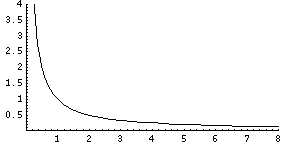
That curve, by the way, is called an asymptote.  It looks like this:

Horizontal Asymptotes

Above is a graph of y =1/x, taken from this website.  The line approaches zero (which, in my analogy, represents mastery of the field), but never reaches it.

Norton Critical Edition of Alice in WonderlandSo, the syllabus for Critical Approaches to Children’s Literature represents one stop along that journey.  What’s on it?  General themes include: didacticism, pleasure, nonsense, audience, genre, diversity. Theoretical approaches include: formalist, psychoanalytic, feminist, queer theory, cultural studies, and others.  As you’ll see (if you follow the link), we’ll be reading fiction by Helen Bannerman, J. M. Barrie, Francesca Lia Block, Anthony Browne, Lewis Carroll, Jean-Marie Leprince de Beaumont, Maria Edgeworth, Neil Gaiman, Jacob and Wilhelm Grimm, Heinrich Hoffmann, Ann Jonas, Guus Kuijer, David Macaulay, L.M. Montgomery, Walter Dean Myers, Marilyn Nelson, Charles Perrault, Jon Scieszka and Lane Smith, Brian Selznick, Dr. Seuss, Mary Martha Sherwood, Shaun Tan, Chris Van Allsburg, and Mary Wollstonecraft, among others.  A Wreath for Emmett TillAnd we’ll gain critical perspective from Robin Bernstein, Michel Foucault, Sigmund Freud, Felicity A. Hughes, Anne Scott MacCleod, Michelle Martin, W.J.T. Mitchell, William Moebius, Mitzi Myers, Perry Nodelman, Walter J. Ong, Lissa Paul, Jacqueline Rose, Jan Susina, and many others.

Yes, there are many other texts and theorists that could be included.  And I’m sure that I will change the syllabus again next time I teach it.  Indeed, I’d like to use Keywords for Children’s Literature, which I co-edited with Lissa Paul (due out from NYU P in May of this year).  In case you’re curious, whenever I use a book of my own, I donate any royalties I receive to an appropriate charity.  When I used my Dr. Seuss: American Icon (in a Seuss class), that worked out to about $1 per book.  So, it’s not much, but I don’t think it’s ethical to profit off of my students in that way.  Anyway, I’m sure this syllabus could be better — and not just because I now note a few formatting errors on the Schedule of Assignments.  (I’ll fix those before class on Wednesday.)  But I also think the syllabus will do the job, as I — and my students — travel along that curve, always approaching, never arriving, but learning a lot along the way.

UPDATE: 18 Jan. 2011, 10:45 am. Looking back at what I wrote (late last night, with minimal editing), there’s a major omission that I need to correct: Naomi Wood.  My Critical Approaches to Children’s Literature syllabus and course pack borrow heavily from hers.  Yes, my class has my own “stamp” on it — and that’s even more true of this year’s iteration of the syllabus.  (The initial syllabus, from Spring 2009, even more closely followed hers.)  But the general course plan is very much hers.  I’m fortunate to have helpful colleagues who share their knowledge, and I want to make sure that Naomi gets due credit here.  So, Naomi: I doff my hat to you!  And, yes, it is a red-and-white-striped topper.  How ever did you know?

Comments (1)