Emily’s Library, Part 4: Ten Alphabet Books

Continuing my series on building the “perfect” children’s library (for criteria, see first post), here are some great alphabet books.  The first post listed Dr. Seuss’s ABC (1963), Crockett Johnson’s Harold’s ABC (1963), and Bill Martin, John Archambault, & Lois Ehlert’s Chicka Chicka Boom Boom (1989).  Here are ten more alphabet titles I’ve recently sent to my niece (Emily, currently 10 months old).

Sandra Boynton, A Is for Angry (1983): coverSandra Boynton, A Is for Angry (1983)

In a book subtitled an animal and adjective alphabet, Boynton illustrates “B is for BASHFUL” with a small bunny looking up at a bashful bear, who is partly concealed behind the letter “B.”  While a fox flees flying fish overhead, “F is for FRIGHTENED.”  As is ever the case, the remarkable emotional range of Boynton’s animals’ faces interacts perfectly with her words, and makes me laugh.  Accompanying “T is for Tangled” is a turkey tangled in a telephone cord.  The turkey is labeled “turkey,” and the telephone is labeled “turkey trap.”  More Boynton books are listed on the first “Emily’s Library” list.

Michael Cheswick, Alphaboat (2002)

A pun-lover’s picaresque which, yes, is undoubtedly too advanced for my 10-month-old niece. But, in a few years, she may appreciate the humor.  The story begins like this: “One day i chanced to stop for t / and listen to sweet Mellow D, / in her old H beside the sea, / sing of her long-lost Mister E.”  And off go the letters on a journey for hidden treasure, accompanied by abundant wordplay.

Donald Crews, We Read: A to Z (1967)

Perhaps best known for Freight Train (included in the first “Emily’s Library” list), Crews made his debut with this book… which was never intended to be a book at all.  A graphic designer, he made it to freshen his portfolio.  It’s less an alphabet book than it is an alphabetically organized book about space.  On the left page, c is for “corner: where the yellow is.”  On the right page, a field of orange, with a yellow square in the bottom-right corner.  Later, a left page gives us h for “horizontal: from side to side,” accompanied by a right page consisting of eight thick horizontal lines that alternate between a lighter green and darker blue.  This book should be brought back into print.

Donald Crews, We Read: A to Z (1967): Mm

Roberto de Vicq de Cumptich, Bembo’s Zoo (2001)

This, too, should be brought back into print.  Using only the Bembo typeface, each letter names an animal, and the letters within that name create the animal.  J is for Jaguar, and iterations of “J,” “a,” “g,” “u,” “a,” and “r” get be rearranged to create the shape of a jaguar.  Ingenious.  Mr. de Vicq de Cumptich has a website devoted to the book.  Check it out.

Roberto de Vicq de Cumptich, "Jaguar" from Bembo's Zoo (2001)

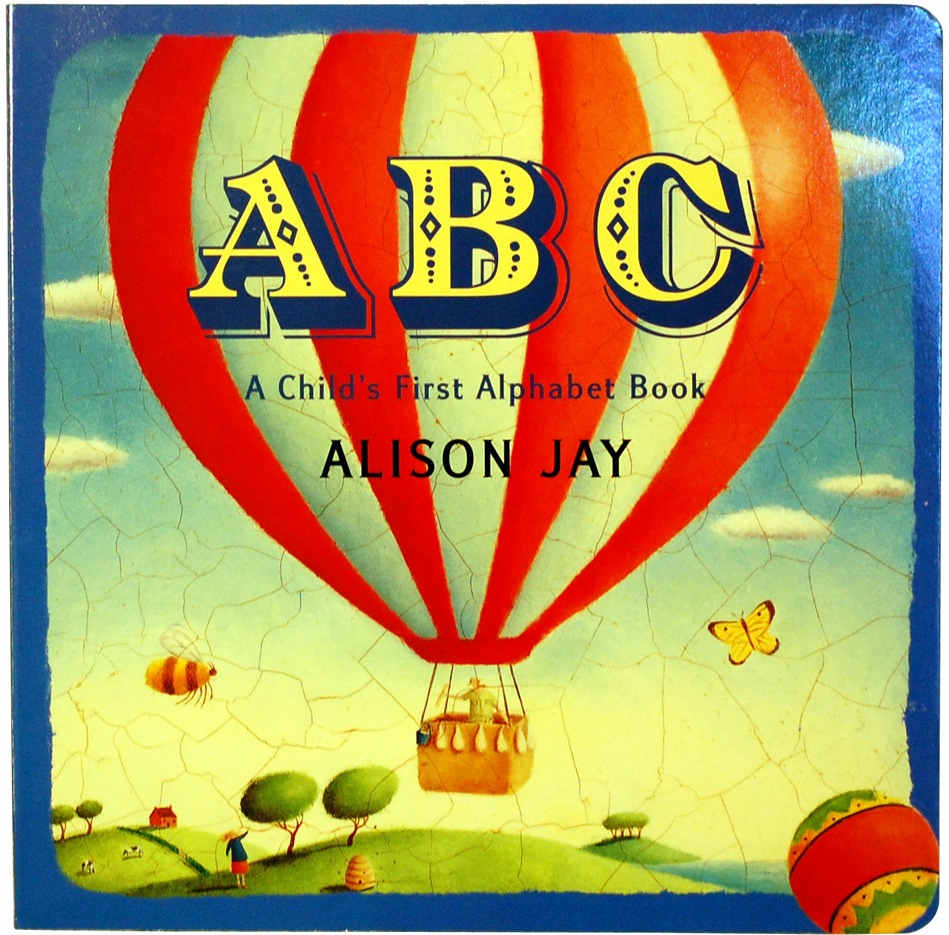
Alison Jay, ABC: A Child's First Alphabet Book (board book version, 2005)Alison Jay, ABC: A Child’s First Alphabet Book (2003)

The board book version (2005, pictured at right) is nearly identical to the picture book.  The only two differences (apart from slightly smaller size, & boards instead of paper) are minor: (1) the cover, and (2) the omission (in the board book) of the final page of text that lists all the other items named by the letter.  For instance, the “M” page tells us “m is for moon,” but it also shows a mountain, moose, and map…  and refers to other pages.  One of the many pleasures of Jay‘s book is following the recurring characters and motifs.  The “M” page also has the nest of eggs that appear on the right-hand page “n for nest,” and again on the “o is for owl” page, which itself has the young woman from the “n is for nest” page holding up what she was drawing — a picture of a panda.  The panda is on “p is for panda,” having a picnic with the man who was reading the map back on “m is for moon.”  And so on.  Anyway, I sent Emily the board-book version because it’s nearly the same as the standard picture book and she’s still more in the “chewing” phase of book appreciation.

Stephen T. Johnson, Alphabet City (1995)

I suspect one reason this book appeals to me is that it recalls my own childhood experience of letters. Having learned my letters at a very young age (thanks to Sesame Street and The Electric Company, on public television), I began seeing letters everywhere. A car’s tire contained an “O.”  Looked at from the right angle, a hardback chair revealed an “L” or an “H.”  In twenty-six paintings, Johnson’s book explores this idea, finding an “E” in a stoplight, “P” at the top of a railing, and a “Z” in a fire escape. In so doing, he encourages readers to seek the alphabet in the landscape.

Amy Krouse Rosenthal and Delphine Durand, Al Pha’s Bet (2011): coverAmy Krouse Rosenthal and Delphine Durand, Al Pha’s Bet (2011)

With words by Rosenthal and pictures by Durand, the book explains how the alphabet came to be in precisely that order.  See, this was back when things were just being invented — including the twenty-six letters. And there was this guy named Al Pha, and he made a bet with himself: he would find a way to organize this (at that time) pile of disorganized letters.  It’s both a joke on why the letters are in this accepted but seemingly arbitrary sequence, and an almost-plausible explanation of how they came to be in this order.  As is always the case, Durand’s pictures are perfect.  And a bit loopy.  I highly recommend her work — some of which you’ll see in the first post devoted to French books.  (Her work is also available in English translation.)  This is the second book by Rosenthal in Emily’s Library.  The first — Duck! Rabbit! — is on the initial list.

Dr. Seuss, On Beyond Zebra! (1955)

She already had this one, courtesy of Linda (her mother’s) and my childhood.  But I wanted to list it here with the alphabet books because it’s not your standard A-B-C book.  One of Seuss’s bestiary books, this catalogue of imaginary animals invites you to invent your own alphabet.  It’s a lesser-known Seuss work that deserves a larger audience.

Paul Thurlby's Alphabet (2011): coverPaul Thurlby, Paul Thurlby’s Alphabet (2011)

Although new, this alphabet book is in the style of mid-twentieth-century advertising & graphic design. It’s also visually inventive.  As Crockett Johnson’s Harold’s ABC does, Thurlby’s book incorporates the letter into the shape of the object it names.  In “J for Jazz,” the “J” is a saxophone being played by a musician.  The two circular parts of “B” contain balls that have just bounced there — because “B” is for Bounce. “Y” shows a man doing yoga, his body forming a letter “Y.”  “E for Embrace” shows two capital letters “E” locked in an embrace: the “E” on the right is flipped horizontally so that its three prongs (ending, respectively, in a head, hand, and foot) and slide in between the prongs of the right-facing “E.”  Very clever.  On the cover, you’re seeing “A for Awesome.”

William Wondriska, A Long Piece of String (1963)

William Wondriska, A Long Piece of String (1963): cover

Recently republished by Chronicle Books, Wondriska‘s nearly wordless story follows a piece of string around an alligator, a bird, a castle, a dog, an elephant,… all the way to zipper.  But the book does not name each animal until the very end of the book when, on a single page, it lists all twenty-six words.  So, as you read, you get to supply the name yourself.

William Wondriska, Sur Le Fil: Mon premier imagier anglais-français (2011) [A Long Piece of String (1963)]

William Wondriska, Sur Le Fil: Mon premier imagier anglais-français (2011) [A Long Piece of String (1963) in French]

A bilingual edition of A Long Piece of String, this version writes the English and corresponding French word on the string near each item.  Some of the English and French words share an initial letter, but not all do — which, I suspect, may have inspired the decision to include the word with each picture.  Interestingly, the book works just as well with the word accompanying the image.  The bilingual edition uses the same typeface as Wondriska’s original, and places the word so that it rests precisely on the string.

Incidentally, I’m on the look out for good ABC books — and good children’s books generally — that were originally published in French. (Emily is being raised in French and English.)  Part 2 of Emily’s Library lists most of the French books I’ve sent so far.  And, at the end of that post, Clementine B & Deborah Freedman both offer promising suggestions, which I’m in the process of checking out!

When possible, I’ve bought each of these books locally, ordering via Claflin Books & Copies.


Amazon.com is a sweatshop, and (when I can) I prefer to buy from places that are not.

Looking for other great children’s books?  Try these blogs:

Related posts on Nine Kinds of Pie:

That’s it for this installment, but there will be more “Emily’s Library” features in the future.

Leave a Comment

Emily’s Library, Part 3: En Français

section of Emily's Library, Emily's Room, Switzerland. Photo taken 31 Dec. 2011Here are a few en français.  For each, I also provide the title as translated into English.  As noted in Emily’s Library, Part 1, I read the books in English (since I don’t speak French) and then send the French originals to my niece (whose parents are raising her in English & French).  I agree that this section of the library needs to expand at a faster rate, and especially welcome further suggestions.

Ramona Badescu, Gros Lapin. illus. Delphine Durand (2007) [Big Rabbit's Bad Mood (2009)]

Badescu writes, “Big Rabbit had a big, bad hairy mood that stuck to him like glue,” and Durand draws a grey, furry oblong creature following big rabbit around.  Big Rabbit spends much of the book trying to evade the bad mood, but to no avail.  In the end, though, the bad mood leaves. Very funny, and evocative of what a bad mood feels like.

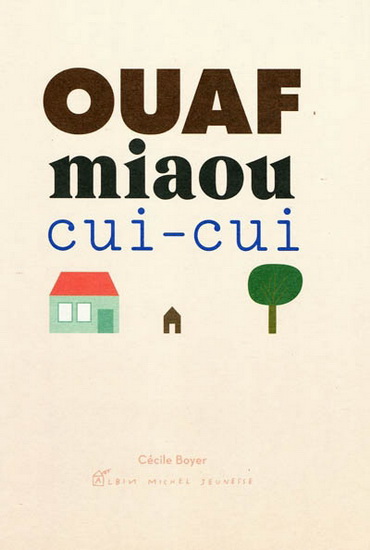
Boyer, Ouaf Miaou Cui Cui (2009): coverCecile Boyer, Ouaf Miaou Cui Cui (2009) [Woof Meow Tweet Tweet (2011)]

Brilliant use of typography to tell a story.  Boyer represents each animal using the word for that animal’s characteristic sound; each sound gets its own typeface.  Ingenious.

Sylviane Donnio & Dorotheé de Monfreid, Je mangerais bien un enfant (2004) [I'd really like to eat a child (2007)]

A funny story about a crocodile who won’t eat the food his parents get him because he’d prefer to eat a child.  Of all the books I’ve sent, this one is a particular favorite of my sister’s.

Delphine Durand, Ma Maison (2000) [My House (2007)]

Non-narrative book that explores the many rooms and creatures that live in the house.  Lots of detail with much to examine on each page.

Durand, Bob & Cie (2004): coverDelphine Durand, Bob & Cie (2004) [Bob & Co. (2006)]

A story about life, the universe, and story, Durand‘s Bob & Cie is one of my all-time favorites. It asks the big questions. It’s funny.  It has philosophical and theological implications, which can be pondered or ignored (depending on the interests and cognitive abilities of the reader).

Jean-Luc Fromental & Joëlle Jolivet, 365 Pingouins (2006) [365 Penguins (2006)]

An oversize book about math, the environment, and… penguins!  Its bold contrasts and limited color palette recalls mid-twentieth century poster design.

Catherine Graindorge & Fiona Land, Mon tout premier livre d’éveil (2005)

This is the sole book featured here — or, indeed, on any of these “Emily’s Library” lists — that I didn’t buy for my niece.  In the tradition of Dorothy Kunhardt’s Pat the Bunny (1940), Mon tout premier livre déveil is a tactile experience, with textures to rub, flaps to pull, even a mirror to look in.  I’m including it here because Emily loves it.  One caution: it might be more sturdily designed.  She’s already torn off two of the flaps.

Marcellino, Le Chat Botte (1999): coverFred Marcellino & Charles Perrault, Le Chat Botte [Puss in Boots] (1999)

The late, great Fred Marcellino did amazing work.

Beatrice Rodriguez, Le voleur de poule (2005) [The Chicken Thief (2010)]

This one is wordless (and so should really be included in yesterday’s list), but I purchased the French edition. Curiously enough, I first saw the book in Germany, where it is published under the title Der Hühnerdieb (2009)

Tullet, Un Livre (2010): coverHervé Tullet, Un Livre (2010) [Press Here (2011)]

New York Times bestseller, Tullet’s picture book reminds us that books are interactive.  Who needs an interactive ebook when you can read this?  Note that, in French, the title is simply A Book, but in English it’s Press Here.

Dorothée de Monfreid, Nuit Noire (2007) [Dark Night (2009)]

Felix, walking home through the forest in the dark, sees many scary creatures — and meets a brave rabbit who shows him how to deal with his fears.

Yes, I am aware that all of these are recent, and I do know Babar and The Little Prince. Saint-Exupéry’s book does not strike me as being for very young readers — a point which, admittedly, also might be made regarding a few other choices I’ve made. Emily has already been given a few Babar books. Regarding recency: as noted at the top, I’m seeking suggestions!

Looking for other great children’s books?  Try these blogs:

Related posts on Nine Kinds of Pie:

That’s it for this installment, but there will be more “Emily’s Library” features in the future.

Comments (3)

Emily’s Library, Part 2: Wordless Picture Books

section of Emily's Library, Emily's Room, Switzerland. Photo taken 31 Dec. 2011As mentioned in Emily’s Library, Part 1, one reason for including these is that they’re multi-lingual, but another is that they’re compelling works of narrative art. They highlight art’s centrality to the picture book itself.  To restate what I noted in yesterday’s post, art is so central to the picture book that, as part of his final revision process, Shaun Tan removes all of the words (to make sure that the pictures carry the story) and then restores just enough words.

Suzy Lee, Wave (2008)

Wordless tale of a girl, at the beach, facing off with the waves. Her movements and facial expressions tell you all you need to know. One of the New York Times’ Best Illustrated Books of that year.  Lee is one of my favorite contemporary illustrators.

Suzy Lee, Shadow (2010)

A near-wordless picture book. You open it with the spine at the top, so that the fold is in the middle of your reading experience, dividing the upper half (a basement) from the lower half (a shadow).  The shadow transforms ordinary objects into an adventure.

Suzy Lee, Shadow (2010): cover

Barbara Lehman, The Red Book (2004)

Lehman, The Red Book (2004): cover

Probably Lehman’s best-known work, this wordless tale is about friends, books, and the unexpected.  You can’t go wrong with a Barbara Lehman book. This one won a Caldecott Honor.

Barbara Lehman, Trainstop (2008)

Another lovely wordless tale from Lehman. It appeals to that sense one has (or I had, when I was a child, and still retain) that, when the train doors open, you might step out into… anywhere.  I need to write a full-length blog post on Lehman.  Her work ranks among the best contemporary children’s books — and, indeed, children’s books in general.

Newgarden and Cash, Bow-Wow Bugs a BugMark Newgarden and Megan Montague Cash, Bow-Wow Bugs a Bug (2007)

As Lane Smith says, “What an odd, sweet, surreal and hilarous adventure from Newgarden and Cash. It’s what Crockett Johnson, Ernie Bushmiller and Rod Serling might have come up with if they shared a bench at the doggie park. I love it!” See also my longer blog post on Newgarden and Cash’s Bow-Wow books, and the board books listed with Emily’s Library, Part 1.

Stephen Savage, Where’s Walrus? (2011)

A comic tale of a walrus on the run, combining the find-the-character game of Where’s Waldo? with a playful narrative and plenty of joie de vivre.  Savage‘s design recalls posters from the 1930s, and the work of Richard McGuire (whose work will make an appearance in a future “Emily’s Library” post).

There are other great wordless books, of course.  These are just the ones I’ve sent so far.

Looking for other great children’s books?  Try these blogs:

Related posts on Nine Kinds of Pie:

 Tomorrow: Emily’s Library, Part 3: En Français!

Comments (1)

Introducing Emily’s Library. Part 1: 62 Great Books for the Very Young

section of Emily's Library, Emily's Room, Switzerland. Photo taken 31 Dec. 2011Welcome to a new feature on Nine Kinds of Pie: “Emily’s Library.” It’s named for my eight-month-old niece, and it will highlight only the very best children’s books. When I learned that my sister was expecting, I decided to create for her child an ideal library of children’s books. She and her spouse could read them to her, and, eventually, Emily could read the books herself.

Since I began this project, I’ve found myself sharing my list of “Emily” books with other parents or parents-to-be. With “Emily’s Library,” I will now be sharing it with you.

What do I mean by “ideal” or “the very best”?  I’m still developing my criteria, but here’s what I have so far.

  1. Old and new. Classics, but also more recent books.  I want neither to reify the past, nor to dwell solely in the present.  Rather, I’d like a range of works from then and now.
  2. Difference. This is fairly broadly defined. I’m thinking of different types of stories (different genres), different nationalities, different ethnicities, different artistic styles….
  3. I want some emphasis on children’s books originally in French. Emily and her parents live in Switzerland. My sister and brother-in-law speak English, French, German, and Spanish, but they’ll be raising Emily primarily in English and French.  Since I don’t speak French, I’ve been reading French books in translation, and then sending Emily the original French-language editions. A broader implication of this criterion is a need to read children’s books that originate in countries (and languages) other than one’s own.
  4. The theme of wordless picture books is (in part) a response to the language issue. Art is legible in any language. Readers can create their own words, changing those words with each reading if they wish. Or they can experience the story fully through the language of pictures. Wordless picture books also feature on this list because they’re great examples of narrative art: they prove, definitively, that a story does not require words. Art is so central to the picture book that, as part of his final revision process, Shaun Tan “test[s] for wordless comprehension. I remove the text and see if it works by itself. And if it does I feel that that’s a successful story.”  And, finally, wordless picture books are here because I happen to like them.
  5. Which brings me to the question of taste. Since it reflects my likes and dislikes, the list will be somewhat idiosyncratic. So, for example, you’ll notice that I’m drawn to humor.
  6. Politically acceptable, inasmuch as possible. The list will not be strictly “politically correct” because: I’m inherently suspicious of orthodoxies, some classics that don’t reflect contemporary social values remain worth reading, and books can be interpreted in many ways. By this last point I mean to say that (with a few exceptions) a book is not a tract: whatever political messages it may harbor, there’s no guarantee that a reader will discern them… simply because literature doesn’t work that way. Having said that, I am interested in books that may teach Emily to respect those who are different from herself, to be receptive to ideas that challenge the status quo, to think critically, and to imagine… whatever she wants.
  7. All of these books are for Emily, and thus reflect my own imagination — what I think she or her parents may enjoy, what might make her smile, give her pleasure, or grant her some insight. Since she is only eight months old, I am of course projecting onto her my own sense of who she is or might become.

I’ve listed these points to underscore the subjectivity of this endeavor. I have written books and articles on children’s literature, I teach courses on children’s literature, and I have amassed a certain amount of “expertise” in the field.  However, I’m acutely aware of how much I have yet to learn, I recognize that tastes vary, and I know that my aesthetic criteria are (as yet) rather vague. If this list does represent a literary canon of sorts, it also acknowledges that canon-formation is an idiosyncratic, flawed, and tricky business.

In sum, I think all of these books are good. You may disagree, or have favorites of your own that I’ve failed to list. Please feel share your disagreements and suggestions in the comments section below. As I say, I know that I’ve much to learn, and would be delighted to learn about other great children’s books.

Without further prologue, here are some of the first 62 books I’ve sent to Emily.  I’ll post more tomorrow and Wednesday, continuing with semi-regularly posts throughout Emily’s childhood.

Janet and Allan Ahlberg, Each Peach Pear Plum (1978)

Enjoy the rhymes, have fun finding nursery-rhyme characters.  Great for very young readers.

Sandra Boynton, Hippos Go Berserk! (1977, rev. 2000)

A counting book featuring the humor and hippos of the inimitable Sandra Boynton.

Boynton, Snoozers: 7 Short Short Bedtime Stories for Lively Little Kids (1997)

Sandra Boynton, Snoozers: 7 Short Short Bedtime Stories for Lively Little Kids (1997)

“I’m not tired!”  The reliably funny Sandra Boynton offers tales for bedtime.  Also features words and music to “Silly Lullaby” (later recorded for Philadelphia Chickens).  I’ve bought Emily quite a few Boynton books — in part ’cause Emily’s mother likes them, and in part ’cause I do.  Here are the other titles I’ve sent:

  • But Not the Hippopotamus (1982)
  • Pajama Time (2000)
  • 15 Animals (2008)

Jeff Brown, Flat Stanley, illus. Tomi Ungerer (1964)

Brown, Flat Stanley, illus. Ungerer (1964): cover

A favorite of mine when I was in first grade. Then, this book appealed to me because it suggested that the imagination could alter the physical universe — Stanley’s near two-dimensionality seemed so real to me. As an adult, I love the book’s dry humor, sense of the absurd, and its silliness. There’s also one joke that Emily may appreciate far sooner than children who only speak English. The “head of the Famous Museum of Art” is Mr. O. Jay Dart. Get it? His name puns on objet d’art (French for “work of art”).

Margaret Wise Brown and Clement Hurd, Goodnight Moon (1947)

Brown’s verse and Hurd’s post-impressionist art combine to deliver the pleasures of evading bedtime. (For more about the book, see Leonard Marcus’s biography of Brown or his The Making of Goodnight Moon.)

Peter Brown, Children Make Terrible Pets (2010)

The central conceit — swapping human and animal roles — is both comic and instructive. If animals saw us as we see them, what would they see?

Burton, Katy and the Big Snow (1943): coverVirginia Lee Burton, Katy and the Big Snow (1943)

Along with Keats’ The Snowy Day and Takao’s A Winter Concert, this was one of a trio of winter-themed books sent to Emily in late October 2011.  It’s another favorite from my own childhood.  As I did then, I love the images of Katy plowing everyone out, the paths she cuts across the landscape, discovering roads where there had been only snow.  There’s something powerful in the book’s presentation of a relatively small being (Katy) remaking a vast snowy landscape.  It suggests that strength need not derive from size.

Eric Carle, The Very Hungry Caterpillar (1969, rev. 1987)

You know this one, don’t you?  I’d be surprised if you didn’t.  It’s a great example of Carle’s vibrant collage-style illustration and storytelling.  Check it out.

Chih-Yuan Chen, Guji Guji (2003, English translation 2004).

When the title character (a crocodile raised by ducks) meets crocodiles who want to eat his family, he realizes that — though he may not be a duck — he needs to defend those he loves. Told with a gentle sense of humor, the book addresses difference without being preachy.

Donald Crews, Freight Train (1978)

Bold colors, clean layout, a “simple” idea beautifully realized.  Those last five words identify a key part of my aesthetic criteria.

Tim Egan, Friday Night at Hodges Café (1994)

I’ve previously devoted a whole blog post to Tim Egan’s work.  He deserves much, much more attention than he has thus far received.  And this book contains one of my favorite lines in all of children’s literature: “Too bad his duck was so crazy.”

Lois Ehlert, Color Zoo (1989): coverLois Ehlert, Color Zoo (1989)

Turn the die-cut pages to see shapes become animals.  See also Ehlert’s companion book, Color Farm (1990).  Bright colors, clever design.  A Caldecott Honor book. In its board book incarnation, great for the youngest readers.

Ian Falconer, Olivia (2000)

The book that launched the literary career of that precocious pig, Olivia is an Eloise for contemporary children. In addition to his sense of humor, Falconer is also great at using white space to pace his narrative.  I imagine him making detailed sketches, and then reducing those to just the vital visual information.

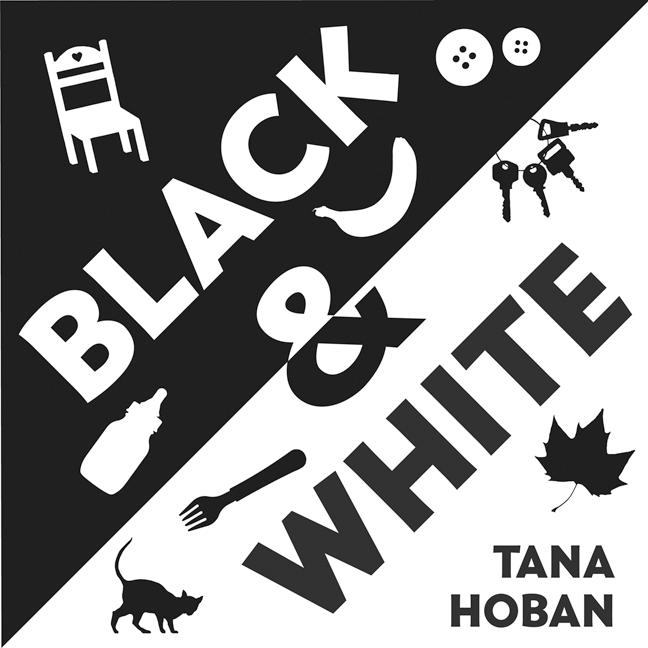
Hoban, Black and White (2007): coverTana Hoban, Black and White (2007)

This book — and its companions Black on White (1993) and White on Black (1993) — show black shapes on white backgrounds and vice-versa.  Buttons, a sailboat, a fork, a flower, a banana.  The pages unfold accordion-style so that you can stand the book up around a baby, and she can look at the images.  The sharp contrast between black and white make the shapes especially vivid to infants (whose eyes are still developing the capacity to focus). This is one of the first books that really interested Emily.

Crockett Johnson, Harold and the Purple Crayon (1955): coverCrockett Johnson, the Harold series (1955-1963):

  • Harold and the Purple Crayon (1955)
  • Harold’s Fairy Tale (1956)
  • Harold’s Trip to the Sky (1957)
  • Harold at the North Pole (1958)
  • Harold’s Circus (1959)
  • A Picture for Harold’s Room (1960)
  • Harold’s ABC (1963)

Quite possibly the best children’s books ever written, and certainly the most succinct expression of the power and peril to be found in the imagination. When I talk to people about Johnson‘s Harold books, they either (a) have not heard of them, or (b) know them and love them. Very rarely do I meet someone who knows the books, but is indifferent.  In sum, if you do not know these, you should.  Start with Harold and the Purple Crayon and Harold’s ABC.

Ezra Jack Keats, The Snowy Day (1962)

Keats, The Snowy Day (1962): coverThis Caldecott-winning book is a favorite from my childhood. Yes, Peter (the book’s protagonist) was the first child of color I had met in literature.  But what left a longer, more lasting impression was the affinity I felt — and feel — for him.  As I was, Peter is a contemplative, curious child.  He makes snow angels, he explores his neighborhood, discovers that his feet can make different kinds of tracks in the snow, and pretends to be a mountain-climber.  As I did, he (or so it seemed to me then) often feels more comfortable in the company of his imagination than in the company of other children.  He does not join in the snowball fight.  After the day is over, he reflects on his adventures.  The bold colors of Keats’s collages, and the thoughtfulness — the inwardness — of his protagonist make The Snowy Day a great book for any child who, like Peter, sees in snow a sense of wonder and possibility.

Laurie Keller, The Scrambled States of America (1998)

I thought Emily might like to learn a little bit about the country where her mother was born. Well, that was part of the reason behind choosing this one. Mainly, I think Keller’s work is hilarious. Sure, there’s a geography lesson here, but there are far more jokes.

Jon Klassen, I Want My Hat Back (2011)

A masterpiece of economy and wit.  Each detail works perfectly.  And its deadpan humor knocks me out each time I read it.

Ruth Krauss and Crockett Johnson, The Carrot Seed (1945)

A little boy plants a carrot, everyone keeps saying “it won’t come up,” but every day he keeps “sprinkling the ground with water.” This story has been interpreted as being about faith, persistence, or simply ignoring the nay-sayers.  Maurice Sendak calls it a “perfect picture book.”

Karla Kuskin, Roar and More (1956)

Poet Karla Kuskin’s first children’s book.  Dynamic layout and typography introduces animals and the sounds they make.  Visually compelling, fun to read aloud, and nice humor (she also provides the sounds of giraffe and fish).

Munro Leaf & Robert Lawson, The Story of Ferdinand (1936)

I expect you know this one, but, if not, then you might like to read my earlier post, “Ferdinand at 75.”

James Marshall, The Three Little Pigs (1989): cover (for paperback edition, 1996)Three versions of three pigs:

  • James Marshall, The Three Little Pigs (1989)
  • Jon Scieszka & Lane Smith, The True Story of the Three Little Pigs by A. Wolf (1989)
  • Eugene Trivisas & Helen Oxenbury, The Three Little Wolves and the Big Bad Pig (1993)

Three versions of the fairy tale. Marshall’s stays closest to Joseph Jacobs’ original, but his illustrations add great comic timing and general daffiness.  Scieszka and Smith tell the story from the wolf’s point of view.  Trivisas and Oxenbury swap the roles of protagonist and antagonist.  Note: be careful of what edition you get of the Marshall.  There’s a re-formatted hardcover version you want to avoid.

Bill Martin, John Archambault, & Lois Ehlert, Chicka Chicka Boom Boom (1989)

Bold colors, swinging verse, and … the alphabet!  One of several ABC books I’ve given thus far.  See also Dr. Seuss’s ABC and Crockett Johnson’s Harold’s ABC.

Mark Newgarden and Megan Montague Cash, the Bow-Wow board books (2007-2009):

  • Bow-Wow Naps by Number (2007)
  • Bow-Wow Orders Lunch (2007)
  • Bow-Wow Hears Things (2008)
  • Bow-Wow Attracts Opposites (2008)
  • Bow-Wow 12 Months Running (2009)
  • Bow-Wow’s Colorful Life (2009)
Newgarden and Cash, Bow-Wow Orders Lunch Newgarden and Cash, Bow-Wow Naps by Number Newgarden and Cash, Bow-Wow Hears Things Newgarden and Cash, Bow-Wow Attracts Opposites Newgarden and Cash, Bow-Wow 12 Months Running Newgarden and Cash, Bow-Wow's Colorful Life

I’ve written an entire post on Newgarden and Cash’s Bow-Wow books. The first, Bow-Wow Bugs a Bug, is listed in tomorrow’s post on wordless picture books. During her first year, the Bow-Wow board books have been Emily’s favorites.

Antoinette Portis, A Penguin Story (2009)

Penguin seeks something new,… and finds it! Love Portis’ graphic style, humor, and how she honors the title character’s curiosity.

Peggy Rathmann, Goodnight Gorilla (1994)

Peggy Rathmann, Good Night, Gorilla (1994): cover

A clever riff on Brown and Hurd’s Goodnight Moon. Rathmann has great comic timing, knows how to let the illustrations tell the story, and includes lots of fun details. The baby giraffe has a toy giraffe, the baby elephant has a toy Babar, and the baby armadillo has … a toy Ernie. Why would the little armadillo have not a toy armadillo, but the Muppet from Sesame Street?  Well, why not?

Michael Rosen and Helen Oxenbury, We’re Going on a Bear Hunt (1989)

Exemplifies the dynamic relationship between words and images that sustains any good picture book.  And it’s a fantastic read-aloud.  For more Oxenbury, see the entry for James Marshall (above) — it contains three versions of “The Three Little Pigs,” one retold by Trivias and Oxenbury.

Amy Krouse Rosenthal & Tom Lichtenheld, Duck! Rabbit! (2009).

Based on the metapicture that fascinated Wittgenstein, two unseen persons debate whether we’re looking at a duck… or a rabbit.

Seuss, Green Eggs and Ham (1960): coverDr. Seuss, Green Eggs and Ham (1960)

Using only 50 different words, Seuss creates a nonsensical classic & his own best-seller.  See also an earlier blog post on this book.

Dr. Seuss, Dr. Seuss’s ABC (1963)

The third of Seuss’s alphabetically themed works.  The first two are The Cat in the Hat Comes Back (1958) and On Beyond Zebra! (1955).

Maurice Sendak, The Nutshell Library (1962)

A collection of four books: Alligators All Around, Chicken Soup with Rice, One Was Johnny, and Pierre.  All are made for tiny hands, and are what Sendak was working on just before he created Where the Wild Things Are (1963).  In other words, this is prime Sendak.  Wild Things will be a future purchase for Emily, but these seemed a better fit for her first year.

Sendak, The Nutshell Library (1962)

Esphyr Slobodkina, Caps for Sale (1940).

A peddler, a nap, and monkeys.  The repetition, the bright colors, and the satisfying resolution have helped this book endure for the last seventy years.

Lane Smith, It’s a Little Book (2011)

Smith, It's a Little Book (2011): cover

For the board book version of the picture book It’s a Book (2010), Smith tones down the joke at the end. He makes other changes (the three main characters are all much younger, for example), but retains much of the original’s sense of humor and mischief. For more Smith, see my longer blog post on him, and the entry for James Marshall (above) — it contains three versions of “The Three Little Pigs,” one retold by Scieszka and Smith.

Toby Speed, Brave Potatoes, illus. Barry Root (2000)Toby Speed & Barry Root, Brave Potatoes (2000).

Why is this book out of print?  It’s one of the best children books published in the new millennium.  A verse tale of vegetables and revolution.  The poetry pops, and the pictures make the “death-defying spuds” seem almost human. Vegetables of the world, unite!  See also my tongue-in-cheek post on this book for Lane Smith & Bob Shea’s blog.

Jon Stone and Michael Smollin, The Monster at the End of This Book (1971)

Thus far, the sole Little Golden Book on this list. Grover (the Muppet) is worried that he’s going to face a monster at the end of the book, and pleads with the reader to help him.  Metafictional humor for beginning readers.  See also Mo Willems’ Elephant and Piggie: We Are in a Book (scroll down).

Yuko Takao, A Winter ConcertYuko Takao, A Winter Concert (1995, trans. 1997)

Along with Burton’s Katy and the Big Snow and Keats’ The Snowy Day, this was part of a trio of winter-themed books I sent Emily in late October 2011.  Rendered in black lines on white paper, a mouse goes to a concert, where she hears “beautiful music” (rendered in small colored dots), which she and the other concert-goers carry home with them — brightening the wintry landscape.  An evocative sense of how music transforms experience.  See also my brief blog post on the book.

Shaun Tan, The Lost Thing (2000)

A modern classic about paying attention, and what happens when we don’t. Later adapted into an Academy Award-winning short film, this book is probably for slightly older children (early grade school, rather than pre-school), but Tan is one of the greatest narrative artists working today — and I thought it important for Emily to have his work in her library. Also, it’s visually rich, with much to reward rereading.

Shaun Tan, Eric (cover)Shaun Tan, Eric (2010)

When a foreign exchange student stays with a family, they try to make him welcome. But what does he think of them? A slightly different version of the story in Tales from Outer Suburbia (2008), this has Tan’s sense of mystery, wonder, and warmth. If there’s a Tan story for the youngest readers, this — despite its more “advanced” vocabulary — is the one.

Martin Waddell and Barbara Firth, Can’t You Sleep, Little Bear? (1988)

This book launched Waddell and Firth’s Little Bear series (no relation to the Little Bear books by Else Homelund Minarik and Maurice Sendak).  A gentle tale, in which big bear helps little bear face his fear of the dark, and get to sleep.

Ellen Stoll Walsh, Mouse Paint (1989)

The pleasure of combining colors, transformation, and evading the cat. The sharp contrast between colors appeal to the eye.

Mo Willems, Don’t Let the Pigeon Ride the Bus! (2003)

Perfect illustration of the “less is more” principle of storytelling. Altering the background color to reflect the title character’s changing mood, Willems provides just enough detail to convey the pigeon’s character — and nothing more. Sympathetic to a child’s desire to be in charge and a great read-aloud, Willems’ book never fails to amuse me.

Mo Willems, Knuffle Bunny: A Cautionary Tale (2004)

Mo Willems, Elephant & Piggie: We Are in a Book! (2010): cover

The book that gave us the phrase “aggle flaggle klabble” and the term “to go boneless” (as in “She went boneless”).

Mo Willems, Elephant & Piggie: We’re in a Book! (2010)

Metafictional tale about reading, starring Willems’ duo.  My favorite of the Elephant & Piggie books, and a worthy companion to Stone and Smollin’s The Monster at the End of This Book (see above).

Looking for other great children’s books?  Try these blogs:

Related posts on Nine Kinds of Pie:

Comments (9)