
Tributes to Maurice Sendak: Visual Artists Respond

Fitting that the passing of an artist should inspire so much art.  Here are a few tributes to Maurice Sendak that I’ve enjoyed. (I’ve assembled links to prose tributes at the bottom of my reminiscence of Maurice; The Comics Journal has its own page of mostly prose tributes, too.)


Pat Bagley

Pat Bagley, tribute to Maurice Sendak

This is easily my favorite, and the one that I think Sendak himself would most have enjoyed. Pat Bagley dos a great job in representing Sendak’s un-sentimental approach to death. Sendak often spoke of his own mortality, and accepted the inevitable with a dark sense of humor.


Hanna Freiderichs (a.k.a. AgarthanGuide)

Avengers on Parade (RIP Maurice Sendak) by AgarthanGuide
Under her Deviant Art pseudonym ArgathanGuide, Hanna Friederichs has created Avengers in a Sendakian parade.  You can find it on her Deviant Art page and Tumblr.  The image calls to mind Sendak’s many parades — in Ruth Krauss’s A Hole Is to Dig (1952), and his own Where the Wild Things Are (1963). The above image derives from a less well-known source: his 1961 mural for Larry and Nina Chertoff that now resides in the Rosenbach Museum.

Maurice Sendak, Chertoff Mural (1961)
The photo of Sendak’s mural, above, comes from The History Blog‘s great story about it, which I recommend.

Update, 13 May, 9:30 am: Thanks to Roger Sutton’s post, added Hanna Friederichs’ full name.


Harry Bliss

Harry Bliss, Sendak

Harry Bliss‘s graveside portrait of Babar, Madeline, Curious George, and the Man with the Yellow Hat evokes how everyone in the children’s literature community has felt — artists, scholars, writers, librarians, teachers, editors, agents, all of us.  Losing Maurice Sendak has felt like a death in the family.  As Kenneth Kidd put it, “Could be the select company I keep, but my Facebook newsfeed is a virtual wake.”


Debbie Milbrath

Deb Milbrath, RIP Mr. Sendak

Most artists invoke Where the Wild Things Are (presumably because it’s Sendak’s most recognizable work), but Debbie Milbrath references a more thematically appropriate work: Outside Over There (1981), in which Sendak filters the kidnapping (and accidental murder of) the Lindbergh baby through Mozart’s Magic Flute,  and ends up with a work that offers glimmers of hope through its darkness.


Andy Marlette

Andy Marlette, Where the Wild Things Are

Andy Marlette imagines wild things paying tribute to Maurice Sendak.  There were many such cartoons — I’ve only included a few here.


Jeff Koterba

Jeff Koterba color cartoon for 5/9/2012 "Sendak"

Jeff Koterba makes Sendak into Max, apt since — as Sendak has admitted — Max is a version of Maurice himself.  I suspect Sendak intended an allusion to Wilhelm Busch’s Max und Moritz (1865).


Nate Beeler

Nate Beeler, [RIP Maurice Sendak]

Nate Beeler imagines roaring terrible roars and gnashing terrible teeth — a first response to Maurice Sendak’s passing.  The first stage of grief.


Bob Englehart

Bob Englehart, [Max and wild thing]

 In Bob Englehart‘s image, a wild thing comforts Max.

Sarah McIntyre

Sarah McIntyre, [Max and wild thing]

I like that Sarah McIntyre has drawn the wild thing seeking comfort from Max. The kid is handling it better than the monstrous, giant, wild thing. Sendak always said that children understood much more than adults give them credit for.


Chris Eliopoulos

Chris Eliopoulos, [Max alone]

Understated, lovely.  The creator of Misery Loves Sherman, Chris Eliopoulos has many different websites to visit.


Mark Streeter

Mark Streeter, And the Wild Things Cried

Mark Streeter‘s comic says what Chris Eliopoulos’s implies — but Eliopoulos assumes a knowing reader, and Streeter does not. Strange though it may seem to those of us in children’s literature, there are people who do not know Maurice Sendak’s work.


Stuart Carlson

Stuart Carlson, RIP

Stuart Carlson‘s tribute seems an apt one to end on. First, mourn. Next, hang your teddy bear, threaten the dog, shout at your mother, and board a boat (… to where the wild things are).

More on Sendak from Nine Kinds of Pie (this blog):

Comments (6)

Crockett Johnson draws Mr. O’Malley, 1962

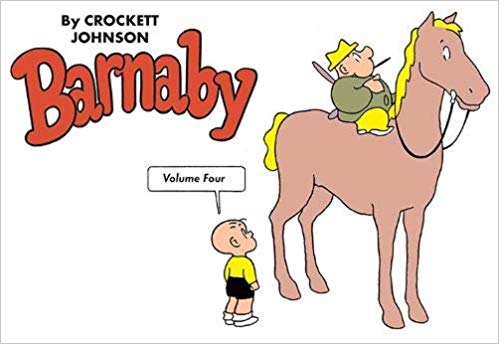
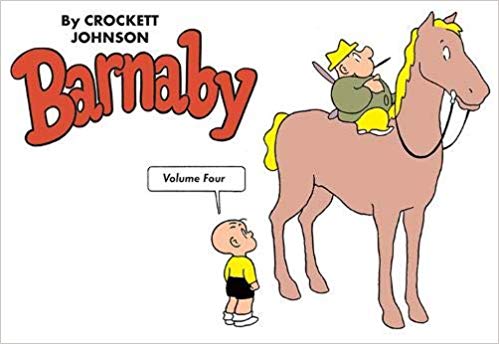
Cushlamochree!  It’s a portrait of Barnaby’s fairy godfather, Mr. O’Malley, in … 1962!  Yes, 1962 — which makes it unusual for several reasons.  First, Crockett Johnson didn’t draw Barnaby for its 1960-1962 revival.  Warren Sattler did.  Second, it’s a bit looser than Johnson’s drawings of O’Malley during Barnaby‘s original 1942-1952 run.  As a result, you can see more clearly the individual pen strokes that create his hat, face, wings, arms, and buttons.

Mr. O'Malley, as drawn by Crockett Johnson, 1962

The drawing comes to us courtesy of Vicki Smith, the daughter of a friend of Frank Paccassi, Jr.  When her mother (who had inherited the drawing from Ms. Smith’s late father) passed away, she sent me Mr. Paccassi’s collection of 1960-1962 Barnaby strips, along with the above drawing and a couple of penny postcards from Crockett Johnson.  A fan of Barnaby, Mr. Paccassi had written to Johnson in the fall of 1962 about obtaining copies of the 1960-1962 run (which had then just concluded).  Johnson obligingly sent him “some extra release proofs I have no use for,” and signed Mr. Paccassi’s copies of Barnaby (1943) and Barnaby and Mr. O’Malley (1944).

As readers of this blog will already know, this is shaping up to be a good year for Crockett Johnson fans:

  • The Complete Barnaby Vol. 1 (co-edited by yours truly and Eric Reynolds), covering the first two years (1942-1943) of Barnaby, is due out late summer / early fall from Fantagraphics. Indeed, on Free Comic Book Day (first Saturday in May), watch for Fantagraphics’ free Barnaby comic book featuring a 30-strip sequence from The Complete Barnaby Vol. 1!
  • Crockett Johnson and Ruth Krauss: How an Unlikely Couple Found Love, Dodged the FBI, and Transformed Children’s Literature (my biography, a dozen years in the making) will be out in September from the University Press of Mississippi.

Indeed, the page proofs for the latter arrived this past Tuesday.  I’ve been reviewing them and constructing the index.  Since they are due back at the end of the month and since I have many other deadlines this month, the blog may be slightly quieter than usual — or the posts may be more brief.

But the many posts devoted to Crockett Johnson and Barnaby should (I hope) keep you amused.  Depending on your stamina and level of interest, there’s a great deal here related to the creation of the biography.  I’ll list some (well, far too many) below:

Comments (1)

Children’s Literature & Comics/Graphic Novels at MLA 2012

Modern Language Association Conference, 2012 logoFor those who may be heading to the MLA in Seattle (5-8 Jan. 2012), here’s a list of all the panels on either children’s literature or comics/graphic novels. I count sixteen panels exclusively devoted to one or more of these subjects, and an additional nine panels in which one ore more paper addresses either children’s literature or comics/graphic novels.  Based on that tally, I feel fairly confident in claiming that this is the MLA with the most number of panels devoted to either children’s lit or comics/graphic novels.  Incidentally, I arrived at the list below via searching the MLA program — so, it’s possible I’ve missed some.  Also, if graphic narratives are your main interest, then do check out Charles Hatfield’s great list of just the MLA comics panels.

Devoted EXCLUSIVELY to CHILDREN’S LIT or COMICS / GRAPHIC NOVELS

These are the panels in which all of the papers address one or more of the above subjects.

48. Filling the Gaps: The Future of Keywords for Children’s Literature

Thursday, 5 January1:45–3:00 p.m., 614, WSCC

A special session

Presiding: Philip Nel, Kansas State Univ.; Lissa Paul, Brock Univ.

1. “Fairy Tale,” Jack D. Zipes, Univ. of Minnesota, Twin Cities

2. “Genre,” Karin E. Westman, Kansas State Univ.

3. “Family,” Kelly Hager, Simmons Coll.; Talia C. Schaffer, Queens Coll., City Univ. of New York

95. The Graphic Novel in Latin America

Thursday, 5 January3:30–4:45 p.m., University, Sheraton

Program arranged by the Division on Twentieth-Century Latin American Literature

Presiding: Hilda Chacón, Nazareth Coll. of Rochester

1. “Criminal Melodrama and Hypertrophic Gesture in ¡Alarma! and ¡Casos de Alarma!,” Sergio Delgado, Harvard Univ.

2. “La grabadora: En busca de una historia alternativa,” Javier Gonzalez, Univ. of Colorado, Boulder

3. “Rupay, the Photojournalistic Archive, and the Sendero War,” Kent L. Dickson, California State Polytechnic Univ., Pomona

106. No(Bodies): Ghost Children in Juvenile Literature

Thursday, 5 January5:15–6:30 p.m., 305, WSCC

Program arranged by the Children’s Literature Association

Presiding: Elizabeth Talafuse, Texas A&M Univ., College Station

1. “Invisible Playmates; or, Childhood Ghosts and Adult Comfort in Burnett, Canton, and Kipling,”Judith Abrams Plotz, George Washington Univ.

2. “My Other Me: Ghost Doubles in Nineteenth-Century American Children’s Poetry,” Angela Franceska Sorby, Marquette Univ.

3. “Children of Air: Children’s Poetry and the Spectral Child,” Richard McDonnell Flynn, Georgia Southern Univ.

4. “Embodied in Name Alone: Nobody Owens and the Metonymic Estrangement from the Living and the Dead in Neil Gaiman’s The Graveyard Book,” Joseph Michael Sommers, Central Michigan Univ.

181. Graphic Narratives Retelling History: Germany

Friday, 6 January8:30–9:45 a.m., University, Sheraton

Program arranged by the Division on Slavic and East European Literatures and the Division on European Literary Relations

Presiding: Ema Vyroubalova, Trinity Coll., Dublin

1. “Sequential Berlin: Jason Lutes’s City of Stones Series,” Ksenia Sidorenko, Yale Univ.

2. “Retelling History in the Borderlands: Jaroslav Rudiš’s Alois Nebel and Bomber by Jaromír 99,”Martha B. Kuhlman, Bryant Univ.

3. “Retelling German History with the Graphic Novel,” Elizabeth Nijdam, Univ. of Michigan, Ann Arbor

For abstracts, visit mlaslavicdivision2012.blogspot.com/.

183. Deep Drawings: Sociopolitical Themes in Anime and Manga

Friday, 6 January8:30–9:45 a.m., Virginia, Sheraton

A special session

Presiding: Joshua Paul Dale, Tokyo Gakugei Univ.

1. “Alternative Manga Magazines in Postwar Japanese Comics: Garo and COM,” CJ Suzuki, Baruch Coll., City Univ. of New York

2. “Subversive Cute: The Other Serious Anime and Manga,” Kerin Ogg, Wayne State Univ.

3. “Current-Affairs Comics in a Global Context: The Comic Heart of Darkness,” Marie Thorsten, Doshisha Univ.

Responding: Joshua Paul Dale

264. Self-Destruction in Children’s and Young-Adult Literature

Friday, 6 January12:00 noon–1:15 p.m., 615, WSCC

Program arranged by the Division on Children’s Literature

Presiding: Melanie Goss, Illinois State Univ.

1. “Resistant Rituals: Self-Mutilation and the Female Adolescent Body in Children’s and Young-Adult Literature,” Cheryl Cowdy, York Univ.

2. “The Power of the Wound: Manifesting Trauma and Self-Destruction in Young-Adult Fantasy Novels,” Balaka Basu, Graduate Center, City Univ. of New York

3. “Self-Reconstruction: Youth Agency and the New Reality of Young-Adult Problem Novels,”Robert Bittner, Univ. of British Columbia

4. “The Final Girl Survives: Adolescent Self-Destruction in Teen Horror,” Christopher William McGee, Longwood Univ.

316. Asian Americans and Graphic Narrative

Friday, 6 January3:30–4:45 p.m., 303, WSCC

Program arranged by the Division on Asian American Literature

Presiding: Timothy Yu, Univ. of Wisconsin, Madison

Speakers: Rachelle Cruz, Univ. of California, Riverside; Lan Dong, Univ. of Illinois, Springfield;Tomo Hattori, California State Univ., Northridge; Caroline Kyungah Hong, Queens Coll., City Univ. of New York; Hye Su Park, Ohio State Univ., Columbus; Gene Luen Yang, San Jose, CA

Session Description:

Gene Luen Yang, author of American Born Chinese, will be the featured speaker in this discussion of Asian American graphic narrative. Graphic novels and memoirs form an increasingly important part of the Asian American literary canon, offering new insights into issues of stereotyping, autobiography, and historical memory. GB Tran’s Vietnamerica, Adrian Tomine’s Shortcomings, and Lynda Barry’s One Hundred Demons will be among the works discussed.

371. The Material History of Spider-Man

Friday, 6 January5:15–6:30 p.m., 606, WSCC

Program arranged by the Discussion Group on Comics and Graphic Narratives

Presiding: Jonathan W. Gray, John Jay Coll. of Criminal Justice, City Univ. of New York

1. “Written in the Body: Spider-Man, Venom, and the Specter of Biopower,” Ben Bolling, Univ. of North Carolina, Chapel Hill

2. “Out of Character: Traces of the Real Spider-Man,” Samantha Close, Univ. of California, Irvine

3. “Tangled Web: Spider-Man’s Discontinuous Continuity,” Charles Hatfield, California State Univ., Northridge

Responding: Danny Fingeroth, New York, NY

For abstracts, visit graphicnarratives.org/ after 1 Dec.

399. How Seattle Changed Comics

Saturday, 7 January8:30–9:45 a.m., 303, WSCC

Program arranged by the Discussion Group on Comics and Graphic Narratives

Presiding: Hillary L. Chute, Univ. of Chicago

1. “Ernie Pook and the Emerald City: Lynda Barry’s Seattle,” Susan E. Kirtley, Portland State Univ.

2. “Underground Aesthetics Turned Alternative Critique: Reconsidering Roberta Gregory’sNaughty Bits,” JoAnne Ruvoli, Univ. of California, Los Angeles

3. “Serial Trauma: Awaiting Charles Burns’s X’ed Out,” Christopher Pizzino, Univ. of Georgia

For abstracts, visit graphicnarratives.org/ after 1 Dec.

434. E-Arming the Future? Technology’s Expanding Influence on the Form and Readership of Young-Adult Literature

Saturday, 7 January10:15–11:30 a.m., 303, WSCC

Program arranged by the Children’s Literature Association

Presiding: Thomas Crisp, Univ. of South Florida

1. “Twilight Online Fandom: Reaching Femininity through Textual Manipulation and Abstraction,”Norma Aceves, California State Univ., Northridge

2. “I’ve Got My iPhone on You: Technology and Surveillance Culture in Gossip Girl,” Sara Day, Southern Arkansas Univ.

3. “Utilizing Technology,” Tammy Mielke, Univ. of Wyoming

570. Ethnographic Encounters: Jewish American and Italian American Graphic Narratives

Saturday, 7 January3:30–4:45 p.m., 307, WSCC

Program arranged by the Discussion Group on Italian American Literature and the Discussion Group on Jewish American Literature

Presiding: JoAnne Ruvoli, Univ. of California, Los Angeles

1. “From Caricature to Complexity: Drawing the Relationship between Italians and Jews in America,” Jennifer Glaser, Univ. of Cincinnati

2. “America Makes Strange Jews: Jewish Identity and Pulp Masculinity in Howard Chaykin’sDominic Fortune,” Brannon Costello, Louisiana State Univ., Baton Rouge

Responding: Miriam Jaffe-Foger, Rutgers Univ., New Brunswick

For abstracts, visit www.aihaweb.org/italianamericanliterature.htm after 24 Dec.

579. Why Comics Are and Are Not Picture Books

Saturday, 7 January5:15–6:30 p.m., 303, WSCC

Program arranged by the Division on Children’s Literature and the Discussion Group on Comics and Graphic Narratives

Presiding: Charles Hatfield, California State Univ., Northridge; Craig Svonkin, Metropolitan State Coll. of Denver

1. “Picture Book Guy Looks at Comics: Structural Differences in Two Kinds of Visual Narrative,”Perry Nodelman, Univ. of Winnipeg

2. “Not Genres but Modes of Graphic Narrative: Comics and Picture Books,” Philip Nel, Kansas State Univ.

3. “Graphic Novels’ Assault upon the Republic of Reading,” Michael Joseph, Rutgers Univ., New Brunswick

4. “The Panel as Page and the Page as Panel: Uncle Shelby and the Case of the Twin ABZ Books,” Joseph Terry Thomas, San Diego State Univ.

630. Comics, Bande Dessinée, Manga: For a Comparative Approach to the Study of Comics

Sunday, 8 January8:30–9:45 a.m., 310, WSCC

A special session

Presiding: Catherine Labio, Univ. of Colorado, Boulder

1. “‘Aint I de Maine Guy in Dis Parade?’: Sympathetic Immigrant Narratives and the Transnational Worker in Early American Comic Strips,” Michael T. R. Demson, Sam Houston State Univ.

2. “Academic Fandom and the Other-ed Side in American Comic Book Studies,” Shawna Kidman, Univ. of Southern California

3. “Masochistic Contracts, Bishōnen, and the Rejection of Futurity: How to Read Manga like a Victorian Woman,” Anna Maria Jones, Univ. of Central Florida

681. Ecocriticism and Literature for Young Readers

Sunday, 8 January10:15–11:30 a.m., 613, WSCC

Program arranged by the Division on Children’s Literature

Presiding: Caroline E. Jones, Texas State Univ.

1. “‘Mother Earth’ and ‘Earth Mothers’: Consequences of Feminizing the Earth and Its Keepers in Children’s Picture Books,” Amy Dunham Strand, Aquinas Coll., MI

2. “Winnie-the-Conservationist: An Ecofeminist Reading of Tuck Everlasting,” Peter Kunze, Florida State Univ.

3. “Ecological Repression and Return: An Ecocritical Approach to Bloor’s Tangerine andCrusader,” Beth Feagan, Longwood Univ.

4. “Reading the South: Teaching Adolescents to Identify with Regional Land,” Julia Pond, Illinois State Univ.

699. Graphic Narratives Retelling History: Serbia and Bosnia

Sunday, 8 January12:00 noon–1:15 p.m., Virginia, Sheraton

Program arranged by the Division on Slavic and East European Literatures

Presiding: Rossen Djagalov, Yale Univ.

1. “The Nova Dobo Festival of Nonaligned Comics in Belgrade,” Lisa Mangum, Independent Publishing Resource Center

2. “How We Survived War, Sanctions, and NATO Bombing, and Then Laughed: Regards from Serbia by Alexandar Zograf,” Damjana Mraovic-O’Hare, Penn State Univ., University Park

3. “Back into Bosnian: Joe Sacco’s Safe Area Goražde Returns Home from War,” Jessie M. Labov, Ohio State Univ., Columbus

Responding: Martha B. Kuhlman, Bryant Univ.

For abstracts, visit http://mlaslavicdivision2012.blogspot.com.

734. Self-Narrating Lives: Genre-Bending Autobiographical Works

Sunday, 8 January1:45–3:00 p.m., 611, WSCC

A special session

Presiding: Johanna Drucker, Univ. of California, Los Angeles

Speakers: Maria Faini, Univ. of California, Berkeley; Anna Gibbs, Univ. of Western Sydney;William Kuskin, Univ. of Colorado, Boulder; Vanessa Place, Les Figues Press; Christine Wertheim, California Inst. of the Arts

Session Description:

This session explores the complexities of self-narration across media and formats with particular emphasis on those that blur genre lines. Autobiographical artists’ books, graphic novels are often highly self-reflexive, and their metacharacter as books about books, or subversions of norms, makes them sites of citation and parody in which formal mimicry and content play with readers’ expectations.


Panels devoted PARTIALLY to CHILDREN’S LIT or COMICS / GRAPHIC NOVELS

Here, I’ve listed only the paper or papers that (as far as I can tell from the title) address the above subjects.

74. Revisiting Emotion and Gender in the Regency

Thursday, 5 January3:30–4:45 p.m., 310, WSCC

A special session

Presiding: Alan Rauch, Univ. of North Carolina, Charlotte

1. “The Mother Attitudes: Ann Taylor’s My Mother, Lady Emma Hamilton, and the Rise of Sentimental Children’s Poetry,” Donelle Ruwe, Northern Arizona Univ.

192. Open Session of the Division on Old English Language and Literature

Friday, 6 January8:30–9:45 a.m., 608, WSCC

Presiding: Paul L. Acker, Saint Louis Univ.

2. “Visualizing Femininity in Children’s and Illustrated Versions of Beowulf,” Bruce D. Gilchrist, Concordia Univ.

329. A Creative Conversation with Richard Van Camp: Writing, Language, and Indigenous Expression

Friday, 6 January3:30–4:45 p.m., Redwood, Sheraton

Program arranged by the Office of the Executive Director

Presiding: Robert Warrior, Univ. of Illinois, Urbana

Speaker: Richard Van Camp, Univ. of Alberta

Session Description:

Richard Van Camp is an accomplished and innovative writer who brings the language and experience of the Tlicho people of the Northwest Territory into his fiction and children’s books. He writes about the resiliency of Indigenous communities but is not afraid to expose and explore the dysfunctions that have come with colonization. His talents are a rare combination of exuberant humor, stark vision, writerly lyricism, and hard-edged wisdom. Links to the author’s work, including some to his short fiction, are available at www.nativewiki.org/Richard_Van_Camp.

409. Visual and Graphic Representations by Hispanic/Luso/Latina Female Writers and Artists

Saturday, 7 January8:30–9:45 a.m., Redwood, Sheraton

Program arranged by Feministas Unidas

Presiding: Magdalena M. Maiz-Peña, Davidson Coll.

2. “La transfiguración femenina: Del animal cínico al terrorismo gótico de la abyección. El comic serial de Cecila Pego y Caro Chinaski,” Carina González, Univ. of Florida

3. “Bodies at the Crossroads: Latinas’ Latina Graphic Narratives,” Margaret Galvan, Graduate Center, City Univ. of New York

For abstracts, visit feministas-unidas.org.

471. Asian/Jewish/American

Saturday, 7 January12:00 noon–1:15 p.m., 304, WSCC

A special session

Presiding: Jaime Cleland, Ohio Univ., Athens

3. “Graphic Transformations: Ethno-racial Identity and Discovery in Two Comics of Childhood,”Tahneer Oksman, Graduate Center, City Univ. of New York

473. Performing Identity in Late Life

Saturday, 7 January12:00 noon–1:15 p.m., Virginia, Sheraton

Program arranged by the Discussion Group on Age Studies

Presiding: Leni Marshall, Univ. of Wisconsin, Menomonie

2. “Melancholic Morphing: Aging Male Protagonists in Recent American Graphic Novels,” Adrielle Anna Mitchell, Nazareth Coll. of Rochester

486. Visual Culture

Saturday, 7 January12:00 noon–1:15 p.m., Redwood, Sheraton

Program arranged by the Women’s Caucus for the Modern Languages

Presiding: Inmaculada Pertusa, Western Kentucky Univ.

2. “Alissa Torres’s Graphic Tale of Grief: American Widow; or, My Husband Bleeds History,” Janis Breckenridge, Whitman Coll.

3. “The Anxiety of Density in Graphic Novels: Solutions Based on Genderic Conventions and Creative Collaborations,” Maria Elsy Cardona, Saint Louis Univ.

692. Human Rights Modes: Testimony

Sunday, 8 January12:00 noon–1:15 p.m., 306, WSCC

A special session

Presiding: Michael S. Galchinsky, Georgia State Univ.

1. “Witness/Testimony: Graphic Narrative as Témoignage in the Humanitarian Work of Médecins sans Frontières,” Alexandra W. Schultheis, Univ. of North Carolina, Greensboro

728. New Paths of Flânerie: Crossings of Gender and Space and the Nineteenth-Century FrenchFlâneur/Flâneuse

Sunday, 8 January1:45–3:00 p.m., Aspen, Sheraton

A special session

Presiding: Heidi Megan Brevik-Zender, Univ. of California, Riverside

2. “On the Misfortunes of Child Flaneurs in French Nineteenth-Century Children’s Books,” Pauline de Tholozany, Gettysburg Coll.


Leave a Comment

Sunday Color Barnaby: O’Malley in Winter

As has been noted twice before on this blog (see here and here), a color Sunday version of Crockett Johnson‘s Barnaby ran from 1946 to 1948.  Courtesy of Colin Myers, here’s a full-page one from the winter of 1948.  Though it’s undated, “winter” would have to be January or February because the color Barnaby concluded in May of 1948.  Most of the Sunday strips are half a page; this one is unusual in that it’s full-page.

Barnaby, Winter 1948

The artist is Jack Morley, the words are by Ted Ferro.  For the daily strips during this period, Johnson was serving in an advisory capacity; I assume he was also serving as a story consultant for the Sunday strips. While they’re not up to Johnson’s exacting standards, the Ferro-Morley strips are still fun.

Not incidentally, my blog has been unusually quiet during this past week because of two Crockett Johnson projects:

  • The Complete Barnaby, Vol. 1. My afterword (complete!) and notes (nearly complete!) are due in to Fantagraphics on December 1st.  The book is due out in June 2012.  You can learn more about it in the Spring/Summer 2012 Fantagraphics catalogue.
  • Crockett Johnson and Ruth Krauss: How An Unlikely Couple Found Love, Dodged the FBI, and Transformed Children’s Literature.  The copyedited text arrived on November 18th, right at the beginning of a Thanksgiving “break” during which I already had an impossibly long list of tasks to complete.  It’s due back on December 9th. The book is due out in September 2012 from the University Press of Mississippi.


Leave a Comment

Syd Hoff, A. Redfield, and Me: Part II

Inspired by BoingBoing’s notice of my post on Syd Hoff’s leftist cartoons, I’m sharing another letter from the late Mr. Hoff, along with a cartoon from 1939.  As those who remember his first letter to me might recall, he and I corresponded — and spoke over the phone a few times — when I was working on Crockett Johnson and Ruth Krauss: How an Unlikely Couple Found Love, Dodged the FBI, and Transformed Children’s Literature (due out in fall 2012 from the University Press of Mississippi).

In the 1930s, Crockett Johnson was New Masses’ art editor, and Hoff contributed cartoons under the name A. Redfield — a pseudonym he reserved for his New Masses and Daily Worker pieces.  Here’s the first page of his third letter to me, followed by a transcription of the same.  He dated it July 1, 2000, but he intended to write August 1, 2000.  (His first letter was July 8, 2000, and his second was July 15, 2000; the one below was posted August 1st.)  The “Dave” you’ll see mentioned is Crockett Johnson, whose real name was David Johnson Leisk and who was known to his friends as “Dave.”

Syd Hoff, letter to Philip Nel, 1 Aug 2000, p. 1

Here’s the transcription, with “[?]” marking places where I’m unsure if my transcription is correct, and brackets [] indicating my own interpolated text:

July 1, 2000

Dear Phil:

To repeat, I never got to know Dave personally, perhaps because I was awfully young.  I got into the “movement” in my teens, was influenced by a student at the Natl. Academy of Design, where I studied for 2 years, starting when I was 16.  The student, Boris Gorelick, with whom I had been in Morris High School in the Bronx, was hurrying out of the Academy one day, just when the NY Daily News has having page 1-3, front page words[?] and photos of “Red” meetings in Union Square, NYC, with mounted police attacking protesters, etc.  “Where ya going, Boris?” I asked innocently, “to one of them Red meetings?”

He gave me an answer I never forgot: “Don’t you know, a Russian tree is just like an American tree?”  Sounds funny, but in one second, I had a universal feeling.

Back to Dave.  Prior to him at N.M. there had been a “Butch Limbach,” whose art was not great, perhaps because he seemed to have just gotten a jolt as an art editor.  Either before him or after, there was Mischa Richter, who was already appearing in The New Yorker, doing a syndicated panel for King Features, and soon to become a successful NYer cartoonist.

[Marginal note, running horizontally next to the above three paragraphs:] I did read the NY Times review of Lewis Allan’s book My “Locomotive History” — + NM showed ex-leaders of the Left, “jumping from a train..  It was said to be a remark of Lenin’s, and Max Gordon of Village Vanguard almost bought it as a curtain trim[?].

By the way, the business manager of N.M. was George Willner, with whom I became very friendly in 1939, when my wife and I took a vacation in Los Angeles, perhaps because Tiba Garlin, of the Garlin family, his wife (Sender sometimes occupied Mike Gold’s space in the Daily worker, with a brother member of the family owned and ran Green Mansions, in the

The “Locomotive History” comment references a Syd Hoff cartoon, published 28 November 1939.  It comments on all those who, after the Hitler-Stalin Pact of August 1939, left the Communist Party.  Riffing on Marx’s idea (and Lenin’s claim) that revolution is the locomotive of history, Hoff shows the locomotive leaving behind all those who have deserted the Party — suggesting that they’ve made a mistake in doing so.

Here’s page two:

Syd Hoff, letter to Philip Nel, 1 Aug 2000, p. 2

The transcription of page two:

Adirondacks, when the Group Theatre at least one summer was the entertainment, with Franchot Tone, its richest and one of its most talented stars.  Such guys as Morris Carnovsky, da Silva, John Garfield, and Elia Kazan etc. were always there, as well as S. Edna Bromberg[?], who eventually would die in London, probably because of a heart attack from being blacklisted in the U.S.A.

Another celebrity in stage and screen, was Philip Loeb, star of the Gertrude Berg TV show, “The Rise of the Goldbergs.”  Red Channels named Philip, demanded that he be dropped from the show, etc.  This was wonderfully done in Woody Allen’s movie, “The Front,” with Zero Mostel checking in at the Taft Hotel in Manhattan, calling room service for a bottle of wine, then dropping out of the 20th floor window, exactly like Loeb had done!

Cafe Society was to become the gathering place for the left in N.Y.  A short way downtown, opposite the Arch in the Village, the great writer (? — my memory fails me at times!) was writing articles for the Jewish Forward (Forvitz) for $5 a piece.  Eventually The New Yorker discovered these, ran them all (?) won a Pulitzer Prize.  His books are bestsellers yet!  He was always in Stewarts Cafeteria.

[Marginal note identifies writer:] Isaac Bashevis Singer

I never knew Seuss had drawn for N.M.  He first “rang a bell” with ads for FLIT, an insect repellent.  “QUICK, Henry, the FLIT!” Seuss character would yell.  I can’t recall “Doctor” ever being a red, though.

I’m trying to get around to answering some of your questions.  I drew for N.M. before my trip to the Coast in 1937, in fact, I

A correction: Dr. Seuss drew cartoons for PM, not for NM (New Masses).  Hoff’s misreading my letter to him, in which I mention Seuss’s work PM.  Hoff is right about Seuss not “ever being a red, though.”  Dr. Seuss was a liberal Democrat, but he wasn’t a leftist.

And page three:

Syd Hoff, letter to Philip Nel, 1 Aug 2000, p. 3

The transcription of page three:

had been doing a daily cartoon for the Daily Worker about right after I left the Academy.  “The Ruling Clawss” was the title Clarence Hathaway, its editor, who was coming up into the Party with Earl Browder gave it that title.  (How awful!  Hathaway would eventually be named in “Workers Enemies Exposed,” shortly before Browder himself, now obviously with “Alzheimer,” would appear on TV with Hamilton Fish of Congress, probably the worst reactionary person in American History.

[Marginal note with arrow pointing to above paragraph:] These remarks should not be printed because they’d destroy me as a “children’s author!”  Please refrain!

By the way, a very young Jack Gifford, was the MC of Cafe Society and he remained a close friend of Barney Josephson for the rest of his life.  Which reminds me, I finally tracked down the mural I had done, and have sent it to Mrs. J.  The widow of a friend of mine had it all the time, and unfortunately she folded it in an envelope.  I hope Terry can use it…  Oh yes, I recall in a bio of Judy Holiday, how she hated Comden and Greene, her old buddys at the Village Vanguard, for not ever sending word or coming to visit her when she was dying from Cancer.

Last words: I have done, am still doing “chalk talks.”  They are one-hour presentations, live drawings with commentary about my life, past and present, drawings of Danny and the Dinosaur, and some of my other books, plus a Weston Woods video of Danny.  Sixty minute shows with more particulars if any one is interested.

I apologize for my

Smith-Corona.

Best wishes,

Syd hoff

Box 2463

Miami Beach, FL 33140

You may be struck by the incongruity of the fact that Hoff writes, “These remarks should not be printed because they’d destroy me as a ‘children’s author!’  Please refrain!” … and yet you are reading these remarks on-line, in a public forum.  What do you think you’re doing? you may be asking.  Can you not keep the secrets of the dead?

Here’s my response.  First, Hoff wrote those words in 2000, five decades after the blacklist.  They show how thoroughly the blacklist imprinted itself on his psyche.  He himself was never blacklisted, though he does have an FBI file.  And, in 2000, the blacklist was history.  Uncovering the fact that an author or artist had contributed to the Daily Worker would not then be a career-ending revelation.

Second, this post does not break the news of Hoff’s political affiliations in the 1930s. I’m not sure who published that news first, but we might credit Julia Mickenberg’s Learning from the Left: Children’s Literature the Cold War, and Radical Politics in the United States (2006).  Julia and I also include this information in our Tales for Little Rebels (2008), which reproduces Hoff’s first children’s book, Mr. His (published by New Masses in 1939).  And, of course, two earlier blog posts on this site also divulge the information: “Syd Hoff, A. Redfield, and Me” (Nov. 2010), and “Syd Hoff’s Teeth” (Feb. 2011).

Third, if we don’t know the past, then we cannot learn from it.  For example, Julia discovered that children’s authors were largely exempt from the blacklist because the blacklisters thought children’s literature too unimportant a field to monitor (in part because most of its creators were women).  If we keep hidden the Left affiliations of Hoff, Wanda Gág, Crockett Johnson, and others, then this understanding gets lost.

We are, at present, reliving some of the same political battles of the 1930s — the role of progressive taxation in maintaining the welfare of the many, of government investment in creating jobs, of government as a necessary regulatory mechanism (in curtailing corporate excess).  Though the Estate Tax applies only to people who leave $5 million or more, its opponents call it the Death Tax — as if it applied to everyone.  As Hoff shows in this 1939 cartoon, the Estate Tax affects only the wealthiest among us.

"It isn't poor pater, Doctor. It's the inheritance tax." Cartoon by A. Redfield (Syd Hoff). Printed in New Masses, 16 May 1939.

Similarly, though strategic spending by the government helped get the U.S. out of the Great Depression, opponents of such investment today allege (without evidence) that it does not create jobs.  Though reckless speculation undid the world economy in 2008, opponents of regulation allege that reinstituting rules such as those provided by the Glass-Steagall Act would somehow be deleterious to business — despite the fact that Glass-Steagall helped stabilize the economy in the 1930s.  In the 1930s, progressives carried the day, instituting many of the social programs (welfare) and legislation (Fair Labor Standards Act, which abolished child labor; Minimum Wage) that we once took for granted.

History offers a guide for our future — if we’re willing to learn from it.  Occupy Wall Street notwithstanding, it’s not yet clear whether we’ll learn from the past or repeat past mistakes.

Related posts:

Comments (3)

Complete Barnaby: flyer

The first promotional flyer for The Complete Barnaby is here.  And no, the strips you see on it are not of the resolution that you’ll experience in the book itself.  Fantagraphics is still working on cleaning up the scans.  But, at least, a hazy glimpse of what’s to come… in June 2012!

Here’s a pdf:

And, below, jpegs of each side of the page.

Complete Barnaby flyer, page 1, Sept. 2011

Complete Barnaby flyer, page 2, Sept. 2011

Comments (1)

Crockett Johnson and the Purple Crayon: A Life in Art

This piece appeared in Comic Art in 2004.  As the magazine is now (sadly) defunct, I’m posting the article here.  Until The Purple Crayon and a Hole to Dig: The Lives of Crockett Johnson and Ruth Krauss appears in 2012, this essay is the most thorough account of Johnson’s life available.  Enjoy!

For those who prefer ‘em, jpegs are below. Click to enlarge.

Philip Nel, "Crockett Johnson and the Purple Crayon: A Life in Art," Comic Art 5 (Winter 2004), p. 2

Philip Nel, "Crockett Johnson and the Purple Crayon: A Life in Art," Comic Art 5 (Winter 2004), p. 3

Philip Nel, "Crockett Johnson and the Purple Crayon: A Life in Art," Comic Art 5 (Winter 2004), p. 4

Philip Nel, "Crockett Johnson and the Purple Crayon: A Life in Art," Comic Art 5 (Winter 2004), p. 5

Philip Nel, "Crockett Johnson and the Purple Crayon: A Life in Art," Comic Art 5 (Winter 2004), p. 6

Philip Nel, "Crockett Johnson and the Purple Crayon: A Life in Art," Comic Art 5 (Winter 2004), p. 7

Philip Nel, "Crockett Johnson and the Purple Crayon: A Life in Art," Comic Art 5 (Winter 2004), p. 8

Philip Nel, "Crockett Johnson and the Purple Crayon: A Life in Art," Comic Art 5 (Winter 2004), p. 9

Philip Nel, "Crockett Johnson and the Purple Crayon: A Life in Art," Comic Art 5 (Winter 2004), p. 10


Philip Nel, "Crockett Johnson and the Purple Crayon: A Life in Art," Comic Art 5 (Winter 2004), p. 11

Philip Nel, "Crockett Johnson and the Purple Crayon: A Life in Art," Comic Art 5 (Winter 2004), p. 12

Philip Nel, "Crockett Johnson and the Purple Crayon: A Life in Art," Comic Art 5 (Winter 2004), p. 13

Philip Nel, "Crockett Johnson and the Purple Crayon: A Life in Art," Comic Art 5 (Winter 2004), p. 14

Philip Nel, "Crockett Johnson and the Purple Crayon: A Life in Art," Comic Art 5 (Winter 2004), p. 15

Philip Nel, "Crockett Johnson and the Purple Crayon: A Life in Art," Comic Art 5 (Winter 2004), p. 16

Philip Nel, "Crockett Johnson and the Purple Crayon: A Life in Art," Comic Art 5 (Winter 2004), p. 17

Philip Nel, "Crockett Johnson and the Purple Crayon: A Life in Art," Comic Art 5 (Winter 2004), p. 18

The above article represents the state of my research in 2004.  While the essay is accurate, I’ve learned a great deal since then — so, if interested in learning more, please check out the book (due from the University Press of Mississippi in mid 2012).  Thank you.


Comments (2)

Artists for FDR

To support President Franklin Delano Roosevelt’s 1944 re-election campaign, Syd Hoff, Crockett Johnson, Lynd Ward, Hugo Gellert, William Gropper, and fourteen other artists illustrated this booklet.

The President's Speech (1944): cover, illustrated by Hugo Gellert

The text is FDR’s speech made before the Teamsters Union on September 23rd, 1944 — also known as the “Fala speech,” since it features his dog, Fala.

Here is Syd Hoff’s page.

The President's Speech (1944): illustration by Syd Hoff

Here is Crockett Johnson’s page.  You’ll note that he drew the famous Fala himself.

The President's Speech (1944): illustration by Crockett Johnson

All artists were members of the Independent Voters Committee of the Arts and Sciences for Roosevelt, a Popular Front alliance devoted to progressive causes.  Indeed, following the election, the group became the Independent Committee of the Arts, Sciences, and Professions (ICASP), which in December 1946 merged with the National Citizens Political Action Committee — becoming the Progressive Citizens of America (PCA).  The PCA became the Progressive Party, which ran Henry Wallace for President in 1948.

A long-time member of the Roosevelt administration, Wallace was FDR’s Vice President during his third term (1941-1945). He also served as Secretary of Agriculture (1933-1940), and Secretary of Commerce (1945-1946).  In that 1948 election, he came in fourth, just behind Dixiecrat Strom Thurmond.  Dewey, who came in second in 1944, again came in second this year.  The winner was Truman, who had been President since FDR’s death in 1945.

A much earlier version of The Purple Crayon and a Hole to Dig: The Lives of Crockett Johnson and Ruth Krauss (forthcoming from UP Mississippi in 2012) included appendices, listing members of progressive organizations to which Johnson belonged.  I find constellations like that to be fascinating.  Due to space, these appendices have been cut.  But I plan to post them at some point.

Comments (1)

Bow-Wow!

Newgarden and Cash, Bow-Wow Bugs a BugA dog.  A bug.  A walk around the block.  From this simple premise comes one of the great picture contemporary picture books — and, while we’re on the subject, great picture books, period.  With a spare, clean design and plenty of humor, Mark Newgarden and Megan Montague Cash’s Bow-Wow Bugs a Bug (2007) is a pleasure to read and to re-read.

Working in a cartoon minimalism reminiscent of Ernie Bushmiller, Crockett Johnson, and Otto Soglow, Newgarden and Cash provide only the details required to tell the story, and omit all else.  The bug is a black dot, the fence a series of long-stemmed “Y”s, and Bow-Wow himself an economy of lines and curves.

Newgarden and Cash, from Bow-Wow Bugs a Bug

Since both foreground and background are iconic, Newgarden and Cash cannot guide readers by (for instance) relying on the difference between an iconic dog and a more detailed rendering of a fence: instead, they direct our attention through movement.  Just after leaving the house, the bug rounds the corner, with Bow-Wow in pursuit.  If you were to draw a line mapping the movement of Bow-Wow’s head across three panels, you’d see that it moves in a shape that resembles a flattened “v.” In the first panel, as the bug moves to the right, Bow-Wow’s head emerges from behind the fence’s edge, at left; this is its highest in the sequence.  In the next panel, Bow-Wow’s head dips to its lowest place in this trio of panels, as his gait traverses the fence’s vertical lines.  In the third and final panel, the head rises up to sniff the other dog’s tail.

Newgarden and Cash, from Bow-Wow Bugs a Bug: with added line of sight

Mapping the movement of Bow-Wow’s head, you’ll see a line that falls, and then rises up to roughly the same height at which it began.  (I’ve drawn in the line to suggest what the eye does when reading these three panels.)

Turn the page, and the book’s delightful sense of the absurd emerges.

Newgarden and Cash, from Bow-Wow Bugs a Bug

Irritated that the bug is hiding among the Dalmation’s spots, Bow-Wow just barks those spots right off.  Later, when Newgarden and Cash’s protagonist meets another terrier who is also following a bug, the dogs sniff each other… and so do the bugs.

Newgarden and Cash, from Bow-Wow Bugs a Bug

Over the next three pages, the dogs undertake an increasingly elaborate ritual of greeting… and the bugs do the same.  Hilarious.

Also wordless.  In its absence of words and iconic style, the book recalls those (mostly) word-free minimalist gems The Little Man with the Eyes (Crockett Johnson) and The Little King (Otto Soglow), the latter of which Newgarden paid tribute to in his The Little Nun strip (1988-1993).

Its debt to comics raises the question of genre.  I’ve been calling it a picture book, but a more accurate claim would be to say that, using the production values of the picture book, Bow-Wow Bugs a Bug uses narrative techniques from comic strips, silent film, and flip books.  I could just sidestep the genre question by calling it a graphic narrative, but Bow-Wow Bugs a Bug is closer to the picture book genre than the six Bow-Wow board books: Bow-Wow Naps by Number (2007), Bow-Wow Orders Lunch (2007), Bow-Wow Attracts Opposites (2008), Bow-Wow Hears Things (2008), Bow-Wow’s Colorful Life (2009), and Bow-Wow Twelve Months Running (2009).

Newgarden and Cash, Bow-Wow Orders Lunch Newgarden and Cash, Bow-Wow Naps by Number Newgarden and Cash, Bow-Wow Hears Things Newgarden and Cash, Bow-Wow Attracts Opposites Newgarden and Cash, Bow-Wow 12 Months Running Newgarden and Cash, Bow-Wow's Colorful Life

With one panel per page, they lack the frequency of juxtapositions common to a comic or to Bow-Wow Bugs a Bug.  Their narratives rely more upon the graphic strategies of picture books.

Less surreal than Bow-Wow Bugs a Bug but just as delightful, the board books are concept books that also have a narrative.  Bow-Wow Attracts Opposites, my favorite of the group, explores the concept of opposites, while our canine protagonist chases a cat.

Newgarden and Cash, "Up. Down." from Bow-Wow Attracts Opposites

Newgarden and Cash, "In. Out." from Bow-Wow Attracts Opposites

As you can see, Bow-Wow is a dog of few words.  Though the board books all have text, it is kept to a minimum.  But that economy of both language and image is precisely why these books work so well.

Small-scale narrative gems, the Bow-Wow stories are masterpieces of economy.  They keep it simple, but are not simplistic.  Indeed, students of graphic narrative should study these  — and Johnson, Soglow, Bushmiller — to learn how to pace and structure an illustrated story.  In restricting themselves to few words (in the board books) or none (in the picture book) and succinct iconic artwork (in both), Newgarden and Cash make their limited palette feel limitless.

Some good news for Bow-Wow fans.  Two new picture books are in the works: Bow-Wow’s Nightmare Neighbors and Bow-Wow’s Curious Comics.

Comments (2)

Happy April Fools’ Day from Crockett Johnson

As a follow-up to Saturday’s post (featuring Crockett Johnson’s Little Man with the Eyes strip), here are a few more of Johnson‘s Little Man comics, starting with one for April Fools Day, 1941.

Crockett Johnson, "The Little Man with the Eyes," 5 April 1941

I was pleased to see Mark Newgarden share the original post on Facebook because — as I was writing the original post — I was thinking of contemporary cartoonists who would like this strip. At the top of my list were (and are) Mark, Chris Ware, and Andy Runton.

Crockett Johnson, "The Little Man with the Eyes," 13 Jan. 1942
In the above strip, I love how the Little Man’s enjoyment slowly recedes, so that, by the final panel, his face registers concern.  Careful readers will also note an error in the fourth panel: one of the Little Man’s eyes is grey when it should be white.  I expect that Collier’s introduced the error in the printing process — Johnson was a perfectionist, and would certainly have noticed such a mistake (had it existed at an earlier stage).

Crockett Johnson, "The Little Man with the Eyes," 20 Sept. 1941

An inkblot in the fourth panel slightly mars it. (No, his mouth hasn’t suddenly run to the side of his face — that’s just a blot.  Look closely, and you’ll see the Little Man’s mouth intersect with the tip of the spoon).  Despite that printing flaw, the strip demonstrates Johnson’s understanding of how faces tell a story.

Crockett Johnson, "The Little Man with the Eyes," 13 July 1940

Other examples of Crockett Johnson’s work (from this blog):

Leave a Comment