A Brief Inquiry Into the Paradoxes of Academic Achievement

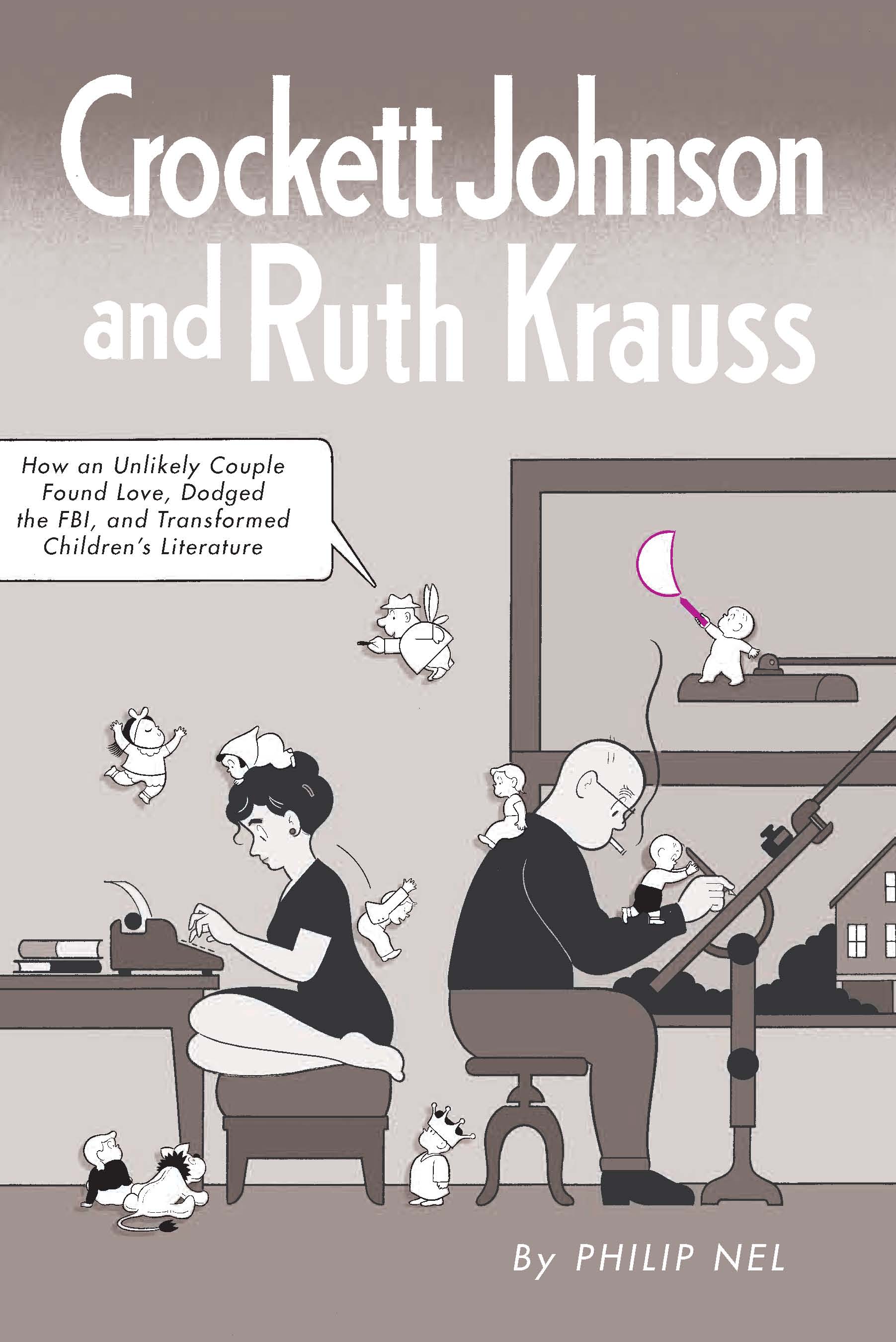
Front cover by Chris Ware for: Crockett Johnson and Ruth Krauss: How an Unlikely Couple Found Love, Dodged the FBI, and Transformed Children's Literature (forthcoming from UP Mississippi, Sept. 2012)When I started writing what was then a biography of Crockett Johnson (back in the late 1990s), I thought: When I finish this, I really will have achieved something. Even as I wrote other books, I continued to think of the biography — which became a double biography of Johnson and Krauss — as The Big Achievement. Sure, Dr. Seuss: American Icon (my third book, published 2004) was OK, and, yes, the media attention it received was certainly flattering. But the biography would be the Truly Important Work.

So, you might (or might not) be asking: (1) Why make this distinction between the biography and my other work? (2) Do I still make this distinction? (3) And, now that the biography is published, does it feel as “Truly Important” as I thought it would?

1. Why make this distinction?

The degree of original research required far surpassed that needed for my other books. I interviewed over 80 people, investigated over three dozen archives and special collections, read everything written by or about Crockett Johnson and Ruth Krauss, and consulted additional hundreds of articles and books. I looked at birth certificates, marriage certificates, census data, property deeds, wills, century-old insurance company maps, and Johnson’s FBI file. If I hadn’t gathered (some of) this information, it would be lost forever. Coping with the mortality of one’s sources is a big challenge for the biographer. Maurice Sendak, Remy Charlip, Syd Hoff, Mischa Richter, Else Frank (Johnson’s sister), Mary Elting Folsom (author who knew Johnson in the 1930s), Gene Searchinger (filmmaker who knew them both), and so many others taught me much about Johnson and Krauss. They have since passed away. If I hadn’t recorded their stories, that information would be gone.

The biography has been more challenging than any other project I’ve tackled, bar none. As I’ve observed before (probably on this blog, and certainly in the talk I gave last month at the New York Public Library), a biography is a jigsaw puzzle, but this puzzle has no box, missing pieces, and no sense of how many pieces you’ll need. There are also the challenges of creating character, knowing which details to omit, and finding a narrative structure. Life has no narrative, but biography has to have a narrative. I have no training in creative writing, but — for this book — I had to try to think like a creative writer.

In sum, there are reasons that a biography takes so long to write….

2. Do I still make this distinction?

Dr. Seuss: American IconSort of. The distinction reflects a tendency to devalue the discipline in which I was trained — the sense that Dr. Seuss: American Icon, though it does draw on considerable original research, is ultimately “just interpreting texts.” In contrast, rigorous historical research, actually uncovering new information, is much more important work. But I say “sort of” because of course there are truly insightful ways of interpreting texts, illuminating formal strategies, transformative critical approaches — Robin Bernstein’s Racial Innocence is one such book. It’s a paradigm-shifter. As I’ve noted before, I don’t have the kind of mind that writes a paradigm-shifting book.

My strength is that I work hard. A biography plays to that particular strength — and perhaps this is one reason that it interests me. It interests me for other reasons, too (the “detective work” part, for example). But it is one intellectual arena where I can do something well: work really hard. Superior intelligence may elude me, but I can put in the hours! So, in some ways I still make the distinction (the amount of research, the box-less puzzle, etc.), but in other ways I do not.

3. Now that it’s published, does it feel like such a Big Achievement?

The response (mostly positive) has been a good feeling. In addition to nice reviews from Anita Silvey, Roger Sutton, Maria Tatar, Kirkus, and the Wall Street Journal, other Notable People Whose Work I Admire have been very complimentary. With apologies for the name-dropping, those people include Chris Ware (who also created the beautiful cover), Dan Clowes, Mark Newgarden, Paul Karasik, Lane Smith, Susan Hirschman, George Nicholson, and Michael Patrick Hearn. Given that Maurice Sendak even responded positively to an early, detail-clogged, incomplete draft, it is of course possible that these folks are simply being kind, and forgiving the book’s many infelicities (as I expect Maurice was). But I’m accepting their kind assessments as genuine because, well, it makes me happy to do so!

That said, as I’ve documented on this blog, the editing process was not entirely harmonious. Some cuts were good ones; others were not. My copy-editor was an historian by training; I needed a writer of fiction. My changes to her edits resulted in some errors, including (as one audience member pointed out at the NYPL last month) a typo in the first sentence. The press refused to change some errors I found in the page proofs (though it did change others). The paperback is priced not at $27, as I had originally been told it would be, but at $40 — this makes it harder to schedule signings because who buys a $40 paperback? These problems make me not want to think about the book at all.

I realize that I should let this go. Publishers introduce errors into manuscripts. Bureaucracies do not always function smoothly. Humans are prone to error, fatigue, and failures of judgment.

Fortunately, despite my irritations, the book does feel like an achievement. Given how long it took to write (I started in 1999), it is thus far my life’s work. It is a big deal.

But there is little time to dwell upon one’s achievements. There are new projects (such as The Complete Barnaby, volume 1 of which is due out early next year), tenure-and-promotion letters to write, letters of recommendation to write, (other people’s) book proposals to review and manuscript to edit, (my) conference abstracts to create and talks to write, planes to catch, meetings to attend, syllabi to revise, syllabi to invent, papers to grade, classes to teach, students to meet. Being an academic is a great job, the work is rewarding, and I feel privileged to do it — even though I rarely have the time to notice those rewards or recognize that privilege. It’s one of the paradoxes of being a professor.

Comments (5)

Crockett Johnson and Ruth Krauss: a mix

Front cover by Chris Ware for: Crockett Johnson and Ruth Krauss: How an Unlikely Couple Found Love, Dodged the FBI, and Transformed Children's Literature (forthcoming from UP Mississippi, Sept. 2012)Here is a mix to celebrate the publication of my new biography, Crockett Johnson and Ruth Krauss: How an Unlikely Couple Found Loved, Dodged the FBI, and Transformed Children’s Literature (2012).  Its official publication date is today (Sept. 1st), though it’s actually been available for a few weeks now. Given my own interest in music, it’s curious that I know relatively little about the musical tastes of Johnson and Krauss. So, while this mix does include some music they liked, it’s organized more by themes — each of which can be explored more fully in my book.

1)     Take the “A” Train  Duke Ellington (1941)      2:56

Crockett Johnson listened to Duke Ellington, and so did Mr. O’Malley. In response to a strip in which Barnaby’s Fairy Godfather enjoys an Ellington record, the composer himself wrote to PM (the newspaper where Barnaby first appeared) to express his admiration for the strip. Johnson owned the LP set The Duke.

2)     The 59th Street Bridge Song (Feelin’ Groovy)  Simon & Garfunkel (1966)            1:43

Johnson was born in 1906 at 444 East 58th Street, a block south of where the 59th Street Bridge was under construction. Though this song (like many on this mix) was released long after his childhood, Simon’s lyric makes me think of the imaginative, dreaming boy who became Crockett Johnson.

3)     Baltimore Fire  Charlie Poole (1929)      3:12

In February 1904, the Great Baltimore Fire destroyed more than 1500 buildings in the city’s downtown business district. Ruth (who turned 3 that year) and her family were far enough north to escape the flames, but memories of the blaze stayed with her. She had a life-long fear of house fires, and kept her manuscripts in the freezer (as a precaution).

4)     Violin  They Might Be Giants (2002)      2:27

When she was growing up, Krauss played the violin. She was a creative player, but not exactly an accomplished one. Her avant-garde poetry (from later in her career) makes me think that she might have enjoyed this song’s Dadaist sense of humor.

5)     If I Had a Boat  Lyle Lovett (1987)      3:09

The sense of humor and associative logic of “If I Had a Boat” might also appeal to Krauss; the other reason for its inclusion is Johnson’s love of sailing.

6)     I Sing I Swim  Seabear (2007)      3:40

Krauss enjoyed swimming. Johnson sometimes joined her. The bio. includes a photo of the two of them, in bathing suits, on a beach — perhaps just before a swim?

7)     Did You See Jackie Robinson Hit That Ball?  Buddy Johnson (1952)      2:18

Both Ruth and Dave (Johnson’s given name, and the one his friends used) supported civil rights for African-Americans. Johnson, a sports fan, joined the End Jim Crow in Baseball Committee in 1945. In 1947, Jackie Robinson joined the Brooklyn Dodgers, becoming the first black player in the American Major Leagues.

8)     A Cup of Coffee and a Cigarette  Jerry Irby (1947); intro. by Bob Dylan (2006)            3:26

Both Ruth and Dave drank coffee, and he smoked.

9)     Coffee in the Morning (Kisses in the Night)  The Boswell Sisters (1933)            2:57

He probably needed the coffee a bit more than she did: he was nocturnal, often working until sunrise, going to bed, and then getting up for breakfast at lunchtime.

“The Midnight Special” and other Southern Prison Songs, performed by Leadbelly and the Golden Gate Jubilee Quartet10)  The Midnight Special  Leadbelly and The Golden Gate Jubilee Quartet (1940)      3:08

Johnson and Krauss had the LP set, “The Midnight Special” and other Southern Prison Songs, performed by Leadbelly and the Golden Gate Jubilee Quartet.

11)  Talking Union  The Almanac Singers (1941)      3:06

An active supporter of labor unions, Johnson would likely have known this song.

12)  The House I Live In  The Ravens (1949)      3:04

An anthem of the Popular Front (and a hit single for Frank Sinatra in 1945), “The House I Live In” was certainly known by Johnson and Krauss. It was written by Earl Robinson and Lewis Allan (pseudonym of Abel Meeropol) — Meeropol/Allen was a leftist better remembered today for writing the anti-lynching song, “Strange Fruit,” which Billie Holiday began performing (and first recorded) in 1939. Though I have found no evidence of it, I would not be surprised if Johnson knew Meeropol: they shared a political outlook, and moved in some of the same New York circles.

13)  Homegrown Tomatoes  Guy Clark (1983)      2:59

Barnaby isn’t the only one who had a Victory Garden. Johnson did, too. After moving to Connecticut in the early 1940s, he enjoyed gardening. By the 1950s he began to favor other pursuits.

14)  Mr. O’Malley and Barnaby  Frank Morgan & Norma Jean Nilsson (1945)            0:07

This, the first of several adaptations of Barnaby, appeared on the 12 June 1945 Frank Morgan Show.

The Carrot Seed (art by Crockett Johnson)15)  The Carrot Seed  Norman Rose (1950)      5:36

The classic adaptation of Ruth Krauss’s 1945 picture book (with art and design by Crockett Johnson).

16)  You Be You and I’ll Be Me  The Free Design (1969)      2:42

The Free Design’s song title seems too close to Ruth Krauss and Maurice Sendak’s I’ll Be You and You Be Me (1954) to be a coincidence, but it of course may well be just that.

17)  What a Dog / He’s a Tramp  Peggy Lee & Oliver Wallace (1955)      2:25

Johnson loved his dogs, and was quite content to let them be their doggy selves.

18) Dog  Bob Dorough (1966)      3:27

19) Onomatopoeia  Todd Rundgren (1978)      1:35

Krauss had a great ear for the sound of words, something you see (and hear) both in her books based on the spontaneous utterances of children and in her later verse.

Crockett Johnson, Merry Go Round (1958)20)  Carousel (La valse à mille temps)  Elly Stone, Wolfgang Knittel (1968)            3:30

Johnson and Krauss owned the LP Jacques Brel Is Alive and Well and Living in Paris, on which this song appears. I expect it was more her choice than his. I’ve also included the song in tribute to Johnson’s least-known (and most experimental) book, Merry Go Round.

21)  Get Happy  Art Tatum (1940)      2:46

Mr. O’Malley wasn’t the only one who enjoyed boogie-woogie piano. Johnson liked it, too. He owned the LP Decca Presents Art Tatum, which includes this song.  ”Happy” also has a nice resonance with The Happy Day (1949), Krauss’s collaboration with Marc Simont.

22)  Comic Strip  Serge Gainsbourg (1968)      2:12

I don’t have a recording of “Mr. O’Malley’s March,” and so instead here is a playful tribute to the comic strip medium.

23)  Pies for the Public  Zoë Lewis (1998)      4:57

“So he laid out a nice simple picnic lunch. There was nothing but pie. But there were all nine kinds of pie that Harold liked best.”

24)  The Books I Like to Read  Frances England (2006)      2:13

This tribute to picture books begins with Where the Wild Things Are (written by Johnson and Krauss’s friend) and name-checks Harold and the Purple Crayon.

Carole King, Really Rosie (art by Maurice Sendak)25)  Alligators All Around  Carole King (1975)      1:54

In recognition of how important Maurice Sendak is to the biography, here is a song based on his book of the same name.

26)  Wake Up (Where The Wild Things Are version)  Arcade Fire (2009)      1:39

It’s impossible to stress enough Maurice’s role in this — both in their lives, and in mine. I wish I could thank him once more.

27)  Neverending Math Equation  Sun Kil Moon (2005)      2:53

During the last decade of his life, Johnson painted tributes to great mathematical theorems and even worked out a couple theorems of his own.

28)  Garden of Your Mind  melodysheep feat. Mr. Rogers (2011)      3:07

The works of Johnson and Krauss inspire us to think and to imagine.

Comments (2)

Crockett Johnson and Ruth Krauss: Chris Ware’s cover

Front cover by Chris Ware for: Crockett Johnson and Ruth Krauss: How an Unlikely Couple Found Love, Dodged the FBI, and Transformed Children's Literature (forthcoming from UP Mississippi, Sept. 2012)

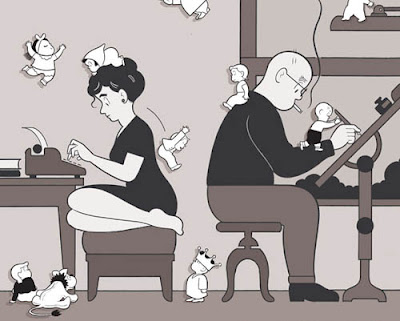
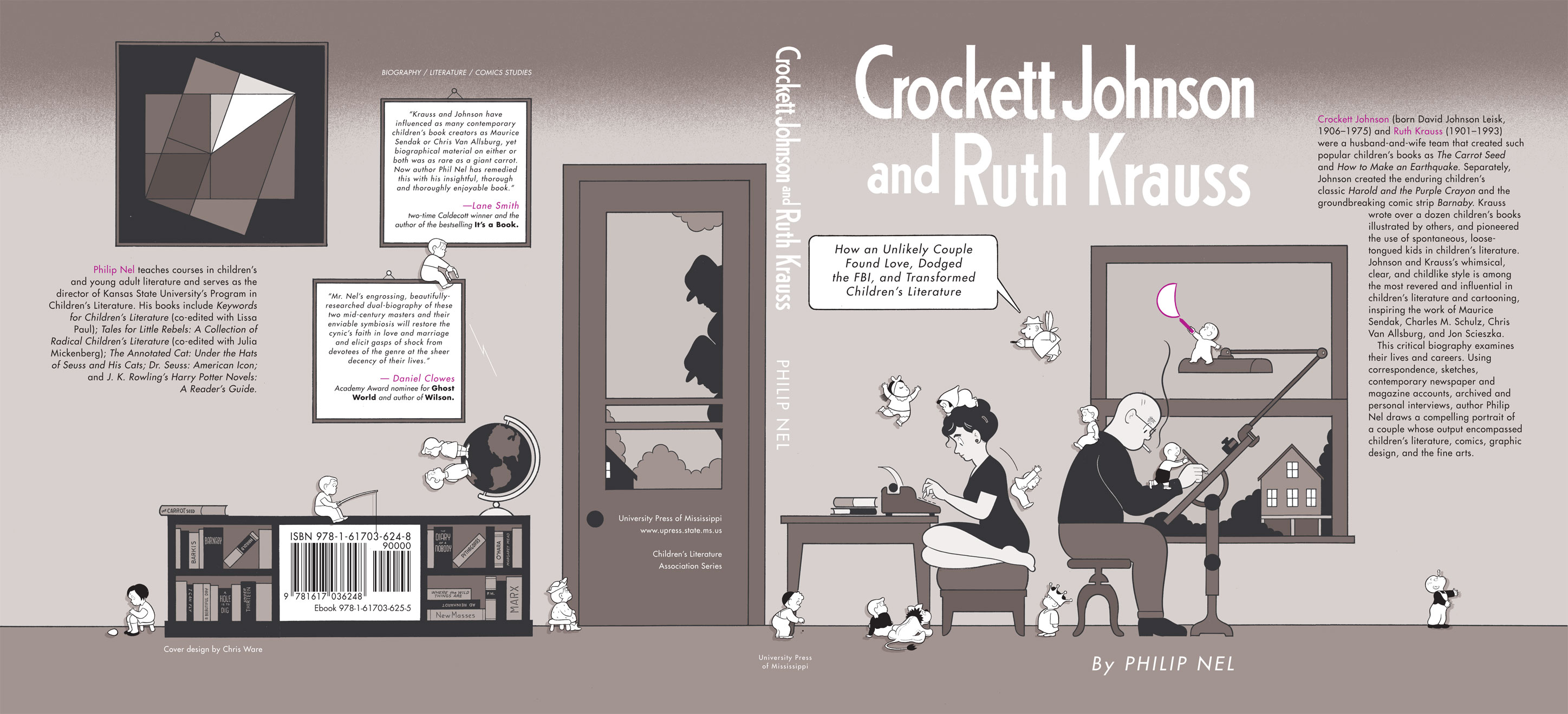
Graphic genius Chris Ware designed the cover for my Crockett Johnson and Ruth Krauss: How an Unlikely Couple Found Love, Dodged the FBI, and Transformed Children’s Literature (due this September from the University Press of Mississippi). The front cover is above.  The full, wrap-around cover is below.  Click on it for a larger image.  Trust me: you’ll really want to see all of the detail.  It’s beautiful.  It’s perfect.  I’ve never been happier about one of my book covers.  And for those keeping count, there are six previous books (two co-edited), all of which have striking covers.  The other designers were no slouches.

But Chris Ware is a genius. And no, I am not overusing that word.  But, yes, perhaps we should add a few more words to describe the cover itself. Clever. Detailed. Vivid. Art.

Full, wrap-around cover by Chris Ware for: Crockett Johnson and Ruth Krauss: How an Unlikely Couple Found Love, Dodged the FBI, and Transformed Children's Literature (forthcoming from UP Mississippi, Sept. 2012)

He’s done the cover in the style of Crockett Johnson.  In the case of the girl dancing above Krauss’s typewriter, it’s Mary Blair filtered through a Crockett Johnson aesthetic; for the boy sliding own her back, it’s Maurice Sendak filtered through Johnson. (The girl is from Krauss‘s I Can Fly, illustrated by Blair; the boy is from her A Hole is to Dig, illustrated by Sendak.)  Finally, Ware transforms all of these styles into something uniquely his own.

Fans of Johnson and Krauss: Are you getting all of the references here?  Would you like some help?  I could fully annotate this cover, but I wonder if that would detract from the pleasure of exploring it yourself.  The academic in me wants to proceed with the annotations, but the art lover wants to stay silent, so that your eyes can linger on Ware’s art, looking slowly, experiencing it on its own terms.  And… the art lover wins.  (No annotations.)  Enjoy!

And: Thank you, Chris Ware!

Comments (14)

Research, Writing, and Getting a Life

Edmund de Waal, The Hare with Amber EyesOne of the many pleasures of Edmund de Waal’s The Hare with Amber Eyes: A Hidden Inheritance (2010) is its evocation of the thrill of research. As he traces the history of his family’s netsuke (small Japanese ivory and wood carvings), de Waal describes great-great-great grandfather Charles Ephrussi’s art-collecting in nineteenth-century Paris as “‘vagabonding’ … done with real intensity”:

Vagabonding was his word. It sounds recreational rather than diligent or professional…. But it does get the pleasure of the searching right, the way you lose your sense of time when you are researching, are pulled on by whims as much as by intent. It makes me think of the rummaging that I am doing through his life as I track the netsuke, the noting of other people’s annotations in the margins. I vagabond in libraries, trace where he went and why. I follow the leads of whom he knew, whom he wrote about, whose pictures he bought. In Paris I go and stand outside his old offices in the rue Favart in the summer rain like some sad art-historical gumshoe and wait to see who comes out. (72-73)

That’s exactly right. Writing a biography — or, truly, intense research of any kind — is detective work. It’s extremely absorbing, getting a lead, following it to a new source, finding connections between lives and ideas. You are on a quest, and you must keep going until you finish!

New York Times Magazine, 15 April 2012But dedication to the quest also takes its toll. As Charles McGrath reports in today’s New York Times Magazine profile of master biographer Robert Caro, researching and writing the third volume of The Years of Lyndon Johnson had taken so long that Caro and his wife went broke. She sold their Long Island home, found them a cheaper apartment in the Bronx, and got a teaching job to help pay the bills. The biographer — obsessive, driven, seeking every last detail — often depends upon a patient, supportive spouse. It’s no coincidence that my forthcoming biography, Crockett Johnson and Ruth Krauss: How an Unlikely Couple Found Love, Dodged the FBI, and Transformed Children’s Literature, is dedicated to Karin. Who else but one’s partner would put up with such fanatical devotion to a book?

This process recalls a line in a recent Times Higher Education piece on academics: “the idealised academic has no ties or responsibilities to limit their capacity to work.” This is equally true of the biographer. For both the professor and the biographer, there is no boundary between life and work. Your life is your work and your work is your life. Or, in the case of the biographer, your work is someone else’s life.

I’m not arguing that one’s work should be all-consuming, though I would note that Caro’s work on LBJ and Edmund de Waal’s absorbing family history are both excellent because each writer is so very thorough, obsessive, and meticulous — in both the research and the writing. McGrath notes that Caro and his editor Robert Gottlieb “argue about length, but they also argue about prose, even about punctuation.”  As Gottlieb says,

You know that insane old expression, “The quality of his defect is the defect of his quality,” or something like that? That’s really true of Bob [Caro]. What makes him such a genius of research and reliability is that everything is of exactly the same importance to him. The smallest thing is as consequential as the biggest. A semicolon matters as much as, I don’t know, whether Johnson was gay.

Beyond providing a helpful context for my own battles with Walter (my editor for the bio), this explains my own process to me. It’s not just about perfectionism. It’s about getting it right. And everything matters: Structure, word choice, punctuation, which detail gets retained and which one gets cut.

Caro had to cut 350,000 words from The Power Broker: Robert Moses and the Fall of New York. He tells McGrath sadly, “There were things cut out of ‘The Power Broker’ that should not have been cut out,” and then shows him “his personal copy of the book, dog-eared and broken-backed, filled with underlining and corrections written in between the lines. Caro is a little like Balzac, who kept fussing over his books even after they were published.” It would be an understatement to say I can relate to that. Though I had to cut far fewer words from my biography of Crockett Johnson and Ruth Krauss, there were things cut that should not have been cut. And I’ve seriously thought of marking up a published copy (due this September) to fix those omissions, or infelicitous changes in phrasing introduced during the copyediting (the copyeditor was unusually fond of passive voice). In looking at the proofs, I thought: Why did I allow the excision of Johnson’s favorite book, George and Weedon Grossmith’s The Diary of a Nobody?  My main reason was (and is) the fact that I can include it — and its satirical style’s influence on Johnson — in one of the afterwords for the 5-volume The Complete Barnaby. It’s hard to let this go, and I’m fortunate to have the luxury to hang on a bit longer. As de Waal writes near the end of his book, he has the feeling that he should “Just go home and leave these stories be. But leaving be is hard” (346).

Most of all, when reading Caro or de Waal, I think: my God, I wish I could write like them! I’m not in their league. Indeed, my league couldn’t find their league on a map. Describing the motorcade in Dallas on 22 November 1963, Caro writes,

Lyndon Johnson was far enough behind the Presidential limousine that the cheering for the Kennedys and the Connallys — for John Connally, some of it, for his onetime assistant, who had become his rival in Texas — was dying down by the time his car passed, and most of the faces in the crowd were still turned to follow the Presidential car as it drove away from them. So that, as Lyndon Johnson’s car made its slow way down the canyon, what lay ahead of him in that motorcade could, in a way, have been seen by someone observing his life as a foretaste of what might lie ahead if he remained Vice-President: five years of trailing behind another man, humiliated, almost ignored, and powerless.  The Vice-Presidency, “filled with trips . . . chauffeurs, men saluting, people clapping . . . in the end it is nothing,” as he later put it. (“The Transition,” The New Yorker, 2 Apr. 2012, 35-36)

Masterful.  I favor tighter sentences myself, but his epic style works well with his subject. We readers know that, in a few moments, President Kennedy will be assassinated; later that day, LBJ will become president. And Caro knows we know. So, he allows our knowledge to inform the scene, and instead focuses on creating Johnson’s (likely) experience at that moment — enduring the relative powerlessness of the Vice-Presidency.

De Waal writes lyrically and with great insight into what it means to be human. Early in the book, he observes, “Melancholy, I think, is a sort of default vagueness, a get-out clause, a smothering lack of focus. And this netsuke is a small, tough explosion of exactitude. It deserves this kind of exactitude in return” (16).  Later, he considers his great grandparents, in Vienna, in the early 19-teens.  The “more assimilated Jews [the great grandparents] worry about these newcomers,” he writes: “their speech and dress and customs are not aligned to the Bildung of the Viennese. There is anxiety that they will impede assimilation.” At the end of this paragraph, de Waal concludes, “Maybe, I think, this is anxiety from the recently arrived towards the very newly arrived.  They are still in transit” (188). Describing his grandmother’s decision to burn letters from her mother (in part, he suggests, because they may mention the great-grandmother’s lovers), de Waal confesses, “There is something about burning all of those letters that gives me pause: why should everything be made clear and brought into the light? Why keep things, archive your intimacies? … Just because you have it does not mean you have to pass it on. Losing things can sometimes gain a space in which to live” (347).

This is the big conundrum of the researcher. To throw out or to keep? I tend towards the latter. (If I throw it out, I might need it later.) But de Waal is right: being encumbered by research (books, articles, photocopies from archives, etc.) grants one little space to live. Further, the time required to sustain research affords little time to winnow out and throw out. It’s hard to manage your archives and move forward with the next project — to say nothing of grading, teaching, editing, committee work, or, say, having a life.

So we keep things. However, as Robin Bernstein observes in her Racial Innocence: Performing American Childhood from Slavery to Civil Rights (2011), things are bearers of stories.  And, as de Waal notes, “It is not just that things carry stories with them. Stories are a kind of thing, too” (349).

They are. And they’ve been on my mind because — for any of my readers who may be in or near Manhattan Kansas next week — I’m giving a talk on this very subject, at 4pm, Tuesday, April 24, in the K-Sate Student Union’s Little Theatre.  The title is “Collaborating with the FBI, Reading Other People’s Mail and Taking Children’s Literature Seriously: Tales from Writing the Biography of Crockett Johnson and Ruth Krauss.” Free and open to the public. My talk will run about half an hour. There’ll be lots of stories.

Comments (1)

That’s Not in the Book, You Know: The Absolutely, Positively, Possibly Final Post Concerning the Editing of the Biography of Crockett Johnson and Krauss

Crockett Johnson, "How to write a book," illus. from Ruth Krauss's How to Make an EarthquakeThe index and (now proofread!) page proofs for Crockett Johnson and Ruth Krauss: How an Unlikely Couple Found Love, Dodged the FBI, and Transformed Children’s Literature (forthcoming this September) are in the mail, heading back to the publisher.  To commemorate this occasion, here are yet more cuts and a few other changes — most of which I’m fine with, but others of which inspire more mixed feelings.

First, some cuts!  I started sketching categories for the index long before the book went into copy-editing phases; as a result, there were names in my draft of the index that no longer appear in the biography.  Here are some of those names and the cuts that prompted their omission.

Abrashkin, Ray

A reference to the co-creator of the Danny Dunn series got relegated to a footnote, then cut altogether.  Here’s the footnote version:

Ruth [Krauss] seems to have adapted her book herself: a draft of the lyrics, in her hand, appears on the back of some notes and sketches for Is This You?  That said, the Children’s Record Guild’s archives have an unsigned contract that credits Ray Abrashkin for writing the record.  Perhaps they collaborated?

I now believe that Krauss wrote the lyrics, though I wouldn’t completely rule out input from Abrashkin. One result of this omission is that the image of The Carrot Seed record now appears … nowhere near the place it’s mentioned in the book.  Originally, the record appeared twice in the text, once at the time it was released, and once when W.D. Snodgrass cited it in his essay on the poet’s tact.  The latter reference remains, but the earlier one (where the record’s image appears) has gone.  (For more about the Children’s Record Guild, check out David Bonner’s Revolutionizing Children’s Records.  Bonner, incidentally, is my source for that unsigned contract.)

Capote, Truman,

When it went into copyediting, the bio. also included this short paragraph (the “Marc” is Marc Simont, who illustrated four of Krauss’s books):

Ruth and Dave also saw Marc socially.  He recalled accompanying them to “a party in Greenwich Village, where a group of young men were doing a farewell party for Truman Capote.”  They had prepared “big signs saying ‘Ciao,’” suggesting that the party was in February 1949, when Capote was leaving for Italy.  But Capote didn’t show up.

If Capote had shown up, this would have been worth including.  He didn’t.  So, cutting this makes sense.

Diary of a Nobody, The,

One of Johnson’s favorite books.  Since I can work this into one of the Complete Barnaby afterwords, I agreed to omit it from the bio.  If I hadn’t had the Barnaby option, then I would have certainly argued that it remain — a writer’s favorite book should be included in the biography of that writer.

Ernst, Max,

Surrealist and father of Jimmy Ernst, who is in the book, as is Jimmy’s spouse, Dallas Ernst.

Flaxer, Abram,

Flaxer was a union organizer and the second husband of Crockett Johnson’s first wife.

Grossmith, George,

Grossmith, Weedon,

The co-authors of The Diary of a Nobody (see above).

Hirschfeld, Al,

In a draft from early May 2011, I still had a reference to Al Hirschfeld, but that disappeared prior to copy-editing phase.  The context was Johnson’s early New Masses cartoons (1934-1935):

            Stylistically, Johnson has not yet arrived at the Otto Soglow-esque minimalism for which he is famous. Although the detail is less abundant and the lines more fluid than his earliest work, these lines display more dramatic variations in thickness — beginning thin at an end, and then inflating to show the shadow of an elbow or to accentuate the nape of the neck, before slimming back down to a point. Unlike Crockett Johnson’s characteristic style, these lines often do not close, instead just suggesting the boundaries of a figure. The faces of those whom he satirizes even include elements of caricature. These features bring his early cartoons nearer to that of his contemporary Al Hirschfeld. Johnson lacks Hirschfeld’s delight in rendering minutiae, and uses a lesser degree of exaggeration, but there is an edge that softens in Johnson’s later, characteristic style — a style which would emerge in just a few years, and which he would not alter for the rest of his career.

No trace of this paragraph remains.

Johnson, Lyndon Baines,

The original paragraph provided a little more context for petitions Johnson and Krauss signed:

Before traveling abroad, Dave and Ruth began speaking out at home. Though they likely voted for President Johnson in 1964 (or, certainly, against Senator Barry Goldwater), Dave and Ruth started opposing Johnson’s foreign policy before his new term began. After the North Vietnamese’s alleged attack (which in fact never occurred) in the Gulf of Tonkin, the August 1964 Gulf of Tonkin Resolution gave the president carte blanche to escalate the Vietnam War.  Though the vast majority of Americans supported this, Dave and Ruth did not. In late December 1964 or early January 1965, Dave was among the 75 national initiating sponsors of the Assembly of Men and Women in the Arts, Concerned with Vietnam.  Joining him were old friends Kay Boyle, Antonio Frasconi, and Ad Reinhardt; New Masses-era colleagues Maurice Becker and Rockwell Kent; and Ray Bradbury, Lawrence Ferlinghetti, Allen Ginsburg, E. Y. Harburg, and Tillie Olsen.

Courtesy of the copy-editor (who, as I say, was charged with doing a lot of actual editing), the final version reads like this:

Before departing, however, they began speaking out against the Vietnam War, which had begun to escalate with the passage of the Gulf of Tonkin Resolution in August. In late December 1964 or early January 1965, Johnson was among the seventy-five national initiating sponsors of the Assembly of Men and Women in the Arts, Concerned with Vietnam.  Joining him were old friends Kay Boyle, Antonio Frasconi, and Ad Reinhardt; New Masses-era colleagues Maurice Becker and Rockwell Kent; and Ray Bradbury, Lawrence Ferlinghetti, Allen Ginsburg, E. Y. Harburg, and Tillie Olsen.

In retrospect, I wish I’d pushed back more on this one — and I encountered several such moments in the page proofs.  However, the copyedited text arrived with a quick deadline when I was already very, very busy.  I did my best, but had I more time to consider, I suspect I would have resisted a bit more.  Ah, well.  The copyeditor did make many improvements to the text.  At the page proofs phase, I of course notice only the changes that I dislike.  And I’ve changed some of those in the proofs phase — but only the critical ones, since changes at this stage require more labor from the press.

The Secret Life of Walter Mitty (1947): movie posterKaye, Danny,

Reviewers compared Ruth Krauss’s The Great Duffy (1946, illustrated by Mischa Richter) to James Thurber’s The Secret Life of Walter Mitty, which was adapted into a film starring Danny Kaye.  The Mitty film (1947), I had written, may be one reason why Krauss’s film treatment of her own The Great Duffy didn’t get picked up.  But that’s purely speculative.  Mention of her film treatment remains, but the Mitty movie has departed.

Kenny’s Window,

The first book written and illustrated by Maurice Sendak.  Introducing the reviews of Ruth Krauss’s I Want to Paint My Bathroom Blue (which he illustrated and which was published the same year), I had the following sentence: “Much praise went to Sendak, whose first picture book, Kenny’s Window (1956), won an honor award from the New York Herald Tribune Book festival that spring.”  That’s gone, and so is the need for this reference in the index.

Leask, Alexander,

A reference to an ancestor of David Johnson Leisk (Crockett Johnson).  I originally had a whole paragraph on this guy.  That got condensed to a passing reference here (David Sr. is Crockett Johnson’s father, and this scene takes place in the 19-teens):

At home, while the nieces played piano, David Sr. sang along, carrying the bass part on tunes like “Mother McCree” and “My Bonnie Lies Over the Ocean.”  The latter is a Scottish song allegedly composed by supporters of Charles Edward Stuart (“Bonnie Prince Charlie”) — the son of James Edward Stuart, whom Dave’s ancestor Alexander Leask supported two hundred years earlier

The first sentence remains in the book; the second sentence has been cut.  So, in this case, we’ve gone from a paragraph to a sentence fragment to… nothing!

A lot of family members have (wisely) been cut:

Leask, Arthur (CJ’s great-great grandfather),

Leask, Christina (CJ’s aunt),

Leask, John (CJ’s uncle),

Leask, Robert (CJ’s uncle),

Leask, Thomas (CJ’s uncle),

Leask, Thomas James (CJ’s great grandfather),

Leask, William (CJ’s distant ancestor),

Leisk, Ella (CJ’s cousin),

I was able to assemble quite a thorough genealogy of Crockett Johnson, but how interesting is this?  To me, very.  To others, not as much.  So, it’s gone.

Masses, The,

Art Young was a mainstay of The Masses, but also contributed to New Masses while Johnson was editor.  Young is still in the book, but the reference to his earlier career has left.

McCrea, Joel,

In a discussion of a 1948 Barnaby narrative, I’d invoked the great Preston Sturges film Sullivan’s Travels (1941, starring Joel McCrea) as a point of comparison.  The entire paragraph is gone, but a version of it will return in The Complete Barnaby, Vol. 4: 1948-1949.

Mencken, H. L.,

I’m completely fine with this cut.  Krauss studied violin at the Peabody Conservatory of Music — Mencken was a frequent visitor at the time.  Himself a pianist, he was also friends with Gustav Strube, Peabody teacher (and conductor of the newly established Baltimore Symphony).  And he knew some of Krauss’s teachers at Peabody, too.  This deserved to be cut because the connection to Krauss is far too tenuous: sure, she likely attended the same symphony concerts as Mencken, and may have been aware of his Peabody connections.  But these connections are not sufficient to keep Mr. Mencken in.

I Led 3 Lives (advert for TV program)Philbrick, Herbert,

I had a very brief reference to Mr. Philbrick (itself condensed from an even longer mention).  It appeared in the context of the FBI’s monitoring of Johnson:

As Herbert Philbrick notes in his memoir, I Led Three Lives (the basis for the Emmy-nominated TV series, 1953-1956), being a successful informant requires convincing the Communists of one’s loyalty: obvious visits from federal agents would give the game away.

Is it necessary?  No.  And so, it’s gone.

Psychoanalyst and the Artist, The,

Book by Daniel E. Schneider, Ruth Krauss’s psychoanalyst — the biography still includes a brief quotation from the book, but its title is now relegated to a citation.

Schwed, Peter,

Johnson was friends with Fred Schwed, Peter’s brother.  But Peter — a Simon & Schuster editor — appeared in the context of his fellow Simon & Schuster editor Jack Goodman.  Goodman & Fred Schwed remain in the book, but Peter’s gone.  Incidentally, Fred Schwed is author of the classic satirical look at Wall Street, Where Are the Customers’ Yachts? (1940, repub. 1955).

Searchinger, Marian,

Spouse of documentary filmmaker Gene Searchinger.  The Searchingers went on a vacation with Johnson and Krauss in the early 1950s, but that trip got cut.  Gene Searchinger is still in the book, though.  A number of his conversations with Johnson were quite illuminating.  I was saddened to discover, a few months ago, that Mr. Searchinger passed away in 2009.  I really enjoyed talking with him, and I think he would have enjoyed the biography.

Zigrosser, Carl,

In 1938, New Masses was planning an art supplement, thinking that such a feature might draw in more readers.  Johnson and contributing editor Herman Michelson went to the Weyhe Gallery to talk to Carl Zigrosser about this.  This entire paragraph has been cut.  Incidentally, someone looking for a project should consider publishing either all of or simply extracts from Zigrosser’s diaries.  I read them on microfilm in the Smithosnian’s Archives of American Art.  Meticulous, and fascinating.  Zigrosser knew everyone.

Zindel, Paul,

Ruth Krauss and Crockett Johnson went to parties thrown by Willard Maas and Marie Menken. So did Andy Warhol and Paul Zindel.  Warhol’s still in the book, but the copy-editor cut Zindel.  I let it stand, but now doubt that decision.


The changes that inspire the most mixed feelings are stylistic.  The copy-editor — who was also charged with editing the manuscript — made many helpful changes, which were valuable (and necessary) for reigning in my large manuscript.  Indeed, you can see many of the good changes in the list above, and in previous posts on this process.  In the copy-editing phase, I pushed back against some suggestions, and let others stand.  As noted above, the copy-edited manuscript arrived with a quick deadline when I lacked time to go through it with the degree of specificity I’d have preferred.  I did my best, but while reading the proofs I noticed some changes I wish I’d caught. I was able to correct some of them, but others had to remain.  With apologies to the copy-editor, these are some of the copy-editor’s changes that most rankled:

  1. Adding passive voice.  I suspect that this may from the copy-editor’s training in history, although I cannot say for certain.  I use passive only very rarely.  I restored most of my active voice, but sometimes let passive sentences stand.  In the proofs, I caught a number of instances in which traces of both sentences were there.  When I caught them, I crossed out the passive verb so that the text made sense.  I suspect, though, that I may have missed some.
  2. Making my sentences needlessly long.  I suspect that this, too, may derive from the copy-editor’s training in history — but I’m not sure.  My response may simply derive from the fact that I resist this trait common to an academic style. I dislike long, twisty academic sentences, and so I try to avoid them whenever I can.
  3. Making my paragraphs needlessly long.  I really want the book to have paragraphs of manageable length.
  4. Cramming all the dialogue together in a single paragraph instead of treating it as dialogue. Where possible, I’ve separated conversations out again.
  5. Cutting dialogue all together.  Dialogue helps create character.  Some of the conversations were clearly not neccessary.  But others,… I’m not so sure.  For example, I wish I’d retained more of Krauss’s last conversation with Sendak.

If I could have had a novelist (instead of an historian) as my copy-editor, that would have been ideal: I want this to read more like a novel, and less like a history. But, of course, I focus here on the changes that rankle because I forget the many (many!) beneficial changes instituted by the copy editor — who, let me repeat, made some very helpful suggestions.  I also focus on these things because I’ve been working on this book for over a dozen years, and (given that massive investment of time and energy) I want it to be the best that it can be. In sum, I focus on these things because I’m a perfectionist and thus have a hard time letting things go!

Crockett Johnson, "Fun at the Post Office" (from Ruth Krauss, How to Make an Earthquake)Anyway. Enough obsessing. It’s done. As I mentioned at the top, the marked-up page proofs and the index are on their way back to the publisher. And the biography will be out in the fall!  Even better, you won’t have to read yet another blog post in which I discuss writing the biography.  Probably.


Far, far too many posts on this blog relate to the writing of this biography.  Believe it or not, the list below does not even contain all such posts.  So, depending on your tolerance for tedium, you might proceed at your own risk here:

Posts tagged Crockett JohnsonRuth Krauss, or Biography may also be of interest.

Comments (2)

The Joy of Index

Crockett Johnson, "How to write a book," illus. from Ruth Krauss's How to Make an EarthquakeOK, “Joy” might be the wrong word — unless we modify that title to “The Anticipatory Joy of Finishing the Index” or “The Joy of Finding a Great Index.”  Creating an index can be a mind-numbing slog, and creating it while checking proofs (as I am doing right now) doesn’t make it any more fun.  But the index is also the most important part of any book.  It’s one reason that I tend to create my indices myself.  Sure, you can hire an indexer.*  But who knows your book better than you do?

Many people will enter Crockett Johnson and Ruth Krauss: How an Unlikely Couple Found Love, Dodged the FBI, and Transformed Children’s Literature (coming fall 2012) via the index. Sure, I like to flatter myself and imagine that people will read the book from cover to cover.  But many people won’t.  The index is there to guide them.

It’s also there to guide people who have read the book, and are trying to locate something they remember reading.  We’ve all done this: OK, I know the book mentions this, but where does it mention it?

So, my index is very detailed.  For the two central characters (Johnson and Krauss), I’ve even created sub-indices.  I’ve only indexed the manuscript up to page 202, but here’s what they look like right now:

Krauss, Ruth Ida:

aesthetics of, 28, 33, 148, 153, 155

athletics of, 12, 14, 25, 68, 154

anthropology and, 51-54, 58, 63-64, 66, 69, 71, 93-94

anti-racism of, 11, 52, 64, 66, 93-94, 102, 104, 120-121, 162, 182

artistic ability of, 29-31, 124

birth of, 9

celebrity of, 187-188

childhood of, 9-15, 25-27,

childlessness of, 97-98

childlike aspects retained by, 14

death of, 102

dogs owned by, 53, 191-192

education of, 12-15, 26-31

family background of, 9-10

fan mail received by,

finances of, 28, 31, 68, 72, 111, 116, 138-139, 166, 201

friendships of, 28

health of, 11, 13, 51, 143

jobs held by, 28, 31, 39

marriages of, 39-40, 58, 68

meets CJ, 54

as mentor, 7, 124, 179-180, 189, 202

music of, 14, 26-27

narcolepsy of, 58, 100

nicknames of, 25-26

phobias and anxieties of, 12, 99, 101, 159-160

physical appearance, 4, 54, 158

political beliefs of, 11, 52, 64, 69, 79, 88, 93-94, 102, 104, 111, 120-121, 199

pseudonyms used by, 39, 189, 200

psychoanalysis and, 159-160

rapport with children, 84, 97-98, 133, 140, 142, 148, 163

religious background of, 4, 10, 13, 42

residences of, 3, 9-10, 12-14, 28, 31, 38-40, 57, 59

and sex, 31, 158

sexism faced by, 15, 39, 58, 72, 104, 127, 181

as surrogate parent,

travels of, 40-42, 51-52, 95, 187, 202

Krauss, Ruth Ida, works of:

advertising, 111, 165, 193

alternate titles for, 80, 114, 122, 126, 144, 166, 180, 182, 189

anti-racist message in, 162

audience for, 66, 96, 142, 155, 162, 170, 181-183, 188, 194

awards and honors, 111

childhood influences on, 25, 121

children’s language in, 5-6, 26, 109, 117, 122, 126, 130-131, 142, 144, 148, 153-154, 188

creative process, 5-6, 13, 72, 82-85, 98-100, 103, 117, 122, 124, 126, 140, 144, 160, 169-171, 188

editor for, 115

fiction for adults, 39, 96

imagination in, 82, 89, 126, 131

as influence, 6, 165-166, 193

innovation in, 116-117, 122-123, 126-128, 137, 140, 142-143, 153-154, 190

moral themes in, 66-67, 69-70, 93-94, 111-112, 121, 126, 130, 137, 162, 199

plays,

poetry, 38-40, 110, 154, 170, 183, 189-191, 195, 197, 199-201

promotional efforts for, 72

revisions of, 82-85, 95-96

sales of, 80, 127, 130, 138, 166, 170

on stage,

on television,

in translation and foreign editions, 120, 176

unpublished, 69, 71, 90, 93-96, 99, 116, 162-163, 169-170

see also specific works.

Leisk, David Johnson (aka Crockett Johnson):

aesthetics of, 7, 17, 24, 33, 44, 49, 68, 72-73, 149, 177-178, 185-187

athletics of, 24, 33, 46

anti-racism of, 47, 54, 79, 88, 104, 119

artistic ability of, 19

birth of, 16

carpentry of, 102, 143

celebrity of, 72, 96, 187-188

childhood of, 16-24, 189

childlessness of, 98

death of,

dogs owned by, 17, 35, 53, 102-103, 156, 191-192

education of, 17, 23-24

family background of, 16-21

fan mail received by, 71, 129

finances of, 32, 34, 44, 72, 81, 92, 147, 157

health of, 59

humor of, 19, 103, 135, 158, 177

jobs held by, 32-34, 44

manner of speaking, 19

marriages of, 35, 50, 58, 68

and mathematics, 23, 73-75

meets RK, 54

as mentor, 7, 124, 158, 180, 202

nocturnal habits of, 67-68, 73, 101-102, 155

origins of name, 16, 19

physical appearance, 4, 33, 54, 57, 149, 158, 179

political beliefs of, 18, 34-37, 43-44, 46-50, 54-56, 58-59, 63, 66, 76-77, 79, 86-88, 95, 103, 106, 108-109, 113, 119, 161, 194, 197

pseudonyms used by, 19, 21, 23, 37

religious background of, 4, 19

residences of, 3, 16-18, 20, 32-33, 35, 38, 57, 59

and sailing, 17, 68, 80, 155, 176, 179

and smoking, 24, 67, 71

as surrogate parent, 143-144

travels of, 49, 95, 187, 202

and typography, 24, 32-33, 73, 88, 176

Leisk, David Johnson (aka Crockett Johnson), works of:

advertising, 32-33, 56, 71, 134-135, 178, 193, 197

alternate titles for, 180-181, 199

animation, 79

audience for, 62-65, 71, 74, 77-78, 180, 185-186, 189

awards and honors, 178

cartoons, 193

comics, 18-22, 35-37, 43, 46-49, 53-65, 67-68, 70-74, 77, 79-82, 86-87, 90-92, 103, 106, 108-109, 113-114, 128-129, 135-137

childhood influences on, 19, 149, 157, 189

creative process, 19, 60, 67-68, 82, 98, 103, 140, 169, 173, 189

editor for, 33-34, 44-45, 49-50

editor for RK’s work, 78, 88, 124

imagination in, 5, 21, 23-24, 46, 67, 114, 148-152, 169, 171, 184, 186

illustrations for others’ work, 47, 66, 72, 78, 88, 139-142, 158

as influence, 5, 7

innovation in, 73, 140, 142-143, 145, 160-162

inventions, 124, 129, 148-149, 155, 158, 180

mathematical theorems,

moral themes in, 35-37, 43, 53-56, 58-59, 66, 75-76, 79, 161, 175-176

paintings,

promotional efforts for, 71

revisions of, 145, 154-155

on radio, 81-82, 105

sales of, 5, 6, 130, 149, 164-165, 170, 180-181, 200

on stage, 79-81, 91-93, 95-96, 104-105

on television, 148

in translation and foreign editions, 156, 176

unpublished, 91, 140-141

see also specific works.

In addition to indexing the book all the way to the end, this index may yet change in other ways — some categories may get removed, and others may be added. But the above entries are one example of how I hope to make the book useful to others.  And the level of detail represented serve as an example of why authors — if they have the stamina — should create their own indices.


* For the record, Lissa Paul and I did hire an indexer for Keywords for Children’s Literature (2011). Jon Eben Field did a fine job.  But I did my own indices for Dr. Seuss: American Icon (2004) and The Avant-Garde and American Postmodernity: Small Incisive Shocks (2002).


An extraordinary number of posts on this blog relate to the writing of this biography.  I can’t imagine that all (or even most) of them will be of interest, but, for the heartier among you, here are most of them:

Posts tagged Crockett Johnson, Ruth Krauss, or Biography may also be of interest.

Comments (2)

Crockett Johnson draws Mr. O’Malley, 1962

Cushlamochree!  It’s a portrait of Barnaby’s fairy godfather, Mr. O’Malley, in … 1962!  Yes, 1962 — which makes it unusual for several reasons.  First, Crockett Johnson didn’t draw Barnaby for its 1960-1962 revival.  Warren Sattler did.  Second, it’s a bit looser than Johnson’s drawings of O’Malley during Barnaby‘s original 1942-1952 run.  As a result, you can see more clearly the individual pen strokes that create his hat, face, wings, arms, and buttons.

Mr. O'Malley, as drawn by Crockett Johnson, 1962

The drawing comes to us courtesy of Vicki Smith, the daughter of a friend of Frank Paccassi, Jr.  When her mother (who had inherited the drawing from Ms. Smith’s late father) passed away, she sent me Mr. Paccassi’s collection of 1960-1962 Barnaby strips, along with the above drawing and a couple of penny postcards from Crockett Johnson.  A fan of Barnaby, Mr. Paccassi had written to Johnson in the fall of 1962 about obtaining copies of the 1960-1962 run (which had then just concluded).  Johnson obligingly sent him “some extra release proofs I have no use for,” and signed Mr. Paccassi’s copies of Barnaby (1943) and Barnaby and Mr. O’Malley (1944).

As readers of this blog will already know, this is shaping up to be a good year for Crockett Johnson fans:

  • The Complete Barnaby Vol. 1 (co-edited by yours truly and Eric Reynolds), covering the first two years (1942-1943) of Barnaby, is due out late summer / early fall from Fantagraphics. Indeed, on Free Comic Book Day (first Saturday in May), watch for Fantagraphics’ free Barnaby comic book featuring a 30-strip sequence from The Complete Barnaby Vol. 1!
  • Crockett Johnson and Ruth Krauss: How an Unlikely Couple Found Love, Dodged the FBI, and Transformed Children’s Literature (my biography, a dozen years in the making) will be out in September from the University Press of Mississippi.

Indeed, the page proofs for the latter arrived this past Tuesday.  I’ve been reviewing them and constructing the index.  Since they are due back at the end of the month and since I have many other deadlines this month, the blog may be slightly quieter than usual — or the posts may be more brief.

But the many posts devoted to Crockett Johnson and Barnaby should (I hope) keep you amused.  Depending on your stamina and level of interest, there’s a great deal here related to the creation of the biography.  I’ll list some (well, far too many) below:

Comments (1)

Crockett Johnson and Ruth Krauss Biography: Final Cuts, Part 3. Does This Make My Manuscript Look Fat?

Crockett Johnson, "How to write a book," illus. from Ruth Krauss's How to Make an EarthquakeI’d intended to post more of these in process, but literally had no time.  The manuscript was due back to the copy-editor yesterday — I mailed it today, and it will reach her Tuesday.  Some of her suggestions were dead-on, some were not, and others were somewhere in between.  I accepted the first type, rejected the second, and the third… required a lot of thought.  (The copy-editor was also charged with finding ways to reduce length.)  To help me evaluate my feelings about what to lose and what not to lose, I repeatedly asked myself: Does this change serve the story I’m trying to tell?

So. Here are some more things you will not see in Crockett Johnson and Ruth Krauss: How an Unlikely Couple Found Love, Dodged the FBI, and Transformed Children’s Literature (coming from UP Mississippi, fall 2012).

I kept coming back to this passage, but couldn’t come up with a way to restore it.  It was right near the beginning of chapter one, and uses a photo of infant Ruth Krauss to offer a glance forward at the woman she became:

She was an only child, and her parents doted on her.  In the above photo, six-month-old Ruth looks over her left shoulder at the camera, conveying the impression that she is in charge, and she wants you to know it.

The photo (of course) remains, the “doting” part has been worked into the previous paragraph, and the copy-editor did a nice job in condensing the family history.  I ultimately decide to let it go, since there are other moments in which an incident from her childhood permits us a glimpse of her future — which constitute some of my (clumsy, perhaps) attempts to create character.  Having no experience writing fiction but requiring the skills of a creative writer, writing this biography has pushed me more than any other project has.

Since this is a critical biography, I need to include some analysis of the creative works of Johnson and Krauss.  The final manuscript does indeed include a bit of this material, but some also got cut in this last round. Although analyses of Ruth Krauss’s verse remain, my thoughts on her poem “Yuri Gagarin and William Shakespeare” have been excised.  Here’s the beginning of poem (also quoted in the book):

Winnie: How sweet to be a cloud

W.S.: when daisies pied and violets

Winnie: floating in the blue

W.S.: and lady-smocks all silver-white

and cuckoo buds of yellow hue

Winnie: Iniquum fatum fatu

W.S.: Cuckoo cuckoo cuckoo

And here’s my analysis (which will not be in the book):

When a late sixteenth-century song about cuckolding encounters an early twentieth-century song of a bear pretending to be a cloud, we might be reminded that Winnie-the-Pooh’s song is also motivated by both desire and deceit: To get the honey he craves, he masquerades as a cloud.  Or we might not see it this way, having forgotten either Shakespeare’s song, or Milne’s, or both. Without the contexts of the originals, the combination may instead be whimsical, playful, and even lyrical.

I’m not conflicted about cutting this.  My other analyses of her verse are better than this, which is fine but not brilliant.  And so… it’s gone!

I did have a hard time excising narrative and, indeed, often resisted suggestions to remove narrative. The copy-editor, for instance, had a tendency to summarize a conversation.  But a conversation works better dramatically — it’s better for storytelling than a summary is.  So, here’s something I cut. Later in life, Crockett Johnson (known as Dave to his friends) grew interested in the Bible, and began reading it carefully:

Mischa Richter asked him, “Well, what about it?  Are you still reading the Bible?”

Dave responded, “I had to stop.  The begats got me.”

I permitted that cut because I have another similar conversation between him and Andy Rooney (which I restored). Also, Mischa Richter is well established in the book — he was a close friend of Johnson’s.  Rooney was not a close friend; they were acquainted, but that’s all.  So, this is a chance to give him a “walk-on” part, as it were.

Omitting examples of Johnson’s dry wit was particularly hard for me.  To offer another example, I ended up cutting this summer 1950 vacation that he and Ruth took with Gene and Marian Searchinger:

Back in Connecticut and unaware that they were under investigation, Dave and Ruth drove off for a brief summer holiday with their friends Marian and Gene Searchinger, a filmmaker who was then working on NBC’s Today show. Each couple in their own car, they traveled up to Nova Scotia. Planning to park the cars on the ferry, they were surprised to learn that one needed to reserve spaces well in advance.  Between two pillars, there was one very small space left on the boat, just large enough for Dave’s little Austin Tudor sedan.  They left the Searchingers’ car on the mainland, and the four of them toured Nova Scotia in Dave’s small car.

They didn’t mind the close quarters, but getting a decent cup of coffee was a challenge. Since all four travelers required regular doses of caffeine, they developed a system. When they came upon a promising restaurant or cafe, one member of the group would enter, and order a cup.  He or she would then signal to the others whether they should come in or not.  The signal was a fist with one finger, two fingers, or three fingers extended — depending on the quality of the coffee.  After the trip, Dave gave Gene a gift commemorating their Nova Scotia holiday.  On a piece of wood, Dave painted a hand rising out of an ocean of coffee: only one finger was sticking up.

I’m a little conflicted about having cut this, but how important is it to the larger narrative?  I ultimately decided that it wasn’t as important to keep as some other stories were, and (a bit reluctantly) let it go.

On the whole, the result of my collaboration with the copy-editor is a better manuscript. That said, I do wish I’d had more time with this. At the busiest time of the term, I’ve had to respond to a heavily-edited manuscript that represents a dozen years of my labor. On the other hand, there is almost no moment during this semester that would have been great timing. The past four months have been the busiest of my professional life.

But that’s always the way. Just when you think you couldn’t get any busier, you do. Or, at least, I do.  And the important thing is that the manuscript is better for this work.  I’m really looking forward to sharing it with the world — in the fall of 2012!


Should this post have proven even slightly interesting, then there’s a remote chance that posts tagged Crockett Johnson or Ruth Krauss or Biography might fail to bore you.  Indeed, if you have read to this point and do not find yourself slipping into unconsciousness, you might test your stamina with some of these related posts.

Comments (1)

Crockett Johnson and Ruth Krauss Biography: Final Cuts, Part 2. The Dog Problem.

Crockett Johnson, BarkisImmersion in the thoroughly copy-edited manuscript has prevented me from getting more cuts up here, but there are plenty to share.  As noted in the post from earlier in the week, the copy-editor was also charged with reducing the length of Crockett Johnson and Ruth Krauss: How An Unlikely Couple Found Love, Dodged the FBI, and Transformed Children’s Literature (coming from UP Mississippi in September 2012).  So, the editing is quite… extensive.

She’s very thorough and, while I do not agree with all of her suggestions, our collaboration is producing a much stronger manuscript.  It forces me to reconsider each choice, every word, everything I’d decided to include.  Sometimes, a cut is easy to make.  For example, I had no trouble following her recommendation to cut this paragraph from a chapter on Crockett Johnson‘s (a.k.a. Dave’s) childhood:

The Queens of Dave’s youth strained under its rapid growth.  Between 1910 and 1925, Corona experienced a housing boom that ended only when there was no more land on which to build. Public School 16 opened in 1908, was already overcrowded by 1911, and siphoned off its excess population when Public School 92 opened in 1913 — about a year after Dave began attending P.S. 16. Although the development was great news for someone in the lumber business (as Dave’s dad was), the unpaved streets were treacherous for automobiles, and the absence of both speed limits and mandatory drivers’ licenses made crossing the road dangerous for pedestrians.

Other examples convey the urbanization of Queens; this one is less interesting than the others.  So, away it goes.

What I find most difficult are those I’ve come to think of under the heading “The Dog Problem.”  These are examples that, while still somewhat contextual, nonetheless inform our sense of who Crockett Johnson or Ruth Krauss were, or of what their work meant.  I call them the “Dog Problem” because the copy-editor has thrown out all stories concerning Johnson’s dogs — or, at least, all of them through Chapter 17 (I’ve not finished going through all of the manuscript).  He was a dog person, and so dogs were a major part of his life and hers.  As a result, I’m uncomfortable with these omissions.  It’s not enough to note that they had dogs (a fact which she does retain).  On the other hand, how many of these dog stories does the book really need?  My compromise, at this point, has been to restore the 1947 dog story, to relocate the early 1940s story to The Complete Barnaby Vol. 1 (coming from Fantagraphics, June 2012), and to omit this one, from Johnson’s first marriage:

Mary Elting and Franklin “Dank” Folsom found them great company, full of humorous stories. Dave and Charlotte had two dogs, one smart and the other not. They used to leave their screen door unlocked (“nobody locked doors in the Village in those days,” Mary says), allowing the dogs to go out into the garden when they pleased. The smart dog figured out how to open the door to come back inside, but the dumb dog did not. When it was raining, the smart dog liked to dash inside, and close the door behind him, leaving the other one out in the rain. Dave chuckled at the antics of his pets.

Johnson’s experience with dogs inform the creation of Gorgon (Barnaby’s dog), Barkis (from his short-lived, single-panel comic), and other dog characters.  They’re less of an influence on Krauss’s work, but very much a part of her daily life.  So, the book ought to have at least one dog story… and now it does!

One “Dog Problem” I’m struggling with right now is from Chapter 17.  She’s marked this paragraph for deletion:

Ruth and Dave also befriended psychiatrist Gil Rose, his wife Ann and their children, after they moved to Rowayton in 1955. An aspiring writer of children’s books, Ann admired Ruth’s work.  Gil enjoyed talking about psychology with Ruth, and often went sailing with Dave on the Five Mile River. One day, as they set out on the river, Dave said, “You know, this river is exactly five miles long.”  Gil, thought, ah, what a wonderful congruence of truth and language: the river is named Five Mile River because it’s five miles in length. After a few moments, Dave added, “Of course, that wasn’t the original name. The original name was, after the fact that there were five mills on the river, it was called the Five Mills River.” In other words, Gil says, “so much for language and truth.”  That, he notes, was typical of Dave’s sense of humor — “iconoclastic, pithy.”

The book contains other examples of Dave’s wit.  Does it need this one?  Well, in the sense that there are other examples, no, I don’t suppose it does need it.  On the other hand, in the sense that it sets up a later sailing story (that I’m definitely going to retain), it is important.  The anecdote also helps create character, which is good.  Dave’s reticent tendencies have made him particularly hard to bring to life.  Ruth was much more outgoing, outspoken, lively.  As a result, she’s much easier to animate on the page.  So, I’ve marked this one with a post-it note.  I’m thinking about it, and will return to it later.  Should you have any thoughts on whether or not to retain it, do feel free to share them in the comments section, below.


If you failed to find this post unbearably dull, you might also enjoy posts tagged Crockett Johnson or Ruth Krauss or Biography.  Indeed, if you have read this far and yet remain conscious, why not try reading some of these related posts?  Go on.  I dare you.

Comments (2)

Crockett Johnson and Ruth Krauss Biography: Final Cuts, Part 1. What’s in a name?

Crockett Johnson, "How to write a book," illus. from Ruth Krauss's How to Make an EarthquakeI know. You thought that me posting omitted portions of the biography was over months ago. So did I. Thing is, the copyeditor for Crockett Johnson and Ruth Krauss: How An Unlikely Couple Found Love, Dodged the FBI, and Transformed Children’s Literature (coming September 2012) was also charged with getting the manuscript shorter still.  And so… there are further cuts.  On the mistaken assumption that two or three people might find these interesting, I’ll share a few.  Today’s concern the derivation of surnames — Krauss and Leisk (Crockett Johnson‘s real name was David Johnson Leisk).  I find this sort of information interesting, but there are other proposed cuts that I find even more worthy of keeping.  So, these items (formerly of Chapters 1 and 2, respectively) are cut.

Derived from the German kraus, Ruth’s surname means “curly” — and her hair was curly.  Though it probably originates in Bohemia, Krauss and its variants also appear in neighboring countries Austria and Germany.

The name Leask may derive from the Norse or Danish word for “a stirring fellow,” or it may be a diminutive of lisse, Anglo-Saxon for “happy.”  Johnson’s ancestors spell the name Leask until the latter half of the nineteenth century, when they also spell it Leisk. These two spellings may explain the name’s variant pronunciations — “Lihsk” or “Leesk.” Johnson pronounced it “Lihsk.”

Are there more cuts to share? you ask.  (Or, possibly, you don’t ask.)  Yes.  Yes, there are.  Plus there’s lots more on the bio, stored away in various corners of this blog.  Posts tagged Crockett Johnson or Ruth Krauss or Biography are probably going to lead you to something connected to the biography.  OK, a few won’t  But most will.  Anyway.  Here are some related posts:

Leave a Comment