Archive for Seuss

Dr. Seuss on “conditioned laughter,” racist humor, and why adults are “obsolete children”

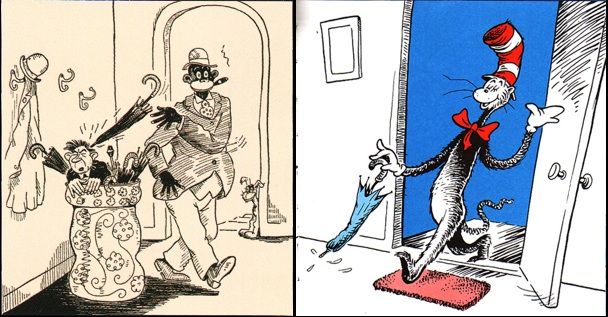
In 1952, Dr. Seuss published an essay in which he pointedly critiqued racist humor. True, his own work — both before and after then — did contain stereotypes. In an essay that’s been languishing at American Quarterly since August 2010, I examine the conflict between Seuss’s progressive impulses and a visual imagination steeped in early twentieth-century caricature. But my point today — Martin Luther King Jr. Day, here in the U.S. — is to highlight Seuss’s anti-racism, and his awareness of how humor is implicated in social structures.

So, then, here is Seuss’s  ”… But for Grown-Ups Laughing Isn’t Any Fun,” which appeared in the New York Times Book Review, 16 Nov. 1952, p. 2.  (The asterisks are in the original — I presume they’re supposed to be ellipses.)


… But for Grown-Ups Laughing Isn’t Any Fun

Dr. Seuss

There are many reasons why an intelligent man should never ever write for children.  Of all professions for a man, it is the most socially awkward.  You go to a party, and how do they introduce you?  The hostess says, “Dr. Seuss, meet Henry J. Bronkman.  Mr. Bronkman manufactures automobiles, jet planes, battleships and bridges.  Dr. Seuss * * * well, he writes the sweetest dear, darlingest little whimsies for wee kiddies!”

Mr. Bronkman usually tries to be polite.  He admits there is a place in the world for such activities.  He admits he once was a kiddie himself.  He even confesses to having read Peter Rabbit.  Then abruptly he excuses himself and walks away in search of more vital and rugged companionship.

Wherever a juvenile writer goes, he is constantly subjected to humiliating indignities.  When asked to take part in a panel discussion along with other members of the writing fraternity he is given the very end seat at the table * * * always one seat lower than the dusty anthologist who compiled “The Unpublished Letters of Dibble Sneth, Second Assistant Secretary of Something-or-Other under Polk.”

Besides that, since we don’t make much money, our friends are always getting us aside and telling us. “Look, now.  You can do better.  After all, with all your education, there must be some way you could crack the Adult Field!”

The thing that’s so hard to explain to our friends is that most of us who specialize in writing humor for children have cracked the adult field and, having cracked it, have decided definitely that we prefer to un-crack it.  We are writing for the so-called Brat Field by choice.  For, despite the fact that this brands us as pariahs, despite the fact this turns us into literary untouchables, there is something we get when we write for the young that we can never hope to get in writing for you ancients.  To be sure, in some ways you are superior to the young.  You scream less.  You burp less.  You have fewer public tantrums.  You ancients are, generally speaking, slightly more refined.  But when it comes to trying to amuse you * * *!  Have you ever stopped to consider what has happened to your sense of humor?

30 x 30 blank space Seuss, illustration for "But for Grown-Ups, Laughing Isn't Any Fun" (1952)

“Him * * * ? Oh, he’s nobody. They say he writes for children”

When you were a kid named Willy or Mary the one thing you did better than anything else was laugh.  The one thing you got more fun out of than anything else was laughing.  Why, I don’t know.  Maybe it has to do with juices.  And when somebody knew how to stir those juices for you, you really rolled on the floor.  Remember?  Your sides almost really did split.  Remember.  You almost went crazy with the pain of having fun.  You were a terrible blitz to your family.  So what?  Your juices were juicing.  Your lava was seething.  Your humor was spritzing.  You really were living.

At that age you saw life through very clear windows.  Small windows, of course.  But very bright windows.

And, then, what happened?

You know what happened.

The grown-ups began to equip you with shutters.  Your parents, your teachers, your everybody-around-you, your all-of-those-people who loved you and adored you * * * they decided your humor was crude and too primitive.  You were laughing too loud, too often and too happily.  It was time you learned to laugh with a little more restraint.

They began pointing out to you that most of this wonderful giddy nonsense that you laughed at wasn’t, after all, quite as funny as you thought.

“Now why,” they asked, “are you laughing at that?  It’s completely pointless and utterly ridiculous.”

“Nonsense,” they told you, “is all right in its place.  But it’s time you learned how to keep it in its place.  There’s much more in this world than just nonsense.”

Your imagination, they told you, was getting a bit out of hand.  Your young unfettered mind, they told you, was taking you on too many wild flights of fancy.  It was time your imagination got its feet down on the ground.  It was time your version of humor was given a practical, realistic base.  They began to teach you their versions of humor.  And the process of destroying your spontaneous laughter was under way.

A strange thing called conditioned laughter began to take its place.  Now, conditioned laughter doesn’t spring from the juices.  It doesn’t even spring.  Conditioned laughter germinates, like toadstools on a stump.

And, unless you were a very lucky little Willy or Mary, you soon began to laugh at some very odd things.  Your laughs, unfortunately, began to get mixed in with sneers and smirks.

This conditioned laughter the grown-ups taught you depended entirely upon their conditions.  Financial conditions.  Political conditions.  Racial, religious and social conditions.  You began to laugh at people your family feared or despised — people they felt inferior to, or people they felt better than.

If your father said a man named Herbert Hoover was an ass, and asses should be laughed at, you laughed at Herbert Hoover.  Or, if you were born across the street, you laughed at Franklin Roosevelt.  Who they were, you didn’t know.  But the local ground rules said you were to laugh at them.  In the same way, you were supposed to guffaw when someone told a story which proved that Swedes are stupid, Scots are tight, Englishmen are stuffy and the Mexicans never wash.

Your laughs were beginning to sound a little tinny.  Then you learned it was socially advantageous to laugh at Protestants and/or Catholics.  You readily learned, according to your conditions, that you could become the bright boy of the party by harpooning a hook into Jews (or Christians), labor (or capital), or the Turnverein or the Strawberry Festival.

You still laughed for fun, but the fun was getting hemmed in by a world of regulations.  You were laughing at subjects according to their listing in the ledger.  Every year, as you grew older, the laughs that used to split your sides diminished.  The ledger furnished more sophisticated humor.  You discovered a new form of humor based on sex.  Sex, a taboo subject, called for very specialized laughter.  It was a subject that was never considered funny in large gatherings.  It was a form of humor you never indulged in at Sunday school.  It was a form of humor that was subtle and smart and you learned to restrict it for special friends.

And, by the time you had added that accomplishment to your repertoire, you know what had happened to you, Willy or Mary?  Your capacity for healthy, silly, friendly laughter was smothered.  You’d really grown up.  You’d become adults * * * adults, which is a word that means obsolete children.

As adults, before you laugh, you ask yourselves questions:

“Do I dare laugh at that in the presence of the boss?  Sort of dangerous, when you consider how he feels about Taft-Hartley.”

“How loud shall I laugh at that one?  Mrs. Cuthbertson, my hostess, is only laughing fifteen decibels.”

“Shall I come right out and say I thought the book was funny?  The reviewer in THE TIMES said the humor was downright silly.”

These are the questions that children never ask.  THE TIMES reviewer and Mrs. Cuthbertson to the contrary notwithstanding, children never let their laughs out on a string.  On their laughter there is no political or social pressure gauge.

That, I think, is why we maverick humorists prefer to write exclusively for children.


Someday, I hope someone will publish a collection of Seuss’s non-fiction. (Some years ago, I proposed such a collection to Random House. This is one of my many failed book ideas — they turned it down.)  Until that day, Seuss scholars and fans will have to seek out these pieces. If you happen to be seeking them, I give full bibliographic citations in Dr. Seuss: American Icon (2004) — borrow it from your local library.

Comments (5)

Seussology

The Cat's hatI’m doing it again — teaching an entire course devoted to Dr. Seuss (the link in this sentence takes you to the current draft of the syllabus).  Art!  Politics!  Verse!  Nonsense!  Activism!  These are but some of the subjects we’ll explore in English 710: Dr. Seuss, a graduate-level course which begins on Wednesday.

Aiming to improve on the earlier Seuss course (taught 5 years ago), I did not look at the earlier syllabus as I drafted this one.  Only when I finished the draft did I read the 2007 version of the class, incorporating some of the worthier parts of that syllabus.  The idea, this time, is to structure the class around a dozen sets of questions — any of which, as I’ve pointed out on the paper assignment, could lead students to a fruitful paper.  Here are a few:

Dr. Seuss, And to Think That I Saw It on Mulberry Street (cover)1. The Child: The Boy in the Book.  How do Seuss’s works conceive of the child? With which understanding of childhood would you link his children? In his works, what sort of power do children have? And which children get that power? How is Seuss’s work influenced by his own childhood, including what he read?

3. Activism, Part 1: Horton Hears a Heil! How do Seuss’s politics play out in his own works? Are there ideological inconsistencies between his stated goals and other messages that the books may convey? What makes an activist children’s book persuasive to its readers?

4. Cartoons, Camp, & Surrealism: The Art of Dr. Seuss. What kind of artist is Dr. Seuss? How do cartoons inform his aesthetic? How do artistic movements inform his aesthetic? Beyond The 5,000 Fingers of Dr. T., does camp play a role in his aesthetic? Indeed, what is the Seuss aesthetic? How does his art work?

7. Gender: Is Seuss for the Goose Seuss for the Gander? The most blunt way to ask this question is this: Was (or is) Dr. Seuss sexist? More subtle ways to ask the question might include: In what ways do Seuss’s books participate in gender stereotypes? In what ways do they resist gender stereotypes? What role, if any, should Seuss’s biography play in your answer to these questions?

10. Marketing: Quick, Henry, the DDT!  There’s debate among those who study Seuss, and in the wider public discourse about Seuss. On the one hand, there are those who argue that much of the posthumous merchandising (Grinch selling breakfast cereal, etc.) violates Seuss’s wishes: his work had a moral and aesthetic value, not merely a commercial one. On the other hand, there are those who will point out that Seuss was a successful advertising man (until the publication of The Cat in the Hat, his primary source of income was advertising), and in fact entered into merchandising agreements during his life. Wade into this debate about art and commerce. Which side is more correct? Or is there a different set of questions we should be asking?

Above: Seuss’s Ford advertisements, 1949

There are also questions about poetry, race, and adaptations, among other topics. (You can find a full list on the paper assignment.)   I chose this structure because the best discussions derive from good questions.

Your Favorite SeussAnother change from last time: using the anthology Your Favorite Seuss, instead of having the students buy individual Seuss books.  I have mixed feelings about this choice.  On the one hand, this is far cheaper than having them buy the individual books — and that’s my primary reason for doing this.  I realize that books are expensive.  And, also in its favor, Molly Leach has done a really nice job in redesigning the layout for each Seuss book.  On the other hand, I’d prefer for students to read the books as originally laid out.  Your Favorite Seuss includes all text, but moves artwork around so that it can include 13 books in fewer pages.  As a compromise, I’m putting the original versions on Reserve (at the library) so that students can also see the originals.

One assignment I’ve retained from the original version of the class is “Sighting Seuss,” which requires students to keep an eye out for appropriations, references, parodies, etc. of Seuss in contemporary popular culture.  Examples might include this Kids in the Hall sketch (1990), in which Dave Foley presents the “Dr. Seuss Bible”:

Another example is NicePeter’s recent “Dr. Seuss vs. Shakespeare: Epic Battles of Rap History #12″ (2011):

As it’s an election year, we should find many examples of Seuss in political satire.  Since the 1990s, people have been aligning Newt Gingrich with the Grinch.

Newt Gingrinch, Newsweek cover (1994) Grinch

But he’s not the only one.  John Kerry, George W. Bush, Osama Bin Laden, Barack Obama, and others have all been caricatured as the Grinch.

There are hundreds of examples of Seuss in popular culture.  The point is to get students to think about the ways in which Seuss circulates in the public imagination.  When people invoke Seuss (or his anapestic tetrameter, or his characters, etc.), to what purpose do they use him?  In popular culture, what does Seuss mean?

One big change from the last time I taught this is that formerly obscure short films by Seuss are now easy to find.  5 years ago, I showed the class a bootleg DVD of Your Job in Germany (1945), a propaganda film written by Theodor Geisel (a.k.a. Dr. Seuss) and directed by Frank Capra.  You can now see this via YouTube or Archive.org.

Indeed, until this weekend I had never seen Our Job in Japan (1945), another U.S. Army propaganda film written by Geisel — and, incidentally, considered so sympathetic to the Japanese that General MacArthur worked to prevent it from being shown to the troops.  But now, it’s very easy to find (as in below, also courtesy of Archive.org).

I’ve assembled a whole page of these films.  We’ll still view a few of these in class, but now the students have the luxury of re-watching them and seeing more than those screened during class.  For those of you who lack the time to view all of those Private SNAFU cartoons, here are a couple of the better ones, which, yes, include some “adult” humor.  (The audience were GIs, not children.)  You will also note the sort of ethnic caricature common to Warner Bros. cartoons of the period.

Private SNAFU: Spies (Aug. 1943)


Directed by Chuck Jones.  If the voice reminds you of Bugs Bunny, that’s because Mel Blanc is also the voice of SNAFU. (From Archive.org)

Private SNAFU: The Home Front (Nov. 1943)


Directed by Frank Tashlin. (From Archive.org)

Well.  Any suggestions?  Let me know.  Classes start on Wednesday, and I’ll be editing the syllabus until then.  Though (of course) I can modify the reading list during the term, I tend to do that only minimally once the semester begins.   If no suggestions, well, I hope you’ve enjoyed learning about, oh,… the thinks that we’ll think!

Comments (1)

Study Shows Dr. Seuss Makes You Happy

Often, media headlines highlight academic research in order to make fun of it — so that people can say, “look at how these eggheads spend their time!” or “They needed a study to prove that!?”  My title (above) alludes to such media coverage, but my purpose here is to highlight a new article which argues… precisely what the title says.  Aaron Ahuvia, a professor in the College of Business at the University of Michigan at Dearborn, writes:

A felicitator is a person or thing which brings happiness to others. As with most good authors, Dr. Seuss was a felicitator in part through the enjoyment people derived directly from his work. But he was a felicitator in a more profound sense as well, because he has helped teach a particular set of values and outlook on life to hundreds of millions of children. Geisel disliked the heavy-handed moralism which was endemic to the children’s literature of his day, but many of his works nonetheless taught a moral point of view. Like that of many children’s authors, his work emphasized honesty and our responsibility to protect those weaker than ourselves. But somewhat less typically, especially for an author of his generation, his work championed personal creativity while rebuking snobbery, materialism, conformity and prejudice. It is the values that underlie Seuss’s stories, and not just the memorable rhymes and funny illustrations, which gave his work the classic status it has today. And it is these values which form the foundation of my argument that he was a felicitator. Specifically, I argue that his books had a modest but nonetheless real influence on millions of children, encouraging their imaginative creativity and discouraging snobbery, social exclusion and materialism.

The article, titled “Dr. Seuss, felicitator,” appears in the International Journal of Wellbeing, 1.2 (2011), 197-213.  You can download it from the journal’s website for free (it’s open access — just scroll down to the “full text” pdf).  I have no expertise in either business or happiness, but I like the social dimension in Professor Ahuvia’s definition of happiness.  Though I’m skeptical of our ability to track the ways in which literature influences those who read it, I also like both the optimism of his assessment and the fact that it’s qualified: he calls Seuss’s effect “modest,” and, later in this paragraph, adds, “children raised on Dr. Seuss had improved odds of growing up to be happy adults.”  ”Improved odds” is, I think, the best we can hope for.

I share this article because I’m interested in the ways in which Seuss circulates in contemporary culture, from political cartoons to scholarly articles to The Simpsons — I deal with this subject in more detail in Chapter 6 of my Dr. Seuss: American Icon (Continuum, 2004).  Some examples of the range of scholarship: One essay argues (incorrectly, as it turns out) that the little cats in The Cat in the Hat Comes Back (1958) are examples of fractals.  Another finds similarities between apparently fantastic Seussian creatures and the natural world (this one is accurate, as far as I can tell).  Here are the citations, in case you want to look them up:

  • Lakhtakia, Akhlesh. “Fractals and The Cat in the Hat.” Journal of Recreational Mathematics 22.3 (1990): 161-4.
  • Raymo, Chet.   “Dr. Seuss and Dr. Einstein: Children’s Books and Scientific Imagination.”  The Horn Book Sept.-Oct. 1992.  Repr. Thomas Fensch, ed., Of Sneetches and Whos and the Good Dr. Seuss: Essays on the Life and Writing of Theodor Geisel (McFarland & Company, 1997):  169-75.

At one point, I imagined that I would maintain a bibliography of all new Seuss — both literary criticism and any other posthumously published Seuss books.  This grew out of a desire both to correct omissions in Dr. Seuss: American Icon, and to add works published since then.  As you can see, I’ve fallen behind on updating it.  I’ll add the above article to it, and will make an effort to add others I’ve omitted, such as Kevin Shortsleeve’s smart new piece in Lynne Vallone and Julia Mickenberg‘s Oxford Handbook of Children’s Literature (2011), and Charles Cohen’s new collection of Seuss’s Redbook stories (The Bippolo Seed). If you see others (and I’m sure you will), feel free to send them my way.  Thanks!

Comments (4)

Oh, the Thinks That He Thought! Some of Seuss’s lesser-known works

from Dr. Seuss's Oh the Thinks You Can Think!

Born 107 years ago today in Springfield Mass., Theodor Seuss Geisel had an extraordinarily prolific career.  Most people know him for the 44 books he wrote and illustrated under the name “Dr. Seuss.”  But that’s only part of his career.  He wrote another 13 books under the name “Theo. LeSieg,” one book as “Rosetta Stone,” and then there are books co-authored, books published posthumously, and books illustrated by others.  And those are only the books.  He did so much more!

So, in honor of his birthday, here are three other “thinks” that Seuss thought.

1. Gerald McBoing-Boing.  Featuring Dr. Seuss’s verse and the animation skills of Bill Melendéz (who would later work on the animated Peanuts specials), United Productions of America released Gerald McBoing-Boing in 1950.  The film would win an Academy Award for Best Animated Short.  The studio would go on to produce a few McBoing-Boing sequels and the Mr. Magoo cartoons.

2. The 5,000 Fingers of Dr. T. Seuss’s live-action musical, released in 1953, features notable performances by Tommy Rettig (later Jeff on TV’s Lassie) and Hans Conried.  For more info., you might take a look at this earlier blog post.  Below, a happily campy musical number featuring Mr. Conried as Dr. T.

3. Advertising, and lots of it. Before he was a children’s writer, Seuss was an ad-man.  Even after he started writing for children (his first children’s book was published in 1937), he still made his living in advertising.  The success of his 13th children’s book, The Cat in the Hat (1957), would change all that.  After the publication of The Cat, he was able to devote himself to writing for children full-time.  For more on Seuss’s ads, you might take a look at this earlier blog post.
Seuss: Flit ad (from UCSD's website)

And there are so many other areas we could explore — political cartoons, to name one example.  His paintings and other illustration work, to name two more.  But I’ll wrap things up in the next few sentences, and offer some suggestions where — in addition to the links throughout this post — you might go to learn more.  Depending on your threshold for flashy web design, you could check out Random House’s Seussville website: it features my biography of Seuss, along with abundant animation and sound effects (I suggest you mute your computer’s volume before clicking on either of the links in this sentence).  For a more complete biography, though, do turn to the primary source for what I wrote for Random House: Judith and Neil Morgan’s Dr. Seuss & Mr. Geisel (1995). Indeed, if you read only one secondary source on Dr. Seuss, that’s the book to read.

Oh, and happy Read Across America Day!

Comments (2)

The End: Children’s Authors’ Last Words

Following the deaths this month of Brian Jacques, Janet Schulman, and Margaret K. McElderry, we turn to the last words of those who wrote for the young — Seuss, Dahl, Thurber, Montgomery, Nesbit, Charles M. Schulz, Crockett Johnson, and others.

“Yes. I’m not going to die tomorrow.”

— Dr. Seuss (Theodor Seuss Geisel, 1904-1991)

Donald Sturrock, Storyteller: The Authorized Biography of Roald Dahl“Ow, fuck!”

— Roald Dahl (1916-1990)

“Oh, balls!”

— Crockett Johnson (David Johnson Leisk, 1906-1975)

“God bless… God damn.”

— James Thurber (1894-1961)

“It’s gone, Mother! Gone! Gone! Gone!”

— Winsor McCay (1867-1934)

“I love you.”

— Hergé (Georges Remi, 1907-1983)

“This copy is unfinished and never will be. It is in a terrible state because I made it when I had begun to suffer my terrible breakdown of 1940. It must end here. If any publishers wish to publish extracts from it under the terms of my will they must stop here. The tenth volume can never be copied and must not be made public during my lifetime. Parts of it are too terrible and would hurt people. I have lost my mind by spells and I do not dare think what I may do in those spells. May God forgive me and I hope everyone else will forgive me even if they cannot understand. My position is too awful to endure and nobody realizes it. What an end to a life in which I tried always to do my best.”

— L. M. Montgomery (1874-1942)

David Michaelis, Schulz & Peanuts“I have a poem coming with its form nebulous, but its content all arranged and a few really good lines done — it is for when I have (if I ever have) done it. (I have caught the Skipper. The D[octor] has come. I hope I can hold the pencil till the D. has gone. Still got him!)”

— E. Nesbit (1858-1924)

“Keep going, finish your book.”

— Charles M. Schulz (1922-2000)

sources: Judith and Neil Morgan, Dr. Seuss & Mr. Geisel: A Biography (Random House, 1995), p. 287; Donald Sturrock, Storyteller: The Authorized Biography of Roald Dahl (Simon & Schuster, 2010), p. 561; Philip Nel, The Purple Crayon and a Hole to Dig: The Lives of Crockett Johnson and Ruth Krauss (University Press of Mississippi, 2012); Neil A. Grauer, Remember Laughter: A Life of James Thurber (University of Nebraska Press, 1995), p. 143; John Canemaker, Winsor McCay: His Life and Art, revised and expanded edition (Harry N. Abrams, 2005), p. 249; Pierre Assouline, Hergé: The Man Who Created Tintin, trans. Charles Ruas (Oxford University Press, 2009) p. 234; “The End of L. M. Montgomery’s Life,” The Anne of Green Gables and L.M. Montgomery Lexicon <http://www.lmm-anne.net/archives/2008/author/the-end-of-l-m-montgomerys-life.html>, 15 Feb. 2011; Julia Briggs, A Woman of Passion: The Life of E. Nesbit 1858-1924 (New Amsterdam Books, 1987), p. 393; David Michaelis, Schulz and Peanuts: A Biography (HarperCollins, 2007), p. 564.

notes: Not all biographies of children’s writers include last words. There are no last words in Leonard Marcus’s biography of Margaret Wise Brown, Barbara Stoney’s of Enid Blyton, nor Barbara Elleman’s of Virginia Lee Burton. Likewise, I don’t know Ruth Krauss’s last words, and so they’re not in my biography of her.

Comments (3)

Cat on the Street, Grinch on the Air

Quick post from Amtrak heading north.  On the way back from the Diane Rehm Show (now archived on website), I passed the person at right, who was selling copies of Street Sense and who kindly granted me this photograph.  I always enjoy spotting signs of Seuss in the world.  And, here, I suspect that Seuss would approve of this donning of the red-and-white-stripped of his famous Cat.  Although I’m not an expert on the organization, Street Sense wants to fight homelessness — and is thus the kind of progressive cause that Ted Geisel (a.k.a. Dr. Seuss) would be likely to support.  It also struck me as appropriate to go from talking about Seuss on the air, to seeing this “cat” on the street.  An apt confluence.

The radio show itself was fun.  My fellow guests, the Rev. Derrick Harkins and Maria Salvadore, were super, and of course Diane Rehm did a wonderful job.  I particularly enjoyed being in studio.  Since Kansas is not exactly a hub of public radio programs, I do most of my interviews long distance — either in a studio in Kansas, or over the phone.  That works a-OK, but the visual cues of the studio experience are even better.  One does not have to listen for the music to know to wrap up a comment quickly; simply look at Diane making the “wrap it up” hand gesture, and you know.  Likewise, it was easier for the guests (and for Diane) to sense who wished to speak next.

And, the more you talk about something, the more you learn — one reason why I enjoy the interchange of class discussion.  For instance, Rev. Harkins made a good point about the openness of Seuss’s message — it’s very inclusive.  The idea that the Grinch learns that “Christmas, perhaps, means a little bit more” doesn’t tell you what it means, exactly, but does (as Maria Salvadore pointed out) strip away all of the “stuff.”  That’s what the Grinch doesn’t like — all the things.  When that’s pared away, he’s able to understand, to have his epiphany.  And what is that epiphany?  I’d say that it’s about community: he joins the circle of Whos, and carves the roast beast himself.  He comes in from exile, & finds a place to belong.  It is, as Charles Cohen points out in his 50th anniversary edition of How the Grinch Stole Christmas!, an echo of the “Prayer for a Child” poem he published in December of 1955 in Collier’s.  There, in an uncharacteristically religious poem, Seuss writes “Please tell all men / That Peace is Good. That’s all / That need be understood. / In every world / In Your great sky. / (We understand. / Both you and I.)”

The Grinch finds peace in the community of Whos — a message that resonates with The Sneetches (in which groups who discriminated against one another cease doing so), and Horton Hears a Who! (in which we learn that a person’s a person).  So… on that note of brotherhood (and sisterhood), I’ll conclude.

Leave a Comment

You’re a Mean One, Mr. Grinch

GrinchWith lyrics by Dr. Seuss (1904-1991) and music by Albert Hague (1920-2001), “You’re a Mean One, Mr. Grinch” has become a holiday classic.  Given that it celebrates a misanthrope, it is admittedly an unusual holiday tune.  Yes, the Grinch does reform by the end of the story, but this song focuses on his nastiness, offering no hint of the transformation to come.  Perhaps the song is so beloved because it celebrates emotions not usually sung about over the holidays: meanness, grouchiness, anger.  People certainly experience such feelings during this time of year, but most holiday tunes don’t celebrate them.  Seuss — who based the character of the Grinch on himself — gives voice to the darker side of Christmastime.  And Hague’s music captures the slipperiness of that “nasty, wasty skunk,” sliding a full octave on each verse’s final iteration of the word “Grinch.”

After Seuss sent Albert Hague his lyric for the song, the composer set it to music, and then invited Seuss over to hear the results.  Sitting at the piano, Hague played it for Seuss: “You’re a mean one, Mr. Grinch!  You really are a heel.  You’re as cuddly as a cactus.  You’re as charming as an eel.  Mr. Grinnnnch!  You’re a bad banana with a greasy black peel.” According to Hague, Seuss said, “anyone who can slide an octave on the word ‘Grinch’ gets the job.”

Here are 15 versions of the song, starting with Thurl Ravenscroft’s original.

Commercial announcement: I’m posting this, in part, to call attention to the Diane Rehm Show of Wednesday, December 22nd, 11 am EST.  I’ll be a guest, and the focus of the entire hour will be How the Grinch Stole Christmas!

1. You’re a Mean One, Mr. Grinch Thurl Ravenscroft (1966)            3:01

Excising Boris Karloff’s narration and placing the verses in a different order, this is almost the song as heard on the 1966 TV special, How the Grinch Stole Christmas! — co-written by Seuss and Chuck Jones, and based on Seuss’s 1957 book of the same name.  There appear to have been two versions recorded: one that appears in the TV special, and one that omits the narration and places the verses in this order.  This is the latter version, brought to you here from A Classic Cartoon Christmas! Many people don’t know that Thurl Ravenscroft is the singing voice of the Grinch — only Karloff is listed in the program’s credits.  Best-known for this song and for being the voice of Tony the Tiger, Ravenscroft also sang back-up on records by Elvis Presley, Bing Crosby, Dinah Shore, and Rosemary Clooney.  You’ll also hear Ravenscroft’s voice on many Dinsey records and in Disney’s theme parks.  Brian E. Jacobs’ excellent All Things Thurl will tell you everything you need to know.

2. You’re a Mean One, Mr. Grinch Mojo Nixon (1992)            2:35

Slightly off-key, and off-kilter.  The man behind “Elvis Is Everywhere” recorded this for his Horny Holidays! (1992).

3. You’re a Mean One, Mr. Grinch Gary Hoey (1998)            3:07

Rockin’ the Grinch, heavy-metal style.  From Hoey’s Ho! Ho! Hoey II (1998).

4. You’re a Mean One, Mr. Grinch Swingerhead (1999)            2:18

From one of my all-time favorite holiday records, Swingerhead’s A Swingerhead Christmas.  This was out of print for a time, but it’s now available from CD Baby.

5. You’re a Mean One, Mr. Grinch Rockapella (2000)            3:14

Like Ben Folds, I’m also not a fan of too much beat-boxing in a cappella.  A little percussion goes a long way.  So, if I’d prefer more subtle “drums” here, Rockapella do rock the Grinch a cappella.  And the lead vocalist really hits those bass notes.  From the group’s Rockapella Christmas.

6. You’re a Mean One, Mr. Grinch Asylum Street Spankers (2001)            3:11

Oscillating between country, jazz, bluegrass, and I-don’t-know-what, the Asylum Street Spankers deliver a genre-bending cover of the song.  From A Christmas Spanking (2001).

7. You’re a Mean One, Mr. Grinch Slaid Cleaves (2001)            3:44

The accordion makes me want to call this the “New Orleans” version of the song, but I’m not sure if that’s strictly accurate… since he grew up in Maine and lives in Texas.  The “Americana” version, perhaps? From Cleaves’ EP Holiday Sampler (2001).

8. You’re a Mean One, Mr. Grinch Pete Nelson (2002)            3:47

The downbeat cover.  If many versions embrace the Grinch’s anger, Nelson‘s recording finds the melancholy behind the green grouch’s mood. Purists will note that I called the Grinch “green”: true, he’s white in Seuss’s original book, but he’s green in the TV special that introduced this song. If you’d like an entire mix of more somber holiday music, you might enjoy my Blue Christmas mix, posted a week or so back.

9. You’re a Mean One, Mr. Grinch The Gypsy Hombres (2002)            3:39

Ever wondered what Django Reinhardt’s recording of the song would sound like?  Look no further.  From the Gyspy HombresDjango Bells.

10. You’re a Mean One, Mr. Grinch Brian Setzer (2005)            2:38

On Dig That Crazy Christmas, Brian Setzer’s rockabilly-inflected big band puts its spin on the Grinch.

11. You’re a Mean One, Mr. Grinch Aimee Mann (2006)            3:27

When I first heard this, I thought: Aimee Mann?  Really? I’m admirer of her work, but never expected her to cover this song.  This version interpolates some of the narration from the TV special — that’s Grant Lee Phillips contributing the male vocal.

12. You’re a Mean One, Mr. Grinch Straight No Chaser (2009)            2:54

More a cappella, but with more subtle use of the beatbox than Rockapella.  Indeed, Straight No Chaser‘s arrangement is more intricate, more complex, but without making the sound too busy.  A nice balance here.  From Christmas Cheers.

13. You’re a Mean One, Mr. Grinch Glee Cast featuring k.d. lang (2010)            3:18

From this season’s special Glee episode, and featuring the vocals of k.d. lang!  Closely modeled on the cover by Aimee Mann, this includes some narration — male vocalist here is Matthew Morrison.

14. Grinch Introduction / The Grinch / “You’re a Mean One, Mr. Grinch” Take 6 (2010)            4:16

I love Take 6, and I expect the comic business would be fun live.  Upon repeated listenings, I find myself wishing there were a version without the ad-libbing.  The arrangement is great, but the humor … wears thin.

15. You’re a Mean One, Mr. Grinch The Raleigh Ringers (2010)            3:37

If you need further evidence of the song’s classic status, look no further than this version… performed on handbells.  From the Raleigh RingersA Wintry Mix.

16. Whoville (Won’t Get Yuled Again) mojochronic (2008)            1:03

As a bonus track, here’s a mash-up of the Grinch and the Who — punning, of course, on the name of the people who live in Whoville.

So, fahoo fores and dahoo dores!  (To say nothing of fahoo ramus and dahoo damus.)  Welcome Christmas!

Comments (2)

“It’s only a step from Genius to Insanity”

Dr. Seuss, illustration of "Rare Craneo-Bulgis" from Are You a Genius? (1933)This post is for my fellow intellectual laborers — be you academics, teachers, authors, artists, carpenters, curators, architects, doctors, plumbers, web designers, or… well, any job that requires you to use your noggin’.  If you think about it (and people reading this blog probably do think about it), intellectual labor covers many jobs — you don’t have to be a member of the “rare Craneo-Bulgis species” (see Dr. Seuss‘s illustration at right).  I’m dedicating it to you because, though unacknowledged, such labor continues over the holidays.  Speaking from my narrow field (English professorland), everyone I know will be finding time to work when we’re officially “off.”

Non-academics may wonder: Why does work continue over the holidays?  Well, for us, this is a time when we’re not teaching and thus a time when we can focus on all the other parts of our job: preparing for next semester; researching, writing, revising our manuscripts; reading other people’s manuscripts for journals or university presses; writing letters of recommendation; perhaps interviewing job candidates or (if a job candidate) being interviewed at MLA; and so on.

Dr. Seuss, cover illustration for Are You a Genius? (1933)This isn’t a complaint: professordom (dom?) is an interesting place to work.  That’s the reason most of us got into the field.  We like reading, thinking, learning, and sharing what we learn.  And I don’t want to lament the scarcity of vacations, even though I think most of us would be happier and healthier if we did have more leisure.  What I would like to do, in tribute to intellectual labor, is offer a couple of puzzles from Robert A. Streeter and Robert G. Hoehn’s Are You a Genius? (Second Series, 1933), because doing so provides an excuse to share some rarely-seen illustrations by Dr. Seuss.

The authors’ introduction begins by advising readers on how to score the tests:

Introduction to Robert A. Streeter and Robert G. Hoehn's Are You a Genius? (1933)

Here, as promised, are a couple of brain-teasers from the book, followed by Seuss’s illustration for each.

1. A laborer can dig a hole 8 ft. square and 8 ft. deep in 8 days.  How long will it take him to dig a hole 4 ft. square and 4 ft. deep?

Dr. Seuss, illustration of laborer from Are You a Genius? (1933)

2. The first syllable of a foreign country is suggested by a word meaning “a low haunt”; the second, by a word meaning “a target.”  What is the name of the country?

Dr. Seuss, illustration of man looking at target, from Are You a Genius? (1933)

In a day or so, I’ll post answers in the comments section.  And, as the book’s authors advise, “It’s only a step from Genius to Insanity.”  A small step, I’d wager….

More Seuss in tomorrow’s post — specifically, the Grinch!

Comments (2)

My Book About Me

These days, I don’t talk much about my first book.  I wrote it when I was 7 years old, in collaboration with Dr. Seuss and Roy McKie.  As you can see, I improved upon their artwork with the aid of stickers from the United Fruit Company (of whose bananas I was then an avid consumer) and the Kellogg Corporation (whose Raisin Bran I ate for breakfast).

My Book About Me by Dr. Seuss, Roy McKie, and Philip Nel, age 7.

As you will soon discover from the interior pages, the handwriting on the latter sticker is not my own (it is my mother’s).  The inflatable bunny and the safari suit (my parents are South Africans) dates the photograph to my sixth Easter.  At the book’s end, I claim to have finished the book on my seventh birthday.

Here, McKie, Seuss, and I take a look at my culinary preferences:

from My Book About Me, by Dr. Seuss, Roy McKie, and one 7-year-old Philip Nel

For those unable to decipher my distinctive crayonmanship, favorite foods then included: hamburgers, candy, fruit salad, swiss cheese, and that rare variety of pickle spelled without the “k.”  I could not stand olives.  This latter claim still holds true, although my favorites have altered.  I’m now more partial to pickles with a “k,” and have grown more discerning in my candy consumption: today, I would replace “candy” with “dark chocolate.”  I still eat swiss cheese, and plenty of fruit, and, though I enjoy a good hamburger, I would no longer rank it at the top of my list.

Interestingly, my choice of profession proved to be a remarkably accurate predictor of my current employment:

page from My Book About Me, by Roy McKie, Dr. Seuss, and a 7-year-old wunderkind known as Philip Nel

After all, the job of English Professor combines the fame of the paleontologist with the modesty of the television star.  In crossing out “TV star” and writing in “paleontologist,” I was not replacing one with the other, but rather suggesting a hybrid that is the job I now hold.  Yes, I was a prescient lad.

Though many books of this vintage (McKie and Seuss’s portions of this book were written in 1969) have been updated, I’m interested to report that this has not been.  Current editions do not replace “Airplane Stewardess” with “Flight Attendant”; nor do they subtract the now rare job of “Milkman” and replace it with, say, “Computer Programmer.”  The list of professions remains exactly as it was 41 years ago.

Finally, a sample of my developing storytelling skills, rendered in letters of varying height and legibility:

from My Book About Me, by Dr. Seuss, Roy McKie, and young storyteller Philip Nel, age 7

Indicative of the paleontology lobby’s influence on my 7-year-old imagination, the story stars a dinosaur.  For those struggling to decode my strikingly original penmanship, here is a transcription:

The Dinosaur

The Dinosaur was walking in the woods one day.  And then he saw a hunter!  And the hunters [sic] gun was ponted [sic] right at him!  And the dinosaur was! frightened.  But…………… then he walked up to the hunter and was very very very brave.  So [he] picked the hunter up by the pants and dropped him.

The end.

With the unique spellings and unusual grammar characteristic of a gifted author, the story swiftly introduces the rising action in the second sentence.  After prolonging the suspense via its deft use of ellipses, the tale concludes with a clever narrative twist that lets readers know they’re reading the work of a master storyteller.  The Dinosaur dispatches the hunter through the rarely used picking-up-by-the-pants-and-dropping technique.  Gasping in delight at this surprising but satisfying conclusion, we salute this 7-year-old wunderkind, who, fortunately, did not grow up to be a writer of fiction.

Comments (10)

The 5,000 Fingers of Dr. T: Soundtrack Extravaganza

5,000 Fingers of Dr. T: FSM 3-CD soundtrack (cover)Film Score Monthly’s newly released 3-CD original motion picture soundtrack to The 5,000 Fingers of Dr. T (1953) is a must for fans of Dr. Seuss, composer Frederick Hollander, or the film itself.  The rest of you might want to see the cult classic before purchasing.  And, for the record, if you’ve any interest in Seuss, it’s worth checking out his sole live-action feature film.

What’s it about? you ask.  It’s an anti-fascist musical about a piano prison camp run by the megalomaniacal Dr. Terwilliker (Hans Conried), and about Bart Collins (Tommy Rettig) who seeks to expose his crazy scheme and free Mrs. Collins (Mary Healy) from Dr. T’s hypnotic grip.  Bart also tries to enlist August Zabladowski (Peter Lind Hayes) to help him in his efforts.  Here’s the trailer.

In the beautifully assembled (and lavishly illustrated) accompanying booklet to this CD set, Alan Lareau — who is writing a biography of Hollander — not only provides the fullest account of Hollander’s life you’re likely to find, but also offers all kinds of interesting information about the film.  For instance, producer Stanley Kramer saw the film as a vehicle for Danny Kaye (as Terwilliker) and Bing Crosby (as Zabladowski). I can easily imagine the film with those actors.  While Conried gives a great performance, Hayes is very much b-movie material — would that Crosby had been available to make the film.  I was also unaware that Tony Bennett had recorded “Because We’re Kids” for his album The Playground (1998), or that Jerry Lewis used the song on his Muscular Dystrophy telethon.

This new 3-disc soundtrack gives you — for the first time — the complete (surviving) soundtrack as Hollander and Seuss conceived it, including material that never made it into the film, alternate takes from the film, composer piano sketches, rehearsal tracks, and of course the final songs from the film itself.  So, yes, it’s for the Seuss (or Hollander) completist.  That said, several of the unreleased songs are quite interesting in and of themselves.  In this one, Peter Lind Hayes expresses his — and Seuss’s — skepticism towards money.

Money, as performed by Peter Lind Hayes

Unlike Cherry Red Records’ single-disc release of a few years ago, these are better quality audio — not pristine by modern standards, but the best possible versions all culled from archival recordings.

Oh, having just re-watched How the Grinch Stole Christmas! earlier this evening, I have to add: if you think the Grinch is a campy fella, well, he’s got nothing on Dr. Terwilliker.  Take a gander at the “Dressing Song,” below.

So, if you’re interested in a kitschy, campy Seuss musical, check out The 5,000 Fingers of Dr. T (it’s available on DVD). Then, pick up FSM’s edition of the soundtrack.  They’ve limited its release to 3,000 copies — so, you might want to act sooner rather than later.

Comments (2)