Archive for Lane Smith

Abe Lincoln’s Dream

Lane Smith, Abe Lincoln's Dream (2012): coverLane Smith’s Abe Lincoln’s Dream invites us, with America’s 16th president, to travel through dreams and corny jokes, and to consider the state of the nation. In a tone that falls between the humor of his John, Paul, George and Ben (2006) and the reflective mood of the Caldecott-Honor Grandpa Green (2011), Smith’s latest picture book imagines an encounter between President Lincoln’s restless ghost and Quincy, a girl who has strayed from her White House tour group. It’s a visually absorbing, gentle story in which good (and bad) humor stave off melancholy, and which encourages readers to reflect on American history.

“Encourages” may be too strong a word. It’s more that the book’s subtlety grants us the space to reflect. Quincy shares her first name with the middle name of America’s 6th president, John Quincy Adams, who, in his post-presidential career fought against slavery. She resembles an older version of the African-American girl from Smith’s The Big Pets (1991). But the book never mentions her race, Adams, nor his politics. Nor that a two-page spread of Lincoln strolling through roses may allude to both the Rose Garden and the variety of flower known as the Lincoln Rose. However, the accretion of these details and others grant the book a visual richness that invites re-reading.

Heck, the book is even typographically engaging. Abe Lincoln’s Dream’s layout recalls broadsides, with lines of text in alternating sizes, some in all capitals. Miraculously, designer Molly Leach has created this broadside look without sacrificing readability. There’s also something in these rectangles of text that echoes two other recurring rectangles: Lincoln’s stovepipe hat, and his long legs.

In Smith’s rendering, Lincoln’s limbs are absurdly long and sharply angular — features that are both comic and accurate. (Lincoln was 6′ 4″.)  These images also reflect a child’s perspective on an adult: as a giant pair of legs that towers over her. Smith introduces this motif in the book’s opening pages, when three different presidential dogs get spooked by Lincoln’s ghost. FDR’s Fala ends up below a framed pair of legs (in the lower part of a portrait), LBJ’s Yuki approaches a pair of legs (LBJ’s) that extend up and off the page, and Reagan’s Rex cowers near table legs.

"Do you know how long a man's legs should be?" from Lane Smith's Abe Lincoln's Dream (2012)

Yes, there are also several silly jokes, some of which involve legs. Lincoln evidently had a fondness for this sort of humor.  (Who knew?  I didn’t.)  Presumably, these jokes helped him cope with the heavy burdens of office. As he tells Quincy, “I apologize if I appear restless, but there was so much to do beyond 1865. Our union was so fragile, so uncertain. Like that ship on the rocky sea.”

In response, Quincy tells him that “A lot has changed since 1865.” Then, Lincoln’s ghost takes her hand and they fly up above the White House.  As Smith’s narrator explains, “The ghost did the flying. The girl answered the questions.” While they soar above the Capitol, past a mural of the Statue of Liberty (and other places), she tells him that things have improved since then. Her words share the page with images that do and do not support her optimism, though the book itself ultimately gestures towards a better future.

"And equality for all?" from Lane Smith's Abe Lincoln's Dream (2012)

When you’re living in a country reluctant to face climate change, its wars, economic inequality, or its crumbing infrastructure, it’s a daily challenge to find hope. Though Abe Lincoln’s Dream doesn’t explicitly address these issues (and there’s no reason it should), its conclusion supplies the hope that all political change requires, and that children seem to possess in greater quantities than adults. The night after her visit, Quincy dreams of “a tall man in black, on a boat moving rapidly toward the rising sun.” On the next (and final) pages, there he is, standing towards the prow of a patriotic steamboat, smiling as he faces the future. Here’s hoping that Quincy’s dream comes true.

"He was smiling" from Lane Smith's Abe Lincoln's Dream (2012)

Learn more about Abraham Lincoln, & Lane Smith:

Leave a Comment

Children’s Literature + Music = Great Album Covers

Many children’s writers and illustrators have created covers for albums.  Below, we’ll look at a dozen or so of these artists.  As is ever the case with any art posted on this website, the artwork belongs to the artists.  Visit their websites!  Buy prints!  Buy their books!  (I’ve included websites for each artist.)  Enjoy!


Saul Bass

Recently republished, Bass‘s Henri’s Walk to Paris (1962, words by Leonore Klein) is fantastic. If he did other children’s books, I’m unaware of them. He did, however, do many famous album covers.  Here are his covers for Elmer Bernstein’s The Man with the Golden Arm (1956), Duke Ellington’s Anatomy of a Murder (1959), and Leonard Bernstein and Stephen Sondheim’s West Side Story (soundtrack, 1961).

The Man with the Golden Arm soundtrack (art by Saul Bass)

Anatomy of a Murder (art by Saul Bass)

West Side Story soundtrack (art by Saul Bass)


Guy Billout

The author-illustrator of The Frog Who Wanted to See the Sea (2007) and Something’s Not Quite Right (2002), Billout has also done album covers. I’m reproducing one below — Crack the Sky’s Animal Notes (1976).  I know I’ve seen other covers, but just cant put my finger on where I’ve seen them.

Crack the Sky, Animal Notes (art by Guy Billout)


R. Gregory Christie

Christie has won Coretta Scott King Honor Awards for his children’s books Palm of My Heart: Poetry by African-American Children (1996), Only Passing Through: The Story of Sojourner Truth (2000), and Brothers in Hope: The Story of the Lost Boys of Sudan (2006). Here are his covers for Justice System’s Rooftop Soundcheck (1994) and John Coltrane’s Complete 1961 Village Vanguard Recordings (1997).

Justice System, Rooftop Soundcheck (art by R. Gregory Christie)

John Coltrane, Complete 1961 Village Vanguard Recordings (art by R. Gregory Christie)
Hat tip to Jules Walker Danielson for this one! And check out her interview with Christie at Seven Impossible Things Before Breakfast.


Marcel Dzama

As far as I know, Dzama has illustrated only one children’s book — They Might Be Giants’ Bed Bed Bed (2003). Admittedly, that makes him a less likely candidate than most of the other artists included here.  Here are his covers for the Weakerthans’ Reconstruction Site (2003), Beck’s Guero (2005), and They Might Be Giants’ The Else (2007)

The Weakerthans, Reconstruction Site (art by Marcel Dzama)

Beck, Guero (art by Marcel Dzama)

They Might Be Giants, The Else (art by Marcel Dzama)


Carson Ellis

Ellis (married to the Decemberists’ front man, Colin Meloy) has created many Decemberists album covers, as well as a few for other artists.  More recently, she’s worked on some cool children’s books, illustrating the late Florence Parry Heide’s Dilweed’s Revenge (2010), Lemony Snicket’s The Composer Is Dead (2009), and Meloy’s Wildwood (2011), among others.

Here are three covers she’s done for the Decemberists.

Her Majesty The Decemberists (art by Carson Ellis)

The Decemberists, Hazards of Love (art by Carson Ellis)

The Decemberists, The King Is Dead (art by Carson Ellis)

And here’s the cover she did for Laura Viers’ July Flame (2010).

Laura Viers, July Flame (art by Carson Ellis)

Much, much more on Ellis’s website!  Also: Jules Walker Danielson did a great (and lavishly illustrated) interview with Ellis over on Seven Impossible Things Before Breakfast.  Indeed, if you care about children’s picture books, you must read Danielson’s blog — preferably, as frequently as you can.


Jim Flora

Flora had a long career designing album covers before the record industry’s preference for photographic covers (in the 1950s, at any rate) reduced demand for his work. At that point, he turned to children’s books, writing such loopy classics as The Fabulous Firework Family (1955), The Day the Cow Sneezed (1957) and many others.  Irwin Chusid has written (and co-written) some super books on Flora, and maintains a great Flora website, from which I’ve taken the following covers: Bix Beiderbecke and Frankie Trumbauer’s Bix and Tram (1947), Gene Krupa and His Orchestra (1947), and Mambo for Cats (1955).

Bix and Tram (art by James Flora)

Gene Krupa and His Orchestra (art by James Flora)

Mambo for Cats (art by James Flora)

You can buy prints of Flora’s album covers (and other artwork) from the website.


Crockett Johnson

I’m mostly avoiding children’s records, but Johnson‘s art for the adaptation of Ruth Krauss’s The Carrot Seed (1950) differs from the cover he did for the book (1945, which he also illustrated).  So, I thought I’d bend my rule a little and include it here.  The recording was performed by baritone-voiced Broadway actor Norman Rose, and was released by Young People’s Records and the Children’s Record Guild.

The Carrot Seed (art by Crockett Johnson)


Richard McGuire

McGuire is a renaissance man.  He wrote and (with his band, Liquid Liquid) performed “Cavern,” the song that became the music for the classic hip-hop track “White Lines,” by Grandmaster Flash and the Furious Five.  He’s created one of the most innovative experiments in comics, “Here” (1989).  He’s created four picture books, including The Orange Book (1993) and What Goes Around Comes Around (1995).  And that’s not to mention his work in film or his New Yorker covers.  Here’s his cover for Liquid Liquid’s compilation Slip in & Out of Phenomenon (2008).

Liquid Liquid, Slip in & Out of the Phenomenon (art by Richard McGuire)


Dave McKean

The prolific Dave McKean is best known for his many collaborations with Neil Gaiman.  But he’s done lots more, including album covers.  Here are his covers for Counting Crows’ This Desert Life (1999), and the UK release of Tori Amos’s single, “God” (1994).

Counting Crows, This Desert Life (art by Dave McKean)

Tori Amos, "God" (art by Dave McKean)

Hat tip, again, to Jules Walker Danielson, whose interview with McKean you should check out — it has lots of art, and even more album covers.  Indeed, the album covers you see here were lifted from her interview.


Maurice Sendak

The greatest living author-artist of children’s books has done a few album covers — many in the early 1950s, but a few later in his career, too. Here’s his art for Cynthia Gooding Sings Turkish and Spanish Folk Songs (1953), Carole King’s Really Rosie (1975, lyrics by Sendak), and Shawn Colvin’s Holiday Songs and Lullabies (1988).

Cynthia Gooding Sings Turkish and Spanish Folk Songs (art by Maurice Sendak)

Carole King, Really Rosie (art by Maurice Sendak)

Shawn Colvin, Holiday Songs and Lullabies (art by Maurice Sendak)


Shel Silverstein

People remember Silverstein primarily for his many children’s books, but he was also a Playboy cartoonist, and songwriter — Johnny Cash’s “A Boy Named Sue” and Dr. Hook’s “On the Cover of Rolling Stone” were both Silverstein songs.  He recorded several albums of his songs for adults, including Drain My Brain (1967), for which he also created the cover below.

Shel Silverstein, Drain My Brain (art by Shel Silverstein)


Lane Smith

In 1983, Smith created album covers for the Dickies’ Stukas Over Disneyland and Oingo Bongo’s Good for Your Soul.

The Dickies, Stukas Over Disneyland (art by Lane Smith) Oingo Boingo, Good for Your Soul (art by Lane Smith)

He’s posted both of these and one other on his abandoned blog, Lane Smith’s Closet: Illustrations from My Drawers.  His other abandoned blogs are also great, but Curious Pages (co-curated with Bob Shea) is fantastic.


Art Spiegelman

Best known for his Pulitzer-Prize-winning Maus, Spiegelman has also worked on a few children’s books, including Open Me… I’m a Dog! (1997), and Jack in the Box (2008).  Here’s his art for Spiked! The Music of Spike Jones, which includes liner notes from Thomas Pynchon (!).

Spiked! The Music of Spike Jones (artwork by Art Spiegelman)


Mark Alan Stamaty

Better known for his cartoons, Stamaty has created a few children’s books, including: Who Needs Donuts? (1973), Minnie Maloney & Macaroni (1976), and Where’s My Hippopotamus? (1985). He also created the artwork for They Might Be Giants’ first album (1986).

They Might Be Giants (art by Mark Alan Stamaty)


Chris Ware

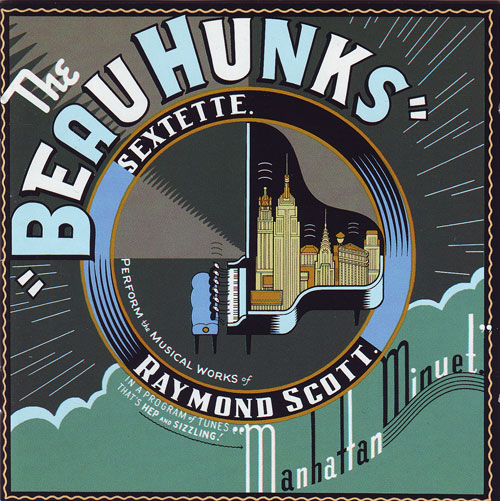
Sure, Mr. Ware is primarily known for his comics & graphic novels, but he did contribute “Fairy Tale Road Rage” to the first volume of Art Spiegelman and François Mouly’s Little Lit, he writes eloquently about childhood, and… well, I like his work.  In addition to other book covers, New Yorker covers (and covers for other magazines), brilliant design work for Fantagraphics and Drawn and Quarterly, he’s done a fair few album covers.  Here is his art for the Beau Hunks’ Manhattan Minuet (1996) and Reginald R. Robinson’s Euphonic Sounds (1998).

The Beau Hunks Sextette, Manhattan Minuet (art by Chris Ware)

Reginald R. Robinson, Euphonic Sounds (art by Chris Ware)

The Hammer Gallery’s Ware site has art for sale.


I assembled this page when I should have been doing other work.  Have I missed some artists of children’s books who also worked on album covers?  Yes, certainly.  Will people point this out in the comments section, below?  I certainly hope so!  Isn’t that what comments sections are for?

Comments (5)

Mock Caldecott 2011: Manhattan, Kansas Edition

With thanks to the Children’s and Adolescent Literature Community (ChALC) for organizing the event and the Manhattan Public Library for hosting it, we held aMock Caldecott at this afternoon.  Of course, we weren’t able to get all of the books we wanted to look at — so, there are certainly Caldecott candidates we didn’t get to review.  Here are the top choices of our group (composed of undergraduates, graduate students, children’s lit faculty, and members of the community)

The Winner:

Lane Smith, Grandpa Green (2011): coverLane Smith, Grandpa Green

A gentle, moving book about memory and age — and something of a departure for Smith.  Though it has humor and Smith’s beautiful, detailed artwork, it’s a more lyrical than his previous work, focused as it is on love and loss.  Though it’s reflective, it’s never melancholic: the boy’s journey through a topiary garden of his grandfather’s life is fun, with plenty of unexpected turns.  People liked the richness of the illustrations, the surprises in the story, and the fact that the book moved them.  For those who’d like to learn more, I gave the book a favorable review on this blog back in August.

John Rocco, Blackout (2011)

The Honor Books:

John Rocco, Blackout.

People spoke of how the book captured a child’s perspective on something scary (the dark) and made that fun.  We also liked its In the Night Kitchen-style layout — the book’s early pages even use a similar color palette to Sendak’s book, which won a Caldecott Honor in 1971.  Set in Brooklyn, Rocco‘s book is about the 2003 blackout, and how the absence of power brought people together.  This won the second-highest number of votes.

Deborah Freedman, Blue Chicken (2011)Deborah Freedman, Blue Chicken.

This tied with the following book for third place in its number of votes.  It’s a story of a chicken who is an artist — or, possibly, an artist who happens to be a chicken.  But not “chicken” in, you know, the “afraid” sense.  This chicken is quite happy to experiment with paint, and color, and — oh, don’t worry, I’m sure the paint will come out of that.  As Freedman‘s Scribble (2007) was, this is a playful book about what art can do.  Only with chickens.

Melissa Sweet, Balloons Over Broadway (2011)Melissa Sweet, Balloons Over Broadway.

This book is about Tony Sarg, who created the balloons for the original Macy’s Thanksgiving Day Parade — and, indeed, started the tradition of having helium characters floating over New York during this November holiday.  Sweet‘s mixed media, experiments with typeface, and shifts in perspective were appealing to some in the group, but others were more critical.  I enjoyed the book, but, given the discussion that preceded its 3rd-place finish, I was surprised to see it land in our Honor category.  Oh, and speaking of surprises, here are some ….

Jon Klassen, I Want My Hat Back (2011)Books That I Thought Were Cool But That Didn’t Make the Cut:

Jon Klassen, I Want My Hat Back.

I was surprised that this one didn’t even land in an “Honor” category for us.  There was some conversation about it as a contender for the Geisel Award, which may be an accurate predictor, but shouldn’t preclude it being a contender for the Caldecott.  My guess is that its minimalist aesthetic may have cost it a few points, when in fact that should have won it points. The book is a masterpiece of economy and wit.  Each detail works exactly right.  And it’s really funny.  I hope Klassen gets something for this one.

Fans of the book might enjoy Not Just For Kids‘ interview with Klassen, in wich he describes the book as follows: ”I wanted to try and make it seem as though it was a badly rehearsed play with animals who were sort of brought in for the day to read these lines.”

Stephen Savage, Where's Walrus? (2011)Stephen Savage, Where’s Walrus?

I’ve an affinity for funny books, so naturally I’m drawn to this one — a comic tale of a walrus on the run, that mixes the find-the-character game of Where’s Waldo? with a playful narrative and plenty of joie de vivre.  Its design recalls posters from the 1930s: bold colors, sharp contrasts, and large bright shapes that look like they were printed.  Savage has created a wordless tale that bears repeated readings.  Good stuff.

And, ah, it has — as Julie Walker Danielson recently observed — been a great year for picture books.  Chris Van Allsburg’s Queen of the Falls, Chris Raschka’s A Ball for Daisy, Mat de la Pena and Kadir Nelson’s A Nation’s Hope: The Story of Boxing Legend Joe Louis, Maurice Sendak’s Bumble-Ardy.  And that list is far from complete.

So, what do you think?  What are your favorite picture books from 2011?  And which do you think will win the Caldecott Medal?

Related links:


Comments (5)

Speak, Topiary

Lane Smith, Grandpa Green (2011): cover

The capacity to surprise is a sign of a true artist.  Though famous for his visual and verbal wit, Lane Smith has written a gentle, moving book about growing old. Grandpa Green has humor, but it relegates its sole joke to a footnote.  (After reporting that in fourth grade, Grandpa Green “got chicken pox,” Smith adds an asterisk and a note to assure us “Not from the chickens.”) Minimal prose combined with a mostly green palette conveys a subtly elegiac quality, as if recollecting a near future in which Grandpa Green’s garden is all that remains of him.

Grandpa Green’s topiary depicts the major events in his life.  In spare text, the narrator — a young boy strolling through the garden — says a few words about each event.  And I do mean a few words.  Most pages have less than a dozen.  On the first, “He was born a really long time ago” has informal diction, suggesting that the boy is a confidant of ours.  Next to those words, a baby-shaped topiary appears to be crying.  Turn the page to discover that the water is fountaining up from a hose held by the boy.  That’s the first of a series of visual cues — each two-page spread has one — hinting at the scene to come.  The topiary rabbit leads us to a giant topiary carrot, because grandpa “grew up on a farm with pigs and corn and carrots…,” and, as the next two-page spread adds, “eggs.”  The illustration of a topiary egg, chick, and rooster point to the chicken-pox joke, providing occasion, on the following two-page spread, to illustrate characters from the stories he read while recovering from his illness — The Wonderful Wizard of Oz, The Little Engine That Could.

Lane Smith, Grandpa Green (2011): "He had to stay home from school. So he read stories about secret gardens and wizards and a little engine that could."

Like the “Time Passes” section of Virginia Woof’s To the Lighthouse, Smith succinctly and swiftly moves us through the years, which — in Green’s case — offers a personal history of the twentieth-century.  Rather than pursuing his dream of studying horticulture after graduating from high school, Green “went to a world war instead.”  Abroad, he “met his future wife,” married her after the war, and “had kids, way more grandkids, and a great-grandkid,” a.k.a. the narrator.  As the boy strolls through his great-grandfather’s life, gathering items that his grandfather misplaced, the physical absence of Grandpa Green gestures towards his inevitable status as memory — which, as we learn in the beautiful dénouement, is the function of the garden.  Grandpa forgets things, but “the important stuff, the garden remembers for him.”

There are other children’s books about aging and loss — notably Dr. Seuss’s satiric You’re Only Old Once! (1986) and John Burningham’s gentle Granpa (1984) — but Grandpa Green is closest to Crockett Johnson’s posthumously published Magic Beach (2005).  It’s slightly mysterious, with a light tone that keeps melancholy mostly at bay.  Grandpa Green is a book that stays with you, as do all whom we have loved and lost.

Comments (2)

It’s a Joke, Jackass

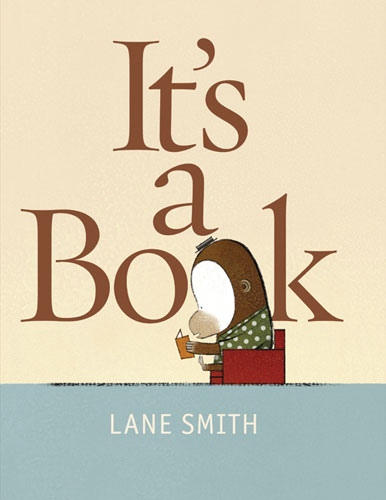
Lane Smith, It's a BookI’m surprised by the extent of the kerfuffle over the use of a single word in Lane Smith’s It’s a Book.  In her Amazon.com review, librarian Margaret Burke writes, “I usually love Lane Smith’s books but was disappointed with the word jackass in the first page. I will NOT put this book in my library collection.”  On her blog, Library Lady writes that the word “simply isn’t necessary” and that, although she “will still share the book in storytime,” she “just won’t read the last page.”  Even Adam Gopnik’s smart and otherwise laudatory review in the New York Times takes issue with the word, calling it a “false note” and a “too-easy joke.”

It is a joke, but easy?  I defy Mr. Gopnik and anyone else to come up with a better punch line.  “It’s a book, silly” and “It’s a book, donkey” simply are not as funny as “It’s a joke, jackass.”  The double meaning of the word “jackass” makes the joke work.  The character is both a male donkey and a foolish individual.  No other punch line will work as well here.

The joke is not exclusively “for adults,” as many Amazon.com reviewers allege.  It’s a joke for kids, too.  How do I know this?  I know this because kids will get the joke.  A joke for adults goes over the heads of children — so, for example, the humor of a joke that relies upon sexual innuendo would likely be lost on a 7-year-old.  But the “jackass” joke is one that a grade-schooler can get.  I suspect that what really upsets the book’s critics is the idea of a child laughing at this “jackass” joke.  Laughter conveys the child’s knowledge that the term for an animal is also a term for a blockhead.  Laughter confirms that the child is not as “innocent” as the adult wishes to believe.  Not willing to concede that his or her assumptions about the imagined innocence of children may be flawed, the adult instead strikes back at the evidence — which, in this case, is It’s a Book.

One Amazon.com reviewer even calls the word an “expletive,” but it isn’t.  “Jackass” is a noun, and certainly an insult to the character at whom it’s directed, but I wouldn’t elevate it to the status of “expletive.”  Nor would any reputable dictionary.  Neither Webster’s Unabridged nor the Oxford English Dictionary lists “jackass” as “slang,” “vulgar,” “offensive,” or “taboo word” (these latter two are terms used by the OED to describe some expletives).  It’s simply conveying the fact that this character is a bit of a dolt. And it’s making a joke as it does so.

Contemporary children face many serious problems: cuts in funding to education, overcrowded schools, poverty, bigotry, abuse, neglect, and so on.  The word “jackass” doesn’t even make the list.  I suppose one reason for opposing the word is that, unlike the many real problems faced by young people, this one seems more manageable.  It’s a single word, it’s uncomplicated, and standing up against it plays upon our culture’s Romantic (and still popular) ideas of children — that they’re innocent, more “pure” than adults.  For some critics, I expect, taking a “principled” stand against “bad language” is satisfying on many levels — emotional, moral, paternal/maternal, etc.

However, decrying the use of this word is also extremely silly.  “Jackass” is a male donkey.  “Jackass” is a fool.  And, in the case of It’s a Book, “jackass” is a joke.

Comments (11)

It’s a Lane Smith Book

Lane Smith, It's a BookComedy is hard.  Lane Smith makes it look easy.  I’m not going to reveal the punch line to his latest, It’s a Book, because I don’t have to: There are plenty of amusing moments along the way.  When the jackass asks, “Where’s your mouse?” Smith provides a wordless page in which a mouse emerges from beneath the monkey’s hat.  Deadpan.  And funny.  On his blog, he provides some insight into some of the labor behind the humor: the jackass was originally a child, but he didn’t want people to think he was mocking a child. So, he turned him into an animal. Which is funnier.  For some glimpses of the finished book, here’s a the book trailer, which, incidentally, also omits the punch line:

In many ways, It’s a Book epitomizes what Smith does.  Most of his books have some metatextual element to them.  That is, they’re books about books, books that reflect on what a book is or should be.  His first collaborations with Jon Scieszka — The True Story of the Three Little Pigs by A. Wolf (1989) and The Stinky Cheese Man and Other Fairly Stupid Tales (1992) — both dismantle fairy tales.  In the former, Al Wolf provides his version of what that huffing and puffing was all about.  In the latter, after Jack the Narrator spoils the story by summarizing it before it begins, the wolf and Little Red Running Shorts leave the story, creating a blank page in the book.  The Happy Hocky Family (1993) and The Happy Hocky Family Move to the Country (2003) parody Dick and Jane and similar primers.  In the first book, Henry and Holly Hocky tell us “We take CARE of our TOYS” because “We do not want our toys to become broken.” Then, enter Cousin Stinky, clad in bright red advertisements from the backs of comic books.  “Where are your toys?” he asks.  Smith follows that with this page:

A page from Smith's The Happy Hocky Family

I love this page.  It gently mocks the earnest good behavior of the preceding pages, where Henry and Holly model how children should take care of one’s toys.  Since Smith has been evoking the well-behaved children of the Dick and Jane books, you might think this page would be on the virtues of sharing, even with Cousin Stinky.  But no.  This page says if you want to take care of your toys, then lie to your cousin.  The comic timing is perfect.

So are all the details. From the ersatz Mondrian on the wall in It’s a Book to the presidential biographies strewn about Katy’s floor in Madam President (2008), Smith creates images that are fun to re-read.  The more you know, the more you notice: his version of Gilbert Stuart’s portrait of George Washington adorns the wall in Katy’s house and serves as the model for Smith’s version of the first president in John, Paul, George & Ben (2006) — the title of which, of course, is a comic riff on the Beatles.

page from John, Paul, George & Ben
The Beatles, Abbey Road

He’s also careful about the details he chooses.  The title page of John, Paul, George & Ben alludes to the Beatles’ Abbey Road (1969), but Smith shows restraint.  He does not show the “four lads” crossing the street or dressed in identical clothes, but he does place their bodies in the same positions as those of Harrison, McCartney, Starr, and Lennon. (Visually, John Hancock corresponds to George Harrison, Paul Revere to Paul McCartney, George to Ringo Starr, and Ben Franklin to John Lennon.)

Lane Smith, from It's a Book

In It’s a Book, he strips away anything that might distract us from the heart of the story — the conflict between the modern jackass and the traditional monkey.  His backgrounds are unusually spare, a change in color suggesting a change in tone or mood.   His language conveys the essential differences between the characters, which in turn creates the humor.

Yes, it’s a book.  But it’s also a fine example of storytelling, artwork, and humor.  In other words, it’s a Lane Smith book.

Comments (1)