Archive for Humor

Get on that pig, and hold on tight.

Baby Monkey (Going Backwards On A Pig).  Artwork by Nathan Mazur.With a hectic new semester about to begin (or, for many of us, already begun) and our new governor’s proposed assault on some of Kansas’ most vulnerable citizens, let us seek solace — and inspiration — in the verse of our greatest living YouTube poet, Parry Gripp.  As he counsels, when

The world has gone insane

and you don’t know what is right,

you got to keep on keepin’ on:

get on that pig, and hold on tight.

This of course is excellent advice for that baby monkey riding backwards (below).

It’s also sound advice for the rest of us.  The world does have a tendency to go “insane,” as Mr. Gripp suggests.  But we must not lose our grip (ha!).  We must “get on that pig, and hold on tight.”

Gripp‘s tunes offer insight into many other predicaments.  If you visit his website, you will also find hummable wisdom on the benefits of oatmeal (in your face, cholesterol!), the dangers of excessive self-Googling, and of course the versatility of our good friend the hamster.

In case you’re curious how a baby monkey came to be riding backwards on a boar, this wasn’t staged.  Both animals were orphaned, and live in the same zoo (in Japan, I think).  The zoo staff introduced them to one another, and they bonded.  Here’s the video clip that inspired Gripp’s song and video:

As aficionados of Gripp know, the “Baby Monkey” song made its debut in September 2010 (not incidentally, also the beginning of a semester).  And he posts a new song on his site every week.  So, check there or follow him on Twitter.

But, come what may, don’t let go of that pig!

Leave a Comment

Safety Last

When I was about 9 years old, watching television one weekend afternoon, I saw a black-and-white film of a bespectacled man climbing the side of a building.  He ascends a floor, narrowly misses falling, is about to enter the building through the window — then, another man emerges, with a policeman in pursuit, and tells the first man to keep climbing for just one more floor.  He does, and again nearly falls (but in a different way than previously).  The pattern repeats, he ascends higher, and the peril increases.  The film oscillates between anxiety and comedy.  I found it riveting.

Harold Lloyd in Safety Last

The film was Safety Last (1923), and the actor Harold Lloyd (1893-1971).  Ever since that afternoon, Lloyd has been imprinted on my imagination.  I will always think of that style of eyewear as “Harold Lloyd eyeglasses.”  (Indeed, when I met my agent for the first time, the first thing I noticed was that his glasses were just like Harold Lloyd’s. And before you ask, no, George is not an accident-prone comedian.  But he does do all his own stunts.)

A couple of years ago, I bought a DVD of the film, and watched it from the beginning, learning that the friend of the character played by Lloyd is supposed to climb the building as a publicity stunt. When the law catches up to the friend, Lloyd’s character ends up doing it instead.  I had not remembered this — I remembered only the intense nervousness of watching Lloyd’s casually dangerous climb, and of being unable to look away… while simultaneously wanting to look away.  And when I watch the film today, I have the same experience.

Given the anxiety it arouses, the image of Lloyd dangling from that clock (see above) is, I suppose, a strange choice for the background of my computer’s desktop.  And yet it’s been my “wallpaper” image for years.  Why?  Because I always feel that there’s never enough time?  Because I’m daily confronting my dislike of heights?  Those may be some of the reasons.  But the main reason, I think, is an acute sense of the precariousness of being alive. We’re here. And then we’re not here. As Woody Allen says in Annie Hall (1977),

There’s an old joke — two elderly women are at a Catskill mountain resort, and one of them says, “Boy, the food at this place is really terrible.” The other one says, “Yeah, I know — and such small portions.” Well, that’s essentially how I feel about life — full of loneliness, and misery, and suffering, and unhappiness, and it’s all over much too quickly.

Allen and Lloyd both understand that comedy and tragedy are not opposites.  They’re close kin.  And, in Safety Last, Lloyd dangles between them, always just a few fingers from falling. To borrow a joke from Steven Wright’s classic comedy record I Have a Pony (1985), “You know how it feels when you’re leaning back on a chair, and you lean too far back, and you almost fall over backwards, but then you catch yourself at the last second? I feel like that all the time.”

Leave a Comment

It’s a Joke, Jackass

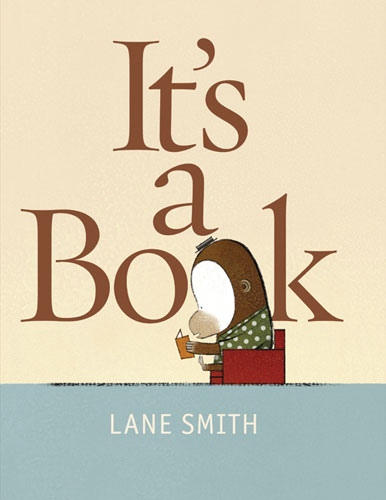
Lane Smith, It's a BookI’m surprised by the extent of the kerfuffle over the use of a single word in Lane Smith’s It’s a Book.  In her Amazon.com review, librarian Margaret Burke writes, “I usually love Lane Smith’s books but was disappointed with the word jackass in the first page. I will NOT put this book in my library collection.”  On her blog, Library Lady writes that the word “simply isn’t necessary” and that, although she “will still share the book in storytime,” she “just won’t read the last page.”  Even Adam Gopnik’s smart and otherwise laudatory review in the New York Times takes issue with the word, calling it a “false note” and a “too-easy joke.”

It is a joke, but easy?  I defy Mr. Gopnik and anyone else to come up with a better punch line.  “It’s a book, silly” and “It’s a book, donkey” simply are not as funny as “It’s a joke, jackass.”  The double meaning of the word “jackass” makes the joke work.  The character is both a male donkey and a foolish individual.  No other punch line will work as well here.

The joke is not exclusively “for adults,” as many Amazon.com reviewers allege.  It’s a joke for kids, too.  How do I know this?  I know this because kids will get the joke.  A joke for adults goes over the heads of children — so, for example, the humor of a joke that relies upon sexual innuendo would likely be lost on a 7-year-old.  But the “jackass” joke is one that a grade-schooler can get.  I suspect that what really upsets the book’s critics is the idea of a child laughing at this “jackass” joke.  Laughter conveys the child’s knowledge that the term for an animal is also a term for a blockhead.  Laughter confirms that the child is not as “innocent” as the adult wishes to believe.  Not willing to concede that his or her assumptions about the imagined innocence of children may be flawed, the adult instead strikes back at the evidence — which, in this case, is It’s a Book.

One Amazon.com reviewer even calls the word an “expletive,” but it isn’t.  “Jackass” is a noun, and certainly an insult to the character at whom it’s directed, but I wouldn’t elevate it to the status of “expletive.”  Nor would any reputable dictionary.  Neither Webster’s Unabridged nor the Oxford English Dictionary lists “jackass” as “slang,” “vulgar,” “offensive,” or “taboo word” (these latter two are terms used by the OED to describe some expletives).  It’s simply conveying the fact that this character is a bit of a dolt. And it’s making a joke as it does so.

Contemporary children face many serious problems: cuts in funding to education, overcrowded schools, poverty, bigotry, abuse, neglect, and so on.  The word “jackass” doesn’t even make the list.  I suppose one reason for opposing the word is that, unlike the many real problems faced by young people, this one seems more manageable.  It’s a single word, it’s uncomplicated, and standing up against it plays upon our culture’s Romantic (and still popular) ideas of children — that they’re innocent, more “pure” than adults.  For some critics, I expect, taking a “principled” stand against “bad language” is satisfying on many levels — emotional, moral, paternal/maternal, etc.

However, decrying the use of this word is also extremely silly.  “Jackass” is a male donkey.  “Jackass” is a fool.  And, in the case of It’s a Book, “jackass” is a joke.

Comments (11)

Crockett Johnson Laughs

Crockett Johnson was not a teller of jokes.  His sense of humor was wry, subtle, sardonic.  He’d quietly offer a well-turned phrase or make an off-hand observation that perfectly addressed the moment.  However, in contrast to his gentle delivery, he “had this sort of earthy laugh,”1 a “marvelous laugh.”2 Courtesy of Nina Stagakis, here is a previously unpublished photograph of Crockett Johnson laughing, circa 1967 — which would make Johnson 60 or 61.

Crockett Johnson Laughs, 1967.  Courtesy of Nina Stagakis.

Having had successful careers as both cartoonist and children’s author, Johnson at the time of this photo had recently embarked upon a new career: abstract artist and mathematician.  He would ultimately paint over 100 mathematically-inspired paintings, and publish two original theorems.

But he’s better remembered for the wit of his words, and the succinct elegance of his artwork’s clean, clear line. One reason his humor succeeded derived from a refusal to condescend to his audience.  As he put it, “Humor for children must be written for adults. I cannot think of a good, humorous children’s book that has not been.  An inconsistency or a line or situation that makes a grownup wince is almost certain to insult, or worse, bore a child.”3

The preceding is part of a series of musings on, material omitted from, and occasional excerpts from my forthcoming The Purple Crayon and a Hole to Dig: The Lives of Crockett Johnson and Ruth Krauss (UP Mississippi, 2012).  At present, none of the above is in the book.  When my editor returns the manuscript, perhaps I’ll find a way to work it in.  However, given that he’ll be writing with suggestions on how to cut 27,000 words, it’s more likely that you’ll only read the above here.

Harold laughs. From Crockett Johnson, Harold's Circus (1959).

from Crockett Johnson, Harold’s Circus (1959).

___________________

1. Dan Richter, telephone interview with Philip Nel, 28 June 2005.

2. Nina Stagakis, telephone interview with Philip Nel, 30 June 2001.

3. Crockett Johnson, in Weston Woods catalogue (Weston, CT: Weston Woods Studios, Inc., 1969), p. 12.

Leave a Comment

Parry Gripp, Commercial Jingles, & Other Good Music

What ever happened to commercial jingles?  When I was growing up, it seemed to me that most products had their own theme songs: “My bologna has a first name — it’s O-s-c-a-r,” “Plop, plop, fizz, fizz,” “Hershey is the great American chocolate bar,” “What walks downstairs, alone or in pairs, and makes such a slinkety sound?”

Parry GrippToday, most commercials just use pop songs that have little (or nothing) to do with the product. I enjoy a good pop song, and in fact have discovered some through their commercial use.  But the jingle mostly has gone out of fashion.

Well, save for Parry Gripp.  The frontman of Nerf Herder (perhaps best known for the theme to Buffy the Vampire Slayer), Gripp writes lots of songs that harken back to the commercial jingles of yore — except that he’s generally not selling anything.  He’s just writing very hummable ditties about his various obsessions… which usually include food or animals (especially hamsters and cats).

People seem to either love or hate Gripp, and probably for the same reason.  After one listen, his songs stay with you.  They’re earworms.  If you find his work too “pop” or simply too “silly,” you probably won’t appreciate “Hamster on a Piano” on an endless loop in your head.  On the other hand, if Gripp’s melodic whimsy appeals to your ear or to your sense of humor, his songs are too fun to resist.

Gripp appeals to the part of me that sang along with the “Slinky” song and tuned into Dr. Demento’s radio show every week. And, as some of the mixes I’ve posted here begin to reflect, I enjoy nearly all varieties of music.  To quote Ray Charles, “It’s like Duke Ellington said, there are only two kinds of music — good and bad. And you can tell when something is good.”  I like that statement because it establishes no aesthetic criteria other than each person’s particular taste.  And that’s as it should be.  When it comes to music, people should not feel obliged to apologize for their taste — say, admit liking a certain type of music, but then dismiss that type of music as “a guilty pleasure.”  With music, there are no guilty pleasures.  To paraphrase Charles’ citation of Ellington, there’s only good and bad, and you can tell when it’s good.

If you enjoy Parry Gripp or Ray Charles or Duke Ellington or Esquivel or AC/DC or Ella Fitzgerald or the Sex Pistols or Jay-Z or Beethoven or Emmylou Harris or Fats Waller or [insert name of artist/composer here], then that’s good music.  If you don’t, then listen something you do enjoy.

Leave a Comment