Archive for Humor

Dr. Seuss on “conditioned laughter,” racist humor, and why adults are “obsolete children”

In 1952, Dr. Seuss published an essay in which he pointedly critiqued racist humor. True, his own work — both before and after then — did contain stereotypes. In an essay that’s been languishing at American Quarterly since August 2010, I examine the conflict between Seuss’s progressive impulses and a visual imagination steeped in early twentieth-century caricature. But my point today — Martin Luther King Jr. Day, here in the U.S. — is to highlight Seuss’s anti-racism, and his awareness of how humor is implicated in social structures.

So, then, here is Seuss’s  ”… But for Grown-Ups Laughing Isn’t Any Fun,” which appeared in the New York Times Book Review, 16 Nov. 1952, p. 2.  (The asterisks are in the original — I presume they’re supposed to be ellipses.)


… But for Grown-Ups Laughing Isn’t Any Fun

Dr. Seuss

There are many reasons why an intelligent man should never ever write for children.  Of all professions for a man, it is the most socially awkward.  You go to a party, and how do they introduce you?  The hostess says, “Dr. Seuss, meet Henry J. Bronkman.  Mr. Bronkman manufactures automobiles, jet planes, battleships and bridges.  Dr. Seuss * * * well, he writes the sweetest dear, darlingest little whimsies for wee kiddies!”

Mr. Bronkman usually tries to be polite.  He admits there is a place in the world for such activities.  He admits he once was a kiddie himself.  He even confesses to having read Peter Rabbit.  Then abruptly he excuses himself and walks away in search of more vital and rugged companionship.

Wherever a juvenile writer goes, he is constantly subjected to humiliating indignities.  When asked to take part in a panel discussion along with other members of the writing fraternity he is given the very end seat at the table * * * always one seat lower than the dusty anthologist who compiled “The Unpublished Letters of Dibble Sneth, Second Assistant Secretary of Something-or-Other under Polk.”

Besides that, since we don’t make much money, our friends are always getting us aside and telling us. “Look, now.  You can do better.  After all, with all your education, there must be some way you could crack the Adult Field!”

The thing that’s so hard to explain to our friends is that most of us who specialize in writing humor for children have cracked the adult field and, having cracked it, have decided definitely that we prefer to un-crack it.  We are writing for the so-called Brat Field by choice.  For, despite the fact that this brands us as pariahs, despite the fact this turns us into literary untouchables, there is something we get when we write for the young that we can never hope to get in writing for you ancients.  To be sure, in some ways you are superior to the young.  You scream less.  You burp less.  You have fewer public tantrums.  You ancients are, generally speaking, slightly more refined.  But when it comes to trying to amuse you * * *!  Have you ever stopped to consider what has happened to your sense of humor?

30 x 30 blank space Seuss, illustration for "But for Grown-Ups, Laughing Isn't Any Fun" (1952)

“Him * * * ? Oh, he’s nobody. They say he writes for children”

When you were a kid named Willy or Mary the one thing you did better than anything else was laugh.  The one thing you got more fun out of than anything else was laughing.  Why, I don’t know.  Maybe it has to do with juices.  And when somebody knew how to stir those juices for you, you really rolled on the floor.  Remember?  Your sides almost really did split.  Remember.  You almost went crazy with the pain of having fun.  You were a terrible blitz to your family.  So what?  Your juices were juicing.  Your lava was seething.  Your humor was spritzing.  You really were living.

At that age you saw life through very clear windows.  Small windows, of course.  But very bright windows.

And, then, what happened?

You know what happened.

The grown-ups began to equip you with shutters.  Your parents, your teachers, your everybody-around-you, your all-of-those-people who loved you and adored you * * * they decided your humor was crude and too primitive.  You were laughing too loud, too often and too happily.  It was time you learned to laugh with a little more restraint.

They began pointing out to you that most of this wonderful giddy nonsense that you laughed at wasn’t, after all, quite as funny as you thought.

“Now why,” they asked, “are you laughing at that?  It’s completely pointless and utterly ridiculous.”

“Nonsense,” they told you, “is all right in its place.  But it’s time you learned how to keep it in its place.  There’s much more in this world than just nonsense.”

Your imagination, they told you, was getting a bit out of hand.  Your young unfettered mind, they told you, was taking you on too many wild flights of fancy.  It was time your imagination got its feet down on the ground.  It was time your version of humor was given a practical, realistic base.  They began to teach you their versions of humor.  And the process of destroying your spontaneous laughter was under way.

A strange thing called conditioned laughter began to take its place.  Now, conditioned laughter doesn’t spring from the juices.  It doesn’t even spring.  Conditioned laughter germinates, like toadstools on a stump.

And, unless you were a very lucky little Willy or Mary, you soon began to laugh at some very odd things.  Your laughs, unfortunately, began to get mixed in with sneers and smirks.

This conditioned laughter the grown-ups taught you depended entirely upon their conditions.  Financial conditions.  Political conditions.  Racial, religious and social conditions.  You began to laugh at people your family feared or despised — people they felt inferior to, or people they felt better than.

If your father said a man named Herbert Hoover was an ass, and asses should be laughed at, you laughed at Herbert Hoover.  Or, if you were born across the street, you laughed at Franklin Roosevelt.  Who they were, you didn’t know.  But the local ground rules said you were to laugh at them.  In the same way, you were supposed to guffaw when someone told a story which proved that Swedes are stupid, Scots are tight, Englishmen are stuffy and the Mexicans never wash.

Your laughs were beginning to sound a little tinny.  Then you learned it was socially advantageous to laugh at Protestants and/or Catholics.  You readily learned, according to your conditions, that you could become the bright boy of the party by harpooning a hook into Jews (or Christians), labor (or capital), or the Turnverein or the Strawberry Festival.

You still laughed for fun, but the fun was getting hemmed in by a world of regulations.  You were laughing at subjects according to their listing in the ledger.  Every year, as you grew older, the laughs that used to split your sides diminished.  The ledger furnished more sophisticated humor.  You discovered a new form of humor based on sex.  Sex, a taboo subject, called for very specialized laughter.  It was a subject that was never considered funny in large gatherings.  It was a form of humor you never indulged in at Sunday school.  It was a form of humor that was subtle and smart and you learned to restrict it for special friends.

And, by the time you had added that accomplishment to your repertoire, you know what had happened to you, Willy or Mary?  Your capacity for healthy, silly, friendly laughter was smothered.  You’d really grown up.  You’d become adults * * * adults, which is a word that means obsolete children.

As adults, before you laugh, you ask yourselves questions:

“Do I dare laugh at that in the presence of the boss?  Sort of dangerous, when you consider how he feels about Taft-Hartley.”

“How loud shall I laugh at that one?  Mrs. Cuthbertson, my hostess, is only laughing fifteen decibels.”

“Shall I come right out and say I thought the book was funny?  The reviewer in THE TIMES said the humor was downright silly.”

These are the questions that children never ask.  THE TIMES reviewer and Mrs. Cuthbertson to the contrary notwithstanding, children never let their laughs out on a string.  On their laughter there is no political or social pressure gauge.

That, I think, is why we maverick humorists prefer to write exclusively for children.


Someday, I hope someone will publish a collection of Seuss’s non-fiction. (Some years ago, I proposed such a collection to Random House. This is one of my many failed book ideas — they turned it down.)  Until that day, Seuss scholars and fans will have to seek out these pieces. If you happen to be seeking them, I give full bibliographic citations in Dr. Seuss: American Icon (2004) — borrow it from your local library.

Comments (5)

Syd Hoff, A. Redfield, and Me: Part II

Inspired by BoingBoing’s notice of my post on Syd Hoff’s leftist cartoons, I’m sharing another letter from the late Mr. Hoff, along with a cartoon from 1939.  As those who remember his first letter to me might recall, he and I corresponded — and spoke over the phone a few times — when I was working on Crockett Johnson and Ruth Krauss: How an Unlikely Couple Found Love, Dodged the FBI, and Transformed Children’s Literature (due out in fall 2012 from the University Press of Mississippi).

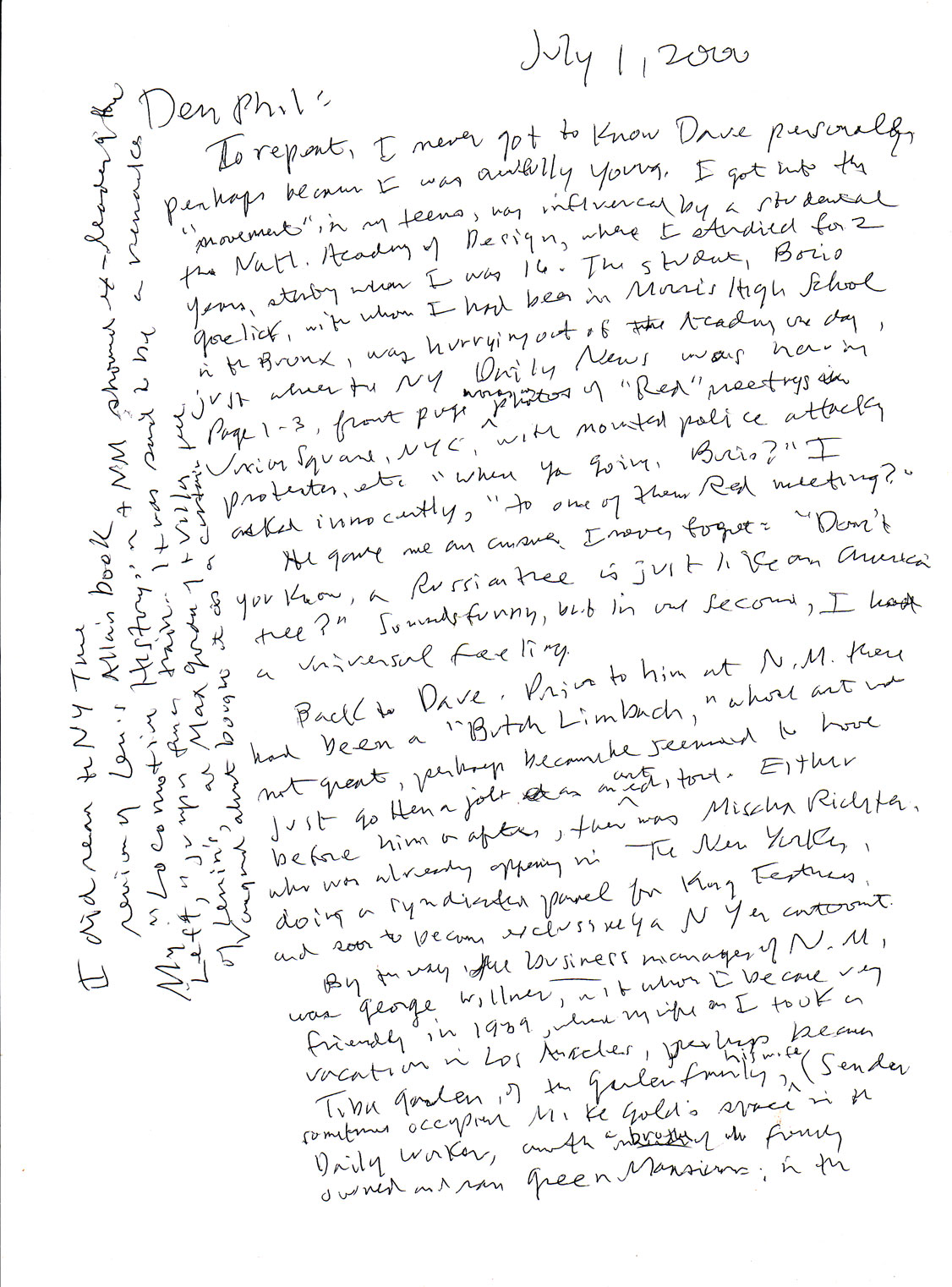
In the 1930s, Crockett Johnson was New Masses’ art editor, and Hoff contributed cartoons under the name A. Redfield — a pseudonym he reserved for his New Masses and Daily Worker pieces.  Here’s the first page of his third letter to me, followed by a transcription of the same.  He dated it July 1, 2000, but he intended to write August 1, 2000.  (His first letter was July 8, 2000, and his second was July 15, 2000; the one below was posted August 1st.)  The “Dave” you’ll see mentioned is Crockett Johnson, whose real name was David Johnson Leisk and who was known to his friends as “Dave.”

Syd Hoff, letter to Philip Nel, 1 Aug 2000, p. 1

Here’s the transcription, with “[?]” marking places where I’m unsure if my transcription is correct, and brackets [] indicating my own interpolated text:

July 1, 2000

Dear Phil:

To repeat, I never got to know Dave personally, perhaps because I was awfully young.  I got into the “movement” in my teens, was influenced by a student at the Natl. Academy of Design, where I studied for 2 years, starting when I was 16.  The student, Boris Gorelick, with whom I had been in Morris High School in the Bronx, was hurrying out of the Academy one day, just when the NY Daily News has having page 1-3, front page words[?] and photos of “Red” meetings in Union Square, NYC, with mounted police attacking protesters, etc.  “Where ya going, Boris?” I asked innocently, “to one of them Red meetings?”

He gave me an answer I never forgot: “Don’t you know, a Russian tree is just like an American tree?”  Sounds funny, but in one second, I had a universal feeling.

Back to Dave.  Prior to him at N.M. there had been a “Butch Limbach,” whose art was not great, perhaps because he seemed to have just gotten a jolt as an art editor.  Either before him or after, there was Mischa Richter, who was already appearing in The New Yorker, doing a syndicated panel for King Features, and soon to become a successful NYer cartoonist.

[Marginal note, running horizontally next to the above three paragraphs:] I did read the NY Times review of Lewis Allan’s book My “Locomotive History” — + NM showed ex-leaders of the Left, “jumping from a train..  It was said to be a remark of Lenin’s, and Max Gordon of Village Vanguard almost bought it as a curtain trim[?].

By the way, the business manager of N.M. was George Willner, with whom I became very friendly in 1939, when my wife and I took a vacation in Los Angeles, perhaps because Tiba Garlin, of the Garlin family, his wife (Sender sometimes occupied Mike Gold’s space in the Daily worker, with a brother member of the family owned and ran Green Mansions, in the

The “Locomotive History” comment references a Syd Hoff cartoon, published 28 November 1939.  It comments on all those who, after the Hitler-Stalin Pact of August 1939, left the Communist Party.  Riffing on Marx’s idea (and Lenin’s claim) that revolution is the locomotive of history, Hoff shows the locomotive leaving behind all those who have deserted the Party — suggesting that they’ve made a mistake in doing so.

Here’s page two:

Syd Hoff, letter to Philip Nel, 1 Aug 2000, p. 2

The transcription of page two:

Adirondacks, when the Group Theatre at least one summer was the entertainment, with Franchot Tone, its richest and one of its most talented stars.  Such guys as Morris Carnovsky, da Silva, John Garfield, and Elia Kazan etc. were always there, as well as S. Edna Bromberg[?], who eventually would die in London, probably because of a heart attack from being blacklisted in the U.S.A.

Another celebrity in stage and screen, was Philip Loeb, star of the Gertrude Berg TV show, “The Rise of the Goldbergs.”  Red Channels named Philip, demanded that he be dropped from the show, etc.  This was wonderfully done in Woody Allen’s movie, “The Front,” with Zero Mostel checking in at the Taft Hotel in Manhattan, calling room service for a bottle of wine, then dropping out of the 20th floor window, exactly like Loeb had done!

Cafe Society was to become the gathering place for the left in N.Y.  A short way downtown, opposite the Arch in the Village, the great writer (? — my memory fails me at times!) was writing articles for the Jewish Forward (Forvitz) for $5 a piece.  Eventually The New Yorker discovered these, ran them all (?) won a Pulitzer Prize.  His books are bestsellers yet!  He was always in Stewarts Cafeteria.

[Marginal note identifies writer:] Isaac Bashevis Singer

I never knew Seuss had drawn for N.M.  He first “rang a bell” with ads for FLIT, an insect repellent.  “QUICK, Henry, the FLIT!” Seuss character would yell.  I can’t recall “Doctor” ever being a red, though.

I’m trying to get around to answering some of your questions.  I drew for N.M. before my trip to the Coast in 1937, in fact, I

A correction: Dr. Seuss drew cartoons for PM, not for NM (New Masses).  Hoff’s misreading my letter to him, in which I mention Seuss’s work PM.  Hoff is right about Seuss not “ever being a red, though.”  Dr. Seuss was a liberal Democrat, but he wasn’t a leftist.

And page three:

Syd Hoff, letter to Philip Nel, 1 Aug 2000, p. 3

The transcription of page three:

had been doing a daily cartoon for the Daily Worker about right after I left the Academy.  “The Ruling Clawss” was the title Clarence Hathaway, its editor, who was coming up into the Party with Earl Browder gave it that title.  (How awful!  Hathaway would eventually be named in “Workers Enemies Exposed,” shortly before Browder himself, now obviously with “Alzheimer,” would appear on TV with Hamilton Fish of Congress, probably the worst reactionary person in American History.

[Marginal note with arrow pointing to above paragraph:] These remarks should not be printed because they’d destroy me as a “children’s author!”  Please refrain!

By the way, a very young Jack Gifford, was the MC of Cafe Society and he remained a close friend of Barney Josephson for the rest of his life.  Which reminds me, I finally tracked down the mural I had done, and have sent it to Mrs. J.  The widow of a friend of mine had it all the time, and unfortunately she folded it in an envelope.  I hope Terry can use it…  Oh yes, I recall in a bio of Judy Holiday, how she hated Comden and Greene, her old buddys at the Village Vanguard, for not ever sending word or coming to visit her when she was dying from Cancer.

Last words: I have done, am still doing “chalk talks.”  They are one-hour presentations, live drawings with commentary about my life, past and present, drawings of Danny and the Dinosaur, and some of my other books, plus a Weston Woods video of Danny.  Sixty minute shows with more particulars if any one is interested.

I apologize for my

Smith-Corona.

Best wishes,

Syd hoff

Box 2463

Miami Beach, FL 33140

You may be struck by the incongruity of the fact that Hoff writes, “These remarks should not be printed because they’d destroy me as a ‘children’s author!’  Please refrain!” … and yet you are reading these remarks on-line, in a public forum.  What do you think you’re doing? you may be asking.  Can you not keep the secrets of the dead?

Here’s my response.  First, Hoff wrote those words in 2000, five decades after the blacklist.  They show how thoroughly the blacklist imprinted itself on his psyche.  He himself was never blacklisted, though he does have an FBI file.  And, in 2000, the blacklist was history.  Uncovering the fact that an author or artist had contributed to the Daily Worker would not then be a career-ending revelation.

Second, this post does not break the news of Hoff’s political affiliations in the 1930s. I’m not sure who published that news first, but we might credit Julia Mickenberg’s Learning from the Left: Children’s Literature the Cold War, and Radical Politics in the United States (2006).  Julia and I also include this information in our Tales for Little Rebels (2008), which reproduces Hoff’s first children’s book, Mr. His (published by New Masses in 1939).  And, of course, two earlier blog posts on this site also divulge the information: “Syd Hoff, A. Redfield, and Me” (Nov. 2010), and “Syd Hoff’s Teeth” (Feb. 2011).

Third, if we don’t know the past, then we cannot learn from it.  For example, Julia discovered that children’s authors were largely exempt from the blacklist because the blacklisters thought children’s literature too unimportant a field to monitor (in part because most of its creators were women).  If we keep hidden the Left affiliations of Hoff, Wanda Gág, Crockett Johnson, and others, then this understanding gets lost.

We are, at present, reliving some of the same political battles of the 1930s — the role of progressive taxation in maintaining the welfare of the many, of government investment in creating jobs, of government as a necessary regulatory mechanism (in curtailing corporate excess).  Though the Estate Tax applies only to people who leave $5 million or more, its opponents call it the Death Tax — as if it applied to everyone.  As Hoff shows in this 1939 cartoon, the Estate Tax affects only the wealthiest among us.

"It isn't poor pater, Doctor. It's the inheritance tax." Cartoon by A. Redfield (Syd Hoff). Printed in New Masses, 16 May 1939.

Similarly, though strategic spending by the government helped get the U.S. out of the Great Depression, opponents of such investment today allege (without evidence) that it does not create jobs.  Though reckless speculation undid the world economy in 2008, opponents of regulation allege that reinstituting rules such as those provided by the Glass-Steagall Act would somehow be deleterious to business — despite the fact that Glass-Steagall helped stabilize the economy in the 1930s.  In the 1930s, progressives carried the day, instituting many of the social programs (welfare) and legislation (Fair Labor Standards Act, which abolished child labor; Minimum Wage) that we once took for granted.

History offers a guide for our future — if we’re willing to learn from it.  Occupy Wall Street notwithstanding, it’s not yet clear whether we’ll learn from the past or repeat past mistakes.

Related posts:

Comments (3)

Friday. Camp?

In naïve, or pure, Camp, the essential element is seriousness, a seriousness that fails. Of course, not all seriousness that fails can be redeemed as Camp. Only that which has the proper mixture of the exaggerated, the fantastic, the passionate, and the naïve.

— Susan Sontag, “Notes on Camp” (1964)

— Rebecca Black, “Friday” (2011)

And yet, as Sontag writes, “The ultimate Camp statement: it’s good because it’s awful . . . Of course, one can’t always say that. Only under certain conditions.”  Those conditions, she explains earlier in her essay, include an abundance of ambition: “When something is just bad (rather than Camp), it’s often because it is too mediocre in its ambition. The artist hasn’t attempted to do anything really outlandish. (‘It’s too much,’ ‘It’s too fantastic,’ ‘It’s not to be believed,’ are standard phrases of Camp enthusiasm.)”  Does the Rebecca Black tune have that abundance of ambition?

I’m not sure.  What makes this song “so bad it’s good” is its juxtaposition of outlandishly banal lyrics with a glossy pop production.  On the one hand, the song sounds slick, professional, expensive.  On the other, its lyrics read like a first draft — or, if there were something that preceded a first draft, then that.  I mean, sure, if you’ve had trouble remembering the order of the days of the week, “Friday” might prove a helpful mnemonic:

Yesterday was Thursday, Thursday
Today is Friday, Friday (Partyin’)
We, we, we so excited
We so excited
We gonna have a ball today

Tomorrow is Saturday
And Sunday comes afterwards
I don’t want this weekend to end.

That said, it is less useful in helping one decide which seat to choose.  Front seat? Back seat? I know I gotta make my mind up… just not sure.

So.  Is the song Camp?  Alex Carpenter’s cover version renders “Friday” in a Camp spirit:

His interpretation brings to mind Sontag’s claim that

Camp taste is, above all, a mode of enjoyment, of appreciation – not judgment. Camp is generous. It wants to enjoy. It only seems like malice, cynicism. (Or, if it is cynicism, it’s not a ruthless but a sweet cynicism.) Camp taste doesn’t propose that it is in bad taste to be serious; it doesn’t sneer at someone who succeeds in being seriously dramatic. What it does is to find the success in certain passionate failures.

On the other hand, “Friday (Groundhog Day Remix)” suggests that the song is merely bad, and not Camp:

The repeated destruction of the “Friday”-playing alarm clock conveys a visceral (and comic) dislike of the song.

My favorite version, and the one that ultimately sways me toward the “Camp” side of the argument, is the ersatz Bob Dylan version:

This performance is emphatically not Camp — which is precisely why it steers me towards the opinion that Rebecca Black’s version is Camp or, at least, can be appreciated as such.  The spare production of faux Dylan’s version brings the banality of the lyrics into focus, and the contrast between its starkness and Black’s original amplifies the Campiness in her version.  What was merely cheesy in her rendition now seems almost extravagantly so.

For the record, I, too, am “lookin’ forward to the weekend, weekend” — though I confess I anticipate no “Partyin’ partyin’ Yeah.”  This weekend leads into our March “break,” during which I hope to catch up on a variety of projects and obligations — uninterrupted by teaching or grading.  Speaking of which, I need to attend to some of the latter now.  Yeah.  Fun, fun, fun, fun.

Comments (6)

It Looks Like Snow

Remy Charlip, It Looks Like Snow (1957): coverAs winter continues its assault, let’s turn to a classic book about winter: It Looks Like Snow (Greenwillow, 1957), Remy Charlip‘s picture-book tribute to John Cage.  Like Cage’s 4’33″ (1952), Charlip’s piece makes the audience’s experience the subject of its experiment.  The primary difference of course is the specific sense through which we apprehend the art — eyes for Charlip, ears for Cage.  So.  Are your eyes ready, then?  Good.  Let’s begin.

The story starts like this:

Remy Charlip, It Looks Like Snow (1957): first two-page spread

And then:

Remy Charlip, It Looks Like Snow (1957): second two-page spread

After which, of course, we meet the protagonist:

Remy Charlip, It Looks Like Snow (1957): third two-page spread

And the protagonist’s pet:

Remy Charlip, It Looks Like Snow (1957): fourth two-page spread

And on it goes … for a total of 24 pages.  Ah, the beauty of the avant-garde!

If you enjoy books that defy expectation, check out Curious Pages: Recommended Inappropriate Books for Kids, the lately dormant but still very cool blog maintained by Lane Smith and Bob Shea.

Comments (7)

Animated Books

Just discovered this short film by Sean Ohlenkamp and Lisa Blonder Ohlenkamp: “Organizing the Bookcase.”  Charming, brief, with a delightful sense of humor, and… lots of books!  (Make sure you stay for the credits!)

Hat tip to Bookshelf Porn, which I found via Betsy Bird’s Fuse #8.

Update, 5 Sept. 2011: YouTube video had moved & so I changed the link.

Leave a Comment

Oh, the Thinks That He Thought! Some of Seuss’s lesser-known works

from Dr. Seuss's Oh the Thinks You Can Think!

Born 107 years ago today in Springfield Mass., Theodor Seuss Geisel had an extraordinarily prolific career.  Most people know him for the 44 books he wrote and illustrated under the name “Dr. Seuss.”  But that’s only part of his career.  He wrote another 13 books under the name “Theo. LeSieg,” one book as “Rosetta Stone,” and then there are books co-authored, books published posthumously, and books illustrated by others.  And those are only the books.  He did so much more!

So, in honor of his birthday, here are three other “thinks” that Seuss thought.

1. Gerald McBoing-Boing.  Featuring Dr. Seuss’s verse and the animation skills of Bill Melendéz (who would later work on the animated Peanuts specials), United Productions of America released Gerald McBoing-Boing in 1950.  The film would win an Academy Award for Best Animated Short.  The studio would go on to produce a few McBoing-Boing sequels and the Mr. Magoo cartoons.

2. The 5,000 Fingers of Dr. T. Seuss’s live-action musical, released in 1953, features notable performances by Tommy Rettig (later Jeff on TV’s Lassie) and Hans Conried.  For more info., you might take a look at this earlier blog post.  Below, a happily campy musical number featuring Mr. Conried as Dr. T.

3. Advertising, and lots of it. Before he was a children’s writer, Seuss was an ad-man.  Even after he started writing for children (his first children’s book was published in 1937), he still made his living in advertising.  The success of his 13th children’s book, The Cat in the Hat (1957), would change all that.  After the publication of The Cat, he was able to devote himself to writing for children full-time.  For more on Seuss’s ads, you might take a look at this earlier blog post.
Seuss: Flit ad (from UCSD's website)

And there are so many other areas we could explore — political cartoons, to name one example.  His paintings and other illustration work, to name two more.  But I’ll wrap things up in the next few sentences, and offer some suggestions where — in addition to the links throughout this post — you might go to learn more.  Depending on your threshold for flashy web design, you could check out Random House’s Seussville website: it features my biography of Seuss, along with abundant animation and sound effects (I suggest you mute your computer’s volume before clicking on either of the links in this sentence).  For a more complete biography, though, do turn to the primary source for what I wrote for Random House: Judith and Neil Morgan’s Dr. Seuss & Mr. Geisel (1995). Indeed, if you read only one secondary source on Dr. Seuss, that’s the book to read.

Oh, and happy Read Across America Day!

Comments (2)

How to Talk Nonsense

John Tenniel, Mad Tea Party

Last Friday, in my English 703: Critical Approaches to Children’s Literature class, the students and I spent 5 minutes talking nonsense.  We’d been reading theories of nonsense, and Lewis Carroll’s Alice books — I thought it would be both fun and educational to put those theories into practice.

So, based on our readings of Tigges, Anderson and Apseloff, and others, I had them enumerate some of nonsense’s formal qualities: language as game; use of puns, double meanings, inversions, opposites; playing on idiomatic language, taking figurative language literally; and so on.  Then, we prepared for the nonsense chat. I set it up as a conversation with me on the one side, and a student on the other.  These were the rules: (1) I asked them to raise their hands when they felt they had an entry point.  (2) When the student could sustain the nonsensical banter no longer, she or he was to pass off the conversation to the next person whose hand was raised.

If speaking nonsense isn’t your forte, you could modify the above exercise as follows: make the teacher both referee and equal participant (i.e., not obliged to hold up the entire side of the conversation).  Speaking nonsense comes quite easily to me.  (Try to contain your surprise.)  You see, my brain naturally comes up with multiple options in reply.  Most of the time, I chose the “sense” reply, and ignore the other options.  If I’m in a social situation, I listen to the other options, and will move back and forth between humor and seriousness, depending on my audience.

Anyway, back to class.  We sustained the conversation for 5 minutes, no problem.  (I wish we’d recorded it — some of our exchanges were quite funny.)  After we finished, I asked them about the experience of talking nonsense.  What had they learned?  This conversation was interesting.  As one student point out, it’s using language not to communicate, but to compete.  As another said, it’s an isolating experience — echoing a comment from nonsense scholar Wim Tigges, whose “An Anatomy of Nonsense” (1987) we read.  Speaking nonsense does, of course, heighten one’s awareness of language’s formal qualities: in order to speak it, you sustain syntax in order to subvert sense.  As Tigges puts it, “nonsense is not the absence of sense, but rather a frustration of expectations about sense” (25).  It plays on the tension between meaning and its absence.

I love to discover pedagogical “stunts” that work (I dislike such stunts for their own sake).  This, I am pleased to report, was a useful exercise.  It educated while it entertained.

Comments (4)

Syd Hoff’s Teeth: The Leftist Satire of A. Redfield

Redfield's The Ruling Clawss (1935): title pageWhile he was contributing to the New Yorker as Syd Hoff, he was also contributing to the Daily Worker and New Masses as A. Redfield — the pseudonym he adopted for his radical work.  The Ruling Clawss (Daily Worker, 1935) collects his cartoons originally published in the Communist daily.  Contrary to what all published biographies (except for the one in Julia Mickenberg’s and my Tales for Little Rebels) allege, Hoff’s first collection of cartoons was not Feeling No Pain (Dial, 1944).  His first such collection — and, in fact, his first published book — was The Ruling Clawss.  Here are a few selections.

Redfield's The Ruling Clawss (1935): "I wish mother would let me live like that for six months so I could write a novel."

Hoff mocks this bourgeois “artist” as a voyeur with no understanding of true suffering.

Redfield's The Ruling Clawss (1935): "... we who turn the wheels of industry ..."

This wealthy, well-fed speaker attempts to align himself with the workers.  He’s also oblivious to how thoroughly he is failing.  The workers’ stony expressions make that failure quite clear to us, though.

Redfield's The Ruling Clawss (1935): "Anybody who says there's starvation in America ought to have his head examined."

If you tuned in to Fox News during the presidency of George W. Bush, you would have heard sentiments similar to those expressed above.

Redfield's The Ruling Clawss (1935): "Give him a nickel, sweetheart. After all, you made a couple of million on the war."

In what may be the most acid cartoon in The Ruling Clawss, Hoff aims at those who profit from war, but remain indifferent to its human costs.

Redfield's Ruling Clawss (1935): "I'm against unemployment insurance — it would make people lazy"

Hoff attacks the still-current conservative argument that suffering is somehow ennobling or motivating.  Only someone who has never suffered could make such a claim.

Redfield's Ruling Clawss (1935): "Aren't you exaggerating just a little bit, Mr. Redfield?"

In “Social Satire,” an essay by Hoff (as Redfield) included as an afterword, the artist argues that most contemporary satirists are not sharp enough: “Today we have a new group of satirists who, at the same time that they bite the bourgeoisie, use only their lips, but not their teeth” (180).  He singles out Peter Arno, Otto Soglow (The Little King), Harold Gray (Little Orphan Annie), Sidney Smith (The Gumps), Chester Gould (Dick Tracy), and Percy Crosby (Skippy) for particular criticism.  He praises only Art Young, “the greatest satirist of his day.”  Everyone else falls short.  They “are talented and funny, but . . . their comedy is all too often a whitewash for people and conditions that, in reality, are not funny” (183).

Hoff (1912-2004) was something of a renaissance man in the field of cartooning.  He wrote syndicated comic strips, satirical cartoons (both with and without teeth), children’s books, and even a 400-page illustrated history of political cartooning.  All told, he was the author, illustrator, or author-illustrator of over 100 books.  Only a few of those books betray the political commitment of his youth — notably, Gentleman Jim and the Great John L (1977) and Boss Tweed and the Man Who Drew Him (1978).  The latter book is about Thomas Nast, another satirist who — like Hoff — created art that, sometimes, sunk sharp teeth into the powerful.

Redfield's Ruling Clawss (1935): left endpaper Redfield's Ruling Clawss (1935): right endpaper

Related posts:

Comments (27)

Crockett Johnson on humor

Crockett Johnson on humor.  From 1969 Weston Woods catalogue.

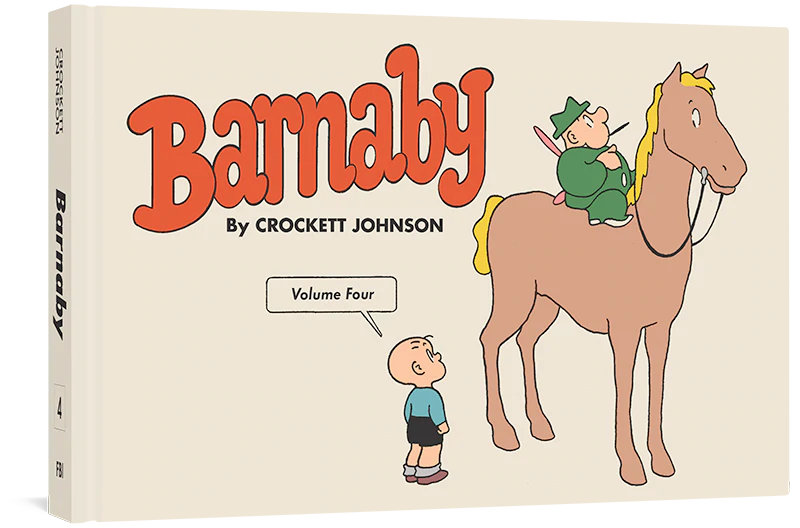
This appears in the 1969 catalogue for Weston Woods Studios. As far as I know, Crockett Johnson said these words on no other occasion. He did, in 1943, tell journalist Charles Fisher, “I don’t draw or write Barnaby for children. People who write for children usually write down to them. I don’t believe in that” — a sentiment echoed above.  But this Weston Woods catalogue is my sole source for these thoughts on humor. And, as it turns out, I ended up not using them in The Purple Crayon and a Hole to Dig: The Lives of Crockett Johnson and Ruth Krauss (forthcoming from the University Press of Mississippi, 2012).  Perhaps they’ll turn up in The Complete Barnaby (first volume due from Fantagraphics in 2012)?

And, with that brief excursion into some (currently) un-used materials gathered while researching the bio…, I’ll conclude.

Leave a Comment

Get on that pig, and hold on tight.

Baby Monkey (Going Backwards On A Pig).  Artwork by Nathan Mazur.With a hectic new semester about to begin (or, for many of us, already begun) and our new governor’s proposed assault on some of Kansas’ most vulnerable citizens, let us seek solace — and inspiration — in the verse of our greatest living YouTube poet, Parry Gripp.  As he counsels, when

The world has gone insane

and you don’t know what is right,

you got to keep on keepin’ on:

get on that pig, and hold on tight.

This of course is excellent advice for that baby monkey riding backwards (below).

It’s also sound advice for the rest of us.  The world does have a tendency to go “insane,” as Mr. Gripp suggests.  But we must not lose our grip (ha!).  We must “get on that pig, and hold on tight.”

Gripp‘s tunes offer insight into many other predicaments.  If you visit his website, you will also find hummable wisdom on the benefits of oatmeal (in your face, cholesterol!), the dangers of excessive self-Googling, and of course the versatility of our good friend the hamster.

In case you’re curious how a baby monkey came to be riding backwards on a boar, this wasn’t staged.  Both animals were orphaned, and live in the same zoo (in Japan, I think).  The zoo staff introduced them to one another, and they bonded.  Here’s the video clip that inspired Gripp’s song and video:

As aficionados of Gripp know, the “Baby Monkey” song made its debut in September 2010 (not incidentally, also the beginning of a semester).  And he posts a new song on his site every week.  So, check there or follow him on Twitter.

But, come what may, don’t let go of that pig!

Leave a Comment