Archive for Comics

Barnaby, Small Scandinavian Investors, and Dapper Dan: Can you help identify these allusions? UPDATE: Mysteries Solved!

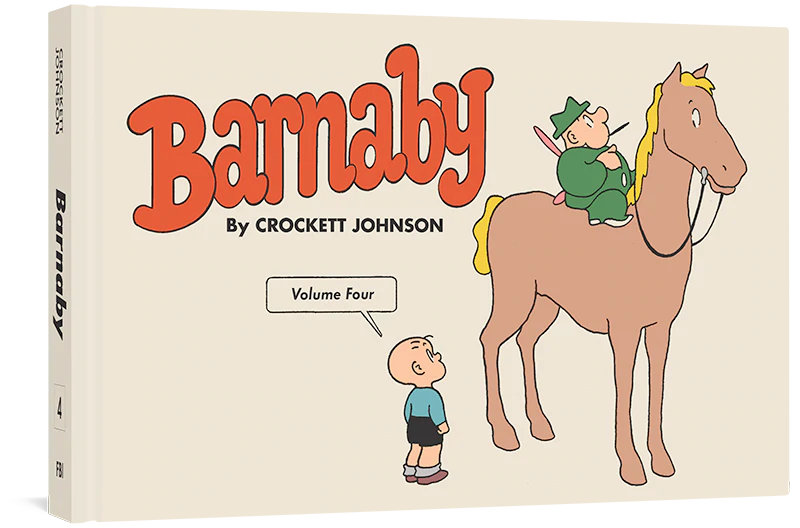
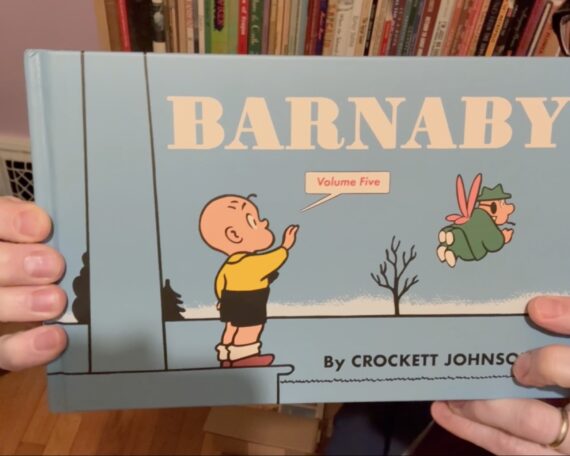
Crockett Johnson’s Barnaby (1942-1952) was both fantasy and topical satire. As noted on an earlier post, each of Fantagraphics’ 5-volume Barnaby series will have notes to explain the topical comments and any other references that may elude the average reader.

I’ve now finished the notes and Afterword for Barnaby Vol. 2: 1944-1945 (2014).

Almost.

There are two allusions that elude me.  Perhaps you can help?  Here are my questions along with the two relevant strips, which I’ve scanned from the Del Rey paperbacks (we’re using better versions of these strips in the volume itself — don’t worry).

Crockett Johnson, Barnaby, 28 Feb 1945

1. For instance, that Scandinavian Pixey, who— (28 Feb. 1945). This seems to be a reference to a specific (possibly diminutive) investor of Scandinavian descent, but I haven’t he foggiest idea as to whom it might be. As you can see in the strip above, Mr. Baxter says “Investment bankers don’t consider Pixies good risks, as a rule—.” He then adds, “Oh, they HAVE made a few exceptions…” and makes this comment.  So, clearly, at least some of Johnson’s readers would have caught this reference.

Crockett Johnson, Barnaby, 27 Apr 1945

2. Dapper Dan’s Outlet Emporium (27 April 1945).  If this is a reference to a specific business, I haven’t been able to find it.  When I was a kid, there was a Dapper Dan toy: a bald-headed man’s face, behind plastic. Using a magnet, you could move the little metal shavings (also encased in the plastic), and give him some hair, a moustache, beard.  But this can’t be it.  In the film O Brother, Where Art Thou? (2000), there’s Dapper Dan pomade, but this is a fictional brand, evidently used only in the film.  I need something that may have been around in 1945.

And, yes, of course, I’ll give credit where it’s due. (I realize that getting one’s name in the Acknowledgments is a rather small “prize” for your help, but,… well, I will to the Acknowledgments the names of those who help identify these two — unless you tell me you don’t want to be identified, that is.)  Thanks in advance for any thoughts you may have.

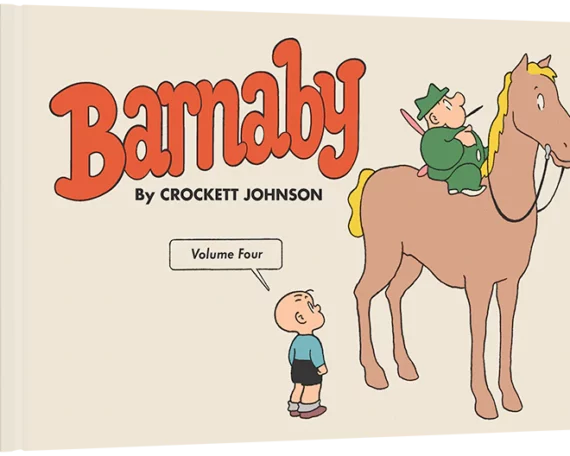
The first Barnaby volume is in press, and will be out in May or June. You can order it from Fantagraphics.

Barnaby, Volume 1

UPDATE, 4:15 pm.  Within less than an hour, both mysteries appear to be solved.  Via Facebook, Mark Newgarden suggests Ivar Kreuger, “the Match King,” as the “Scandinavian” allusion.  This makes sense.  It’s the kind of allusion Johnson would make.  He’s already had O’Malley proudly identify himself as mentor to Charles Ponzi.

Brian Herrera suggests “Dapper Dan” Hogan, a legendary Irish mobster.  The mobster was known for his style, and indeed appears to be the origin of the nickname “Dapper Dan.” Johnson loved detective fiction & true crime stories. This is the sort of allusion he would make. So, combine the historical allusion with an Outlet Emporium and you get a not-too-reputable source of fashionable menswear, exactly the sort of place where a captain of industry (as O’Malley is, at this point in the narrative) would not be expected to shop — hence, the joke.

Mark also points out that the name “Dapper Dan” precedes Daniel Hogan.  It had been attached to products prior to that time.  And there’s even an Eddie Cantor song, says Brian.  So, all of this is grist for my mill — and the note!

THANKS, MARK AND BRIAN!


Leave a Comment

Shrdlu, Minsky, Burke & Hare

When you look at Chris Ware’s post-Newtown New Yorker cover, the looks on the parents’ faces call to mind the previous month’s massacre in Connecticut. But 10 years from now, readers (I hope) will see just a scene of children entering a school as their parents watch intently. In creating the notes for Volume 2 of Crockett Johnson’s Barnaby, I’m facing this challenge as I work to help contemporary readers follow the political satire.

Johnson’s comic strip was a fantasy, and you can enjoy it without knowing the contemporary scene of 1944 to 1945.  But I’m one of those people who wants to know. In reading Fantagraphics’ beautiful Krazy Kat series, I was always a little disappointed when one of Herriman’s obscurities lacked an explanation in the book’s “Ignatz Debaffler Page.”  So, for Fantagraphics’ equally beautiful Barnaby series (the first volume of which should be available in March), I’m catering to the reader ­— like me — who wants to turn to the back of the book, and find an explanatory note.

In addition to being topical, Barnaby was also wide-ranging in its allusions. Johnson’s characters offer wry commentary on American politics in the 1940s, but also reflect his interests in mathematics, mystery novels, and popular culture. There are many referents that might be obscure even to his readers in 1944 and 1945.  On 28 September 1945, the lettering on a con-artist swami’s door reads “SWAMI ESYAYOUISIJA.”  I spent some time staring at this before realizing that the swami’s surname is “YES” in four languages: Pig Latin (ESYAY), French (OUI), Spanish (SÍ), and German (JA).

ShrdluEarlier that same month, Barnaby introduces a printer’s devil named “Shrdlu.”  He’s a friend of Barnaby’s fairy godfather, Mr. O’Malley. Why Shrdlu? A linotype machine arranged the letters in order of how frequently they were used. In English, that order is ETAOIN SHRDLU. On the machine, the first column (reading downward) was ETAOIN, and the second was SHRDLU. Thus, as the OED explains, “ETAOIN SHRDLU” are “The letters set by running a finger down the first two vertical banks of keys on the left of the keyboard of a Linotype machine, used as a temporary marking slug but sometimes printed by mistake; any badly blundered sequence of type.” So, Shrdlu is the ideal name for a newspaper employee who, as he explains on 4 September, is “responsible for all omissions, typographical errors, pied lines, switched captions and misspelled names.”

etaoin shrdlu from Linotype: The Film on Vimeo.

On 28 March 1944, O’Malley says he’s a devotee of Minsky’s brand of humor. Who? He’s referring to the comics employed by the Minsky Brothers, who were more famous for their risqué burlesque shows. Johnson’s also making an in-joke: one Minsky comedian, Jimmy Savo, provided some inspiration for the character of Mr. O’Malley.

O'Malley phones Burke & HareNear the beginning of his career as a Wall Street financier, Barnaby’s fairy godfather decides to phone a brokerage firm. So, he checks the phone book, and says “This firm’s name has a familiar ring to it. ‘Burke & Hare.’” The name may be familiar, but it’s not the kind of familiarity one associates with a reputable firm. It recalls the infamous Burke and Hare Murders of 1828. Over the course of 10 months in Edinburgh, Scotland, William Burke (1792-1829) and William Hare (1792-?) murdered 16 people, and sold the corpses to Dr. Robert Knox, who needed cadavers for his anatomy lectures.

Even though you don’t require these notes to enjoy the strip, a thorough editor (that’s me!) provides them… for the few readers who (like me!) want to know.

Barnaby Volume 2: 1944-1945 should be out in early 2014, and Barnaby Volume 1: 1942-1943 is due in March. I expect to receive an advance copy in the next week or two.

Note: All Barnaby images are from the Del Rey paperbacks (1985-1986). For the Fantagraphics books, expect higher-quality images and paper.

Barnaby, Volume 1

Coming in March, from Fantagraphics: Barnaby Volume 1: 1942-1943, co-edited by Philip Nel and Eric Reynolds. Design by Daniel Clowes. Introduction by Chris Ware. Essays by Jeet Heer and Dorothy Parker. Biographical Afterword and Notes by Philip Nel. You can pre-order it now.

Comments (5)

Barnaby, Vol. 1

Barnaby, Volume 1

The book went to press earlier this month, and will be out in the spring.  I can’t wait for you to see it.  Crockett Johnson’s Barnaby Volume 1 is truly a thing of beauty.

If you read any books published by Fantagraphics, this last sentence will not surprise you.  But in case you are not (yet) a Fantagraphics devotee, let me give you a little behind-the-scenes look at why this book looks so great.  (If you can’t wait to see a few glimpses, please scoot on over to Fantagraphics’ post on Barnaby Volume 1: it includes images and Daniel Clowes‘ rough sketch for the cover.)

Fantagraphics is perfectionistic in all the right ways.  At each phase of the process, Eric Reynolds — who is co-editing the Barnaby books with me — contacted me with specific questions.  Most recently, at page-proofs phase, we talked about the layout of my essay, as well as those by Chris Ware and Jeet Heer.  Dan Clowes put the epigraph for the first section of my essay in a Barnaby-style speech bubble.  I thought: that looks cool. Might we try the same treatment for the other epigraphs? We did, and liked the result.  Eric, Dan, and Fantagraphics designer Tony Ong also experimented with how to lay out my notes.  We proofread everything many times, had conversations about grammar and word choice.  Eric worked hard on getting the spacing just right on the back cover’s panels (visible, if too small to read clearly, on Fantagraphics’ post — and below).  If these details sound boring to you, they really shouldn’t.  This sort of keen attention to detail makes for a beautiful book.

Barnaby, Volume 1: cover

Fantagraphics works with the best people.  Daniel Clowes! Chris Ware! Jeet Heer!  Dan designed the book to look as if it were designed by Crockett Johnson in the 1940s.  When you look at (for example) the back cover, it does not look as if it was designed using contemporary software.  The lines look hand-ruled because (I believe) they were hand-ruled.  For the typeface, Dan used Futura because that’s the distinctive typeface of Barnaby — and, incidentally, of Ruth Krauss‘s The Carrot Seed, which Johnson illustrated & designed.  Chris wrote a beautiful, insightful introductory piece on Johnson and Barnaby.  I’m tempted to quote it here, but I think I’ll leave it as a surprise.  I will say, though, that there are few comics creators who can speak as lucidly as Chris can about how comics work.  I’ll also say that Chris’s piece will make you look at Harold (of purple crayon fame) in a new way.  And… that’s all I’ll say.  Comics scholar Jeet Heer’s introduction features the best description of Mr. O’Malley (Barnaby’s fairy godfather) that I’ve ever read: “half-pixie and half-grifter, an otherwordly being most at home in low-life dives and gambling dens, raider of other people’s fridges and cigar boxes, an inept wizard whose magic only works intermittently and often with unintended consequences, a self-mythologizer whose account of his own past glories is an improbable farrago of tall tales, a rhetorician quick to smooth over any difficulty with rococo eloquence and irrelevant digressions.”

Fantagraphics — specifically, Eric Reynolds — communicated with me clearly and regularly.  He was always clear, polite, and had the best interests of the project at heart.  A great guy to work with.  I’m delighted that we’ll be working together on volumes 2 through 5!  (We’re collecting the full ten-year run of Barnaby, 1942-1952, with two years in each volume.)

Finally, we could not have done this without the help of collectors who loaned us their newspapers or scanned strips — the Smithsonian, Harvard University, and Charles Cohen, in particular.  So.  Thanks to them!  Note to the curious: a complete collection of old newspaper strips are not just lying around in an archive.  You have to go looking for them.  It’s an enormous amount of work, and is one of the reasons Volume 1 took so long.  The other is Fantagraphics’ admirable perfectionism.

So.  This spring.  Barnaby Volume 1.  Get it!

Comments (2)

Children’s Literature and Comics/Graphic Novels at MLA 2013

MLA Boston 2013

For those heading to the MLA in Boston (3-6 January 2013), here’s a handy list of panel sessions on either children’s literature or comics/graphic novels.  I compiled the list below by searching the MLA’s program for children’s literature (so, I may have missed some), and by re-posting the comics/graphic novels sessions from the MLA Comics/Graphic Narratives Discussion Group: sessions sponsored by the group & other comics/graphic novels events — I strongly encourage you to visit those pages for more information.  The second of the two pages also lists individual papers on comics and graphic narratives.


90. Paintings and Photographs Remediated in Film, Graphic Narrative, and Newspaper

Thursday, 3 January, 3:30–4:45 p.m., Riverway, Sheraton Boston

Program arranged by the International Society for the Study of Narrative and the American Comparative Literature Association

Presiding: Emma Kafalenos, Washington Univ. in St. Louis; Lois Parkinson Zamora, Univ. of Houston

  1. “The Remediation of Painting within Cinematic Narrative Discourse,” David Henry Richter, Queens Coll., City Univ. of New York
  2. “Remediated Photographs and Reconstructed Memories: Personal and Familial Pasts in Fun Home: A Family Tragicomic,” Genie Giaimo, Northeastern Univ.
  3. “Front-Page Ekphrasis,” Lisa Zunshine, Univ. of Kentucky

105. Theorizing the Early Reader

Thursday, 3 January3:30–4:45 p.m., Jefferson, Sheraton

Program arranged by the Division on Children’s Literature

Presiding: Abbye Meyer, Univ. of Connecticut, Storrs

  1. “Curiosity Killed the Kid: The Drive for Knowledge in Early Readers,” Jennifer M. Miskec, Longwood Univ.
  2. “Empathy and the Developing Reader,” Karen Coats, Illinois State Univ.
  3. “From ‘Loose Baggy Monsters’ to ‘Terrific Fun!’: Adaptations of Victorian Novels for Young Readers,” Katie R. Peel, Univ. of North Carolina, Wilmington

132. Black Studies and Comics

Thursday, 3 January, 5:15–6:30 p.m., Back Bay D, Sheraton Boston

Program arranged by the Discussion Group on Comics and Graphic Narratives

Presiding: Qiana Joelle Whitted, Univ. of South Carolina, Columbia

  1. “(In)Visible Bodies: Rewriting the Politics of Passing in Incognegro, a Graphic Mystery by Mat Johnson and Warren Pleece,” Christophe Dony, Univ. of Liège
  2. “Birth of an Imperium: Tragedy, Comedy, and the Graphic Representation of African American History,” Jonathan W. Gray, John Jay Coll. of Criminal Justice, CUNY
  3. “A Work of Its Time and a Timeless Work: The Spirit, Ebony White, and Will Eisner’s Legacy,” Andrew James Kunka, Univ. of South Carolina, Sumter

201. Margin Call: The Marginalization of (Children’s) Poetry

Friday, 4 January8:30–9:45 a.m., Jefferson, Sheraton

Program arranged by the Division on Children’s Literature

Presiding: Michael Joseph, Rutgers Univ., New Brunswick; Joseph Terry Thomas, San Diego State Univ.

  1. “New-Found Tongues,” Lissa Paul, Brock Univ.
  2. “(Mis)Reading Romantic Children’s Verse,” Donelle Ruwe, Northern Arizona Univ.
  3. “If This Is the Golden Age of Children’s Poetry, Why Is Everything So Yellow?” Richard McDonnell Flynn, Georgia Southern Univ.

303. Graphic Lives in Wartime

Friday, 4 January, 1:45–3:00 p.m., The Fens, Sheraton Boston

Program jointly arranged by the Division on Autobiography, Biography, and Life Writing and the Discussion Group on Comics and Graphic Narratives

Presiding: Linda Haverty Rugg, UC Berkeley; Joseph (Rusty) Witek, Stetson Univ.

  1. “Joe Sacco on Joe Sacco,” Julia Watson, Ohio State Univ., Columbus
  2. “Ethical Obligation in the Wartime Graphic Memoir: Theorizing the Face in Marjane Satrapi’s Persepolis,” Joseph Darda, Univ. of Connecticut, Storrs
  3. “Atomic Bomb Manga,” Hillary Chute, Univ. of Chicago
  4. “Views from Nowhere: Journalistic Detachment in Joe Sacco’s Palestine,” Marc Singer, Howard Univ.

504. New England DIY (Do-It-Yourself) Comics

Saturday, 5 January, 12:00 noon–1:15 p.m., The Fens, Sheraton Boston

Program arranged by the Discussion Group on Comics and Graphic Narratives

Presiding: Martha B. Kuhlman, Bryant Univ.

  1. “Minicomics and the Graphic Nonnovel,” Isaac Cates, Univ. of Vermont
  2. “Comics Culture and Community: Providence,” Martha B. Kuhlman
  3. “‘Like Us Be Free and Bold’: Innovation, Rebellion, and Self-Reliance in Boston Minicomics,” Susan E. Kirtley, Portland State Univ.
  4. “The Illegitimate Sons of Superman: DIY Publishing and the Rutland Halloween Parade,” Craig Fischer, Appalachian State Univ.

608. Children and Fame

Saturday, 5 January3:30–4:45 p.m., Public Garden, Sheraton

Program arranged by the Children’s Literature Association

Presiding: Nicole Lynne Wilson, Wayne State Univ.

  1. “Girls Just Want to Control the Fun: Power and Fame in Gossip Girl and The Clique,” Anne Layman Horn, Temple Univ., Philadelphia
  2. “‘The World Will Be Watching’: The Panoptic Nature of Fame in Suzanne Collins’s Hunger Games Trilogy,” Nicole Lynne Wilson
  3. “‘Un-Chosen One Roolz!’: Sidekicks, Fame, and Autonomy in the Harry Potter Novels and Un Lun Dun,” Jennifer Mitchell, Weber State Univ.

623. Gender(ed) Performativities in Latin American and Latina/o Graphic Novels

Saturday, 5 January, 5:15–6:30 p.m., Room 205, Hynes Convention Center

Program arranged by the Division on Twentieth-Century Latin American Literature

Presiding: Hilda Chacón, Nazareth Coll. of Rochester

  1. “Unbecoming Cuban American: Representations of Female Subjectivity in Bad Habits: A Love Story, by Cristy Road,” Irune del Rio Gabiola, Butler Univ.
  2. “Ashes and Masks: Gender according to Gilbert Hernandez,” Christopher Pizzino, Univ. of Georgia
  3. “Trans-nepantlista Visual Geographies and the Inked Latina Body: Ana Mendieta’s Graphic Life Writing,” Emma Ruth García, Colby Coll.; Magdalena M. Maiz-Peña, Davidson Coll.

657. Cash Bar Arranged by the Discussion Group on Comics and Graphic Narratives

Saturday, 5 January, 7:00–8:15 p.m., Independence West, Sheraton Boston

To quote the description from the MLA Discussion Group on Comics and Graphic Narratives’ blog, “Please join us for this informal mixer—and help us chart our future! Members of the Discussion Group’s Executive Committee will be on hand to chat about our programming, our plans, and the further growth of comics studies at the MLA. We invite your input, and hope to connect with all those who are interested in comics scholarship. Not to be missed!”


676. Re–Understanding Comics

Sunday, 6 January, 8:30–9:45 a.m., Gardner, Sheraton Boston

A special session

Presiding: Margaret Galvan, Graduate Center, City Univ. of New York

  1. “The Citational Uses and Abuses of Understanding Comics and the Scholarly Futures They Forecast,” Michael Chaney, Dartmouth Coll.
  2. “Living Lines: Comics as a Phenomenological Encounter,” David Bahr, Borough of Manhattan Community Coll., City Univ. of New York
  3. “Drawing on Theory,” Samantha Close, Univ. of Southern California

Responding: Charles Hatfield, California State Univ., Northridge


695. Race, Girlhood, and Social Justice in Children’s Literature

Sunday, 6 January10:15–11:30 a.m., Beacon A, Sheraton

Program arranged by the Children’s Literature Association and the MLA Committee on the Literatures of People of Color in the United States and Canada

Presiding: Michelle Holley Martin, Univ. of South Carolina, Columbia

  1. “A Credit to Their People: Race and Resilient Rebirth in Ntozake Shange’s Whitewash and Alma Flor Ada’s My Name Is Maria Isabel,” Ada McKenzie, Coll. of the Bahamas
  2. “Battling for Opportunity: The Girl Soldiers of Shuttered Windows and Warriors Don’t Cry,”Sara Schwebel, Univ. of South Carolina, Columbia
  3. “Fired Up: Compromising Social Justice in the Figure of the Girl,” Sarah Sahn, Univ. of Illinois, Urbana

Responding: Kristen Proehl, Clemson Univ.


709. Picturing Photography in Graphic Memoirs

Sunday, 6 January, 10:15–11:30 a.m., Berkeley, Sheraton Boston

A special session

Presiding: Courtney Baker, Connecticut Coll.

  1. “The Queer Contest between Modern and Postmodern Modes of Vision in Alison Bechdel’s Fun Home,” Robin Bernstein, Harvard Univ.
  2. “Drawn Photographs and the Performance of (Post)Memory in Carol Tyler’s You’ll Never Know,” Mihaela Precup, Univ. of Bucharest
  3. “‘I Saw It’: The Photographic Witness of Keiji Nakazawa’s Barefoot Gen,” Laura Wexler, Yale Univ.

790. Comics, Moving Images, and Intermedial Criticism

Sunday, 6 January, 1:45–3:00 p.m., Gardner, Sheraton Boston

Program arranged by the Division on Film

Presiding: Nicholas Sammond, Univ. of Toronto; Paul D. Young, Vanderbilt Univ.

  1. “Autobiographical Constructions: Authorial Absence and Presence in Julie Doucet and Michel Gondry’s My New New York Diary,” Frederik Køhlert, Univ. of Montreal
  2. Avatar: The Last Airbender and Shifting Intermedial Spaces,” Sandra K. Stanley, California State Univ., Northridge
  3. “Spiegelman’s Home Movie: Art at Auschwitz,” Brad Prager, Univ. of Missouri, Columbia

Leave a Comment

Teaching Building Stories

Chris Ware's Building Stories (2012). Photo by Alan Trotter.As one of the first people to teach Chris Ware’s Building Stories (which just came out last month), I thought I would share what I’m planning. Given the loud and enthusiastic acclaim that has greeted Building Stories, I expect that others will also teach the work.  (To the best of my knowledge, the only other person teaching Building Stories this term is Dave Ball.)  As serious readers of comics and graphic novels already know, Building Stories is a box containing fourteen textual objects — book, booklets, magazines, newspapers, Little-Golden-Book-designed book, small folded strips, board game, and the box itself (which resembles the box to a board game).

This poses some challenges.  Since these items can be read in any order, where do you begin?  Should you impose an order at all?  For practical reasons, I have imposed an order.  I’ve told students that they can read this work in any order they like, but we have a specific order in which we’ll be discussing it, in class.  The order in which the items emerge from the box determined my order.  That, I figured, was both arbitrary and consistent.  I say “consistent” because I expect that all boxes were packed similarly: so, each reader would encounter this “order” first.  As we get deeper into the work, I will also ask about how order shapes our sense of chronology and meaning.  However, to start, I’ve dived the class into groups of two or three, assigned each a section on which they’ll become an “expert,” and provided some “generic” questions.  Here’s what I told the students when I announced this plan a month ago, followed by a collection of readings (on Building Stories) that I’ve been collecting since then.  (My name for each section derives either from the first lines of text or from something more descriptive.)

Chris Ware, Building Stories (unpacked)


As mentioned in class today (16 Oct.), I’ve divided up the readings for Chris Ware’s Building Stories — this is on the page I handed out in class, and the syllabus’s Schedule of Readings (scroll down).  As I also mentioned, the book is the graphic novel event of the season.  It made its debut about 2 weeks ago, and was the best-selling book on the New York Times‘ Graphic Books list this past Sunday (14 Oct.).  In this post, I’m listing: (1) the questions (same as those handed out in class), (2) the list of readings, and (3) links to some of the many reviews, essays, and stories that have been published in the past few months.


THE QUESTIONS

  1. What stories does this part (or these parts) build?  Provide at least three examples.
  2. What do we learn about our unnamed protagonist (the amputee)?  In some cases, the connection will be more challenging to make. Pick three moments.
  3. Why tell this story in this form (book, newspaper, magazine, booklet, etc.)?
  4. What questions do you have?  These can be discussion questions or simply subjects that perplex you.

Each group (or pair) should address these questions, and bring them with you on your day.  Bring an extra copy for me, so that I can follow along during discussion.


SCHEDULE OF READINGS

13 November

Group 1

1) [wordless / 7.5 x 25 cm / nights and days]

2) “God… I can’t bear it… I can’t… I can’t” / “I don’t care… I just don’t care…” [2-sided folded strip]

3) “Her laugh is like a flight of tiny birds, taking off…” / “Momma, I don’t know how I feel right now. I mean, I don’t know how to say it. I’m just not happy or sad. I’m in between.” [2-sided folded strip]

4) Branford, the Best Bee in the World

Group 2

5) September 23rd, 2000 [Golden Book]

15 November

Group 3

6) “Shit” [magazine]

7)”VVVFFFMMMMMMMMMMM” [magazine]

8) DISCONNECT [larger magazine]

27 November

Group 4

9) “I JUST WANT TO FALL ASLEEP AND NEVER WAKE UP AGAIN” / [Acme Novelty Library No. 18]

29 November

Group 5

10) The Daily Bee [newspaper]

11) “Recently, my high school boyfriend friended me on Facebook…” / “As a kid, I could sit in front of a mirror and stare at myself for hours, trying to imagine what I’d look like when I grew up…” [newspaper]

12) “Before winter starts” [architecture / blueprint / board]

Group 6

13) “god…” [newspaper]

14) “It all happened so fast… When I think back now I almost can’t believe it” [newspaper]

15) Building Stories [the box]


LINKS

Interviews

  • Kevin Larimer, “The Color and the Shape of Memory: An Interview With Chris Ware,” Poets & Writers Nov.-Dec. 2012.
  • Casey Burchby, “The Life Cycle of a Cartoonist: An Interview with Chris Ware,” Los Angeles Review of Books, 25 Oct. 2012.  Wherein Mr. Ware observes, “books offer a sort of reassuring physical certainty for the ineffable uncertainties of life, but then again I’m 44 and don’t tweet or have a Facebook page or participate in most of the things that blunt the textures of experience in favor of delivering them up more quickly to your friends, so maybe that’s just me.”
  • Debbie Millman, “Chris Ware,” Design Matters, 19 Oct. 2012.  45-minute audio interview.
  • Stephen Carlick, “Building stories with graphic novelist Chris Ware,” MacLean’s, 19 Oct. 2012.
  • John Williams, “Book Review Podcast: Chris Ware’s ‘Building Stories,’” New York Times Book Review podcast, 19 Oct. 2012.
  • Rosanna Greenstreet, “Q+A: Chris Ware,” The Guardian, 12 Oct. 2012.  In which Mr. Ware reports, “My head looks like an uncooked ham with glasses.”
  • Françoise Mouly, “The Quotable Chris Ware,” The New Yorker, 12 Oct. 2012.  Click through each picture (at bottom) to find such quotations as: “I don’t think of myself as an illustrator. I think of myself as a cartoonist. I write the story with pictures—I don’t illustrate the story with the pictures.”
  • Chris Mautner, “‘I Hoped That the Book Would Just Be Fun’: A Brief Interview with Chris Ware,” The Comics Journal, 10 Oct. 2012.  Wherein Mr. F.C. Ware provides a helpful definition: “memory is more like a gem or a flower or a three-dimensional something that we can turn and turn inside out and get into and out of.”
  • Kat Ward, “Inside Chris Ware’s Graphic-Novel-in-a-Box,” Vulture, 7 Oct. 2012. Repr. from New York Magazine, 15 Oct. 2012.
  • “Good Minds Suggest—Chris Ware’s Favorite Concept Books,” Good Reads, Oct. 2012.
  • Calvin Reid, “Life in a Box: Invention, Clarity and Meaning in Chris Ware’s ‘Building Stories,’” Publishers Weekly, 28 Sept. 2012.  In which Chris Ware offers some insight into his creative process: ”I try to write in a way that hopefully reflects something of how I experience life happening…. What it’s like to be inside a body experiencing the world with all the myriad multi-layers of thoughts and memories that happen at the same time. And then the way that those things contradict each other and then the way that we think of ourselves as people, somehow all layered together.” And explains why he prefers books to e-books: “There’s something about the ideas and thoughts and feelings and uncertainties that go into books that demand a certain opposite and opposing structure to contain them. It’s almost like an aesthetic necessity that the books have, they have to confine and protect these ineffable things in a way.”
  • Christopher Irving, “Chris Ware on Building a Better Comic Book, “ Graphic NYC, 6 Mar. 2012.  A long interview, in which Ware observes, “I do believe that cartooning, a very memory-based art, has something fundamental to do with a constant sort of revision of ourselves and our lives, the same sort of resorting and refiling that goes on when we’re dreaming.”  When the interviewer observes, “Your comics, especially, are about memory,” Mr. Ware responds: “Because that’s what life is. It’s all we have.”

Essays

Reviews

Other


That (the above) is what they have to get us started.  At times, I wonder if I’m a little ambitious in assigning this dense, layered, beautiful, complex, experimental work to an undergraduate class on graphic novels.  But, based on my experience with the class so far, I think they’ll rise to the challenge.  In any case, teaching Ware is like teaching James Joyce or (in a children’s literature class) Lewis Carroll.  The bright, thoughtful students tend to be intrigued, and embrace the experiment.  Other students require more help in making sense of it.

Teaching Ware is also like teaching Joyce or Carroll because Ware changes our understanding of what the medium can do.  He writes strips that can (and must) be read in more than one direction, pages that need to be read multiple times, and books that make other cartoonists feel that they need to rethink their approach to comics.  If you’re teaching a class in graphic novels or comics, you have to teach Ware.  He pushes the medium further, and (I expect) will be pushing my students in the coming weeks.  So.  Here’s to the grand experiment!

Image sources: Alan Trotter’s 5∞, Mark Hayes’ Passing Notes.

Giving credit where it’s due: I found most of those links via Dave Ball’s Facebook page or his The Comics of Chris Ware: Drawing Is a Way of Thinking Facebook page.

Comments (6)

Moomins!

Left to right: Sniff, Snufkin, Moominpappa, Moominmamma, Moomintroll, Mymble, Groke, Snork Maiden, Hattifatteners

In America, children generally do not grow up with Tove Jansson’s Moomins as part of their childhood. Why is this? In other parts of the world, the Moomins are well-known and loved. There have been several animated television series made in countries as different as Japan, Sweden, and even the Soviet Union. There’s an amusement park in Finland. There are picture books, chapter books, and a comic strip. And there’s every imaginable product, as I learned a few weeks ago at Helsinki airport’s Moomin Store.

Moomin figurines at Moomin Store, Helsinki airport

Karin and I talked about this last night, and here are a few thoughts why people (of any nationality) should read the books, and perhaps why they have not caught on as well in the States as they have in other countries.  Following that, a few basic facts about the series and their creator.

1) Fun and philosophical.  Like A. A. Milne and E.H. Shepherd’s Winnie the Pooh books, Jansson’s Moomin books feature visually appealing characters with a gently philosophical turn of mind.  Generally speaking, the Moomins look like a cross between Winnie-the-Pooh and a hippo (but a cuddly one).  They grapple with such questions as whether mother still loves us, finding one’s home and family in the face of natural disaster, how we mourn the dead, and whether there will be enough jam for the pancakes.  And, as the last item on my list indicates, Jansson tackles big ideas with a light touch.  The books are warm, funny, and generous of heart.

Moominmamma, Moominpappa, Moomintroll, Snork Maiden

2) The books are about community.  They’re about more than just the Moomin family; they’re about others who live in (or just happen to be passing through) Moominvalley. There are the members of the gently bohemian Moomin family: Moominmamma, Moominpappa, Moomintroll.  There’s the Snork Maiden, Moomintroll’s on-again/off-again girlfriend; her brother, the Snork; Snufkin, traveler, troubadour, and Moomintroll’s best friend; Little My, a strong-willed, mischievous, independent Mymble; and Sniff, a capitalist version of Piglet, and friend of Moomintroll’s.  There are also Thingumy and Bob, small creatures who speak in Spoonerisms; the Niblings, hungry creatures who enjoy educational games; and many more. Moomin fans will fault me for neglecting the Hemulens, Fillyjonk, Too-Ticky, the Hattifattners, the Groke, and so on.  But the point here is that the Moomins are the glue that hold the community together.

3) The Moomins want to live life on their own terms — though not at the expense of others.  They’re individuals, but not selfish.  Community is important, but so is pursuing one’s own dreams.  On a related note, I also love the fact that they hibernate during the long, cold Scandinavian winters — a fact which motivates the plot for Moominland Midwinter (1958). One winter, Moomintroll wakes up, and decides that he wants to experience the season.

Moomintroll in Tove Jansson's Moominland Midwinter

4) Where to start? If you haven’t read the Moomin stories, you need to. But where do you begin?  In English translation, there are 9 chapter books, 3 picture books, and 6 volumes (and counting) of the Moomin comic strip.  I recommend starting with Finn Family Moomintroll (first published in the US as The Happy Moomins, 1952) or Moominsummer Madness (1955).  Though not the first two books in the series, they offer the strongest introduction.  Purists may want to start with Comet in Moominland (1951) or even The Moomins and the Great Flood, the very first book (though the last translated into English, probably because it omits most major characters).  As an alternate choice, Drawn & Quarterly’s beautiful collections of the Moomin comic strip offer a great introduction.  The strip can be a bit more topical and more surreal, but it also provides more of Jansson’s art, which is always a pleasure.

Tove Jansson, Finn Family Moomintroll (current edition)
Tove Jansson, Moominsummer Madness (current edition)

5) Wait. What are all the books, again?

The chapter books:

  1. The Moomins and the Great Flood (English translation, 2005).  Translation of Småtrollen och den stora översvämningen (1945).
  2. Comet in Moominland (1951).  Translation of Kometjakten (1946).
  3. Finn Family Moomintroll (1952).  Translation of Trollkarlens hatt (1948).
  4. Moominsummer Madness (1955).  Translation of Farlig Midsommar (1954).
  5. Moominland Midwinter (1958).  Translation of Trollvinter (1957).
  6. Moominpappa’s Memoirs (1969).  Translation of Muminpappans memoarer (1968), itself a revision of Muminpappans Bravader Skrivna av Honom Själv (1950), which first appeared in English as The Exploits of Moominpappa (1966).  In order of initial publication, this ought to go earlier, I know.  I put it here because it offers a history of the parents’ generation, and that’s more meaningful if you already know the stories of the younger generation (Moomintroll et al).
  7. Tales from Moominvalley (1963).  Translation of Det osynliga barnet (1962).  Short stories.
  8. Moominpappa at Sea (1966).  Translation of Pappan och havet (1965).  A book about loneliness and displacement, in which the usually reliable Moominmamma begins to come unraveled.
  9. Moominvalley in November (1971). Translation of Sent i november (1971).  A Moomin book without Moomins: the other characters arrive at the Moomins’ house and figure out how to cope without them.

These last two Moomin chapter books are darker, more existential.  I would not recommend starting with these.

Tove Jansson, The Book About Moomin, Mymble, and Little My (translated by Sophie Hannah, 2009)The picture books:

There are actually five, but only three have been translated into English.

  1. The Book About Moomin, Mymble and Little My. I recommend the new translation by Sophie Hannah (2009).  First published as Hur gick det sen? (1952), which actually means What happens next?  The most visually & technically innovative of Jansson’s picture books.
  2. Who Will Comfort Toffle? Sophie Hannah’s translation (2003) is again great.  First published as Vem ska trösta knyttet (1960).
  3. The Dangerous Journey.  Another fine translation by Sophie Hannah (2010).  First published as Den farliga resan (1977).

The comics: Drawn & Quarterly have been republishing these, which were started by Tove and later taken over by her brother Lars.  (By volume 6, it’s all Lars.)

6) What language were they published in, originally?

Though Tove Jansson (1914-2001) was Finnish, she was part of that nation’s Swedish-speaking minority.  She wrote the books in Swedish. The books have been published in all major languages.

7) What are “Moomins” called in Finnish?

Muumi.

8) And in Swedish?

Mumintroll.

Tove Jansson, in 19569) How do you pronounce Tove Jansson?

“Toe-vuh Yon-sun,” with the accent on the first syllable in each word.  For many years, I pronounced her first name as if it rhymed with “stove,” and her surname as if the “J” were hard.  Then, I heard her niece, Sophia Jansson — who, as readers of Tove Jansson’s The Summer Book know, was very close to her aunt — talk about the Moomins and Tove.  And I realized how wrong I was.  So, to say it correctly, think Swedish and say “Toe-vuh Yon-sun.”

10) Where can I learn more?

Commercial:

Reference:

Publishers:

Comments (9)

Clear Lines and Comics Luminaries: A Report from SPX

Crockett Johnson's Barnaby and the American Clear Line School. Left to right: Mark Newgarden, Daniel Clowes, Chris Ware, Eric Reynolds, Philip Nel. Photo by Paul Karasik.

It’s hard to put into words what it means to spend over a dozen years on a book, and then be able to talk about it with smart, talented people whose work I admire.  Saturday’s panel at the Small Press Expo — featuring Daniel Clowes, Mark Newgarden, Chris Ware, Eric Reynolds, and myself — was exactly that.  Titled “Crockett Johnson’s Barnaby and the American Clear Line School,” the panel aimed (among other things) to spread the word about Fantagraphics’ Complete Barnaby: Eric and I are co-editing, Dan is designing, Chris wrote an intro for Volume 1.  Since that book isn’t out yet (currently expecting a February ’13 pub date), it also enabled me to draw upon my dozen years of research for Crockett Johnson and Ruth Krauss: How an Unlikely Couple Found Love, Dodged the FBI, and Transformed Children’s Literature (which is just out, and features a cover by Chris).

For 50 minutes, we had an illuminating conversation about Crockett Johnson, Barnaby, and how comics work.  Few people understand comics as well as Mark, Dan, and Chris do.  If you’ve ever heard Chris Ware speak or read an interview with him, you’ll know that he is one of a very few comics creators who can articulate, clearly & with precision, how particular comics work — and do this all without notes, speaking in what sound like perfectly punctuated paragraphs.  He was just as sharp, the following day, on the Building Stories conversation between him and Dave Ball.

Crockett Johnson's Barnaby and the American Clear Line School. Left to right: Mark Newgarden, Daniel Clowes, Chris Ware, Eric Reynolds, Philip Nel. Photo by Paul Karasik.

It’s also fascinating to me that three quite different cartoonists are drawn to Barnaby. With the exception of Ice Haven (my favorite Clowes book, incidentally), Daniel Clowes’ works have the fewest visual similarities to Johnson’s style. Chris Ware’s precise line recalls Johnson’s, though he favors more detailed pages than Johnson does. Mark Newgarden’s line is thicker and looser than Johnson’s, though his aesthetic is closer to Johnson’s succinct minimalism.  What all four share in common is a sharpness, a precision that gives their work a vital presence on the page.  All four understand the visual grammar of cartoons; they are fluent in the language of images.

Commercially, SPX was a success, also. Fantagraphics kindly sold copies of my biography (we sold all of them), and set up signings for me at their booth — the first of which found me sitting next to Dan.  Chris very generously signed the prints of his cover, for my Johnson-Krauss bio., and I sold about a dozen of those, too.

Daniel Clowes and Philip Nel signing books at the Fantagraphics booth. Photo by Alvin Buenaventura.

But, for me, what made it special was getting to hang out with so many great artists, writers, editors, & scholars. I never thought I’d find myself at dinner with Dan Clowes, Chris Ware, Charles Burns, Adrian Tomine, and Françoise Mouly. When I told Mike Deforge (an up-and-coming comics creator who was also at that dinner) that I felt like I’d been invited to the grown-ups’ table and wondered how the heck I got there, he admitted that he felt the same way.  So, a hearty thanks to Alvin Buenaventura for inviting us! (On that note, check out Daniel Clowes: Modern Cartoonist, edited by Alvin & with an essay by Chris.)

There are many other highlights — hanging out with Mark N. & Megan Montague Cash, getting to show them original Barnaby strips at the Smithsonian, meeting fellow Crockett Johnson fans, other comics scholars, seeing Warren Bernard’s astonishing personal collection of comics (at his house), discovering a group of comics artists engaged in an ongoing alphabet project, and so much more.  And the Barnaby panel was a career highlight.

Thanks again to Dan, Mark, Chris, and Eric for making it happen.  Thanks to Bill Kartalopoulos for including us in his great program.  And thanks to everyone I met for a fantastic SPX.

Photos by Paul Karasik (top two) and Alvin Buenaventura (lower one). Thanks, fellas!  Enjoyed seeing you, too!

Comments (3)

Cushlamochree! Barnaby, the Small Press Expo, & more

Chris Ware, poster for Small Press Expo 2012

Do you like comics? Any chance you’ll be in the vicinity of Bethesda, MD this weekend?  If so, then come to the Small Press Expo!  On Saturday the 15th, you can hear Daniel Clowes, Mark Newgarden, Chris Ware, Eric Reynolds, & me talk about Crockett Johnson‘s Barnaby.  Here’s the panel description:

Barnaby advertisement, 19 April 1942Crockett Johnson’s Barnaby and the American Clear Line School

12:00 pm | White Flint Auditorium

In a canny mix of fantasy and satire, amplified by the clean minimalism of Crockett Johnson’s line, Barnaby (1942-1952) expanded our sense of what comics can do. Though it never had a mass following, this tale of a five-year-old boy and his endearing con-artist of a fairy godfather influenced many. To mark the launch of The Complete Barnaby,Dan ClowesMark NewgardenChris Ware, and the book’s two co-editors — Fantagraphics’ Eric Reynolds and Crockett Johnson biographer Philip Nel — discuss the wit, the art, and the genius of Barnaby.

Later that day, I’m chairing a panel on “Comics as Children’s Literature,” featuring Françoise Mouly, Renée French, and Brian Ralph:

Comics as Children’s Literature
5:00 pm | White Flint Auditorium

Comics’ fraught historical legacy as children’s literature and children’s comics’ status as an expanding category of contemporary publishing will be discussed by cartoonist and picture book author Renée FrenchFrançoise Mouly, founder of the TOON Books imprint and co-editor of The TOON Treasury of Classic Children’s ComicsMark Newgarden, co-author of the “Bow-Wow” children’s comics and picture book series; and Brian Ralph, author of the all-ages graphic novel Cave-In. Children’s literature scholar Philip Nel will lead the conversation.

I’m honored to be in such august company.

But there’s more!  Perhaps you would like to buy a 20″ x 39″ print of Chris Ware’s beautiful cover for my biography of Crockett Johnson and Ruth Krauss?

Chris Ware's cover for Crockett Johnson and Ruth Krauss: How an Unlikely Couple Found Love, Dodged the FBI, and Transformed Children's Literature

I will be selling prints specially designed by Mr. Ware.  (He’s removed all of the text except the title and my name.)  Find me at the Fantagraphics booth (tables W40-44), where we’ll also be selling (and I’ll be signing) copies of the biography itself:

  • Saturday, September 15, 1:00 – 2:00 PM    Daniel Clowes // Philip Nel
  • Sunday, September 16, 2:00 – 3:00 PM    Philip Nel // Rich Tommaso

Both items will be available while supplies last.  You can see a full signing schedule on Fantagraphics’ website.

There’s much more.  Artists Gilbert & Jamie Hernandez, Paul Karasik, Adrian Tomine,… plus a full panel each devoted to Ware & to Clowes, footage of cartoonists screened by Mark Newgarden,… comics scholars David Ball, Sara Duke, Ken Parille,… and, oh, go read the conference schedule.

Hope to see you there!

(And… here ends my commercial announcement.)

Leave a Comment

Fall 2012 Graphic Novel Course: New! Improved! Flawed!

I sometimes feel that I should apologize to students who took earlier iterations of my courses. I know more now than I did then, and have crafted a much better syllabus than we used for that earlier class.  That said, I also know that in a few years’ time, I will consider my current (new! improved!) syllabi to be embarrassingly inadequate. But, then, the more we learn, the more we are conscious of how much we do not know.

My new “Graphic Novel” course — its third iteration — occasions these reflections. I’m particularly pleased with the paper assignments: Using Ivan Brunetti’s Cartooning Philosophy and Practice (a required text for the first time), I’ve scrapped one large paper for two smaller ones, both of which require (a) creativity and (b) analysis of part a.  One of these creative assignments is to render an entire novel as a single-panel cartoon.  Yes, this is challenging, but Brunetti walks you through the process, and students can follow his example (click for larger image).

From Ivan Brunetti's Cartooning Philosophy and Practice (2007, 2011): The Catcher in the Rye as a single-panel comic

The idea in both this and the other creative assignment is to get the students to think like a comics artist.  It is not to create a comics artist.  I’m an English professor, and this is neither a creative-writing class nor a studio class & so I do not expect them to create art.  In evaluating students’ work, I’m grading their analysis rather than the creative work itself.  Why did they make these choices and not different ones?  Do they think their choices worked? What have they learned from the experience? These are the questions their analysis must address.

Ivan Brunetti, Cartooning Philosophy and Practice (2011)I want students to see just how difficult and complex the comics form is. With a novel, you have all that is available to a creative writer — diction, tone, metaphor, point of view, and so on. With comics, you have all that is available to a creative writer and to an artist. It’s not only the words that matter; it’s every millimeter of space on the entire page. Students need to think about layout, design, size, shape, space, perspective, and so on.  Graphic novels — I’m using the term “comics” and “graphic novel” interchangeably — are far more formally complex than ordinary novels.  I hope the creative assignments will help students appreciate the form’s complexity.

In order to deepen their sense of how comics work, I’m also assigning more critical reading. Scott McCloud’s definition (juxtaposed pictorial and other images in deliberate sequence) — itself a modified version of Will Eisner’s — has become the dominant way of thinking about comics. Scott McCloud, Understanding Comics: The Invisible Art (1993)And it’s a valuable paradigm. But Mark Newgarden and Paul Karasik provide another model, Brunetti yet another, and Robert C. Harvey another still.  It’s valuable for students — and all of us — to ponder competing theories of how comics work.

An ideal course would give equal time to the single-panel comic (which McCloud excludes from his definition), the daily comic strip, the comic book, and the long-form graphic narrative (often called the “graphic novel”). Mine spends most of its time on the longer-form works, but does include more comic strips than it used to — and that’s an improvement. What I really want is a brief anthology of classic comic strips, running from Winsor McCay (Little Nemo in Slumberland) to Richard Thompson (Cul de Sac). The large format of McCay would make his inclusion tricky, but let’s say we just include one McCay and as a fold-out.  Then you’d want other greats: George Herriman, Otto Soglow, Frank King, Ernie Bushmiller, Hal Foster, Milt Caniff, Crockett Johnson, Walt Kelly, Charles M. Schulz, G. B. Trudeau, Lynn Johnston, Lynda Barry, Bill Watterson, Aaron McGruder, Richard Thompson.  Oh, and I’m sure I’m missing someone.  Anyway, one could do a week’s worth of a narrative-driven strip but otherwise restrict the selection to a few Sunday strips per artist, say. This is the anthology I want to assign. Since it doesn’t exist, I furtively copy a very few strips for the course pack or handouts.

Ho Che Anderson, KingIt’s all about balancing competing interests. I want different graphic styles, different time periods (my course offers only a glance a medium’s history, alas), different identity categories (race, gender, sexuality, nationality, &c.). On this last point, I’m pleased to be including Ho Che Anderson’s excellent King: A Comics Biography, but sad to have lost Gene Luen Yang’s American Born Chinese and even Neil Gaiman’s Sandman (!).  There are texts I feel bad about cutting (Persepolis, which does at least remain on my Lit for Adolescents syllabus), work that I keep meaning to include but don’t (Joe Sacco’s Palestine), and artists I lack the courage to assign in an undergraduate class (I’ve taught the brilliant, powerful, disturbing work of Phoebe Gloeckner in a grad class, but not undergrad).  But I like what’s there: Spiegelman’s Maus, Tan’s The Arrival, Barry’s One Hundred Demons, Tezuka’s Buddha (Vol. 1), Bechdel’s Fun Home, Moore and Gibbons’ Watchmen, Ware’s brand-new Building Stories (which isn’t out until October), and all the rest.  (If you didn’t follow the link to the syllabus in the second paragraph, then click on relevant words in this sentence.)

Every syllabus is an impossible puzzle that begets a series of necessary but regrettable compromises. That’s never more true than in Big Broad Course Topics: Children’s Literature, The Novel, the Graphic Novel. These topics are immeasurably huge, and a single semester cannot even approach doing them justice.

But… that’s OK. Each such course provides an introduction to the material, and gives students the skills to seek out more knowledge on their own. And this is the point of college: to prepare students for a lifelong journey of learning. Students should graduate from a university proud of what they’ve learned, but also humbled and inspired by all they’ve yet to learn. College is only the first step.

Taken in that context, I’d say that my syllabi for Fall 2012 — while they could be better, and will be, in future — represent a pretty good first step.  (Though, of course, critical comments are always welcome!)

Comments (4)

Syd Hoff at 100

Syd Hoff (1912-2004) would have been 100 this year.  As readers of this blog will know, I corresponded with Syd (here’s one letter & here’s another) while researching my biography of Crockett Johnson and Ruth Krauss (coming this September)!

In commemoration of Hoff’s centennial, Sarah Lazarovic has created a wonderful cartoon, based on Dina Weinstein’s exhibit at the Miami Public Library (June 14-October 1, 2012).  Here’s the first page of her cartoon (click to enlarge).

Sarah Lazarovic, "Syd Hoff's Cartoon Life," p. 1

The entire comic is on-line at Tablet: A New Read on Jewish Life.  See her website for more of her work.

Syd Hoff posts (on this site):

Syd Hoff links (elsewhere):

Hat tip to Julia Mickenberg for Lazarovic’s comic.

Leave a Comment