Archive for Chris Ware

Teaching Building Stories

Chris Ware's Building Stories (2012). Photo by Alan Trotter.As one of the first people to teach Chris Ware’s Building Stories (which just came out last month), I thought I would share what I’m planning. Given the loud and enthusiastic acclaim that has greeted Building Stories, I expect that others will also teach the work.  (To the best of my knowledge, the only other person teaching Building Stories this term is Dave Ball.)  As serious readers of comics and graphic novels already know, Building Stories is a box containing fourteen textual objects — book, booklets, magazines, newspapers, Little-Golden-Book-designed book, small folded strips, board game, and the box itself (which resembles the box to a board game).

This poses some challenges.  Since these items can be read in any order, where do you begin?  Should you impose an order at all?  For practical reasons, I have imposed an order.  I’ve told students that they can read this work in any order they like, but we have a specific order in which we’ll be discussing it, in class.  The order in which the items emerge from the box determined my order.  That, I figured, was both arbitrary and consistent.  I say “consistent” because I expect that all boxes were packed similarly: so, each reader would encounter this “order” first.  As we get deeper into the work, I will also ask about how order shapes our sense of chronology and meaning.  However, to start, I’ve dived the class into groups of two or three, assigned each a section on which they’ll become an “expert,” and provided some “generic” questions.  Here’s what I told the students when I announced this plan a month ago, followed by a collection of readings (on Building Stories) that I’ve been collecting since then.  (My name for each section derives either from the first lines of text or from something more descriptive.)

Chris Ware, Building Stories (unpacked)


As mentioned in class today (16 Oct.), I’ve divided up the readings for Chris Ware’s Building Stories — this is on the page I handed out in class, and the syllabus’s Schedule of Readings (scroll down).  As I also mentioned, the book is the graphic novel event of the season.  It made its debut about 2 weeks ago, and was the best-selling book on the New York Times‘ Graphic Books list this past Sunday (14 Oct.).  In this post, I’m listing: (1) the questions (same as those handed out in class), (2) the list of readings, and (3) links to some of the many reviews, essays, and stories that have been published in the past few months.


THE QUESTIONS

  1. What stories does this part (or these parts) build?  Provide at least three examples.
  2. What do we learn about our unnamed protagonist (the amputee)?  In some cases, the connection will be more challenging to make. Pick three moments.
  3. Why tell this story in this form (book, newspaper, magazine, booklet, etc.)?
  4. What questions do you have?  These can be discussion questions or simply subjects that perplex you.

Each group (or pair) should address these questions, and bring them with you on your day.  Bring an extra copy for me, so that I can follow along during discussion.


SCHEDULE OF READINGS

13 November

Group 1

1) [wordless / 7.5 x 25 cm / nights and days]

2) “God… I can’t bear it… I can’t… I can’t” / “I don’t care… I just don’t care…” [2-sided folded strip]

3) “Her laugh is like a flight of tiny birds, taking off…” / “Momma, I don’t know how I feel right now. I mean, I don’t know how to say it. I’m just not happy or sad. I’m in between.” [2-sided folded strip]

4) Branford, the Best Bee in the World

Group 2

5) September 23rd, 2000 [Golden Book]

15 November

Group 3

6) “Shit” [magazine]

7)”VVVFFFMMMMMMMMMMM” [magazine]

8) DISCONNECT [larger magazine]

27 November

Group 4

9) “I JUST WANT TO FALL ASLEEP AND NEVER WAKE UP AGAIN” / [Acme Novelty Library No. 18]

29 November

Group 5

10) The Daily Bee [newspaper]

11) “Recently, my high school boyfriend friended me on Facebook…” / “As a kid, I could sit in front of a mirror and stare at myself for hours, trying to imagine what I’d look like when I grew up…” [newspaper]

12) “Before winter starts” [architecture / blueprint / board]

Group 6

13) “god…” [newspaper]

14) “It all happened so fast… When I think back now I almost can’t believe it” [newspaper]

15) Building Stories [the box]


LINKS

Interviews

  • Kevin Larimer, “The Color and the Shape of Memory: An Interview With Chris Ware,” Poets & Writers Nov.-Dec. 2012.
  • Casey Burchby, “The Life Cycle of a Cartoonist: An Interview with Chris Ware,” Los Angeles Review of Books, 25 Oct. 2012.  Wherein Mr. Ware observes, “books offer a sort of reassuring physical certainty for the ineffable uncertainties of life, but then again I’m 44 and don’t tweet or have a Facebook page or participate in most of the things that blunt the textures of experience in favor of delivering them up more quickly to your friends, so maybe that’s just me.”
  • Debbie Millman, “Chris Ware,” Design Matters, 19 Oct. 2012.  45-minute audio interview.
  • Stephen Carlick, “Building stories with graphic novelist Chris Ware,” MacLean’s, 19 Oct. 2012.
  • John Williams, “Book Review Podcast: Chris Ware’s ‘Building Stories,’” New York Times Book Review podcast, 19 Oct. 2012.
  • Rosanna Greenstreet, “Q+A: Chris Ware,” The Guardian, 12 Oct. 2012.  In which Mr. Ware reports, “My head looks like an uncooked ham with glasses.”
  • Françoise Mouly, “The Quotable Chris Ware,” The New Yorker, 12 Oct. 2012.  Click through each picture (at bottom) to find such quotations as: “I don’t think of myself as an illustrator. I think of myself as a cartoonist. I write the story with pictures—I don’t illustrate the story with the pictures.”
  • Chris Mautner, “‘I Hoped That the Book Would Just Be Fun’: A Brief Interview with Chris Ware,” The Comics Journal, 10 Oct. 2012.  Wherein Mr. F.C. Ware provides a helpful definition: “memory is more like a gem or a flower or a three-dimensional something that we can turn and turn inside out and get into and out of.”
  • Kat Ward, “Inside Chris Ware’s Graphic-Novel-in-a-Box,” Vulture, 7 Oct. 2012. Repr. from New York Magazine, 15 Oct. 2012.
  • “Good Minds Suggest—Chris Ware’s Favorite Concept Books,” Good Reads, Oct. 2012.
  • Calvin Reid, “Life in a Box: Invention, Clarity and Meaning in Chris Ware’s ‘Building Stories,’” Publishers Weekly, 28 Sept. 2012.  In which Chris Ware offers some insight into his creative process: ”I try to write in a way that hopefully reflects something of how I experience life happening…. What it’s like to be inside a body experiencing the world with all the myriad multi-layers of thoughts and memories that happen at the same time. And then the way that those things contradict each other and then the way that we think of ourselves as people, somehow all layered together.” And explains why he prefers books to e-books: “There’s something about the ideas and thoughts and feelings and uncertainties that go into books that demand a certain opposite and opposing structure to contain them. It’s almost like an aesthetic necessity that the books have, they have to confine and protect these ineffable things in a way.”
  • Christopher Irving, “Chris Ware on Building a Better Comic Book, “ Graphic NYC, 6 Mar. 2012.  A long interview, in which Ware observes, “I do believe that cartooning, a very memory-based art, has something fundamental to do with a constant sort of revision of ourselves and our lives, the same sort of resorting and refiling that goes on when we’re dreaming.”  When the interviewer observes, “Your comics, especially, are about memory,” Mr. Ware responds: “Because that’s what life is. It’s all we have.”

Essays

Reviews

Other


That (the above) is what they have to get us started.  At times, I wonder if I’m a little ambitious in assigning this dense, layered, beautiful, complex, experimental work to an undergraduate class on graphic novels.  But, based on my experience with the class so far, I think they’ll rise to the challenge.  In any case, teaching Ware is like teaching James Joyce or (in a children’s literature class) Lewis Carroll.  The bright, thoughtful students tend to be intrigued, and embrace the experiment.  Other students require more help in making sense of it.

Teaching Ware is also like teaching Joyce or Carroll because Ware changes our understanding of what the medium can do.  He writes strips that can (and must) be read in more than one direction, pages that need to be read multiple times, and books that make other cartoonists feel that they need to rethink their approach to comics.  If you’re teaching a class in graphic novels or comics, you have to teach Ware.  He pushes the medium further, and (I expect) will be pushing my students in the coming weeks.  So.  Here’s to the grand experiment!

Image sources: Alan Trotter’s 5∞, Mark Hayes’ Passing Notes.

Giving credit where it’s due: I found most of those links via Dave Ball’s Facebook page or his The Comics of Chris Ware: Drawing Is a Way of Thinking Facebook page.

Comments (6)

Clear Lines and Comics Luminaries: A Report from SPX

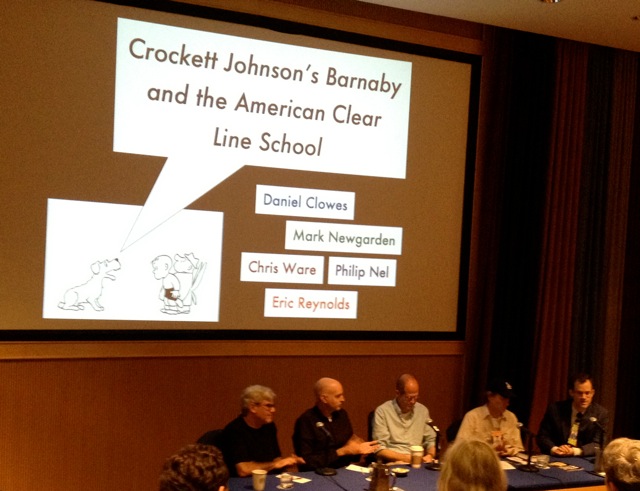
Crockett Johnson's Barnaby and the American Clear Line School. Left to right: Mark Newgarden, Daniel Clowes, Chris Ware, Eric Reynolds, Philip Nel. Photo by Paul Karasik.

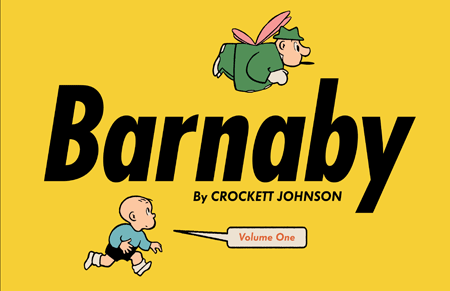
It’s hard to put into words what it means to spend over a dozen years on a book, and then be able to talk about it with smart, talented people whose work I admire.  Saturday’s panel at the Small Press Expo — featuring Daniel Clowes, Mark Newgarden, Chris Ware, Eric Reynolds, and myself — was exactly that.  Titled “Crockett Johnson’s Barnaby and the American Clear Line School,” the panel aimed (among other things) to spread the word about Fantagraphics’ Complete Barnaby: Eric and I are co-editing, Dan is designing, Chris wrote an intro for Volume 1.  Since that book isn’t out yet (currently expecting a February ’13 pub date), it also enabled me to draw upon my dozen years of research for Crockett Johnson and Ruth Krauss: How an Unlikely Couple Found Love, Dodged the FBI, and Transformed Children’s Literature (which is just out, and features a cover by Chris).

For 50 minutes, we had an illuminating conversation about Crockett Johnson, Barnaby, and how comics work.  Few people understand comics as well as Mark, Dan, and Chris do.  If you’ve ever heard Chris Ware speak or read an interview with him, you’ll know that he is one of a very few comics creators who can articulate, clearly & with precision, how particular comics work — and do this all without notes, speaking in what sound like perfectly punctuated paragraphs.  He was just as sharp, the following day, on the Building Stories conversation between him and Dave Ball.

Crockett Johnson's Barnaby and the American Clear Line School. Left to right: Mark Newgarden, Daniel Clowes, Chris Ware, Eric Reynolds, Philip Nel. Photo by Paul Karasik.

It’s also fascinating to me that three quite different cartoonists are drawn to Barnaby. With the exception of Ice Haven (my favorite Clowes book, incidentally), Daniel Clowes’ works have the fewest visual similarities to Johnson’s style. Chris Ware’s precise line recalls Johnson’s, though he favors more detailed pages than Johnson does. Mark Newgarden’s line is thicker and looser than Johnson’s, though his aesthetic is closer to Johnson’s succinct minimalism.  What all four share in common is a sharpness, a precision that gives their work a vital presence on the page.  All four understand the visual grammar of cartoons; they are fluent in the language of images.

Commercially, SPX was a success, also. Fantagraphics kindly sold copies of my biography (we sold all of them), and set up signings for me at their booth — the first of which found me sitting next to Dan.  Chris very generously signed the prints of his cover, for my Johnson-Krauss bio., and I sold about a dozen of those, too.

Daniel Clowes and Philip Nel signing books at the Fantagraphics booth. Photo by Alvin Buenaventura.

But, for me, what made it special was getting to hang out with so many great artists, writers, editors, & scholars. I never thought I’d find myself at dinner with Dan Clowes, Chris Ware, Charles Burns, Adrian Tomine, and Françoise Mouly. When I told Mike Deforge (an up-and-coming comics creator who was also at that dinner) that I felt like I’d been invited to the grown-ups’ table and wondered how the heck I got there, he admitted that he felt the same way.  So, a hearty thanks to Alvin Buenaventura for inviting us! (On that note, check out Daniel Clowes: Modern Cartoonist, edited by Alvin & with an essay by Chris.)

There are many other highlights — hanging out with Mark N. & Megan Montague Cash, getting to show them original Barnaby strips at the Smithsonian, meeting fellow Crockett Johnson fans, other comics scholars, seeing Warren Bernard’s astonishing personal collection of comics (at his house), discovering a group of comics artists engaged in an ongoing alphabet project, and so much more.  And the Barnaby panel was a career highlight.

Thanks again to Dan, Mark, Chris, and Eric for making it happen.  Thanks to Bill Kartalopoulos for including us in his great program.  And thanks to everyone I met for a fantastic SPX.

Photos by Paul Karasik (top two) and Alvin Buenaventura (lower one). Thanks, fellas!  Enjoyed seeing you, too!

Comments (3)

Cushlamochree! Barnaby, the Small Press Expo, & more

Chris Ware, poster for Small Press Expo 2012

Do you like comics? Any chance you’ll be in the vicinity of Bethesda, MD this weekend?  If so, then come to the Small Press Expo!  On Saturday the 15th, you can hear Daniel Clowes, Mark Newgarden, Chris Ware, Eric Reynolds, & me talk about Crockett Johnson‘s Barnaby.  Here’s the panel description:

Barnaby advertisement, 19 April 1942Crockett Johnson’s Barnaby and the American Clear Line School

12:00 pm | White Flint Auditorium

In a canny mix of fantasy and satire, amplified by the clean minimalism of Crockett Johnson’s line, Barnaby (1942-1952) expanded our sense of what comics can do. Though it never had a mass following, this tale of a five-year-old boy and his endearing con-artist of a fairy godfather influenced many. To mark the launch of The Complete Barnaby,Dan ClowesMark NewgardenChris Ware, and the book’s two co-editors — Fantagraphics’ Eric Reynolds and Crockett Johnson biographer Philip Nel — discuss the wit, the art, and the genius of Barnaby.

Later that day, I’m chairing a panel on “Comics as Children’s Literature,” featuring Françoise Mouly, Renée French, and Brian Ralph:

Comics as Children’s Literature
5:00 pm | White Flint Auditorium

Comics’ fraught historical legacy as children’s literature and children’s comics’ status as an expanding category of contemporary publishing will be discussed by cartoonist and picture book author Renée FrenchFrançoise Mouly, founder of the TOON Books imprint and co-editor of The TOON Treasury of Classic Children’s ComicsMark Newgarden, co-author of the “Bow-Wow” children’s comics and picture book series; and Brian Ralph, author of the all-ages graphic novel Cave-In. Children’s literature scholar Philip Nel will lead the conversation.

I’m honored to be in such august company.

But there’s more!  Perhaps you would like to buy a 20″ x 39″ print of Chris Ware’s beautiful cover for my biography of Crockett Johnson and Ruth Krauss?

Chris Ware's cover for Crockett Johnson and Ruth Krauss: How an Unlikely Couple Found Love, Dodged the FBI, and Transformed Children's Literature

I will be selling prints specially designed by Mr. Ware.  (He’s removed all of the text except the title and my name.)  Find me at the Fantagraphics booth (tables W40-44), where we’ll also be selling (and I’ll be signing) copies of the biography itself:

  • Saturday, September 15, 1:00 – 2:00 PM    Daniel Clowes // Philip Nel
  • Sunday, September 16, 2:00 – 3:00 PM    Philip Nel // Rich Tommaso

Both items will be available while supplies last.  You can see a full signing schedule on Fantagraphics’ website.

There’s much more.  Artists Gilbert & Jamie Hernandez, Paul Karasik, Adrian Tomine,… plus a full panel each devoted to Ware & to Clowes, footage of cartoonists screened by Mark Newgarden,… comics scholars David Ball, Sara Duke, Ken Parille,… and, oh, go read the conference schedule.

Hope to see you there!

(And… here ends my commercial announcement.)

Leave a Comment

It’s here, in hardcover and paperback.

Greetings, faithful readers. I am pleased to report that Crockett Johnson and Ruth Krauss: How an Unlikely Couple Found Love, Dodged the FBI, and Transformed Children’s Literature — a book that was twelve years in the making — now exists in both hardcover and paperback.  I received my author copies today, which means that it should be available for shipping from warehouses in the next few weeks (the official publication date is September 1st).

Crockett Johnson and Ruth Krauss: How an Unlikely Couple Found Love, Dodged the FBI, and Transformed Children's Literature (hardcover). Crockett Johnson and Ruth Krauss: How an Unlikely Couple Found Love, Dodged the FBI, and Transformed Children's Literature (paperback).
The author poses with the hardcover. The author poses with the softcover.

It’s already available on the Kindle, Nook and SONY Reader, but I find the ebook’s absence of book design a little disappointing.  So, I recommend purchasing the paperback. First, it’s cheaper.  Second, only the paperback has the full wraparound cover (designed by Chris Ware).  The Kindle version supplies only the front cover.1 On the hardcover, the artwork wraps around the spine and onto the back cover, but, since there is no dust jacket, the cover ends at the vertical edges of both back and front covers.  The paperback also has no dust jacket, but does have folded flaps that mimic a dust jacket  — they fold in along the vertical edges, tucking in between front cover and first page, and between last page and back cover.  Thus, the paperback allows you to view the full wrap-around cover.

Chris Ware's cover for Crockett Johnson and Ruth Krauss: How an Unlikely Couple Found Love, Dodged the FBI, and Transformed Children's Literature

The only other ways to see the full cover are on this blog or in the poster versions.  The generous Mr. Ware has designed a version of the cover — sans blurbs, UPC symbol, etc. — that is currently being made into posters.  I plan to sell them at book events. (I’m selling them rather than giving them away because I’ve underwritten the cost of this endeavor, and I’d like to make back my investment.)

Anyway.  My point is that the book is now officially real.  For me, a book is not a book until I hold it in my hands.  It doesn’t matter that I’ve signed the contract, delivered the manuscript, edited the manuscript (many times in this case), obtained rights to reprint the images (88 for this one), checked the page proofs, or seen the image for the jacket.  The book is only real for me at the moment I actually see a physical copy for the first time.  For this book, that moment was late this afternoon.

My biography of Crockett Johnson and Ruth Krauss is now real.


1.  I haven’t seen the Nook or SONY Reader versions. I assume they look much as the Kindle version does, but cannot verify that assumption.

Comments (11)

What Do Professors Do All Summer? Friday

The very last day of my summertime academic chronicle.  The work will go on, but I’m only recording a week’s worth of it on the blog.  If you’re just tuning in, for the past week (starting on Saturday), I’ve kept track of my daily activities in order to answer the age-old question: What do professors do all summer?  Tomorrow, I’ll offer a few reflections on the whole experience.  But, for now, here’s what I did on …

Friday, 18 May 2012

12:00 – 12:05 am.  Was so absorbed in the comics-and-picture-books essay that I didn’t notice the hour had passed midnight.  Am going to send to Charles Hatfield for his input.  I think it’s developed nicely, and (fortunately) remains below the 5000 words we’ve been allocated for this issue.  But, you know, one could always benefit from a second set of eyes!

12:05 – 12:30 am. Finished yesterday’s post.  Shared it with Facebook & Twitter.  Emailed Charles H. a copy of that essay.

12:30 – 12:45 am. Washed some dishes in sink, started dishwasher for others. Put away some of the books I was working with today.

12:45 – 1:30 am. Evening ablutions, bed, read G. Neri and Randy DuBurke’s Yummy: The Last Days of a Southside Shorty (2010), which I’m considering for the fall’s graphic novel class (thanks to Gretchen Papazian for the suggestion!).

8:05 – 8:40 am.  Got up, checked email.  Enjoyed a brief video of niece Emily (thanks to sister Linda!). Logged into Facebook & answered an email there.  Read Francisco X. Stork’s essay on depression (hat tip to Jules Walker Danielson). Very good piece, whether or not you’ve ever struggled with depression.  Read it.  Also read Stork’s books.  I’ve only read two, but both — The Last Summer of the Death Warriors and Marcello in the Real World — are really good. I also checked out the schedule of Hillary Chute’s comics extravaganza. Spiegelman keynote tonight!  Going to watch on-line.

8:40 – 9:00 am.  Jumping jacks, stretched, etc.  Getting off to a later start this morning.

9:00 – 9:50 am.  Ran 4 miles, and did the exercises at the playground en route — one set of chin-ups, one of upside-down-push-ups.  I’m sure the latter has a real name, but I don’t know what to call it.  If anyone is confused and wishes not to be, I described the exercise on Saturday’s post.  Today’s was a more contemplative, slower sort of run.  Noticed a yellow and black… finch?  Small bird.  Saw four bunnies (technically, hares) during the course of my run, which is more than I’d've expected, given my late start. (Bunnies, a.k.a. hares, are nocturnal.) During the run, in my head, I also started to write the Sendak book proposal and table of contents.  This is one reason why it’s hard to keep track of work time.  I’m always thinking, and often such intellectual labor is connected to my professional work. Jeff Smith, Bone vol. 1: Out from Boneville

9:50 – 10:30 am.  Checked email, discovered that the scans of Jeff Smith’s art have arrived (in my campus mail box) from Cartoon Books.  Thanks, Kathleen!  This means that I can get the Moby-Dick-and-Bone article (co-written with Jennifer Hughes) submitted today.  Or, I hope it means that.  The only question I have is: will the journal’s website be able to cope with such a large image size?  Decided I should write down some of the book proposal before it leaves my head — though I don’t honestly think it will.  I think it’s incubating, and will continue to develop, whether or not I write anything down.  Spent some time writing down a few notes.  Realized I was hungry.

10:30 – 10:45 am.  There will be no post-running exercises today.  Breakfast & writing.  This is one way in which the scholarly process is similar to the creative process: you write because you have an idea.  You do not write because you know it’s a good idea or because someone will want to publish your idea.  You write because the idea is there and must be expressed.  As I noted in this blog’s inaugural post, I’ve had many ideas for books.  Nearly half of all my proposed books have not found a publisher.  I don’t yet know what will become of this one.

10:45 – 10:50 am.  Cleaned up some of the html in yesterday’s post.  I noticed that there wasn’t a space between each entry, and, in the html, discovered that “div” tags seem to be the culprit.  Where did they come from?  I don’t know.  I’ve removed them, and now the page looks fine.

10:50 – 11:00 am.  Responded to email (professional).

11:00 – 11:25 am.  Checked into Facebook.  Read this and this, both of which are related to my job.  From the first piece (a smart essay by Stephen J. Mexal) we learn that “When conservatives declare that English classes don’t teach literature anymore, what they’re really trying to do is deprofessionalize the profession of college-level English.”  We also learn that Andrew Breitbart continues to be an idiot.  From the second (a report on an academic Harry Potter conference), we learn that some scholars of older popular literature (Shakespeare, say) wish to delegitimize the study of newer popular literature and of books for children. The article also provides strong evidence that John Mullan may be a fool.  The article quotes Mullan as saying: “I’m not against Harry Potter, my children loved it, [but] Harry Potter is for children, not for grownups. … It’s all the fault of cultural studies: anything that is consumed with any appearance of appetite by people becomes an object of academic study.”  He also says that academics “should be reading Milton and Tristram Shandy: that’s what they’re paid to do.”  Hmm, “fool” is not quite the right epithet.  The word “ignorant” better describes Professor Mullan, as would the words “completely unqualified to offer such pronouncements.”

11:25 – 11:35 am.  Up next, after my shower: Routledge editorial work.  Figured out what I need to look at.  Have two items which require responses — these only date from earlier in the month, and both are revisions.  After I respond to these, I will be caught up with Routledge work.

11:35 – 11:45 am.  Responded to tweets regarding that asinine quotation from Professor Mullan, which prompted Natalia Cecire to share her Cecire’s First Law of Journalism About Academia. Natalia Cecire on media and academe

Too true.

11:45 – 12:10 pm.  Shower, shave, dress.

12:10 – 12:40 pm. Misc. email.  Thanks to Jules Walker Danielson, read Richard Michelson’s remembrance of Maurice Sendak.  Hadn’t seen this one!  Added link to bottom of this page.  Also wrote to see if I could purchase a copy of Hunger Mountain‘s special June issue on Maurice Sendak.  Wrote back to Jules, too.

12:40 – 12:45 pm.  Added another sentence to the comics-and-picture-books essay.  Thought I was “done” with this draft.  Apparently not. Ho Che Anderson, King

12:45 – 2:00 pm.  Lunch.  Started reading Ho Che Anderson’s King: A Comics Biography (Special Edition, 2010; orig. published 1993-2002), and in fact spent most of this segment of time reading it.  I’m considering this book for my graphic novels class.  It’s excellent.  The sole problem is that the hardcover costs $35.  I didn’t see a paperback.  I prefer not to assign hardcover books.  I made an exception once to assign Guus Kuijer’s The Book of Everything, but that was much less costly.  And I still want to see Kuijer’s novel come out in paperback.

2:00 – 2:30 pm. Finally getting down to the Routledge work!  But… not doing well at it.  Falling asleep sitting up. Too tired to focus properly.

2:30 – 3:00 pm. Nap.

3:00 – 3:45 pm.  Energized by nap, was able to offer much more clear response.  One report done!  Also wrote another professional email on a different subject.

3:45 – 4:45 pm.  Responded to another Routledge piece.  Also, a little after 4, tuned into WFMU (on-line, via iTunes radio), caught Laura Cantrell hosting & playing records by Ana Egge (“Bad Blood,” “Hole in Your Halo”), The Mastersons (“Tell Me It’s Alright”), Lianne Smith (“Bicycle”), Chris Erickson (“All I Need”).  Really great alt-country.  Richard Flynn would enjoy this.  Also enjoyed Sara Watkins’ “You and Me.”

4:45 – 4:55 pm. Internet issues.  Rebooted the cable box & the wireless router.  Everything’s working except for my MacMail (and thus I cannot send my second Routledge report).  Can’t figure out why, but suspect that Kansas State University’s email is down again.  Tried rebooting.

4:55 – 5:05 pm.  Fundraising call from Obama for America.  The president has been more a politician than the statesman I hoped he would be.  However, I support the human rights of gays and lesbians (which include the right to marry, and to serve openly in the military), I appreciate his understanding that trickle-down economics is a myth (even if he failed to pursue repeal of what I now think of as the Bush-Obama Tax Cut), I support his efforts to reform health care (even if they did not go far enough and may well be struck down by the conservative majority on the Supreme Court), am glad he has gotten us out of Iraq (and wish he would also withdraw troops from Afghanistan, too).  In sum, if his record is mixed, he has had significant accomplishments, and is certainly better than Governor Mitt “I’ll say anything” Romney.  So, I made a modest contribution to his re-election effort — which, by my estimation, has about a 50-50 chance of succeeding.

5:05 – 5:25 pm.  Rebooting seems to have worked.  I can send email again.  Wrote up some of the preceding.

5:25 – 5:40 pm.  Guitar.  Played a bit more of “Dancing in the Dark” (Springsteen) before hand forced me to abandon the effort.  It’s definitely improving, but just not as fast as I’d like.  Played “Run On for a Long Time” (traditional, Moby’s “Run On” samples the version by Bill Landford & The Landfordaires, but the Blind Boys of Alabama have a great version as does Johnny Cash [under the title "God's Gonna Cut You Down"]), “She’s Got a New Spell” (Billy Bragg), and “Bizarre Love Triangle” (New Order).

5:40 – 6:00 pm.  Professional email sent. Also started on submitting the images for the Moby-Dick-&-Bone article.

6:00 – 6:30 pm.  Tuned in to HillaryCon, in anticipation of Art Spiegelman’s talk. Finished uploading Moby-Dick-&-Bone article.

6:30 - 8:00 pm.  Turned full attention to HillaryCon, so I could watch as well as hear her intro & then Art Spiegelman’s talk.  Really fantastic conversation between WJT Mitchell and Art Spiegelman.  My hope is that — in addition to being broadcast — it has also been recorded.  I also took notes.

“I discovered the parody before I knew the original”

— Art Spiegelman on MAD

“It’s important to have work that isn’t easy to assimilate”

— Art Spiegelman on comics & the classroom (one of his concerns was that, in gaining legitimacy, and finding their way into the classroom, some comics [a.k.a. graphic novels] are written to be taught rather than to be art)

“If children like something, adults get very concerned and try to control it.”

— Art Spiegelman (this quote, for me, also explains any attempt to ban or otherwise regulate a popular children’s book)

“I learned to read trying to figure out whether Batman was a good guy or a bad guy”

— Art Spiegelman, in the context of comics now being seen as an aid to literacy (and also alluding to Toon Books).

“In 1908, you could easily earn $20 to $200 as a cartoonist. What’s amazing is that it’s still true!”

— Art Spiegelman, in a remark inspired by an 1908 advertisement he had projected up on the screen.

“The avant-garde of comics is moving very much into the visual side of comics.”

— Art Spiegelman, on where comics is headed in the future.

“I have to get past my schoolboy snarl and admit that it’s not only bad stuff that happens in classrooms.”

— Art Spiegelman, responding to a question about an earlier comment he’d made on having comics taught in classrooms

I know what it’s like to have the technology not work as planned, but Art Spiegelman’s frustration with the latest version of PowerPoint particularly resonated with me.  He had everything all ready to go on an earlier version of PowerPoint, but the new version (on the computer up on stage) removed the control he’d been expecting.  This is exactly why Microsoft products are so frustrating.  Each new iteration screws something up from a previous iteration.  It’s always one step forward and two steps back.  Or, to be more accurate, it’s one step forward, and the menu you need to take the two steps back is now hidden under a new category which you can find if you place your mouse over that word, or, as a short cut, over an entirely different word, or, etc. etc.

Let me also say that Chris Ware’s poster for the conference is a thing of beauty.  (Click for a larger image.  No, seriously.  You have to click on it.  It’s amazing.)

Chris Ware, Comics: Philosophy and Practice

8:00 – 8:20 pm.  Wrote up the preceding.

8:20 – 8:45 pm.  Responded to couple of Facebook items, but most of this time was devoted to professional correspondence (which, yes, is also personal because, as I frequently have mentioned in this chronicle, most of my colleagues are also my friends!).

8:45 – 9:00 pm.  Started drafting reflections on this week’s experiment.  Am counting this as work, but you can deduct it, if you like.

detail from Chris Ware's cover of my biography, Crockett Johnson and Ruth Krauss: How an Unlikely Couple Found Love, Dodged the FBI, and Transformed Children's Literature (2012)9:00 – 9:20 pm.  Made Chris Ware’s cover of my forthcoming biography my “cover photo” on Facebook. He does such beautiful work. I’ve said it before, but it bears repeating: I’ve never had such a beautiful cover for one of my books, and nor am I likely to ever again. Also looked at photos of my niece Emily, via my sister’s Facebook page.  And chose a couple of videos to end this day’s post.

9:20 – 9:30 pm.  Continued drafting some reflections on this week’s experiment.

9:30 – 10:00 pm.  Once I started writing, I couldn’t stop.  Kept drafting those reflections.  Also checked into Facebook again because I wanted to find an article I saw earlier.

10:00 – 10:25 pm.  More professional correspondence (some of which, yeah, is personal, for noted before, etc.).

10:25 – 10:45 pm. Couldn’t resist tinkering further with the comics-&-picture-books essay. And so,… I did. Evidently, I am not done with it.  Also more correspondence.  Received from Eric the list of Barnaby strips we have.  I now need to go through and figure out which ones we’re missing.

10:45 – 11:25 pm. Read more of Ho Che Anderson’s King: A Comics Biography, which is really well done.

11:25 – 11:45 pm. Correspondence.  My friendly email debate with Michael Patrick Hearn continues.  I don’t think either of us is convincing the other one, but it’s a conversation worth having (or I hope so, anyway).

11:45 – 12:00 pm.  Started dishwasher.  Looked at this photo of the comics “brain trust” at HillaryCon. Wish I were there!  Also: Preparing for bed!

Coming tomorrow: Reflections on this week’s experiment.

Total hours worked: 10 hours, 30 minutes.

I’d embed the Cure’s “Friday, I’m in Love”  here, but YouTube has disabled embedding “by request” (by request from whom? Polydor posted the video).  My next thought was Serge Gainsbourg’s video for “Comic Strip” (featuring Brigitte Bardot), but embedding has also been disabled for that one.  So, instead here’s one of Gainsbourg and Mireille Darc lip-synching “Comic Strip” on French TV.

Or, if you prefer a song with a specific “Friday” reference, you might like last season’s Sing-Off contestants performing a mash-up of the Verve’s “Bittersweet Symphony,” the Who’s “Baba O’Reilly,” Gwen Stefani’s “Hollaback Girl,” and Katy Perry’s “Last Friday Night.”  Sadly, NBC has cancelled The Sing-Off.

What’s that you say?  You haven’t had your fill of banality?  Well, then, you might explore the links below.  If symptoms persist, please consult your physician.  Thank you.

Comments (1)

Crockett Johnson and Ruth Krauss: Chris Ware’s cover

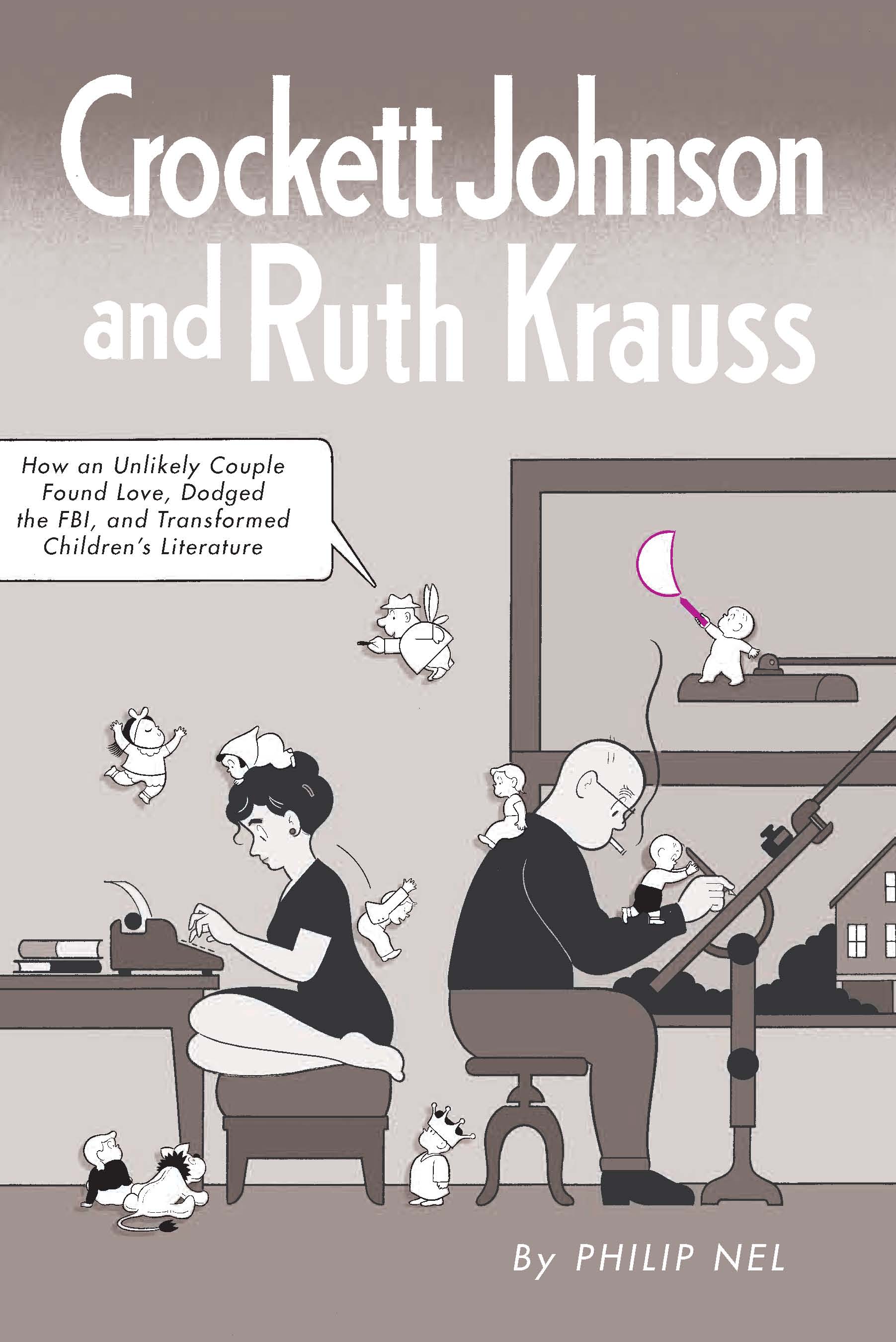
Front cover by Chris Ware for: Crockett Johnson and Ruth Krauss: How an Unlikely Couple Found Love, Dodged the FBI, and Transformed Children's Literature (forthcoming from UP Mississippi, Sept. 2012)

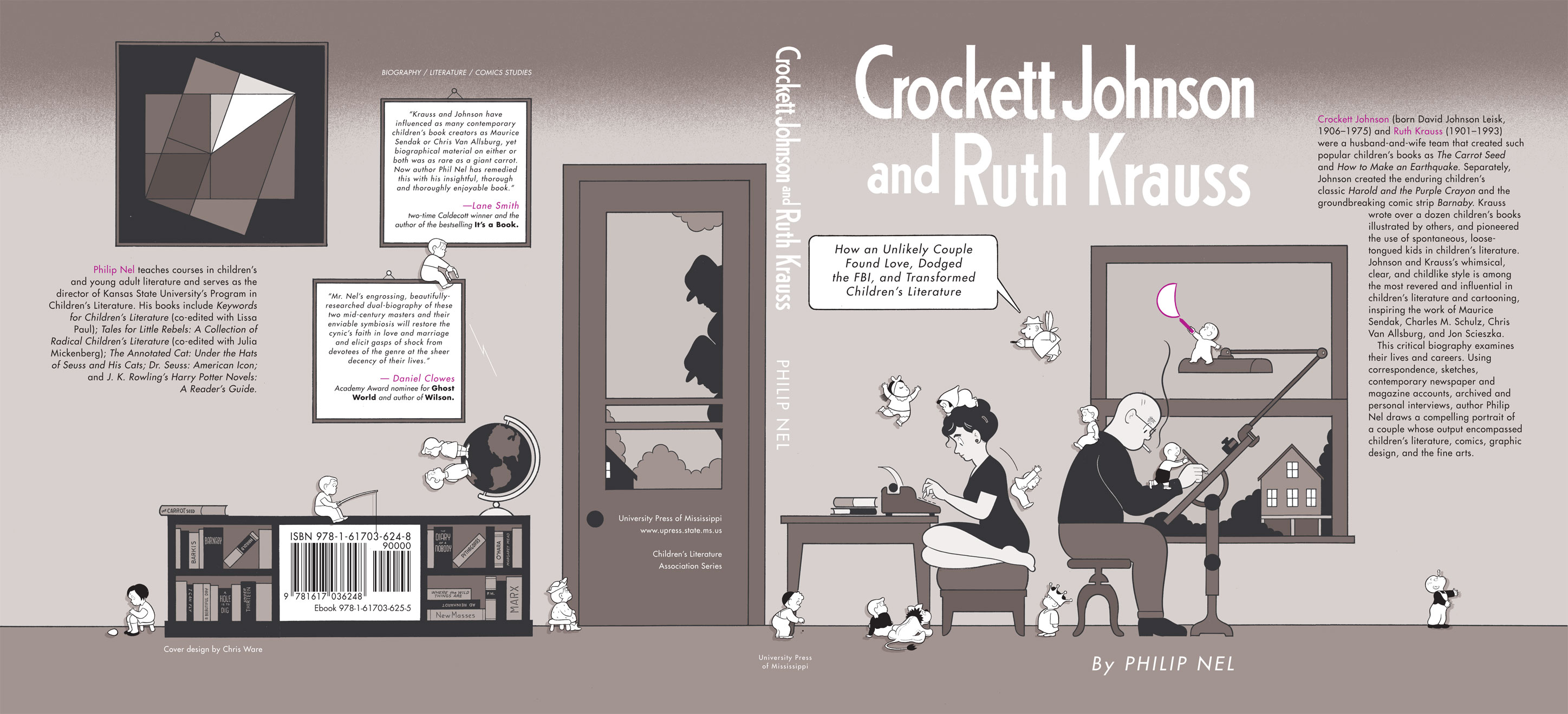
Graphic genius Chris Ware designed the cover for my Crockett Johnson and Ruth Krauss: How an Unlikely Couple Found Love, Dodged the FBI, and Transformed Children’s Literature (due this September from the University Press of Mississippi). The front cover is above.  The full, wrap-around cover is below.  Click on it for a larger image.  Trust me: you’ll really want to see all of the detail.  It’s beautiful.  It’s perfect.  I’ve never been happier about one of my book covers.  And for those keeping count, there are six previous books (two co-edited), all of which have striking covers.  The other designers were no slouches.

But Chris Ware is a genius. And no, I am not overusing that word.  But, yes, perhaps we should add a few more words to describe the cover itself. Clever. Detailed. Vivid. Art.

Full, wrap-around cover by Chris Ware for: Crockett Johnson and Ruth Krauss: How an Unlikely Couple Found Love, Dodged the FBI, and Transformed Children's Literature (forthcoming from UP Mississippi, Sept. 2012)

He’s done the cover in the style of Crockett Johnson.  In the case of the girl dancing above Krauss’s typewriter, it’s Mary Blair filtered through a Crockett Johnson aesthetic; for the boy sliding own her back, it’s Maurice Sendak filtered through Johnson. (The girl is from Krauss‘s I Can Fly, illustrated by Blair; the boy is from her A Hole is to Dig, illustrated by Sendak.)  Finally, Ware transforms all of these styles into something uniquely his own.

Fans of Johnson and Krauss: Are you getting all of the references here?  Would you like some help?  I could fully annotate this cover, but I wonder if that would detract from the pleasure of exploring it yourself.  The academic in me wants to proceed with the annotations, but the art lover wants to stay silent, so that your eyes can linger on Ware’s art, looking slowly, experiencing it on its own terms.  And… the art lover wins.  (No annotations.)  Enjoy!

And: Thank you, Chris Ware!

Comments (14)

Children’s Literature + Music = Great Album Covers

Many children’s writers and illustrators have created covers for albums.  Below, we’ll look at a dozen or so of these artists.  As is ever the case with any art posted on this website, the artwork belongs to the artists.  Visit their websites!  Buy prints!  Buy their books!  (I’ve included websites for each artist.)  Enjoy!


Saul Bass

Recently republished, Bass‘s Henri’s Walk to Paris (1962, words by Leonore Klein) is fantastic. If he did other children’s books, I’m unaware of them. He did, however, do many famous album covers.  Here are his covers for Elmer Bernstein’s The Man with the Golden Arm (1956), Duke Ellington’s Anatomy of a Murder (1959), and Leonard Bernstein and Stephen Sondheim’s West Side Story (soundtrack, 1961).

The Man with the Golden Arm soundtrack (art by Saul Bass)

Anatomy of a Murder (art by Saul Bass)

West Side Story soundtrack (art by Saul Bass)


Guy Billout

The author-illustrator of The Frog Who Wanted to See the Sea (2007) and Something’s Not Quite Right (2002), Billout has also done album covers. I’m reproducing one below — Crack the Sky’s Animal Notes (1976).  I know I’ve seen other covers, but just cant put my finger on where I’ve seen them.

Crack the Sky, Animal Notes (art by Guy Billout)


R. Gregory Christie

Christie has won Coretta Scott King Honor Awards for his children’s books Palm of My Heart: Poetry by African-American Children (1996), Only Passing Through: The Story of Sojourner Truth (2000), and Brothers in Hope: The Story of the Lost Boys of Sudan (2006). Here are his covers for Justice System’s Rooftop Soundcheck (1994) and John Coltrane’s Complete 1961 Village Vanguard Recordings (1997).

Justice System, Rooftop Soundcheck (art by R. Gregory Christie)

John Coltrane, Complete 1961 Village Vanguard Recordings (art by R. Gregory Christie)
Hat tip to Jules Walker Danielson for this one! And check out her interview with Christie at Seven Impossible Things Before Breakfast.


Marcel Dzama

As far as I know, Dzama has illustrated only one children’s book — They Might Be Giants’ Bed Bed Bed (2003). Admittedly, that makes him a less likely candidate than most of the other artists included here.  Here are his covers for the Weakerthans’ Reconstruction Site (2003), Beck’s Guero (2005), and They Might Be Giants’ The Else (2007)

The Weakerthans, Reconstruction Site (art by Marcel Dzama)

Beck, Guero (art by Marcel Dzama)

They Might Be Giants, The Else (art by Marcel Dzama)


Carson Ellis

Ellis (married to the Decemberists’ front man, Colin Meloy) has created many Decemberists album covers, as well as a few for other artists.  More recently, she’s worked on some cool children’s books, illustrating the late Florence Parry Heide’s Dilweed’s Revenge (2010), Lemony Snicket’s The Composer Is Dead (2009), and Meloy’s Wildwood (2011), among others.

Here are three covers she’s done for the Decemberists.

Her Majesty The Decemberists (art by Carson Ellis)

The Decemberists, Hazards of Love (art by Carson Ellis)

The Decemberists, The King Is Dead (art by Carson Ellis)

And here’s the cover she did for Laura Viers’ July Flame (2010).

Laura Viers, July Flame (art by Carson Ellis)

Much, much more on Ellis’s website!  Also: Jules Walker Danielson did a great (and lavishly illustrated) interview with Ellis over on Seven Impossible Things Before Breakfast.  Indeed, if you care about children’s picture books, you must read Danielson’s blog — preferably, as frequently as you can.


Jim Flora

Flora had a long career designing album covers before the record industry’s preference for photographic covers (in the 1950s, at any rate) reduced demand for his work. At that point, he turned to children’s books, writing such loopy classics as The Fabulous Firework Family (1955), The Day the Cow Sneezed (1957) and many others.  Irwin Chusid has written (and co-written) some super books on Flora, and maintains a great Flora website, from which I’ve taken the following covers: Bix Beiderbecke and Frankie Trumbauer’s Bix and Tram (1947), Gene Krupa and His Orchestra (1947), and Mambo for Cats (1955).

Bix and Tram (art by James Flora)

Gene Krupa and His Orchestra (art by James Flora)

Mambo for Cats (art by James Flora)

You can buy prints of Flora’s album covers (and other artwork) from the website.


Crockett Johnson

I’m mostly avoiding children’s records, but Johnson‘s art for the adaptation of Ruth Krauss’s The Carrot Seed (1950) differs from the cover he did for the book (1945, which he also illustrated).  So, I thought I’d bend my rule a little and include it here.  The recording was performed by baritone-voiced Broadway actor Norman Rose, and was released by Young People’s Records and the Children’s Record Guild.

The Carrot Seed (art by Crockett Johnson)


Richard McGuire

McGuire is a renaissance man.  He wrote and (with his band, Liquid Liquid) performed “Cavern,” the song that became the music for the classic hip-hop track “White Lines,” by Grandmaster Flash and the Furious Five.  He’s created one of the most innovative experiments in comics, “Here” (1989).  He’s created four picture books, including The Orange Book (1993) and What Goes Around Comes Around (1995).  And that’s not to mention his work in film or his New Yorker covers.  Here’s his cover for Liquid Liquid’s compilation Slip in & Out of Phenomenon (2008).

Liquid Liquid, Slip in & Out of the Phenomenon (art by Richard McGuire)


Dave McKean

The prolific Dave McKean is best known for his many collaborations with Neil Gaiman.  But he’s done lots more, including album covers.  Here are his covers for Counting Crows’ This Desert Life (1999), and the UK release of Tori Amos’s single, “God” (1994).

Counting Crows, This Desert Life (art by Dave McKean)

Tori Amos, "God" (art by Dave McKean)

Hat tip, again, to Jules Walker Danielson, whose interview with McKean you should check out — it has lots of art, and even more album covers.  Indeed, the album covers you see here were lifted from her interview.


Maurice Sendak

The greatest living author-artist of children’s books has done a few album covers — many in the early 1950s, but a few later in his career, too. Here’s his art for Cynthia Gooding Sings Turkish and Spanish Folk Songs (1953), Carole King’s Really Rosie (1975, lyrics by Sendak), and Shawn Colvin’s Holiday Songs and Lullabies (1988).

Cynthia Gooding Sings Turkish and Spanish Folk Songs (art by Maurice Sendak)

Carole King, Really Rosie (art by Maurice Sendak)

Shawn Colvin, Holiday Songs and Lullabies (art by Maurice Sendak)


Shel Silverstein

People remember Silverstein primarily for his many children’s books, but he was also a Playboy cartoonist, and songwriter — Johnny Cash’s “A Boy Named Sue” and Dr. Hook’s “On the Cover of Rolling Stone” were both Silverstein songs.  He recorded several albums of his songs for adults, including Drain My Brain (1967), for which he also created the cover below.

Shel Silverstein, Drain My Brain (art by Shel Silverstein)


Lane Smith

In 1983, Smith created album covers for the Dickies’ Stukas Over Disneyland and Oingo Bongo’s Good for Your Soul.

The Dickies, Stukas Over Disneyland (art by Lane Smith) Oingo Boingo, Good for Your Soul (art by Lane Smith)

He’s posted both of these and one other on his abandoned blog, Lane Smith’s Closet: Illustrations from My Drawers.  His other abandoned blogs are also great, but Curious Pages (co-curated with Bob Shea) is fantastic.


Art Spiegelman

Best known for his Pulitzer-Prize-winning Maus, Spiegelman has also worked on a few children’s books, including Open Me… I’m a Dog! (1997), and Jack in the Box (2008).  Here’s his art for Spiked! The Music of Spike Jones, which includes liner notes from Thomas Pynchon (!).

Spiked! The Music of Spike Jones (artwork by Art Spiegelman)


Mark Alan Stamaty

Better known for his cartoons, Stamaty has created a few children’s books, including: Who Needs Donuts? (1973), Minnie Maloney & Macaroni (1976), and Where’s My Hippopotamus? (1985). He also created the artwork for They Might Be Giants’ first album (1986).

They Might Be Giants (art by Mark Alan Stamaty)


Chris Ware

Sure, Mr. Ware is primarily known for his comics & graphic novels, but he did contribute “Fairy Tale Road Rage” to the first volume of Art Spiegelman and François Mouly’s Little Lit, he writes eloquently about childhood, and… well, I like his work.  In addition to other book covers, New Yorker covers (and covers for other magazines), brilliant design work for Fantagraphics and Drawn and Quarterly, he’s done a fair few album covers.  Here is his art for the Beau Hunks’ Manhattan Minuet (1996) and Reginald R. Robinson’s Euphonic Sounds (1998).

The Beau Hunks Sextette, Manhattan Minuet (art by Chris Ware)

Reginald R. Robinson, Euphonic Sounds (art by Chris Ware)

The Hammer Gallery’s Ware site has art for sale.


I assembled this page when I should have been doing other work.  Have I missed some artists of children’s books who also worked on album covers?  Yes, certainly.  Will people point this out in the comments section, below?  I certainly hope so!  Isn’t that what comments sections are for?

Comments (5)