
Archive for Children’s Literature

A Manifesto for Children’s Literature; or, Reading Harold as a Teenager

Those of us who read, create, study, or teach children’s literature sometimes face skepticism from other alleged adults.  Why would adults take children’s books seriously?  Shouldn’t adults be reading adult books?

There are many responses to these questions:

  1. Children’s books are the most important books we read because they’re potentially the most influential books we read. Children’s books reach a young audience still very much in the process of becoming. They stand to make a deeper impression because their readers are much more impressionable.
  2. Adults who dismiss children’s literature neglect their responsibilities as parents, educators, and citizens. What future parents, teachers, doctors, construction workers, soldiers, leaders, and neighbors read is of the utmost importance, if for no other reason than some of us will continue to live in the world they inherit. If books leave such a powerful impression on young minds, then giving them good books is vital.
  3. Almost no children’s literature is written, illustrated, edited, marketed, sold, or taught by children. Adults — and adults’ idea of “children” — create children’s books. It’s profoundly hypocritical for an adult to suggest children’s literature as unworthy of adult attention. Indeed, adults who make such claims are either hypocrites, fools, or both.
  4. Children are as heterogeneous a group as adults are. There is no universal child, just as there is no universal adult. Defining the readership of any work of “children’s literature” is a tricky, sticky, complex task. Paradoxically and as the term itself indicates, “children’s literature” is defined by its audience — it’s for children. It thus a literature for an audience whose tastes, reading ability, socio-economic status, hobbies, health, culture, interests, gender, home life, and race varies widely. Children’s literature is literature for an unknowable, unquantifiable group. The very term “children’s literature” is a problem. Only someone who has never thought about children or what they read could argue that children’s literature does not merit serious consideration.
  5. Children’s literature has aesthetic value. Good children’s books are literature. Good picture books are portable art galleries. If we don’t take children’s literature seriously, then we diminish an entire art form and those who read it. We also prevent ourselves from being able to distinguish quality works from inferior ones — thus neglecting our responsibilities outlined in no. 2, above. This is not to suggest that we can or should all agree on what is a great children’s book. We can’t and we shouldn’t. What we can and should do is care about what makes children’s books bad or good, average or classic, banal or beautiful.

But my focus in this post is less on those preceding five points (or the many other points that could be added) and more on a sixth point: that children’s books have much to give those of us who are no longer children. There are levels of meaning we may have missed when we read the book as a child. There are experiences adults have that grant us interpretations unavailable to less experienced readers — just as children may arrive at interpretations unavailable to adults who have forgotten their own childhoods. In children’s books, there is art, wisdom, beauty, melancholy, hope, and insight for readers of all ages.

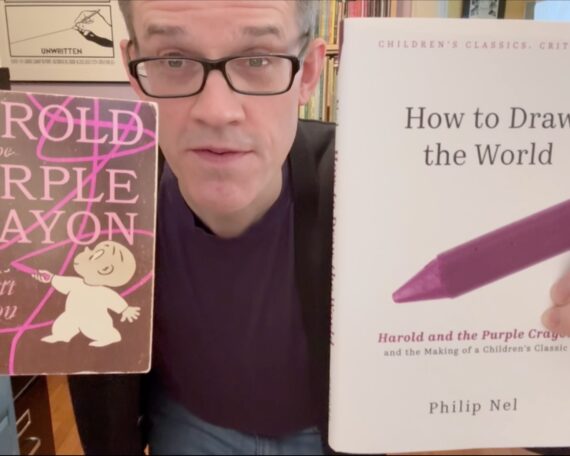
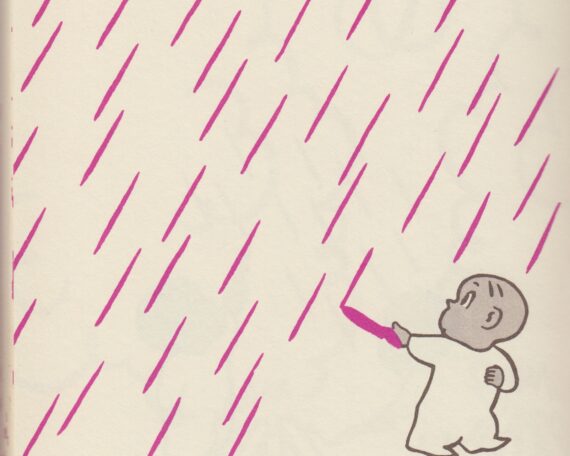
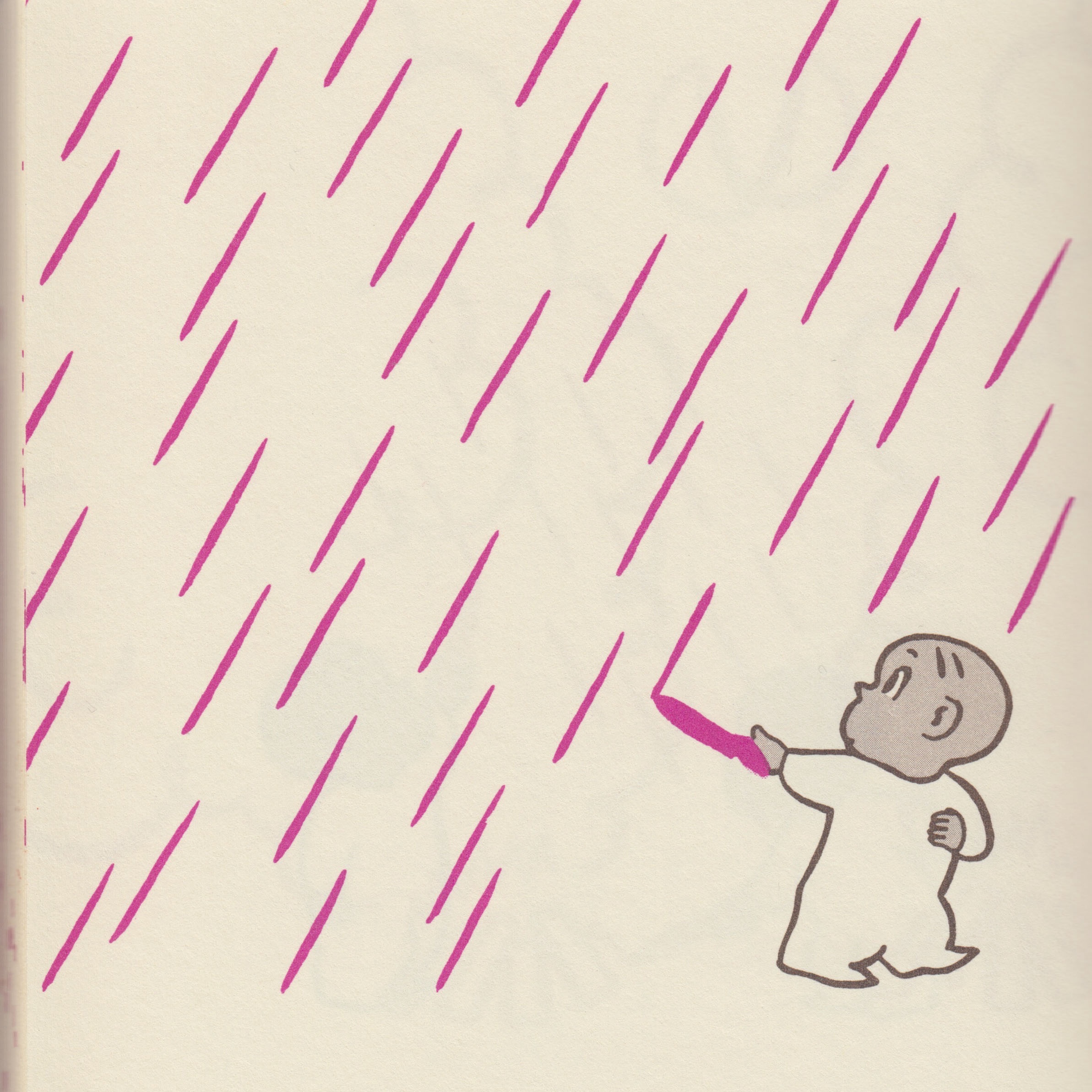
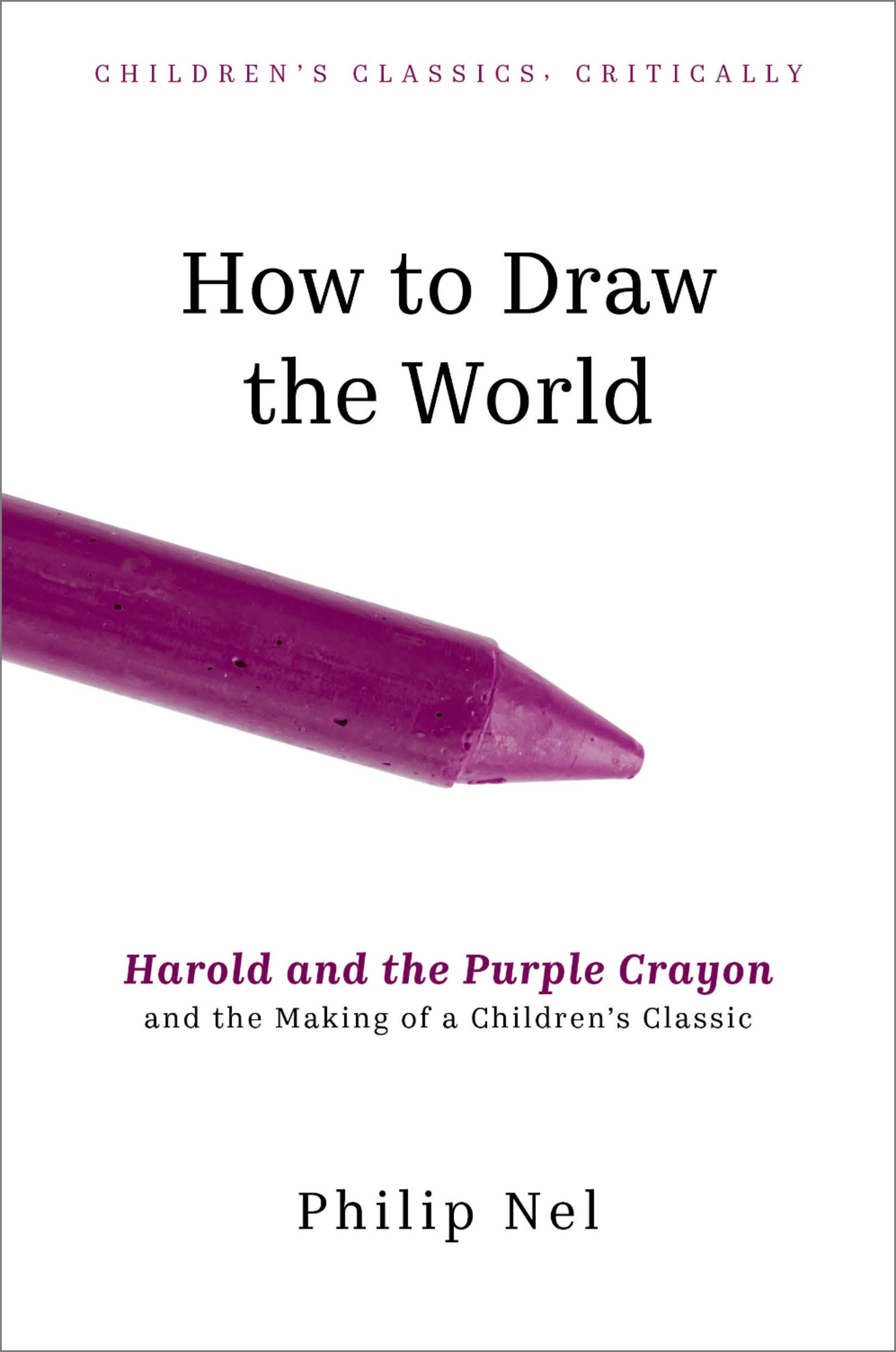
Crockett Johnson, Harold and the Purple Crayon (1955): coverWhat inspires me to make this sixth claim is that I have no memory of reading Harold and the Purple Crayon as a child. As an adult, I created a website devoted to the book’s creator, Crockett Johnson, and wrote a biography of Johnson and his wife, fellow-children’s book writer Ruth Krauss. But the book that inspired both website and biography is completely absent from my memories of early childhood.

The book does appear in memories of those memories. In eighth grade, when I had long since “graduated” into reading chapter books, my mother got a job teaching at a private school, thus enabling my sister and I to attend the school for free. Once a week (or was it once a month?), there was a faculty meeting after the end of the school day. During that meeting, my sister and I were left alone in the school library to do our homework. She did her homework. I did not. Instead, I wandered over to the picture books and began reading them. There, I rediscovered Harold and the Purple Crayon, a book I then remembered fondly from my pre-school days. I also realized that there were other books about Harold — Harold’s Trip to the Sky, Harold’s ABC. Had I read these other Harold stories when I was younger? I wasn’t sure. But I knew they were just as enchanting as the first Harold book.

So, at the age of 14 — an age when you might expect a person to be reading Young Adult novels — I began to collect paperbacks of Crockett Johnson’s Harold books.

I don’t know what needs were fulfilled by those particular words and pictures. Perhaps it was the books’ presentation of the imagination as a source of power and possibility. Maybe Harold’s iconic, clear-line style better enabled me to identify with him as he, and his crayon, navigated an uncertain, emerging landscape.

For that matter, I don’t know why, as a freshman in college, I adopted as my bedtime reading A. A. Milne’s The World of Pooh and The World of Christopher Robin. (The former contains both Winnie-the-Pooh and The House at Pooh Corner; the latter collects all the verse from When We Were Very Young and Now We are Six.)

My point is that books “for children” can speak to people of all ages and backgrounds — if we are ready to listen. It’s hard to predict when or why we will be ready to listen. It is indeed dangerous to assume that recommended age-ranges on the backs of books will tell us anything about who may read those books. When I read and re-read the Harold stories at age 14, the books did not then have age ranges on them, though I note that a more recent copy of Harold’s Fairy Tale claims it’s for “Ages 3 to 8.” As Philip Pullman has said of his own work,

I did not intend the book for this age, and not that; for one class of reader, and not others. I wrote it for anyone who wants to read it, and I want as many readers as I can get, and I want to meet them honestly…. For a book to claim “This was written for children of 11+”, when it simply wasn’t, is to tell an untruth.

Exactly.

Books “for children” or “for teenagers” are books for all who are ready to listen to them. They are for all who recognize that art cannot be confined within such narrow labels.

Comments (16)

Emily’s Library, Part 6: 35 More Books for the Very Young

This is the latest installment in my ongoing series of The Best Books for Young Readers. As I noted in the first post, I’m trying to assemble the ideal library for my niece, who turns 2 this month. I recognize that what I consider “ideal” or “best” may be idiosyncratic, but since I do have some knowledge of children’s literature and since people often ask me about good books for children, I thought that a public list of my choices might be of some use to others.

Since Emily’s being raised in both French and English, you’ll also see some livres en français as well as the occasional Bücher auf Deutsch.  She lives in Switzerland, near both France and Germany. Her parents speak primarily English and French at home, but she also encounters German at the crèche (day care).  So, I’ve started to add some titles in German, too.  Nearly all of these non-English books are also available in English; when they are, I’ve also included the English title.

As in the previous entry, when there are two copies of a book (i.e., the same book in two languages), I’ve only counted it once in the above tally.

Rita et MachinJean-Philippe Arrou-Vignod and Oliver Tallec, Rita et Machin (2006) [Rita and Whatsit (2009) in its original French]

A little girl in a bad mood, Rita doesn’t like her birthday presents. But the one box that is running away from her is at least different. Inside, is a dog with a strong personality of its own. But, by the end of the story, the two have become friends. Tallec’s spare, slightly squiggly cartoons provide just enough detail for Arrou-Vignod’s narratives: we see only what the story requires, and little more.

Rita et Machin å la plageJean-Philippe Arrou-Vignod and Oliver Tallec, Rita et Machin a la plage (2006) [Rita et Machin à la Plage (2010) in its original French]

In this book, Rita is the one who starts in the good mood: “Rita loves the beach. Whatsit [Machin] the dog doesn’t like it quite so much.”  In particuar, what Whatsit [Machin] wants to do is not what Rita wants to do. They do play together, and by the end, “Whatsit [Machin] really loves the beach. Rita doesn’t like it quite so much.”   (My quotations here come from the English translations.)

Mon Chat Le Plus Bête du MondeGilles Bachelet, Mon Chat Le Plus Bête du Monde (2004) [My Cat, the Silliest Cat in the World (2006) in its original French]

Thanks to Sandra Beckett for suggesting this book about the silliest cat in the world,  Well, the text describes the animal as a cat, but all the pictures show an elephant — a metaphor, perhaps, for a particularly destructive cat.  Or, perhaps the “cat” really is an elephant and this narrator should not be trusted.  Thanks to J Nick (in the comments, below) for alerting me to the fact that there is an English translation.  I had no idea!  And I am now seeking a copy en anglais.

Pomelo granditRamona Badescu, Pomelo grandit, illus. by Benjamin Chaud (2010) [Pomelo Begins to Grow (2010) in its original French]

Pomelo, a small pink elephant, explores his world, and discovers that… he’s grown! This makes him feel special, but also raises questions. Will he “turn gray as soon as he grows up”?  And “Does everyone in the world grow at the same speed, or do some grow more quickly than others?” Also, “does growing up mean one has to stop clowning around?”  Benjamin Chaud’s bright, slightly loopy illustrations animate little Pomelo, as he ponders these questions. Thanks to Enchanted Lion Books, English-speaking readers (and English-speaking children) can enjoy the translations of both Pomelo books — and, yes, my quotations here are from the translations rather than the French original.

Pomelo et les couleursRamona Badescu, Pomelo et les couleurs, illus. by Benjamin Chaud (2011) [Pomelo Explores Color (2012) in its original French]

I especially like the philosophical turn of these two Pomelo books. In this one, Badescu and Chaud do not tell us that, say, the colors are red orange yellow green blue indigo violet. Colors themselves have different feelings to them.  There’s “the promising red of ripening strawberries,” “the hypnotizing red of love,” and “the surprising red of ripe tomatoes.”  A lovely, warm, and gently comic journey through colors, featuring that diminutive pink elephant — Pomelo.

Anne Bertier, mercredi (2010)Anne Bertier, Mercredi (2010)

A delightful story in blue, orange, and white. Every day, little square and little circle get together to play games. Each can change or divide his shape, impersonating a butterfly, a flower, a mushroom. If you think it strange to have a blue square and an orange circle as the book’s central characters, then you haven’t read Lionni’s Little Blue and Little Yellow.   I would love it if someone were to publish an English-language version. Enchanted Lion Books? NYR Children’s Collection?  Any takers?

from Anne Bertier, Mercredi

from Anne Bertier, Mercredi

Polkabats and Octopus SlacksCalef Brown, Polka-Bats and Octopus Slacks (1998)

Heir to Edward Lear, Dr. Seuss, and Shel Silverstein, Calef Brown writes (and illustrates) narrative poems that tell of pesky snails, Georgie Spider, a funky snowman, polkabats, and eight other curiosities. This is the first of Brown’s books for children; if you enjoy it, you might try Dutch Sneakers and Flea Keepers (2000) or Tippintown (2003). Emily’s current interest in the sounds of words inspired my choice of Polkabats and Octopus Slacks.  Also, it’s quite funny.  And funny is good.

Calef Brown's "Snails" from Polkabats and Octopus Slacks

Quint Buchholz, Schlaf gut, kleiner BärQuint Buchholz, Schlaf gut, kleiner Bär (1993) [Sleep Well, Little Bear (1994) in its original German]

Realism rendered via pointillism, Buchholz’s pictures are both concrete and soft, combining clarity with dreaminess.  They are the ideal images to accompany a little bear who is not tired, and so looks out over the yard and back on the adventures of the day, remembering: when he was a pirate; his neighbor Mrs. Rose, who tells stories to her flowers; the scarecrow in the meadow; the circus in the next town over, which he glimpsed while on a shopping trip; and other notable events.  Then, at last, the little bear succumbs to sleep. A lovely bedtime tale.

Margaret Wise Brown and Leonard Weisgard, The Important BookMargaret Wise Brown and Leonard Weisgard, The Important Book (1949)

Inspired by spending time with Emily in December, I chose this book in response to her delight in identifying (what to adults are) ordinary features of the world. At the age of 20 months, she very much enjoyed learning the names of the nouns in her world. Brown’s poetic text and Leonard Weisgard’s art does precisely that, offering brief meditations on grass, wind, snow, an apple, the sky, and others.

Clo Casile, So Sweet Alphabête!Clo Casile, So Sweet Alphabête! (2011)

This Swiss-themed alphabet book was something of an impulse buy. I’m a fan of alphabet books (see Part 4 of Emily’s Library), and saw this one when in Switzerland with Emily and her family.  It struck me as a comic idea to try to define an entire nationality in an alphabet book, and so — without thinking much about it — I bought this small picture book and gave it to Emily. It’s quite clever, but it’s also an example of a book bought more out of affection, and less because I thought “This is a masterpiece!” But, as you can see from the pages below, it’s fun.

A & B from Clo Casile, So Sweet Alphabête!

C & D from Clo Casile, So Sweet Alphabête!

E & F from Clo Casile, So Sweet Alphabête!

Marjorie Flack, Angus and the DucksMarjorie Flack, Angus and the Ducks (1930)

The book that introduces Angus finds the curious terrier facing off against a group of ducks. Flack’s pacing is excellent, as is the book’s layout and design. The first two-page spread to feature both Angus and the ducks has a hedge stretching diagonally across both pages, separating not only protagonist and antagonists but the text associated with each. Flack often places the text in different locations on the page, which creates a more dynamic reading experience, as the eye navigates the combinations of word and images.  Most readers may not consciously notice these elements, but they’ll experience them in the well-told, funny tale of the inquisitive little dog… and the ducks!

Marjorie Flack, Angus and the Cat (1932)

The second book about Angus, who now goes chasing after a cat. The cat ultimately proves slyer than Angus, who regrets having chased her.  A worthy sequel to the original tale.

Julie Fogliano and Erin E. Stead, and then it’s spring (2012)

It’s been a long winter in Switzerland, just as it has here in North America. As Anita Silvey wrote last month of this book, “I haven’t seen a picture book since The Carrot Seed that so brilliantly explores the idea of life and hope coming out of a seed.”

from Julie Fogliano and Erin E. Stead, and then it’s spring


from Julie Fogliano and Erin E. Stead, and then it’s spring

Cornelia Funke, Der geheimnisvolle Ritter NamenlosCornelia Funke, Der geheimnisvolle Ritter Namenlos. Illus. Kerstin Meyer (2001) [Princess Knight in its original German]

In English, this is a full-sized picture book, but in German it’s a tiny picture book. I’m not sure why the size changes depending on the country. In Funke‘s tale, Violetta is as capable as her brothers, so why can’t she train as a knight also? She does, often practicing secretly, at night. And she gets very good. On the occasion of her sixteenth birthday, her father proposes a jousting tournament in which the winning knight will win her hand in marriage. Violetta is not pleased, and devises a plan to win her own freedom.

Tove Jansson, The Book About Moomin, Mymble, and Little My (translated by Sophie Hannah, 2009)Tove Jansson, The Book About Moomin, Mimble, and Little My (1952, new transl. by Sophie Hannah, 2009)

As Moomintroll hurries home through the woods, the holes on the right-hand pages offer glimpses of where he’s headed, and those on the left recall where he’s been.  The shapes removed from each page are precise, allowing the subsequent pages (and previous ones) to be read one way as a glimpsed fragment, and another when on its own page. On the second two-page spread, Moomintroll walks along a path that goes through the trees, and towards what seems to be a house in front of a blazing son. Turn the page, and the sun is the sun, but the house turns out to be Mymble’s hair. Clever design and Sophia Hannah’s new translation make the new (well, 2009) Enfant edition the one to get — well, for English-speakers, anyway.

Tove Jansson, L’Histoire de Moumine, Mumla et Petite Mu: Que crois-tu qu’il arriva?

The French version of The Book About Moomin, Mimble, and Little My, which (in Jansson‘s original Swedish) is Hur gick det sen? (What Happened Next?).  I’m not sure why the English translation didn’t retain the original title — especially since it makes much more sense.  (The French edition seems to have combined the two versions of the title.)

Stephen T. Johnson, City by NumbersStephen T. Johnson, City by Numbers (1998)

Following the same logic as his Caldecott Honored Alphabet City (featured in Emily’s Library, Part 4), Johnson finds numbers in New York. The Brooklyn Bridge (which gave us an “M” in Alphabet City) viewed from another angle is the number 4. Two adjacent wastebins — also on the cover — create an 8. Looking ahead to his As Is for Art: An Abstract Alphabet (2008), some of the figures are a little more challenging to perceive. To see the distorted 10 reflected in the side of a building, or the 15 in the cement between bricks, you need to know what you’re looking for and keep looking until the shapes emerge — which, of course, is part of the fun!

Jon Klassen, This Is Not My HatJon Klassen, This Is Not My Hat (2012)

For his second in what I sincerely hope is a trilogy of “hat books,” Klassen manages to be even funnier than the first — which is listed in the debut post of this “Emily’s Library” series.  A small fish steals a small hat from a big fish. In Klassen’s text, the fish assures us (and himself) that he’ll get away with it. The pictures tell a different story.  The tension between words and images creates a drolly amusing tale that will serve as a warning to potential hat-snatchers. Or, possibly, not. Either way, it’s funny and you’ll enjoy it.

Ole Könnecke, Anton Can Do MagicOle Könnecke, Anton Can Do Magic (2011). First published as Anton kann zaubern (2006)

Rendered in clear lines and spare backgrounds, Könnecke’s story tells of Anton, his swami-style hat, and… magic!  Or is it?  Anton thinks it is. Könnecke’s text agrees with Anton, but the pictures tell a different story.  A gently humorous tale of now you see it… now you don’t!

Edward Lear, His Shoes Were Far Too Tight, illus. Calef BrownEdward Lear, His Shoes Were Far Too Tight, illus. Calef Brown & masterminded by Daniel Pinkwater (2011)

Indicative of that interest in language, she has lately been enthralled by Edward Lear’s The Owl and the Pussycat — Ian Beck’s version of this tale appears in the fifth installment of Emily’s Library. This book includes that poem, along with ten others, including “The Duck and the Kangaroo,” “The Jumblies,” “The Quangle Wangle’s Hat,” and “How Pleasant to Know Mr. Lear.”  Calef Brown’s art is as “concrete and fastidious” as Mr. Lear’s mind.

Edward Lear and Fred Marcellino, The Pelican Chorus and Other NonsenseEdward Lear and Fred Marcellino, The Pelican Chorus and Other Nonsense (1995).

The late, great Fred Marcellino did a beautiful job creating art for “The New Vestments,” “The Owl and the Pussycat,” and “The Pelican Chorus.”  His animals manage to look like animals and people at the same time. Their gestures and facial expressions are somehow both human and not. I don’t know how he did it, but I wish he had been around to create more art. (He died in June 2001, at the age of 61.)

Astrid Lindgren and Ingrid Vang Nyman, Pippi Moves In!Astrid Lindgren and Ingrid Vang Nyman, Pippi Moves In! (2012). [Translation of Pippi Flytarr in Och Andra Serier (2010)]

First published in Swedish in 1957, this is the comic-book (or, if you prefer, graphic novel) version of Pippi Longstocking’s adventures. The stories have less text and are more brief than in the novel, but Pippi is just as unruly, subversive, and amusing.  Like the Tove Jansson book (above), this is part of Drawn & Quarterly‘s new “Enfant” line of comics/picture books for young readers.

James Marshall, Goldilocks and the Three BearsJames Marshall, Goldilocks and the Three Bears (1988)

Marshall’s version begins like this:

Once there was a little girl called Goldilocks.

“What a sweet child,” said someone new in town.

“That’s what you think,” said a neighbor.

In this Caldecott Honor book, we’re rooting for the bears and not Goldilocks, who “was one of those naughty little girls who do exactly as they please.”  But Marshall’s wit and deftly comic illustrations maintain a level of silliness that keeps us smiling.  His retellings of fairy tales are well worth your while.  Emily already has his version of “The Three Little Pigs” (see “Emily’s Library, Part 1”) and three of his George and Martha books (see Part 5).

Peter McCarty, Little Bunny on the MovePeter McCarty, Little Bunny on the Move (1999)

Though the book certainly reminds me of how Little Emily is often on the move (and increasingly independent), McCarty’s succinct language and delicate pencil-and-watercolor artwork create a work that is both gentle and a page-turner. We’re drawn into the softness of the picture, and wonder just where is this little bunny going?

Iona Opie and Rosemary Wells, Here Comes Mother Goose Iona Opie and Rosemary Wells, Here Comes Mother Goose (1999)

The sequel to their My First Mother Goose (1996, included in Part 5 of “Emily’s Library”), Here Comes Mother Goose does not disappoint. The book’s many bright, funny illustrations compliment the poems’ silliness. She sticks with the original rhymes, except for one. With the sense of mischief exhibited by her animal characters, Wells revises the “What are little boys made of?” / “What are little girls made of?” rhyme, reminding us that little girls can also play in the swamp and little boys can make capable chefs.

Luke Pearson, Hilda et le Géant de la NuitLuke Pearson, Hilda et le Géant de la Nuit [Hilda and the Midnight Giant (2011) in French, transl. by Judith Taboy].

The French translation of the second book in Luke Pearson’s Hilda series is, perhaps, better suited for a 3- or 4-year-old (at the youngest). But Emily will grow into it, and, meanwhile, her father and mother can enjoy it. In an artistic style that is part René Goscinny and part Hayao Miyazaki, Pearson draws a thoughtful, resourceful heroine who will, I hope, take us on many more adventures. (The third Hilda book, Hilda and the Bird Parade is now out. I’m not sure if it’s been translated into French as yet.)

Francesco Pittau & Bernadette Gervais, Visite Au ZooFrancesco Pittau & Bernadette Gervais, Visite Au Zoo (2011)

Emily has loved this book of animals, but it has the problems that all flap books have. Small hands can easily tear the flaps off.  I’m also not wild about the pages of stickers (designed to be added to the blank, negative-space animals — each is a white silhouette of the animal in question).  I do like the way layout of the pages presents a panorama of different animals, their names, and the sounds they make.  The bright, bold colors against the black background makes the animals and words “pop.” The book’s huge size (44 cm tall by 32 cm wide) allows for a truly immersive experience.  But, despite my stated attempt only to give Emily the very best children’s books, I ultimately give this one a bit of a mixed review.

Yvan Pommaux, Un nuit, un chat…Yvan Pommaux, Un nuit, un chat… (1994)

With a tip of the hat (the cat’s hat, perhaps?) to Sandra Beckett for recommending this one, which follows a cat’s adventures during the night.  To the best of my knowledge, this one is not available in English translation.

Dr. Seuss, Happy Birthday to You! (1959)

Emily already has this one, courtesy of her mother’s (and my) childhood. I’m listing it here in honor of her second birthday.  In it, as you may know, “You” travel with the Birthday-Bird, to Katroo, a place where they really know how to celebrate a birthday.

Ben Towle, Animal AlphabetBen Towle, Animal Alphabet (2012)

A small, handmade book of 11 cm (wide) by 9 cm (tall), Animal Alphabet is 26 pages of ink-and-watercolor illustrations of animals, from Alpaca to Zebu.  Towle focuses on the lesser-known mammals, fish, and insects.  Though his website labels it a “minicomic,” it’s really more a very small picture book. As of this writing, his website is the only place to get it.

Frank Viva, Along a Long RoadFrank Viva, Along a Long Road (2011)

Travel by bicycle, around a small town, into a tunnel, over a bridge, and then turn back to the beginning and do it again. Viva takes you on a trip, using: 5 colors, bold graphics evocative of mid-century posters, and spare, poetic language.  It’s dynamic, precise, fun.  It’s also his first picture book.  A stunning debut.

from Frank Viva, Along a Long Road

Mo Willems, Goldilocks and the Three DinosaursMo Willems, Goldilocks and the Three Dinosaurs (2012)

“Once upon a time, there were three Dinosaurs: Papa Dinosaur, Mama Dinosaur, and some other Dinosaur who happened to be visiting from Norway.”  Willems offers his Fractured-Fairytale version of “Goldilocks and the Three Bears,” complete with a Matisse allusion, Norway jokes (a calendar reads “Norway ‘Gateway to Sweden’”), and 2 morals (one for Goldilocks, the other for the Dinosaurs).  Once again, Willems does not disappoint.  How does the man write so many books, and make all of them really good?

Mo Willems, Knuffle Bunny, Too (2007).

The sequel to Knuffle Bunny features mistaken identities, mystery, and a late-night exchange. If you think I’m going to try to summarize the plot of this one, guess again.

Tim Wynne-Jones, Zoom, illus. Eric BeddowsTim Wynne-Jones, Zoom, illus. Eric Beddows (1997).  Contains Zoom at Sea (1983), Zoom Away (1985), and Zoom Upstream (1992).

A cat who likes to play with water, Zoom dreams of going to sea, and finding his Uncle Roy, captain of the Catship.  So, he goes to Maria’s house, which, in each book, proves to be a kind of portal that leads Zoom (and Maria) to distant places: the ocean, the North Pole, Egypt.  Beddows’ crisp black-and-white pencil drawings make these travels seem not only real, but possible. When Maria turns the wheel, we do not ask how a house could contain an ocean. We simply follow along.

Gene Zion & Margaret Bloy Graham, Harry the Dirty DogGene Zion & Margaret Bloy Graham, Harry the Dirty Dog (1956, re-colored 2002)

I’d have preferred to get the 1956 (non-recolored) version. I doubt that Emily will mind (and Graham did the recolorization herself), but I do wish that the original were still available.  Anyway.  Harry, “a white dog with black spots,” hates baths. So, he buries the scrubbing brush in the backyard, and runs away from home.  In the many places he plays (which Graham renders full of activity, with many places for our eye to alight), Harry gets so dirty that “he changed from a white dog with black spots to a black dog with white spots.”  Rendered in thick lines and with an expressive cylindrical eye, Harry is a very expressive dog.  But his expressiveness seems to fail him when he returns home, and the family doesn’t recognize him!  (And, just in case you haven’t read the book, I’m not going to spoil the ending here.)

Gene Zion & Margaret Bloy Graham, No Roses for Harry! (1958)

Another in the Harry series. As this edition has (happily) not been recolored, it preserves Graham’s contrasts between three basic colors — which, in this case, are green and orange. Harry’s sweater is green, and the roses on it are orange. It’s a present from Grandma (the children’s grandmother, not his). And he detests it. He spends the first two thirds of the book trying and failing to get rid of it. He succeeds, and in an ingenious manner.

When possible, I’ve bought each of these books locally, ordering via Claflin Books & Copies.


Amazon.com is a sweatshop, and (when I can) I prefer to buy from places that are not.

Looking for other great children’s books?  Try these blogs:

Related posts on Nine Kinds of Pie:

That’s all for this installment, but there will be more “Emily’s Library” features in the future.

Comments (4)

Fighting Rape Culture: Steubenville, Activism, and Children’s Books

Laurie Penny calls Steubenville’s “rape culture’s Abu Ghraib moment.” As she says, “The pictures from Steubenville don’t just show a girl being raped. They show that rape being condoned, encouraged, celebrated.”  In calling it the “Abu Ghraib moment” for rape culture, Penny says, “It’s the moment when America and the world are being forced, despite ourselves, to confront the real human horror of the rapes and sexual assaults that take place in their thousands every day in our communities.”

I hope she’s right. I hope people do confront it. To create a change in a culture that condones rape, we need more than hope. We need to act. Here’s what educators might do.

Laurie Halse Anderson's Speak1. Teach Laurie Halse Anderson’s Speak or other young adult novels that address rape and its aftermath.  (I know there are other novels that would fit the bill, but this is the one I always teach.)  And teach these books to high school students.

Anderson’s Speak is a sensitive, thoughtful examination of rape and its aftermath. It also has many moments of dark humor: The book’s protagonist, Melinda Sordino, has an incisive wit. It’s hard to imagine a teenage male (or, really, anyone) reading this book and continuing to think that rape is somehow “OK.” That said, I realize that it’s a lot to expect a single book to change rape culture.  So, we should also…

2. Debunk myths about rape. When I teach Speak, I always tell my students the following, often framed by the comment that they probably already know this. But, post-Steubenville, I realize I cannot take that knowledge for granted. Indeed, just last week, a local weekly in Manhattan Kansas (where I live and work) published some breathtaking stupidity on the subject of rape.

So, then, here is what I do. I ask them to define rape, and we debunk the myths.

I ask: Define rape.  What is it?

  • rape myth: the person fails to say “no,” and so silence means “yes”; or “no” may mean “yes” if it’s said in a certain way…
  • rape: In fact, no means no.  Rape is sexual intercourse with someone without that person’s consent.  If you have sexual intercourse with someone and you do not have their consent, that’s rape. Two very good examples from the novel: Melinda remembering the party, back in August (133-36); Melinda imagining receiving counsel from Oprah et al (164).
  • rape myth: that men are at the mercy of their sexual drives and therefore rape when they are overly frustrated or when the opportunity arises.  That’s false.
  • rape is a crime of power, not of desire.  Rapists often speak not of their sexual arousal or attraction to their victims, but of their desire to hurt or dominate them.
  • rape myth: Rapes occur on dark deserted streets between strangers.
  • rape: In fact, a majority of rapists and victims know each other.  Rapes often occur in the home.  Many women experience date rape or acquaintance rape.  In other words, you’re more likely to be raped by someone you know.

Or, as Mallory Ortberg writes in response to CNN’s (truly bizarre) representation of the rapists as victims, “For readers interested in learning more about how not to be labeled as registered sex offenders, a good first step is not to rape unconscious women, no matter how good your grades are. Regardless of the strength of your GPA (weighted or unweighted), if you commit rape, there is a possibility you may someday be convicted of a sex crime.”

3. “Feminist” is not a dirty word. If you support equal pay for equal work, if you think women deserve equal treatment under the law, if you believe women deserve the right to vote, then congratulations! You’re a feminist! So. Stop apologizing for being a feminist. Stop using the phrase “I’m not a feminist, but….” And when someone uses a phrase like “feminazi,” call that person out. Feminism offers a critique of the power relations between the genders, and argues that there should be a balance of power. This is a good thing. It’s not fascist. It points out that women are human beings — a basic fact which the Steubenville rapists evidently did not know. Their lack of knowledge has now landed them both in jail.

4. Teach Women’s Studies in high school. As punk-rock legend Henry Rollins writes in response to this case, we should “Put women’s studies in high school the curriculum from war heroes to politicians, writers, speakers, activists, revolutionaries and let young people understand that women have been kicking ass in high threat conditions for ages and they are worthy of respect.” He also suggests that high schools teach sex ed, and explain to students what rape is and is not.

I read the other day of a college administrator saying that Women’s Studies should be cut because it doesn’t help students get jobs. I’ve no empirical evidence that his claim is true (and neither did he), but consider this: Women’s Studies can help keep you out of jail. It can make you a better human being. A sense of human decency and lack of a criminal record would be welcome in many places of work.

5. Teach books — fiction, non-fiction — with smart, interesting, strong, three-dimensional female protagonists, and books with thoughtful, considerate male protagonists.  This is by no means an exhaustive list, but it is at least a start.

Children’s Picture Books and Graphic Novels

    • Ludwig Bemelmans, Madeline (1939)
    • Virginia Lee Burton, Katy and the Big Snow (1943). Yes, I realize that the protagonist is a snowplow, but she’s a she and a hero.
    • Ian Falconer, Olivia (2000) and its sequels.
    • Florence Parry Heide, Princess Hyacinth: The Surprising Tale of a Girl Who Floated, illus. Lane Smith (2009)
    • Ellen Jackson, Cinder Edna, illus. Kevin O’Malley (1994)
    • Crockett Johnson, Harold and the Purple Crayon (1955)
    • Munro Leaf, The Story of Ferdinand (1936)
    • Suzy Lee, Wave (2008)
    • Suzy Lee, Shadow (2010)
    • Robert Munsch, The Paper Bag Princess, illus. Michael Martchenko (1980)
    • Luke Pearson, Hilda and the Midnight Giant (2012)
    • Antoinette Portis, A Penguin Story (2009)
    • Antonio Ramirez and Domi, Napi (2004), Napi Goes to the Mountain (2006), and Napi Makes a Village (2010)
    • Faith Ringgold, Tar Beach (1991)
    • Chris Van Allsburg, Queen of the Falls (2011)
    • Bernard Waber, Ira Sleeps Over (1972)
    • Mo Willems, Knuffle Bunny (2004), Knuffle Bunny, Too (2007), Knuffle Bunny Free (2010).
    • Jay Williams, Philbert the Fearful, illus. Ib Ohlsson (1966)
    • Jay Williams, The Practical Princess, illus. Friso Henstra (1969)
    • Jeanette Winter, Wangari’s Trees of Peace (2008)

Children’s Novels and Graphic Novels

    • Joan Aiken, The Wolves of Willoughby Chase (1962)
    • Ruby Bridges, Through My Eyes (1999)
    • Beverly Cleary, the Ramona books (1955-1999)
    • Roald Dahl, Matilda (1988)
    • Barry Deutsch, Hereville: How Mirka Got Her Sword (2010)
    • Louise Fitzhugh, Harriet the Spy (1964)
    • Neil Gaiman, Coraline (2002)
    • Virginia Hamilton, Zeely (1967)
    • Michael Hoeye, the Hermux Tantamoq series: Time Stops for No Mouse (1999), The Sands of Time (2001), No Time Like Show Time (2004), Time to Smell the Roses (2007)
    • Polly Horvath, The Canning Season (2003)
    • Diane Wynne Jones, Howl’s Moving Castle (1986)
    • Hilary McKay, the Casson Family series: Saffy’s Angel (2001), Indigo’s Star (2003), Permanent Rose (2005), Caddy Ever After (2006), Forever Rose (2007).
    • Linda Sue Park, Project Mulberry (2005).
    • Katherine Patterson, The Great Gilly Hopkins (1978).
    • Sara Pennypacker, Sparrow Girl (2009).
    • Tor Seidler, The Wainscott Weasel (1993). Seidler’s male characters tend to be introspective, & thoughtful.
    • Siena Cherson Siegel, To Dance: A Ballerina’s Graphic Novel, artwork by Mark Siegel (2006)
    • Maurice Sendak, The Sign on Rosie’s Door (1960)
    • Roderick Townley, The Great Good Thing (2001)
    • Jean Webster, Daddy Long-Legs (1912)
    • Vera B. Williams, Amber Was Brave, Essie Was Smart (2001)

Young Adult Novels and Graphic Novels

    • Louisa May Alcott, Little Women (1868-1869)
    • Laurie Halse Anderson, Speak (1999)
    • Avi, The True Confessions of Charlotte Doyle (1990)
    • Lynda Barry, One! Hundred! Demons! (2002).  A graphic novel.
    • Kristin Cashore, Graceling (2008), Fire (2009), Bitterblue (2012)
    • Suzanne Collins, The Hunger Games (2008)
    • John Green, The Fault in Our Stars (2012)
    • James Kennedy, The Order of Odd-Fish (2008)
    • Astrid Lindgren, Pippi Longstocking (1957)
    • Linda Medley, Castle Waiting (2000).  A graphic novel, repr. with an intro by Jane Yolen (2006).
    • L. M. Montgomery, Anne of Green Gables (1908) and its sequels.
    • Terry Pratchett, the Tiffany Aching books: The Wee Free Men (2003), A Hat Full of Sky (2004), Wintersmith (2006), I Shall Wear Midnight (2010).
    • Philip Pullman, The Golden Compass (1995), The Subtle Knife (1998), The Amber Spyglass (2000). Lyra is a great character, but so is Will.
    • Meg Rosoff, How I Live Now (2004)
    • Sara Ryan, Empress of the World (2001)
    • Marjane Satrapi, Persepolis (2003).  A graphic novel.
    • Dodie Smith, I Capture the Castle (1948)
    • Virginia Euwer Wolff, True Believer (2002)
    • Jacqueline Woodson, The House You Pass on the Way (1997)
    • Jane Yolen, Briar Rose (1992)

Anthologies:

    • Marlo Thomas and friends, Free to Be You and Me (1974)
    • Jack Zipes, ed., Don’t Bet on the Prince (1986)

As I say, this list is not exhaustive — it’s just a starting point.  So, you should feel free to add other recommended titles in the comments section below.

6. Rape culture is a massive social problem. Changing it requires action at all levels of government, and all levels of education. If your senator or representative voted against reauthorizing the Violence Against Women Act, publicize the fact that they are part of the problem. For example, in the state of Kansas, Senator Pat Roberts, Representative Tim Huelskamp, and Representative Mike Pompeo all voted against the Violence Against Women Act. We might phone their offices and ask them: Why do you support violence against women? Why do you enable rape culture? How often do you beat your wife? Why do you think spousal abuse should be encouraged?

Courtesy of Mother Jones, here is a list of the senators and representatives who voted against reauthorizing the act. All Democrats voted for it — except for Texas Democrat Rubén Hinojosa, who abstained. All Republicans voted against reauthorizing the Violence Against Women Act — except for six, who abstained from voting.

160 Republicans Voted Against the Violence Against Women Act

Here is a full list of every representative who voted against this legislation, with links to contact information: http://www.opencongress.org/vote/2013/h/55

7. RAINN (Rape, Abuse, & Incest National Network) has two ways you can get involved.  1) Donate to the #Speak4RAINN campaign, which helps rape survivors get the help they need. 2) Students can enter the “How Speak Spoke to Me” Contest. The prize? A visit to your class from Laurie Halse Anderson herself.

[Added point no. 7 & the above video on 5 April 2013.]

Related links:

Related content on this blog (Nine Kinds of Pie):

Comments (6)

Annotating My Brother’s Book: Some initial thoughts on Sendak’s use of Blake’s pictorial language. A guest post by Mark Crosby

In his foreword to My Brother’s Book (2012), Stephen Greenblatt suggests that Shakespeare is the major influence on Maurice Sendak’s final competed work.  But Blake loomed much larger in Sendak’s visual imagination.  He collected rare Blake manuscripts, drawings, watercolors, illuminated books, and prints, read biographies of Blake, and studied his art and poetry.  In this series of annotations (below), Blake scholar Mark Crosby shows us how Blake illuminates Sendak’s My Brother’s Book.


In terms of the visual narrative trajectory, Sendak reconfigures aspects of Blake’s visual language to chart the transition from the realm of innocence to the harsh world of experience (a transition that is, for Blake, always marked by some form of loss).

Front Cover:

Sendak juxtaposes the beautiful, a woodland scene possibly atop a hill, with the sublime of a subterranean cavern or hollow beneath that looks out on a field of stars surrounding a red sphere. The vignette not only invokes Blake’s frequent juxtaposition of pastoral landscapes with the (subterranean) sublime, such as the title page of The Marriage of Heaven and Hell, but also introduces the key visual motifs of stars and red sphere (sun?) that recur throughout Sendak’s book. Both motifs are conspicuous in Blake’s pictorial language.

William Blake, Title-page, The Marriage of Heaven and Hell, copy H (1790-3)
Maurice Sendak, My Brother's Book (2012): cover
William Blake, Title-page, The Marriage of Heaven and Hell, copy H (1790-3)
Maurice Sendak, My Brother’s Book (2012): cover

Blake deploys spheres of differing sizes throughout his pictorial work. In illuminated books such as The (First) Book of Urizen, they often represent the primordial (material) state of the titular Urizen, watched over by Los — the fallen form of Urthona, who in Blake’s mythopoetic system represents the imagination. (Many critics interpret Los as Blake’s poetic/pictorial avatar).

Plate 8, Song of Los, copy A (1795)
William Blake, Plate 11, The Book of Urizen, copy A (1794)
Blake, Plate 8, Song of Los, copy A (1795)
Blake, Plate 11, The Book of Urizen, copy A (1794)

In these instances, the spheres have a negative charge as they are objects of containment. In Blake’s longest illuminated book, Jerusalem, Blake uses spheres more positively as sources of light.

William Blake, Plate1, Song of Los (1795)
William Blake, Plate 97, Jerusalem (c. 1820)
Blake, Plate1, Song of Los, (1795)
Blake, Plate 97, Jerusalem (c. 1820)

Frontispiece:

Sendak’s depiction of two slumbering, clothed males in a pastoral setting under a radiating sun calls to mind Blake’s positive use of sphere imagery. The sleeping brothers, Jack and Guy, have a number of visual referents in Blake. When depicted in a pastoral setting, Blake’s sleeping figures are sometimes associated with animals (sheep, lions) such as Songs of Innocence, America A Prophecy and The Song of Los. In Blake’s visual language, these images represent the realm of innocence, where the ideals of play, spontaneity, and intimacy with nature haven’t yet been corrupted.  Sendak’s use of these Blakean motifs in the frontispiece similarly suggests that the slumbering brothers inhabit a pre-lapsarian realm, although they are clothed unlike many of Blake’s pre-lapsarian figures.

William Blake, America A Prophecy
Maurice Sendak, My Brother's Book (2012): frontispiece
Blake, America A Prophecy
Sendak, My Brother’s Book (2012): frontispiece
William Blake, The Song of Los
William Blake, Songs of Innocence
Blake, The Song of Los
Blake, Songs of Innocence

Sendak visually signals the end of innocence and the transition to experience in the next illustration, which compositionally draws on Blake’s depiction of himself in Milton (c. 1804-1811).  By modeling Jack’s pose after the figure of ‘William’, leaning backwards at the waist with his arms in a cruciform pose (a pose that Blake uses to denote sacrifice), Sendak is not only drawing parallels between ‘Jack’ and ‘William’ but also invoking what is a transformative moment in this particular illuminated book. In Milton, this illustration depicts a revelatory experience for the narrator that marks a transition from one perceptionary state to another, a complex and more visionary state involving the amelioration of the titular Milton into the poetic consciousness of Blake’s narrator.

William Blake, Plate 29, Milton copy B (1811)
Maurice Sendak, My Brother's Book (2012): "On a bleak midwinter's night" William Blake, Plate 33, Milton copy B (1811)
Blake, Plate 29, Milton copy B (1811)
Sendak, My Brother’s Book (2012), p. 9: “On a bleak midwinter’s night”
Blake, Plate 33, Milton copy B (1811)

Like Blake, Sendak also provides a counterpart to Jack’s cruciform pose with Guy’s mirrored pose on p. 15. On plate of 33 Milton, Blake provides a counterpart to the illustration of ‘William’, depicting ‘Robert,’ Blake’s brother, in a mirror pose. In both designs, stars are falling into their right feet. Compositionally, Sendak’s illustration on p. 15 seems also indebted to Goya’s Saturn Devouring his Children (1819-22/3).

Goya, Saturn Devouring His Children (1819-22)
Maurice Sendak, My Brother's Book (2012): "Into the lair of a bear"
Goya, Saturn Devouring His Children (1819-22)
Sendak, My Brother’s Book (2012), p. 15: “Into the lair of a bear”

Sendak’s use of these particular poses suggests similarities between Jack and Guy’s fraternal relationship and William and Robert’s. While Robert Blake died at 24, he became a source of creative inspiration for Blake. In 1788, a year after Robert’s death, Blake claimed that his brother visited him in a dream and gave him instructions for illuminated printing: the method he used to create his illuminated books. Sendak’s use of these specific poses hints at a similar creatively productive relationship between Sendak and his brother.

Page 11: Sendak’s depiction of Jack and Guy separated by a sublime landscape (tempestuous ocean, mountains of ice) invokes particular aspects of the narrative trajectory of Blake’s mythopoetic system.  For Blake, the fall comes through division, the splintering of a unified entity into enclosed selfhoods.  Once separated these selfhoods, which Blake calls ‘Zoas’, typically remain closed off from each other, perceiving existence through limited, subjective vision. Sendak’s depiction of one brother in profile, hands covering his face, while the other brother is frozen behind a wall of ice, suggests the negative impact of subjective perception or, as Blake would call it, single vision. Sendak also gestures to way that Blake conceived of the transition from youth (innocence) to adulthood (experience) as fundamentally about loss. The two brothers have lost each other, their perceptions of each other as well as, by implication, their innocence.

William Blake, America A Prophecy, copy E
Maurice Sendak, My Brother's Book (2012): "While Guy wheeled round in the steep air"
Blake, America A Prophecy copy E
Sendak, My Brother’s Book (2012), p. 13: “While Guy wheeled round in the steep air”

p. 13: For the composition of the central figure, Sendak draws on Blake’s frequent use of clothed (skin tight, all-in-one suits) or nude figures with arms raised, typically in an elevated cruciform pose (the symbol of Christological sacrifice), and appearing to ascend.  In ‘Laughing Song’, from Songs of Innocence Blake depicts a young boy, facing away, with arms raised. The title page of Visions of the Daughters of Albion has a nude figure facing forward with arms raised, while we see variations of this figure on the title pages of America and plate 2 of VDA, and Moses Indignant at the Gold Calf. With the possible exception of America, these figures inhabit or represent the realm of innocence. Sendak suggests that this brother has yet to make the transition to experience by depicting Jack in a pastoral setting.

William Blake, Songs of Innocence
William Blake, Visions of the Daughters of Albion, copy A (1793)
Blake, Songs of Innocence
Blake, Visions of the Daughters of Albion copy A (1793)
William Blake, Visions of the Daughters of Albion
William Blake, Moses Indignant at the Gold Calf (1799-1800)
Blake, Visions of the Daughters of Albion
Blake, Moses Indignant at the Gold Calf (1799-1800)

William Blake, Plate 14, The Book of Urizen, copy A (1794)pp. 19/23/29:  Sendak’s depiction of Guy diving ‘through time so vast’ on page 23 draws on Blake’s depiction of a muscular nude (possibly Los) diving into an abyss. There are numerous cosmic journeys in Blake’s poetic oeuvre, such as the narrator’s journey from caverns to the far reaches of the universe in The Marriage of Heaven and Hell and Milton’s journey from eternity to Blake’s cottage in Milton. In Blake’s design, the figure is holding onto rocks, which denote material existence.  Sendak’s depiction of figures partially obscured by horizontal lines on pp. 19/29 recalls Blake’s use of this technique in The Book of Urizen to suggest containment.

Maurice Sendak, My Brother's Book (2012): "Guy slipped dutifully into the maw of the great bear"
William Blake, Plate 4, The Book of Urizen, copy A (1794)
Sendak, My Brother’s Book (2012), p. 23: “Guy slipped dutifully into the maw of the great bear”
Blake, Plates 14 and 4, The Book of Urizen, copy A (1794)

p. 31: Sendak returns to the pastoral in this design, with the slumbering brothers in poses that compositionally echo the frontispiece as well as Blake’s numerous slumbering figures. The brothers are clothed again, in what appear to be flowing semi-transparent robes that draw on Blake’s regular use of diaphanous or semi-transparent robes in his illuminated books and watercolour designs, including his illustrations to Milton.  While Sendak sets the brothers in a pastoral realm, this seems to be a different from that depicted in the frontispiece and may relate to Blake’s illustration on plate 19 of Jerusalem: a realm of soft delusions that numbs creative agency.

William Blake, Mirth (1816-1820)
Blake, Plate 19, Jerusalem, copy E (c. 1820)
Blake, Mirth (1816-1820)
Blake, Plate 19, Jerusalem, copy E (c. 1820)

All Blake images are from the William Blake Archive. All Sendak images are from his My Brother’s Book (Michael di Capua/HarperCollins, 2012).


Mark Crosby is co-author, with Robert N. Essick, of the first critical edition of William Blake’s Genesis manuscript (University of California Press, 2012) and is co-editor of Re-envisioning Blake (Palgrave, 2012). He is Assistant Professor of English at Kansas State University, and the bibliographer and associate editor for the William Blake Archive, the largest and most comprehensive free to access digital repository of Blake’s works on the web.

Comments (3)

Happy Birthday to Dr. Seuss! A guest post by Charles D. Cohen

Dr. Seuss: Revell - Birthday Bird

Happy Birthday to Dr. Seuss today!

What do we know about Ted and birthdays?  We know that he wrote a birthday book.  Published on August 12, 1959, Happy Birthday To You was Ted’s first book with completely new characters in two years (since the Grinch–the two books that were published in between returned to previously created characters) and he anxiously wanted it to be a success.

Wanting to return with something special, Ted created his first full-color book.  It worked–according to a Dec. 17, 1960 article in the New Yorker, the first print run of 100,000 copies “proved inadequate… Within a few weeks, stocks of the book were exhausted, and fifty thousand additional copies were run off.”

Of course, after The Cat in the Hat and How The Grinch Stole Christmas came out in 1957, Dr. Seuss books were, in general, pretty popular.  By the June 5, 1960 issue of The New York Times Book Review section, a Random House advertisement celebrated that “5 out of the 16 books on the New York Times children’s best seller list are DR. SEUSS books.”

Happy Birthday to You! delivers the expected menagerie of strange animals, but this time, readers weren’t marveling at Marco or Gerald McGrew amid all of these wonders.  For the first time, Ted created a book about the prospect of YOU entering the world of Dr. Seuss and being surrounded by flower-snipping Who-Bubs and foliage-toting Hippo-Heimers, a cafeteria-carrying Smorgasboard and a time-telling fish, singing herrings and plumbing-horn blowing Zummers, and transportation beasts like Hiffers and Hooded Klopfers.

There was a particular aspect to birthdays that was important to Ted.  In “Happy Birthday To You!,” the Birthday Bird exclaims, “There is no one alive who is you-er than you.” Moreover, he explains that “If we didn’t have birthdays, you wouldn’t be you” and, if you weren’t you, “You might be a doorknob!  Or three baked potatoes!/You might be a big bag full of hard green tomatoes.”

Ted was taken with this concept of personal uniqueness throughout his life.  At a party given for his 80th birthday, he surprised guests, who had prepared speeches, with a poem of his own:

If my Daddy had shacked up

with some lady else…

just supposing, for instance,

Miss Abigail Schmeltz…

or Patricia MacPhee…

or Louella McGee…

I would not have resulted.  I wouldn’t be me!

There’d just be no telling who the hell I might be!

For example, had he foolishly eloped to South Wooster

with some floozy named Florabell Frankenstein Flooster,

I might now be writing for Simon and Schuster.

As he got older, Ted generally tried to avoid public celebrations of his own birthday, claiming that he would “observe his birthday in West Ear Lobe, Saskatchewan.”  When asked whether his fame would make him “a big noise in West Ear Lobe,” Ted guilefully replied, “You don’t know West Ear Lobe.”

In addition to his usual aversion to publicity, the problem was also that birthdays eventually become reminders of aging—a fact that Ted skewered in one of his more surrealistic birthday pieces, presented to the publisher who brought him to Random House.  For Bennett Cerf’s birthday in 1940, Ted reworked a piece that he’d written several years earlier for his alma mater’s literary-arts magazine.  It was a parody of Romantic poems like John Keats’ “Ode on a Grecian Urn,” in which Ted replaced visions of the beauty and grandeur of pentelic marble (of which the Parthenon was constructed) with his own “pentellic (sic) bilge”:

PENTELLIC BILGE FOR BENNETT CERF’S BIRTHDAY

The fine-toothed comb of Time marches on

Through the scalp of Life.


The dull, blunt needle of Time

Sews another button on a sadly worn pair of underdrawers.


In the dank, musty, spider-webbed cellar of Existence

The Superintendent of the Animate

Throws another shovel full of the Anthracite of Breath

Into the gassy, Old-fashioned Furnace of Living.


In the Cookie Jar of the Infinite

A sour, forgotten lump of angel cake

Becomes one year staler.


For every hour has sixty minutes;

Every minute, sixty cream puffs;

Every cream puff, sixty umlauts;

Every umlaut, sixty shirt sleeves…

Stitch….Stitch….Stitch….


A mildewed cloud leans its crutches against

The half-mast lamp post of oblivion,

And clears its throat to speak.

But no one gives ear.

Who gives a cockeyed sausage wreath!


Who cares if the strings of the Zither of Life

Are flecked with one more flick of Corn Flakes!

…Who cares if Cerf is thirty-umpfh

Or if he’s umpfh-and-forty!


O Anguish of Age!  Is there no one who cares?


…I care, shouts a man with a face not unkind!

I care, shouts a girl with a dancing behind!

…I care, shouts a fellow named Thidwick Hieronimus!

I care, shouts another whose name is anonymous!


…So come and let us frantic freshly!

Come and let us dorsal deftly!

Come and let us limber lushly

In a Grecian Urn!


And let us sing with throats unfurled

And tonsils blithe and snorty!

For Bennett Cerf is thirty-nine.

Good Lord!  It’s 1940!

Now it’s 2013, the 109th anniversary of Ted’s birth.  The best way that I can think to commemorate the day is with his own creation, as he created it for Revell in 1960.

Dr. Seuss: Revell - Birthday Bird with box

Enjoy the day without which Ted would have had no others.  He has meant a great deal to each of us in different ways.


Charles D. Cohen is the author of The Seuss, the Whole Seuss, and Nothing But the Seuss: A Visual Biography (Random House, 2004), editor of Dr. Seuss’s The Bippolo Seed and Other Lost Stories (Random House, 2011), and 50th anniversary editions of Dr. Seuss’s How The Grinch Stole Christmas (Random House, 2007) and Yertle the Turtle and Other Stories (Random House, 2008).  The images featured above are from here and here.

Leave a Comment

Moomin Merchandise

Occasionally, publishers and authors send me children’s books. When time and interest coincide (alas, too infrequently), I review them and post my reviews here. More often, I write reviews of books I’ve bought. I do not review children’s-book-related tie-ins. I view such products with some skepticism, and have written critically about merchandising that targets children.

But I really like the Moomin products that Chronicle Books sent me — sent each of us Niblings, in fact — to congratulate us on the launch of our new blogging group. They’re adorable. Tasteful. Nicely produced. And, yes, they’re an appropriate gift for a group of bloggers who have named themselves after a minor character in Tove Jansson’s Moomin books.

If you do not know the Moomin books, you will want to read this post before reading further.  Take your time.  I’ll wait.

Moomin Notecards (Chronicle Books)Back? Well, to continue: I find myself puzzled at why I feel more comfortable admiring my new Moomin notecards than I would, say, a package of Bertie Bott’s Every Flavour Beans. Why does it feel “OK” to blog about these Moomin goodies but not the latest Potter merchandise?

One could argue that it’s because Moomin marketing is less ubiquitous than Harry Potter marketing. There may be something to that argument, but the Moomins are hardly obscure.  Sure, people in the U.S. are less Moomin-literate than the rest of the world, but Jansson’s characters are globally recognized. There are books, animated cartoons, stores of merchandise, and even an amusement park (in their creator’s native Finland). So, I don’t think it’s just fetishizing a pop cultural obscurity. Moomins are world famous.

Nostalgia, then? As Julie Sinn Cassidy argues in “Transporting Nostalgia: Little Golden Books as Souvenirs of Childhood” (2008), the Little Golden Books “function as snapshots, souvenirs, or relics of an imagined ideal of childhood,” and are often marketed to adult readers as such (148). While nostalgia also underwrites Moomins’ marketability, I never read Jansson’s books when I was a child. I first read them in my mid-20s. My wife grew up on them, and — as my scholarly interests shifted to children’s literature — she introduced me to the Moomin stories.  So, for me at least, childhood nostalgia falls short as an explanation.

Moomin journal (Chronicle Books)To say that these items have been tastefully made moves us into highly subjective aesthetic areas, but the designers have created products with an aesthetic that closely matches Tove Jansson’s.  I’m sure that good design is one reason for their appeal, but it feels insufficient.

The answer comes, as it often does, from Henry Jenkins. My relationship to Jansson’s Moomin characters is that of what he calls the “aca-fan,” a “hybrid creature which is part fan and part academic.” I simply like the Moomin characters and stories. They make me happy, in the way that the Mills Brothers’ recording of “Funiculi Funicula” does, or Crockett Johnson’s Harold and the Purple Crayon does. And Chronicle Books’ Moomin products are kinda cool.  If you’re a Moomin fan, you’ll probably enjoy these, too.

Related posts (on this blog):

Comments (1)

Maurice Sendak, Uncensored

The Comics Journal 302 (2013): coverComics people will already know what is being billed as (and probably is) Maurice Sendak’s Final Interview.  (It was conducted in 2011, and he died last May.)  So, I’m writing this for all the children’s literature people out there: here’s why you might want to read this interview, which appears in the latest issue (no. 302) of The Comics Journal.

Pre-publication, Sendak’s fantasy of assassinating President George W. Bush and Vice President Dick Cheney got the most publicity. People who didn’t know Sendak were shocked, not realizing that he was making a dark joke. That said, it’s no understatement to say that he truly despised the Bush administration. One of the first times he and I spoke (on the telephone), Maurice referred to President George W. Bush as “that fucking fuckface.” This was back in June 2001, before 9/11 became an opportunity to launch “pre-emptive war,” before Abu Ghraib, before warrantless wiretapping, before torture, and all the rest. Needless to say, Sendak’s opinion of the administration did not improve over time.

Yes, you read his nickname for Mr. Bush correctly. What’s particularly delightful about this interview is that it has not been expurgated. Often, reporters edit out Sendak’s exuberant profanity. Gary Groth (who conducted this interview) leaves it all in. As a result, when you read the interview, it sounds like Sendak talking with you. He loves Henry James, “Jew-hating motherfucker that he is.”  He has an irrational, “impersonal hatred” for Alec Baldwin, “that fat-faced fuck.”  And so on.

He and Groth talk a lot about movies, including why Buster Keaton is better than Charlie Chaplin, favorite actresses (Simone Signoret, Bette Davis, Carole Lombard) and why most contemporary films aren’t worth seeing. But they also talk about William Blake, Herman Melville, Salman Rushdie, Nathaniel Hawthorne, Franz Schubert, and Vincent Van Gogh’s wife.  It’s a wide-ranging interview, covering many subjects.

The Comics Journal: Sendak interview

As is always the case, Sendak is quotable:

On the creative process: “I’m trying to be honest with you. That you never feel you’ve gotten it right because you have a kind of vision, or a kind of feeling. But your body, your hands, the brush in your hand — nothing equips you to fulfill what the original impulse was. So the original impulse is the most exciting thing” (43).

On the publishing industry: “we cannot, I think, separate ourselves from our time. Like when I began in the ’50s … Young people were welcomed. New things were happening, a surge of energy, a surge of hope. A surge of happiness. And now it’s all dwindled. And so I say, look, I’m very lucky that’s when my time was. What a blessing that I could be there and then and be with editors and people in the publishing world who appreciated young people and wanted them to be crazy like I was. Nobody wants them now” (47).

On writing children’s books: “I get criticized for doing too many serious books. Why is there a dead child in your books? Why is there a chagrined mother? Because that’s the way it is. It works both ways. You either become very superficial and do it for the money, or you become very serious and you turn people off. And if it’s a book for children, my God! I would not know how to write a book for children. I’ve never written a book for children. And yet I’m known as a children’s-book writer and illustrator, OK?” (53).

Bonus: the interview is lavishly illustrated with both art from Sendak’s books and images from other works he mentions. There’s an essay by Alexander Theroux, and a reminiscence from Gene Deitch. (I also contributed an overview of Sendak’s career.) But the interview itself will be of greatest interest.

Though lengthy, the interview does not cover everything important. They don’t talk about Ruth Krauss, one of the key professional relationships in Sendak’s life. (For that, you’ll need to read Sendak’s “Ruth Krauss & Me: A Very Special Partnership” [Horn Book, May/June 1994] or my bio. of Johnson and Krauss.) But this was to have been as the first in a series of interviews, and so Groth never got to ask all of the questions he’d planned to. In any case, for a comprehensive interview with someone as accomplished as Sendak was, you would need an entire book.

Above all, in reading Groth’s interview, it’s great to hear Maurice’s voice — his salty, funny, grumpy, insightful, irascible voice — just one last time.

Related content at The Comics Journal:

Related content on this blog:

Leave a Comment

Introducing the Niblings

The Niblings

Meet the Niblings, a new blog consortium (found on both Facebook and Twitter), representing Seven Impossible Things Before Breakfast (Julie Danielson, a.k.a. Jules), A Fuse #8 Production (Betsy Bird), Nine Kinds of Pie (yours truly), and 100 Scope Notes (Travis Jonker). We considered calling ourselves “100 Notes on Why 7 8 9,” but, happily, the group liked my suggestion of “The Niblings.”

Our goal with this group is to share — in one convenient location — links from our blogs, as well as other interesting links related to the field of children’s literature. Instead of us sharing links to our respective blogs on four separate pages, consider this (the Facebook page or Twitter feed) a one-stop resource center for information on children’s literature. This was initially Jules’ idea, ’cause she isn’t happy unless she’s collaborating with others, and she has immense respect for these three other blogs. And she couldn’t pass up the fun numerology in these four blog titles.

“The Niblings” comes from Tove Jansson’s Moomin series: 

“Do you like educational games?” Hodgkins asked cautiously.
“I love them!” said the Nibling.
I sat down and didn’t know what to say.

— Tove Jannson, final chapter of Moominpappa’s Memoirs (1968, revision of The Exploits of Moominpappa, 1950), translated by Thomas Warburton, p. 147

Why this name for our group?

  1. Tove Jansson‘s Niblings love educational games and are, of course, often hungry. And we four children’s-lit bloggers have a comparably rapacious curiosity.
  2. It is the nature of blogs to take small bites of things. Niblings like to gnaw on things, too. (Niblings also chew off noses they think are too long. We vow not to do this.)
  3. “Niblings” is a term for nieces or nephews and thus offers an additional link to young readers.
  4. The word evokes other literary groups, such as the Inklings (C.S. Lewis, J.R.R. Tolkien, et al), as well as Fanny Burney’s 1779 play The Witlings (which satirizes the literary world).
  5. It’s slightly absurd, rather like Monty Python, Moxy FruvousBoing Boing (the blog), or A Fuse #8 Production (Betsy’s blog).

The NiblingsWe hope you enjoy our group. The cover image/logo was created by the great Megan Montague Cash and is © 2013 The Niblings (Betsy Bird, Julie Danielson, Travis Jonker, Philip Nel).

Leave a Comment

Abe Lincoln’s Dream

Lane Smith, Abe Lincoln's Dream (2012): coverLane Smith’s Abe Lincoln’s Dream invites us, with America’s 16th president, to travel through dreams and corny jokes, and to consider the state of the nation. In a tone that falls between the humor of his John, Paul, George and Ben (2006) and the reflective mood of the Caldecott-Honor Grandpa Green (2011), Smith’s latest picture book imagines an encounter between President Lincoln’s restless ghost and Quincy, a girl who has strayed from her White House tour group. It’s a visually absorbing, gentle story in which good (and bad) humor stave off melancholy, and which encourages readers to reflect on American history.

“Encourages” may be too strong a word. It’s more that the book’s subtlety grants us the space to reflect. Quincy shares her first name with the middle name of America’s 6th president, John Quincy Adams, who, in his post-presidential career fought against slavery. She resembles an older version of the African-American girl from Smith’s The Big Pets (1991). But the book never mentions her race, Adams, nor his politics. Nor that a two-page spread of Lincoln strolling through roses may allude to both the Rose Garden and the variety of flower known as the Lincoln Rose. However, the accretion of these details and others grant the book a visual richness that invites re-reading.

Heck, the book is even typographically engaging. Abe Lincoln’s Dream’s layout recalls broadsides, with lines of text in alternating sizes, some in all capitals. Miraculously, designer Molly Leach has created this broadside look without sacrificing readability. There’s also something in these rectangles of text that echoes two other recurring rectangles: Lincoln’s stovepipe hat, and his long legs.

In Smith’s rendering, Lincoln’s limbs are absurdly long and sharply angular — features that are both comic and accurate. (Lincoln was 6′ 4″.)  These images also reflect a child’s perspective on an adult: as a giant pair of legs that towers over her. Smith introduces this motif in the book’s opening pages, when three different presidential dogs get spooked by Lincoln’s ghost. FDR’s Fala ends up below a framed pair of legs (in the lower part of a portrait), LBJ’s Yuki approaches a pair of legs (LBJ’s) that extend up and off the page, and Reagan’s Rex cowers near table legs.

"Do you know how long a man's legs should be?" from Lane Smith's Abe Lincoln's Dream (2012)

Yes, there are also several silly jokes, some of which involve legs. Lincoln evidently had a fondness for this sort of humor.  (Who knew?  I didn’t.)  Presumably, these jokes helped him cope with the heavy burdens of office. As he tells Quincy, “I apologize if I appear restless, but there was so much to do beyond 1865. Our union was so fragile, so uncertain. Like that ship on the rocky sea.”

In response, Quincy tells him that “A lot has changed since 1865.” Then, Lincoln’s ghost takes her hand and they fly up above the White House.  As Smith’s narrator explains, “The ghost did the flying. The girl answered the questions.” While they soar above the Capitol, past a mural of the Statue of Liberty (and other places), she tells him that things have improved since then. Her words share the page with images that do and do not support her optimism, though the book itself ultimately gestures towards a better future.

"And equality for all?" from Lane Smith's Abe Lincoln's Dream (2012)

When you’re living in a country reluctant to face climate change, its wars, economic inequality, or its crumbing infrastructure, it’s a daily challenge to find hope. Though Abe Lincoln’s Dream doesn’t explicitly address these issues (and there’s no reason it should), its conclusion supplies the hope that all political change requires, and that children seem to possess in greater quantities than adults. The night after her visit, Quincy dreams of “a tall man in black, on a boat moving rapidly toward the rising sun.” On the next (and final) pages, there he is, standing towards the prow of a patriotic steamboat, smiling as he faces the future. Here’s hoping that Quincy’s dream comes true.

"He was smiling" from Lane Smith's Abe Lincoln's Dream (2012)

Learn more about Abraham Lincoln, & Lane Smith:

Leave a Comment

Antonio Frasconi (1919-2013)

Frasconi

Antonio Frasconi, woodcut artist and children’s-book illustrator, died on January 9th at the age of 93. I heard about it this morning, but I’ve yet to find a full obituary (apart from this brief notice by Joey of Purchase College). So, I’m writing a few words.

He was born in Buenos Aires, to Franco Frasconi (a chef) and the former Armida Carbonia (a restaurateur), both of whom had emigrated from Italy during World War I.  Young Antonio grew up in Montevideo, where, by age 12, he had become a printmaker’s apprentice and, by his teens, was seeing his satirical cartoons appear in local newspapers.

In the 1940s, he began working in woodcuts, producing work which won him a scholarship from the Art Students League in New York.  To study there, he emigrated to the United States in 1945.  By 1948, he had his first exhibit — at the Weyhe Gallery, also in New York.

But the reason I know about him are his beautiful illustrations for children’s books. He married fellow artist Leona Pierce in 1951, and the birth of their first son, Pablo, in 1952, inspired him to create work for young people. As Frasconi noted in a 1994 Horn Book interview, “the happiness he brought, both as an inspiration and as an audience for my work, made me think in terms of using my work as part of his education.”  Frasconi observed that, with his accented English, his own reading to Pablo was different than his wife’s reading to Pablo. He went to the library, looking for bilingual books, and, finding none, decided to create his own.

The result was the groundbreaking and beautiful See and Say: A Picturebook in Four Languages (Harcourt, 1955). It presents a series of objects, each named in in English (printed in black), in Italian (blue), French (red), and Spanish (green).  Illustrated in bright woodcut prints, the book is a great “first words” book for young children, and language education for any age. Though not the first children’s book Frasconi illustrated, it was the first one he both wrote and illustrated, and I highly recommend it. Used copies are not too hard to find, but this book (attention, New York Review Children’s Collection!) really ought to be brought back into print.

Antonio Frasconi, from See and Say (1955)

Antonio Frasconi, from See and Say (1955)

The images above come from The Ward-o-Matic‘s post on See and Say.  Visit the site to see more.

Back in 2000, I spoke with Mr. Frasconi because he was a very close friend of Crockett Johnson. Both men leaned left, had artistic influences that extended beyond children’s books, and held each other’s work in high regard. Indeed, Antonio’s political leanings inspired him to move — along with his family (Leona, Pablo, and Miguel) — to Village Creek, a planned integrated community that is directly adjacent to Rowayton, Connecticut, where Johnson and his wife Ruth Krauss lived.  That was in 1957.  The family met Johnson and Krauss soon after moving there, and quickly became friends.

photo of Antonio FrasconiThere were regular spaghetti dinners at Ruth and Dave’s house (Crockett Johnson’s real first name was “Dave,” and friends called him “Dave”).  Antonio illustrated Ruth’s The Cantilever Rainbow (1965), her greatest avant-garde children’s book.  When the Berkeley Free Speech Movement (1964-1965) got television coverage, Dave phoned Antonio so that he could come over and see it (at that time the Frasconis didn’t have a TV). So, the family went over and watched the protests. When Dave started serious painting, the Frasconis were among the first people he showed them to. As Miguel Frasconi recalled, Dave was “so excited,” as he explained to Antonio “the geometric properties of these pictures — like he had discovered something totally new.” At the time, Miguel thought: “this is an adult, and he’s as excited as a little kid.”

While my own brief acquaintance (one interview, really) with Antonio Frasconi and his family derived from work on my biography of Crockett Johnson and Ruth Krauss (2012), Frasconi’s work is well worth getting to know in its own right.  He illustrated and designed over 100 books, including collections of poetry by Langston Hughes, Walt Whitman, and Pablo Neruda. He created Los Desparecidos (The Disappeared, 1984), a powerful collection of woodcuts that tells the story of those tortured, imprisoned, or killed under the Uruguayan dictatorship.  He created art for children’s books.  He was a great teacher, artist, and humanitarian.

Thanks for sharing your recollections with me.  And rest in peace, Mr. Frasconi.

Works Consulted:

“Antonio Frasconi.” The Annex Galleries. <http://www.annexgalleries.com/artists/biography/739/Frasconi/Antonio>

“Antonio Frasconi.” Contemporary Authors Online. Detroit: Gale, 2003. Literature Resource Center. Web. 13 Jan. 2013.

 “Antonio Frasconi (Uruguay).” North Dakota Museum of Art. <http://www.ndmoa.com/Exhibitions/PastEx/Disappeared/Frasconi/index.html>

Goldenberg, Carol. “An interview with Antonio Frasconi.” The Horn Book Magazine Nov.-Dec. 1994: 693+. Literature Resource Center. Web. 13 Jan. 2013.

Nel, Philip. Telephone interview with Antonio Frasconi. 12 Oct. 2000.

—.  Telephone interview with Miguel Frasconi. 2 Dec. 2007.

—.  Telephone interview with Pablo Frasconi. 28 Nov. 2007.

Sources for images: Facebook post from Miguel FrasconiWard-o-Matic blog post on See and Say, and “Artist and Professor Antonio Frasconi, 1919-2013” (at Jane Public Thinking).

Comments (7)