Archive for Censorship

The Edwin Mellen Effect

Edwin Mellen Press


It’s Opposites Day at The Chronicle of Higher Education. The headline reads, “Edwin Mellen Press Drops Lawsuit Against University Librarian.”

Chronicle's Misleading Headline

The article reports that Edwin Mellen Press has withdrawn the suit against McMaster University and Dale Askey, BUT Edwin Mellen Press is still suing Dale Askey.  Beyond the fact that the Chronicle should have let its readers know it was celebrating Opposites Day, this development raises several questions about the allegedly scholarly press known as Edwin Mellen Press.

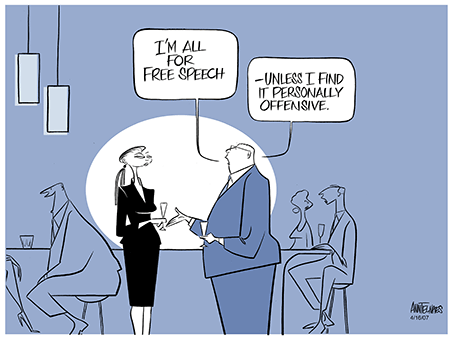
  1. The news release’s internal contradictions are remarkable.  Without any irony whatsoever, Edwin Mellen Press in its press release says that “EMP remains resolute that all have the right to free speech.”  How is suing a librarian for $1 million an affirmation of that principle?  For that matter, how did suing Lingua Franca over its characterization of Edwin Mellen Press uphold “the right to free speech”?  This doesn’t make any sense.  And when you follow that claim about “right to free speech” in the very next sentence with “all have the right to take steps, including legal action, to protect their good names and reputation,” you’re reminding your audience that Edwin Mellen Press launches lawsuits at its critics in order to shut them up.  So, not a very effective piece of rhetoric.
  2. Even before Edwin Mellen Press launched this suit, it did not have a “good reputation.”  As Timothy A. Lepcyzk pointed out at EduHacker, when Edwin Mellen Press launched this suit against Askey, punching the words “Edwin Mellen Press” into Google would elicit the following suggestions: “edwin mellen press quality,” “edwin mellen press review,” “edwin mellen press reputation,” “edwin mellen press vanity,” “edwin mellen press vanity press.”  Edwin Mellen’s news release speaks of “EMP’s good reputation” and of the right to protect that reputation.  However, it didn’t have a good reputation when it filed this suit, and its reputation has only declined since then.
  3. You can’t erase the internet.  When you punch the publisher’s name into Google now, you get these automatic suggestions:  ”edwin mellen press,” “edwin mellen press reputation,” “edwin mellen press review,” and “edwin mellen press vanity.”  Below that, the first hit is the press’s website, but all other hits are other websites, each of which reference the press’s litigious behavior.  There are scores of articles on the Press, and they’re not flattering.  Did it seek to cement its reputation as a litigious bully or further delegitimize its allegation that it’s a “scholarly press” (a claim made in its latest press release)?  If so, then it has succeeded.  If it had other aims, it’s failed.Google: Edwin Mellen Press Vanity
  4. If the press cannot manage its own damage control, what does that say about its publicity department?  If dropping one suit (but not the other) was an attempt to control some of the damage that Edwin Mellen Press has inflicted on itself, it has instead inspired further speculation about its incompetence.  As Rick Anderson notes in his really nice close-reading of the Mellen news release, the publisher’s behavior “is simply bizarre.”
  5. This isn’t over yet.  Sign the petition!  There are currently over 3100 names on the petition.  Let’s keep those numbers rising.
  6. Finally, the Streisand Effect should be renamed the Edwin Mellen Effect. This PR debacle that the press has chosen to inflict upon itself will, I suspect, ultimately result in its undoing.  Its attempts to silence its critics have only amplified those critics’ voices.

More information on Edwin Mellen Press & Its Attempts to Silence Its Critics:

Leave a Comment

The People’s Library

“Nazis destroyed books to ‘purify’ German culture. Bigots do it in the name of God, or Allah. What’s Bloomberg’s excuse? ‘Hygiene’?”

— Salman Rushdie, via his Twitter account, 16 Nov. 2011

“If corporations are people, tents are definitely speech.”

— Ben Chappell, prof. of American Studies, University of Kansas (via Eric Michael Johnson [@ericmjohnson on Twitter], who credits @rmmilner and @docfreeride as his sources), 15 Nov. 2011.

The term “fascist” is used too often and too loosely in American political discourse. Mayor Bloomberg is not a fascist. However, in ordering the destruction of a library, the mayor’s actions evoke the symbolism of fascist and other totalitarian regimes. One expects that he did not intend a metaphoric alliance with such groups. Indeed, he wisely ordered the books to be thrown in the dumpster, rather than having them set on fire.

But Salman Rushdie — who knows a thing or two about the destruction of books — is not wrong when he hears parallels between Nazis’ attempts to “purify” culture via the destruction of books that (they alleged) would pollute minds, and Bloomberg’s claim that he’s acting to promote “the health and safety of the public.”  That was his explanation for the Tuesday 1:30 am attack on Occupy Wall Street, and the destruction of its library.  And you can see the appeals of his rhetoric: who would argue against “guaranteeing public health and safety”?  Unfortunately for the mayor, evidence contradicts his rhetoric.  Though Mayor Bloomberg worked to prevent reporters from covering the raid (for their own safety, he alleged), too many people were able to capture the event on film.  Looking at those images, the chaos and violence of the assault does not resemble either “health” or “safety.”

Occupy Wall Street Library (after)

Which is precisely why Mr. Rushdie’s parallel gains symbolic force.  As the mayor’s predecessors (fascist and otherwise) have done, Mr. Bloomberg uses language to mask ideology.  In a delightfully Orwellian use of language, he claims the twin goals of “guaranteeing public health and safety, and guaranteeing the protestors’ First Amendment rights” but, since (he said) the former outweighed the latter, “inaction was not an option.”  In other words, he needed to attack peaceful protesters in the middle of the night, while they slept, because they posed a danger to the public.  This sounds a bit like George W. Bush’s doctrine of preemptive war: the protesters may pose a danger, and so Bloomberg had to attack them before they did.  It also echoes the U.S. Army Major in Vietnam who, speaking to a reporter in 1968, said, “It became necessary to destroy the town to save it.”

The accidentally fascist overtones of the mayor’s purposefully thuggish order may be the greatest gift he could give the Occupy Wall Street movement.  Not only is the violence of this nighttime attack likely to galvanize the Occupy Wall Streeters, but it may also persuade others to join them. When you wage war on a library, you wage war on all who read, write, and think. When you attack books, you attack democracy.  And when you do these things, people fight back.

As Ben Chappell observes, “If corporations are people, tents are definitely speech.” And libraries are both.

The Occupy Wall Street Library (before the raid)

Image sources: “Urgent: Raid of Occupy Wall Street” (Occupy Wall Street Library, 15 Nov. 2011); “Occupy Wall Street Library Removed as NYPD Evicts Protesters” (School Library Journal, 15-16 Nov. 2011).

Leave a Comment

Senseless Violence: The NYPD Destroys Library. UPDATE #3

Occupy Wall Street Library (before) Occupy Wall Street Library (after)

“I cannot live without books; but fewer will suffice where amusement, and not use, is the only future object.”

Thomas Jefferson to John Adams, 10 June 1815

“Knowledge is power.”

Thomas Jefferson to to Joseph Cabell, 22 January 1820

“Let me conclude by thanking the NYPD, FDNY, and the Department of Sanitation for their professionalism earlier this morning. Thank you.”

Mayor Michael Bloomberg, 15 November 2011, after the NYPD and the NY Sanitation Department evicted Occupy Wall Street, destroying 5000 books.

“Apparently the NYPD have destroyed the donated library at #ows - I don’t think you need a metaphor, but crushing 5000 books might be one.”

– Simon HB (@norock on Twitter), 15 November 2011

 UPDATE as of 5:30 pm Central Time.  All of the Library has not been destroyed.  It’s being “held captive” by the City.  Here is a photo, courtesy of Mayor Bloomberg’s Twitter account (and The Observer).

Occupy Wall Street Library: "Property from #Zuccotti, incl #OWS library, safely stored @ 57th St Sanit Garage; can be picked up Weds"

UPDATE as of 11:30 pm Central Time: Occupy Wall Street Library asks, “And where is the rest of it?”: “We’re glad to see some books are OK. Now, where are the rest of the books and our shelter and our boxes? Nice try guys, but we won’t be convinced until we actually have all our undamaged property returned to us.”

UPDATE as of 12:30 pm Central Time, 16 Nov. 2011: Occupy Wall Street Library reports “that their claim that the library was ‘safely stored’ was a lie.”  About half of the books are missing; many others are damaged or destroyed.  Initial reports that books were thrown into dumpsters seem, in fact, to be accurate.  And this blog’s initial claim that the NYPD destroyed the library is also accurate.

Books from Occupy Wall Street Library.  They were damaged during the NYPD raid.

Image sources: “Michael Bloomberg Destroys a Library to Shut Down Dissent in New York City” (Irregular Times, 15 Nov. 2011); “URGENT: Raid in Progress” (Occupy Wall Street Library, 15 Nov. 2011); OWS Library Safe and Sound; Held Captive By City” (New York Observer, 15 Nov. 2011); “UPDATE: State of Seized Library” (Occupy Wall Street Library, 16 Nov. 2011).

Comments (2)

Why Meghan Can’t Read

stack of booksIn an op-ed piece that the Wall Street Journal published as an article, Meghan Cox Gurdon criticizes contemporary young adult fiction for its darkness. As she writes, “it is … possible—indeed, likely—that books focusing on pathologies help normalize them and, in the case of self-harm, may even spread their plausibility and likelihood to young people who might otherwise never have imagined such extreme measures.”  In other words, reading about troubled teens may not help console the troubled, but may in fact create more troubled teens.

Rebutting this claim, one Meghan Cox Gurdon wisely notes, “Now, whether you care if adolescents spend their time immersed in ugliness probably depends on your philosophical outlook. Reading about homicide doesn’t turn a man into a murderer; reading about cheating on exams won’t make a kid break the honor code.”  In other words, reading about troubled teens will not create more troubled teens.  Since Gurdon makes this point earlier in the same article, one wonders whether there are two Gurdons at work here — say, Gurdon (who deplores darkness in lit for teens) and Gurdon Prime (who recognizes that darkness need not beget darkness).

Gurdon Prime makes a strong point. Representing anorexia, bullying, rape, racism, or any of the host of challenges that teens face is different from endorsing any of those things. For this reason, Gurdon misses the mark when she accuses the “book industry” of using “the vehicle of fundamental free-expression principles to try to bulldoze coarseness or misery into … children’s lives.”  As Gurdon Prime knows, representation is different from endorsement. Since Gurdon does not appear to be in as close contact with her (former, I presume?) collaborator, I’d like to amplify Gurdon Prime’s point with a few tips on how to tell the difference between representation and endorsement.

1) Which characters does the novel represent sympathetically?  With which ideas do those characters seem aligned?

2) Since detecting sympathy seems a challenge for Gurdon, here are some literary terms to keep in mind:

A. Point of view.  Whose points of view does the book represent?  If it is a third-person narrative, does it tend to align itself with particular characters?  Which ones?  When?  Why?  If it is a first-person narrative, is the narrator reliable?  Or do the narrator’s perceptions and interpretations of events fail to coincide with the implied opinions and norms of the author?  If a book gives you reason to doubt the veracity of its narrator, then you have an unreliable narrator — and you’d be wise to view this character’s words with skepticism.

B. Diction, which is a fancy term for “word choice.”  The words an author chooses convey tone, a term for the speaker’s attitude towards the object of discourse.  If, for instance, Gurdon Prime suggested that Gurdon were “a narrow-minded, nattering nitwit,” one would feel compelled to note the sarcasm in such a choice of words.  The alliterative pleasures of that repeated “n” aside, this would be an ad hominem attack on Gurdon — personal and needlessly hostile.  And such diction might make us interpret Gurdon Prime as mean-spirited, even cruel.  On the other hand, what if Gurdon Prime instead said that Gurdon were “guilty only of her concern for young people, a concern which sometimes manifests itself in language that conveys passion more than it does an ability to read critically”?  In addition to suspecting Gurdon Prime of harboring an academic affiliation, we might also note the sympathy manifest in phrases like “concern for young people” and in the politic nature of the criticism: in this claim, “language” is the culprit, not Gurdon herself.

C. Narrative structure.  Who gets the first word in the book?  Who gets the last?  What impact does structure have on point of view?

3) There are of course many other literary features to consider here.  And many novels are ambiguous, requiring the reader to think about where to place her or his sympathy.  If Collins’ The Hunger Games (one of the books Gurdon cites) invites criticism of the violent spectacle in which Katniss and other tributes must participate, how do we evaluate those moments where the novel seems to invite us to root for Katniss, hoping that her acts of violence allow her to survive?  Is Collins’ novel complicit with what it strives to critique?  Or is she hoping to make the reader uneasy, by engendering in her or him the very feelings that the novel exposes as dangerous?

I suspect that Gurdon Prime understands all of the preceding points.  Here’s hoping that Gurdon is willing to listen to her erstwhile writing partner — indeed, here’s hoping that they collaborate again.  Together, they might produce some lasting work.

You might also be interested in:

Image source: “Summer Reading,” on Howdy!

Comments (4)

Free Pi!

No, Pi cannot be copyrighted, despite what one composer claims.  I had wondered why Michael John Blake’s beautiful YouTube video of “What Pi Sounds Like” had been taken down.  I’d linked to it in my “Happy π Day from Crockett Johnson” post, and then it… disappeared.  Blake explains why below:

Vi Hart has a truly excellent response to Lars Erikson, the composer who filed the claim against Michael Blake.  Check it out:

As Hart notes, Erikson has also written a melody based on Pi — but it’s a different melody.  I am not a legal expert, but I don’t think that Erikson’s claim has any standing: If this were a case of one melody sounding like another, then Mr. Erikson would have precedent.  See for instance, the case of George Harrison’s “My Sweet Lord,” in which Mr. Harrison’s piece was ruled to have borrowed from the Chiffons’ “He’s So Fine,” and Mr. Harrison was ordered to pay royalties to the song’s composer.  (I’ve complied a page of such borrowings — most of which have not resulted in lawsuits — on a blog post inspired by allegations made against Lady Gaga’s “Born This Way”.)

Compare the two Pi songs.  Here is the first movement of Lars Erikson’s Pi Symphony:

NewScientist has re-posted Michael Blake’s original video for “What Pi Sounds Like”:

You can also buy Michael Blake’s “What Pi Sounds Like” on iTunes.  When I listen to these two works, side by side, I find it a bit of a stretch to claim that Blake has somehow plagiarized Erikson’s work.  Yes, they both draw inspiration from 3.1415926535…, but sharing a common influence does not allow us to conclude that one work “stole” from the other.  Honestly, the main conclusion I draw from all of this is that Lars Erikson has the heart of a lawyer, and that Michael John Blake has the heart of an artist.

What do you think?

Comments (5)

Huckleberry Finn, Tom Sawyer, and Offensiveness

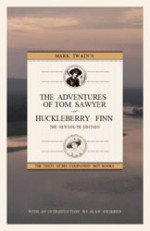
NewSouth's Bowdlerized edition of Mark TwainYes, you’ve all heard about NewSouth Press publishing Huckleberry Finn and Tom Sawyer without the “n” word.  But a couple of important points are getting lost in all the uproar.

As Natalia Cecire points out on her blog, the “political correctness” circus-goers are missing the point. I find it more noteworthy that such Bowdlerization is a common practice in children’s literature, but that it takes the Bowdlerization of a “classic” to make the news. The uproar focuses on Huckleberry Finn, the book canonized as a classic (i.e., for discerning grown-ups), and not Tom Sawyer, the book deemed “for children only” — even though both books have been altered in this new edition. (As Bev Clark has pointed out, at the time of their publication both books were considered both “boys’ books” and literature [for adults].)  The implication here is that it’s more acceptable to Bowdlerize the children’s book (Tom Sawyer) than it is to Bowdlerize the classic (Huckleberry Finn).

Also, people should be more offended not by so-called “political correctness” but by our unwillingness to help children make sense of offensiveness. Though Mark Twain was progressive on race for a 19th-century white male, his books ought to offend current sensibilities. If reading Huckleberry Finn or Tom Sawyer in the 21st-century fails to offend, then we’re not really reading these books. And that’s a subject worthy of further discussion.

Comments (3)

It’s a Joke, Jackass

Lane Smith, It's a BookI’m surprised by the extent of the kerfuffle over the use of a single word in Lane Smith’s It’s a Book.  In her Amazon.com review, librarian Margaret Burke writes, “I usually love Lane Smith’s books but was disappointed with the word jackass in the first page. I will NOT put this book in my library collection.”  On her blog, Library Lady writes that the word “simply isn’t necessary” and that, although she “will still share the book in storytime,” she “just won’t read the last page.”  Even Adam Gopnik’s smart and otherwise laudatory review in the New York Times takes issue with the word, calling it a “false note” and a “too-easy joke.”

It is a joke, but easy?  I defy Mr. Gopnik and anyone else to come up with a better punch line.  “It’s a book, silly” and “It’s a book, donkey” simply are not as funny as “It’s a joke, jackass.”  The double meaning of the word “jackass” makes the joke work.  The character is both a male donkey and a foolish individual.  No other punch line will work as well here.

The joke is not exclusively “for adults,” as many Amazon.com reviewers allege.  It’s a joke for kids, too.  How do I know this?  I know this because kids will get the joke.  A joke for adults goes over the heads of children — so, for example, the humor of a joke that relies upon sexual innuendo would likely be lost on a 7-year-old.  But the “jackass” joke is one that a grade-schooler can get.  I suspect that what really upsets the book’s critics is the idea of a child laughing at this “jackass” joke.  Laughter conveys the child’s knowledge that the term for an animal is also a term for a blockhead.  Laughter confirms that the child is not as “innocent” as the adult wishes to believe.  Not willing to concede that his or her assumptions about the imagined innocence of children may be flawed, the adult instead strikes back at the evidence — which, in this case, is It’s a Book.

One Amazon.com reviewer even calls the word an “expletive,” but it isn’t.  “Jackass” is a noun, and certainly an insult to the character at whom it’s directed, but I wouldn’t elevate it to the status of “expletive.”  Nor would any reputable dictionary.  Neither Webster’s Unabridged nor the Oxford English Dictionary lists “jackass” as “slang,” “vulgar,” “offensive,” or “taboo word” (these latter two are terms used by the OED to describe some expletives).  It’s simply conveying the fact that this character is a bit of a dolt. And it’s making a joke as it does so.

Contemporary children face many serious problems: cuts in funding to education, overcrowded schools, poverty, bigotry, abuse, neglect, and so on.  The word “jackass” doesn’t even make the list.  I suppose one reason for opposing the word is that, unlike the many real problems faced by young people, this one seems more manageable.  It’s a single word, it’s uncomplicated, and standing up against it plays upon our culture’s Romantic (and still popular) ideas of children — that they’re innocent, more “pure” than adults.  For some critics, I expect, taking a “principled” stand against “bad language” is satisfying on many levels — emotional, moral, paternal/maternal, etc.

However, decrying the use of this word is also extremely silly.  “Jackass” is a male donkey.  “Jackass” is a fool.  And, in the case of It’s a Book, “jackass” is a joke.

Comments (11)

Book-Banners Hurt Young People

Banned Books Week 2010 posterAs I look at the American Library Association’s lists of Banned and Challenged Books, one recurring theme emerges: most (though not all) depict difficulties faced by children and teens. Though the motive for banning books is protection, restricting access to these books hurts the children and teens who are most in need of them.  Laurie Halse Anderson‘s Speak and Maya Angelou‘s I Know Why the Caged Bird Sings both addresses the aftermath of rape. Harry Potter tells of a child who thrives despite the active neglect of his foster parents. Rudolfo Anaya‘s Bless Me, Ultima depicts the experience of facing peers who ridicule you for your culture and of facing parents more invested in their dreams than your own.  Tim O’Brien‘s The Things They Carried and Walter Dean Myers‘s Fallen Angels depicts how war shapes a young psyche.  Justin Richardson, Peter Parnell, and Henry Cole’s And Tango Makes Three shows that same-sex parents appear elsewhere in the animal kingdom, too.  Alex Sanchez‘s Rainbow Boys depicts the challenges gay teens face.

Children in vulnerable populations need to read books that help them make sense of their experiences.  As Mr. Antolini tells Holden Caulfield in J.D. Salinger‘s The Catcher in the Rye (another frequently challenged book), “you’ll find that you’re not the first person who was ever confused and frightened and even sickened by human behavior. … Many, many men have been just as troubled morally and spiritually as you are right now.  Happily, some of them kept records of their troubles.  You’ll learn from them — if you want to. … They tend to express themselves more clearly, and they usually have a passion for following their thoughts through to the end” (189).  Or ,as Holden says earlier in the novel, “What really knocks me out is a book that, when you’re all done reading it, you wish the author was a friend of yours and you could call him up on the phone whenever you felt like it” (18).

Many of the books that have been banned or challenged are exactly the books that can be the friend to the young person who desperately needs to know that she or he is not alone, that other people have faced similar struggles.  Though there are many such teens, I have been thinking a lot about the high suicide rate among gay teen-agers.  (And, yes, Given Holden’s anxiety about “flits,” The Catcher in the Rye may not be the book to which gay teens turn.)

Dan Savage’s “It Gets Better” Project has strikes me as particularly effective because it lets GLBTQ youth know not only that they’re not alone, but also that the traumas of high school do end and life can be good and even wonderful at times.

David Leviathan, Boy Meets BoyOf course, I’d much rather that young people lived in the world of David Levithan’s Boy Meets Boy, where teen-agers are allowed to express their sexual preference without fear of bullying.  But we don’t live in that world.  In the past three weeks, bullying has led to the suicides of Tyler Clementi, Seth Walsh, Asher Brown, Billy Lucas, and others whose deaths have not made headlines.  It’s extremely hard for teen-agers to realize that life can get better for them. Videos like this can help.

I think that books can help, too.  In my Literature for Adolescents class, I teach Francesca Lia Block’s Weetzie Bat and Sara Ryan’s Empress of the World.  I teach the former for its frank depiction of sexuality, but also its magical realism, its lyrical prose, and its influence on later writers… such as Sara Ryan, who alludes to Weetzie in her novel.  I teach her Empress of the World because — in addition to being a well-written narrative — I find that my students are more likely to teach it than Weetzie Bat.  They’re able to appreciate Weetzie Bat as art, but the conception of Cherokee Bat makes some uncomfortable.Sara Ryan, Empress of the World Since many will go on to be high school teachers, I want them to have a book about gay teens that they feel comfortable teaching.

(Incidentally, I’m definitely open to other suggestions for other gay-friendly books for that “slot” on the syllabus.  Each time I teach the class, I change it a little, swapping out some books, adding new ones, and so on.  So… if you have suggestions, please place them in the comments below.)

High school can be a difficult time — especially if you’re a member of any group that’s mocked, bullied or ridiculed for being “different.”  It’s hard enough growing up knowing that, say, your government believes that your sexuality makes you unfit to serve your country in uniform.  Or growing up knowing that you need to keep your love a secret, lest you be the victim of a hate crime.  If you’re taught to feel ashamed for who you are, you may not be inclined to talk to other people.  A library is one place where you might find the books that can talk to you, and to help you know that you’re not alone.

Teen-agers of all types (different genders, sexualities, nationalities, ethnicities, body types, religions, etc.) need access to books that help them make sense of what they are going through.  Denying them access to these books contributes to their marginalization and puts them at greater risk.

Why do some parents want to deny young readers access?  I say “parents” because, according to the American Library Association, over half (55%!) of all challenges to books come from parents.  To put that in perspective, the next-highest group of challengers are patrons (13%), followed by other (11%), administrators (9%), and board members (3%).  I have to believe that, in seeking to deny readers access, these parents are acting in what (they think) is the best interests of their community.  And, certainly, the desire to protect one’s children is universal (or nearly universal) among parents — and for good reason.

But any individual young person will not match one parent’s idea of what teenage-hood (or childhood) “is” or “should be.”  There are as many different kinds of teen-agers (and children) as there are different kinds of adults.  Never do we hear an adult say, “This book is inappropriate for adults” or “adults will like this.”  Yet, if we replace the word “adults” with “teen-agers” or “children,” then we’ll see a phrase encountered far too often.  A grown-up resists generalizations about him- or her-self, but is often quite happy to generalize about younger people.  This (well-intentioned) impulse to protect young adults by upholding such generalized, abstract notions of “teen-ager” or “child” not only fails to prepare young persons for the sometimes cruel world they face, but in fact has a greater potential to make their lives harder.

I know that literature is not in itself a solution to the problems of homophobia and bullying.  But it can help diminish the effects of both. And for the friends and families of Tyler Clementi, Seth Walsh, Asher Brown, Billy Lucas and all the other young GLBTQ people out there, we need to support the freedom to read.

Comments (2)

Speaking Out

Laurie Halse Anderson's SpeakWesley Scroggins, Associate Professor of Management at Missouri State University, thinks that Laurie Halse Anderson‘s Speak (1999) is “soft pornography.”  Having read and taught Speak many times, I suspect that Mr. Scroggins either lacks some basic literary skills (such as how to detect tone) or is in need of psychological counseling. As an English professor, I’m not qualified to help with the latter, but I can help him with the former.  So, Dr. Scroggins, I’m dedicating this blog post to you.

In an editorial printed on Saturday, Professor Scroggins makes the “soft pornography” allegation and then writes the following about Speak:

This is a book about a very dysfunctional family. Schoolteachers are losers, adults are losers and the cheerleading squad scores more than the football team. They have sex on Saturday night and then are goddesses at church on Sunday morning. The cheer squad also gets their group-rate abortions at prom time. As the main character in the book is alone with a boy who is touching her female parts, she makes the statement that this is what high school is supposed to feel like. The boy then rapes her on the next page. Actually, the book and movie both contain two rape scenes.

Professor Scroggins has described some plot elements, but has not discerned the novel’s perspective on those events.  The above summary is akin to saying of Ray Bradbury‘s Fahrenheit 451 (1953) that it shows firemen as pyromaniacs who start fires instead of putting them out, and burn books, too!  The book does display these events, but it does so in order to invite us to consider them critically.

Speak‘s narrator, Melinda Sordino, uses a literary technique known as irony.  When we use irony, we’re deliberately creating tension between a superficial, literal meaning, and a different, deeper, intended meaning.  If, for instance, I were to speak of George W. Bush’s eloquence or Barack Obama’s pessimism, I would be speaking ironically: the former U.S. president is as famous for his misstatements (“Bushisms”) as the current U.S. president is for his optimism.  Similarly, Melinda is speaking ironically when she writes, “I think the Merryweather cheerleaders confuse me because I missed out on Sunday school.  It has to be a miracle. There is no other explanation.  How else could they sleep with the football team on Saturday night and be reincarnated as virginal goddesses on Monday?” (29).  Here’s how you can tell.  First, statements like “It has to be a miracle” and “There is no other explanation” are hyberbole: exaggerated statements.  Indeed, in context, both are so exaggerated as to make the reader doubt their veracity.  Second, the second half of the final sentence quoted contradicts the first half: it’s not possible both to “sleep with the football team” and to be a “virginal goddess.”  Indeed, depending on one’s religious beliefs, it’s doubtful that anyone can be a “goddess” (another example of the hyperbole that engenders doubt). We might characterize the tone (speaker’s attitude towards the object of discourse) as sarcastic.  Sarcasm (which frequently involves deploying apparent praise as criticism) is a blunt form of irony.  The combination of hyperbole, contradictory statements, and a sarcastic tone helps us understand that Melinda is speaking ironically here.  Specifically, she’s criticizing the hypocrisy of a social order that endorses such a double standard in its treatment of women — treating the cheerleaders, as she says in the sentence following the one I quoted, “as if they operate in two realities simultaneously” (29-30).  Perceiving irony requires the reader to use context to detect tone.

Here, for example, is the context for Melinda’s statement, “This was what high school was supposed to feel like” (134).  Throughout the novel, Melinda speaks primarily to the reader and says very little to the other characters.  Just before she began her freshman year of high school, she went to a party, drank beer, and was raped.  The event traumatizes her.  She feels shame (survivors of rape often blame themselves), and doesn’t want to talk to anyone about what happened.  She says, “This was what high school was supposed to feel like” just as she begins to recall the events leading up to her rape.  A “gorgeous cover-model guy,” a senior whose name she does not know, begins flirting with her, and kisses her.  A little drunk, she “couldn’t figure out how to tell him to slow down,” but believes that he is attracted to her: “Nearly knocked me off my feet, that kiss.  And I thought that just for a minute there that I had a boyfriend, I would start high school with a boyfriend, older and stronger and ready to watch out for me” (135).  In other words, the statement “This was what high school was supposed to feel like” describes her state of mind prior to the senior’s sexual assault.  Inexperienced with alcohol and inexperienced with dating, Melinda is unaware that the senior’s intentions are anything other than romantic.  We, the readers, know better.  We know she is talking about the party where something happened, the party to which she has alluded many times already.  We know that something painful is about to occur.

And it does.  Immediately after she expresses the thought that the senior (who, we learn later, is named Andy) will look out for her, the next sentences are “He kissed me hard again. His teeth ground hard against my lips. It was hard to breathe” (135).  And then “A cloud cloaked the moon.  Shadows looked like photo negatives” (135).  Several words here clue the reader into the fact that something is about to go wrong.  The darkness of the “cloud cloaked” and shadows, and the uncanniness of “photo negatives” convey that Melinda’s experience is taking a dark turn. So, too, does the repetition of the word “hard” (three times) coupled (twice) with sensations of pain or distress: “teeth ground hard against my lips” and “hard to breathe.”  If you’re more than just functionally literate, you should recognize this.

Dr. Scroggins does not seem to be more than just functionally literate because he classifies the next scene as “soft pornography.”  If he finds a young girl’s rape to be sexually exciting, then he is in dire need of counseling.  Indeed, were I his employer, I would remove him from the classroom until he had undergone such counseling: such a man is a potential danger to students and colleagues.  However, Psychology is not my area of expertise.  (I earned a B.A. in English and in Psychology, but a Ph.D. in English.)  So, let us assume that the issue is literacy and not pathology.  Here is the scene he describes as pornographic:

“Do you want to?” he asked.

What did he say? I didn’t answer.  I didn’t know. I didn’t speak.

We were on the ground. When did that happen? “No.” No I did not like this. I was on the ground and he was on top of me. My lips mumble something about leaving, about a friend who needs me, about my parents worrying. I can hear myself — I’m mumbling like a deranged drunk. His lips lock on mine and I can’t say anything. I twist my head away. He is so heavy. There is a boulder on me. I open my mouth to breath, to scream, and his hand covers it. In my head, my voice is clear as a bell: “NO I DON’T WANT TO!” But I can’t spit it out. I’m trying to remember how we got on the ground and where the moon went and wham! shirt up, shorts down, and the ground smells wet and dark and NO! — I’m not really here, I’m definitely back at Rachel’s crimping my hair and glueing on fake nails, and he smells like beer and mean and he hurts me hurts me hurts me and gets up

and zips his jeans

and smiles (135-136).

The fact that the next thing Melinda does is call 911 should be a clue that the preceding experience was not meant to elicit desire.  If it aroused Dr. Scroggins, then let us assume he simply lacks sufficient literacy skils to perceive why this scene is disturbing.

Here’s why it is.  First of all, it’s a textbook case of rape: Andy (the senior) forces Melinda to have sex without consent.  He asks, “Do you want to?” Melinda at first does not reply, but then says (at the top of the long paragraph) “No.”  So, right there: rape.

Second of all, the words Melinda uses to describe the experience convey her pain, Andy’s coercion, and the subsequent trauma.  She says, “I twist my head away” — a sign of resistance.  She wants to move but cannot because he is more powerful than she is: “There is a boulder on me.” When she tries to scream, he covers her mouth with his hand.  These, not incidentally, are also signs of rape.  Rape is a crime of power, not of desire.  The moment when she thinks, “I’m not really here,” is a moment of dissociation, common when a person is experiencing trauma.  Finally, the repeated “hurts me hurts me hurts me” should give Dr. Scroggins and any reader a clue that this experience is not erotic, but painful.  It’s a crime.  It’s called rape.

If Professor Scroggins does not know the difference between rape and consensual sex, then he is a criminal waiting to happen.  If, on the other hand, he simply lacks sufficient literacy skills to read literature, then I hope that this blog posting may be of some help to him.

UPDATE, 9:00 pm.  There are many other interesting responses to this editorial.  Here are links to a few of them:

Comments (10)

Can Censoring a Children’s Book Remove Its Prejudices?

When I posted news of my “Censoring Children’s Literature” course last month, several people (well, OK, one person …maybe two) expressed an interest in hearing more about the course.  So, given that Banned Books Week is coming up next week, here’s an update. Having lately been examining two versions of Hugh Lofting’s Doctor Dolittle (1920, 1988) and three versions of Roald Dahl’s Charlie and the Chocolate Factory (1964, 1973, 1998), we’ve been addressing this question: Do Bowdlerized texts alter the ideological assumptions of the original?  The answer is more complicated than you might think.

One could make a case for “yes, they do alter the ideological assumptions of the original.”  The 1988 edition of Doctor Dolittle removes all references to skin color: “black man” becomes “man,” and “white man” becomes “man” or “foreign man.”  Instead of tricking Prince Bumpo by preying on his desire to be white (in the original), Polynesia tricks Prince Bumpo by hypnotizing him (in the current version).  In the 1973 edition of Charlie and the Chocolate Factory, the Oompa-Loompas are no longer African Pygmies — they’re from Loompaland.  Illustrator Joseph Schindelman changes their colors from black to white, and current illustrator Quentin Blake keeps them white in his 1998 edition.  Inasmuch as Willy Wonka’s workers are human beings imported from another country, the whitened Oompa-Loompas remove the original book’s implication that a person of European descent had enslaved people of African descent, and that the latter group had gladly accepted their new lot as his slaves.  Similarly, inasmuch the colonialist impulses of Doctor Dolittle are now no longer so explicitly attached to skin color, the 1988 edition diminishes the overt racism of the original edition.  The King of the Jolliginki may still throw childish temper tantrums and Prince Bumpo still may be easily duped, but in the new edition they’re simply color-less victims of Lofting’s satire.

The Oompa-Loompas, as illustrated by Joseph Schindelman, 1964

The Oompa-Loompas, as illustrated by Joseph Schindelman, 1964

The Oompa-Loompas, as illustrated by Joseph Schindelman, 1973

The Oompa-Loompas, as illustrated by Joseph Schindelman, 1973

The Oompa-Loompas, as illustrated by Quentin Blake, 1998

The Oompa-Loompas, as illustrated by Quentin Blake, 1998

One could also make a case for “no, they do not alter the ideological assumptions of the original,” claiming that the new versions instead more subtly encode the same racial and colonial messages of the original versions.  After all, the Oompa-Loompas still live in “thick jungles infested by the most dangerous beasts in the entire world,” and are still a “tribe” who do not learn English until they come to Britain.  Even though the animals are now nonsensical (“hornswogglers and snozzwangers and those terrible wicked whangdoodles”), it’s not unreasonable for a child to assume that a “tribe” living in “thick jungles” are Africans living in Africa.  And they still happily acquiesce to being shipped to England “in large packing cases with holes in them,” and find life in a factory preferable to life in their native land.  Though I don’t agree with all of Eleanor Cameron’s 1972 critique, the 1973 and 1998 versions of Charlie and the Chocolate Factory do not fundamentally contradict her concerns about “Willy Wonka’s unfeeling attitude toward the Oompa-Loompas, their role as conveniences and devices to be used for Wonka’s purposes, their being brought over from Africa for enforced servitude, and the fact that their situation is all a part of the fun and games.”

Similarly, while the 1988 edition of Doctor Dolittle makes an effort to make race invisible, it does not make the original book’s colonial ideologies vanish.  Though now from “the Land of the Europeans” instead of “the Land of the White Men,” Doctor Dolittle is an enlightened white European who goes to civilize the natives.  The King of the Jolliginki may now be colorless, but he still lives in a palace “made of mud” in the jungle, and is foolish enough to be duped by a bird (Polynesia).  Both he and his men are prone to childlike tantrums, which (even sans color) invokes the stereotype of Africans as childlike.  And the monkeys still stand in for indigenous people. They are sick because of lack of proper sanitation (flies infect their food supply), and they have no history: “the monkeys had no history books of their own before Doctor Dolittle came to write them for them, they remember everything that happens by telling stories to their children.”  Removing skin color from the text and illustrations does not necessarily remove colonialism.  As New York librarian Isabelle Suhl wrote of the Doctor Dolittle series in 1968, “These attitudes permeate the books … and are reflected in the plots and actions of the stories, in the characterizations of both animals and people as well as in the language that the characters use. Editing out a few racial epithets will not, in my view, make the books less chauvinistic.”

The Story of Doctor Dolittle, frontispiece, illustrated by Hugh Lofting, 1920

frontispiece, The Story of Doctor Dolittle, illustrated by Hugh Lofting, 1920
The Story of Doctor Dolittle, frontispiece, 1988

frontispiece, The Story of Doctor Dolittle, illustrated by Hugh Lofting, 1988

So, then.  What do you do with these books?  If you’re persuaded by the idea that de-colorizing the books also removes ideology, then you can with clear conscience read the new versions to young people and encourage young people to read them.  After all, Dahl himself revised Charlie and the Chocolate Factory, and in so doing replaced Africa with the pleasantly nonsensical Loompaland.  And Doctor Dolittle’s kindness towards animals has inspired many advocates of animal rights.  The 1988 edition uses the words of one such person, Jane Goodall, as a blurb on the back of the book: “Any child who is not given the opportunity to make the acquaintance of this rotund, kindly, and enthusiastic doctor/naturalist and all of his animal friends will miss out on something important.”  Along side of any troubling ideas, the Dolittle books contain much that may delight and instruct.

However, if you’re concerned that the books simply dress up racial and colonial ideologies in different costumes, then you face a choice: (1) Discourage children from reading them, (2) Permit children to read only the Bowdlerized versions, (3) Allow children to read any version, original or Bowdlerized.

(1) Discussing revised editions of her own works, Anne Fine asks, “Which is the real version? Who’s to say? The originals are the ones I would save from a fire. I rather hope the newer versions are the ones my readers would take with them to desert islands.”  I think what she means by this is that she hopes people re-read the revised editions, but thinks the originals should be preserved for posterity.  In Should We Burn Babar?, Herbert Kohl uses a similar logic: “I wouldn’t ban or burn Babar, or pull it from libraries.  But buy it?  No.  I see no reason to go out of one’s way to make Babar available to children, primarily because I don’t see much critical reading going on in the schools and children don’t need to be propagandized about colonialism, sexism, or racism.”  So, then, we might relegate Charlie and the Chocolate Factory and Doctor Dolittle — whether original or revised — to the status of cultural artifact, historically significant but no longer read.

One problem with this approach is that it acts as a kind of covert censorship, a blacklist of sorts.  It says: “oh, no, we’re not banning the book.  We’re just not inviting it.”  So, if you’re of a libertarian mindset, this response will not suffice.

(2) What about allowing children to read only the Bowdlerized versions, then?  That might (in some measure) appease the person of libertarian leanings who nonetheless does not wish to collude in the replication of harmful ideologies.  Yes, it might… if you believe that the Bowdlerized versions do — as Lori Mack, editor of the 1988 version of Doctor Dolittle, said of that volume — “preserve Hugh Lofting’s style and spirit” but without “the offensive caricature.”  However, if you’re a literary purist who believes in granting access to the original work or if you worry that these versions offer only a more subtle, insidious kind of propagandizing, then this approach will fail.

But will it?  Books containing stereotypes (whether re-costumed or not) invite children to participate in that way of thinking, but children do not have to accept the invitation.  They may resist.  If a book’s presentation of people of color does not conform to other images of people of color, then a child may dismiss the book as anomalous.  As an outlier, it perhaps does not unconsciously shape their perceptions.

(3) If you believe in the child’s potential to resist, then you might argue for granting access to the original work on the grounds that the egregiousness of the original’s stereotypes will serve as a kind of “warning flag.”  In other words, one might argue that blunt offensiveness is less harmful than a subtler delivery of prejudices because the reader is more likely to reject the former.  We can read a book and disagree with the book; encountering a book with racist imagery might be more likely to provoke our censure.  Encountering a book in which that imagery has been cleaned up (even while leaving other underlying assumptions intact) might be less likely to provoke our censure.  In sum, we could make the case that unvarnished prejudice serves as a better teaching tool.

One problem of this approach, however, is the disproportional burden it places on members of the stereotyped group.  The white child (for example) who encounters Prince Bumpo or an Oompa-Loompa has the unearned privilege of not seeing people of her or his ethnicity being stereotyped.  The African-American child (for example) does not have that privilege.  This is not to say that prejudice lacks any ill consequences for the dominant group — a white child learning that he or she is more important, more central, can teach that child that dominating children (or adults) of color is acceptable behavior.  Rather, this is to say that prejudice harms different groups in different ways.

What, then, is the solution?  I’d be the first to acknowledge that there is no ideal solution.  One could argue, for instance, that a “colorless” Doctor Dolittle rightly highlights the fact that race is a fiction: black, white, beige, yellow, etc. are pure fantasy.  We’re all members of the human race.  On the other hand, one could counter that claim by noting that while race may be imaginary, people act on racial distinctions as if they were real: denying the social fact of race is a form of lying.

As an educator, I’m inclined to fall back on the (albeit imperfect) solution of reading troubling texts with young people, and talking with them about what they encounter.  As Herb Kohl writes, “It is not developmentally inevitable that children will learn how to evaluate with sensitivity and intelligence what the adult world presents them.  It is our responsibility, as critical and sensitive adults, to nurture the development of this sensibility in our children.”  Further, he notes, critical reading can be a source of both pleasure and power: “children quickly come to understand that critical sensibility strengthens them. It allows them to stand their ground ….  It is a source of pleasure of well — of the joy that comes from feeling that one is living according to conviction and understanding.”

As a negative state, innocence cannot be sustained indefinitely.  As they grow up, children will gain experience and knowledge.  Some of those experiences will hurt; some of that knowledge will make them sad.  If we exclude troubling works from the discussion, then children are more likely to face sadness and pain on their own.  It is, I think, better that we give them the tools with which to face prejudice-bearing literature.  In doing so, we can help them learn to cope with a world that can be neither just nor fair.  With this knowledge, perhaps we may also give them a source of power.

Comments (54)