Archive for February, 2011

The End: Children’s Authors’ Last Words

Following the deaths this month of Brian Jacques, Janet Schulman, and Margaret K. McElderry, we turn to the last words of those who wrote for the young — Seuss, Dahl, Thurber, Montgomery, Nesbit, Charles M. Schulz, Crockett Johnson, and others.

“Yes. I’m not going to die tomorrow.”

— Dr. Seuss (Theodor Seuss Geisel, 1904-1991)

Donald Sturrock, Storyteller: The Authorized Biography of Roald Dahl“Ow, fuck!”

— Roald Dahl (1916-1990)

“Oh, balls!”

— Crockett Johnson (David Johnson Leisk, 1906-1975)

“God bless… God damn.”

— James Thurber (1894-1961)

“It’s gone, Mother! Gone! Gone! Gone!”

— Winsor McCay (1867-1934)

“I love you.”

— Hergé (Georges Remi, 1907-1983)

“This copy is unfinished and never will be. It is in a terrible state because I made it when I had begun to suffer my terrible breakdown of 1940. It must end here. If any publishers wish to publish extracts from it under the terms of my will they must stop here. The tenth volume can never be copied and must not be made public during my lifetime. Parts of it are too terrible and would hurt people. I have lost my mind by spells and I do not dare think what I may do in those spells. May God forgive me and I hope everyone else will forgive me even if they cannot understand. My position is too awful to endure and nobody realizes it. What an end to a life in which I tried always to do my best.”

— L. M. Montgomery (1874-1942)

David Michaelis, Schulz & Peanuts“I have a poem coming with its form nebulous, but its content all arranged and a few really good lines done — it is for when I have (if I ever have) done it. (I have caught the Skipper. The D[octor] has come. I hope I can hold the pencil till the D. has gone. Still got him!)”

— E. Nesbit (1858-1924)

“Keep going, finish your book.”

— Charles M. Schulz (1922-2000)

sources: Judith and Neil Morgan, Dr. Seuss & Mr. Geisel: A Biography (Random House, 1995), p. 287; Donald Sturrock, Storyteller: The Authorized Biography of Roald Dahl (Simon & Schuster, 2010), p. 561; Philip Nel, The Purple Crayon and a Hole to Dig: The Lives of Crockett Johnson and Ruth Krauss (University Press of Mississippi, 2012); Neil A. Grauer, Remember Laughter: A Life of James Thurber (University of Nebraska Press, 1995), p. 143; John Canemaker, Winsor McCay: His Life and Art, revised and expanded edition (Harry N. Abrams, 2005), p. 249; Pierre Assouline, Hergé: The Man Who Created Tintin, trans. Charles Ruas (Oxford University Press, 2009) p. 234; “The End of L. M. Montgomery’s Life,” The Anne of Green Gables and L.M. Montgomery Lexicon <http://www.lmm-anne.net/archives/2008/author/the-end-of-l-m-montgomerys-life.html>, 15 Feb. 2011; Julia Briggs, A Woman of Passion: The Life of E. Nesbit 1858-1924 (New Amsterdam Books, 1987), p. 393; David Michaelis, Schulz and Peanuts: A Biography (HarperCollins, 2007), p. 564.

notes: Not all biographies of children’s writers include last words. There are no last words in Leonard Marcus’s biography of Margaret Wise Brown, Barbara Stoney’s of Enid Blyton, nor Barbara Elleman’s of Virginia Lee Burton. Likewise, I don’t know Ruth Krauss’s last words, and so they’re not in my biography of her.

Comments (3)

Eight Facts About Roald Dahl

Donald Sturrock, Storyteller: The Authorized Biography of Roald DahlLast week, I finally finished Donald Sturrock’s Storyteller: The Authorized Biography of Roald Dahl.  I highly recommend it.  In addition to being well-written and carefully researched, it’s a heck of a story.  In it, you’ll encounter such facts as these:

  1. During World War II, Dahl was a spy.  (This has previously been documented in Jennet Conant’s The Irregulars: Roald Dahl and the British Spy Ring in Wartime Washington.)
  2. Dahl knew many people, including President and Eleanor Roosevelt, Ernest Hemingway, Walt Disney, Lillian Hellman, and Alfred A. Knopf.  Though he was conservative, Dahl was friends with Henry Wallace — U.S. Vice President during Roosevelt’s third term, and Progressive Party candidate for president in 1948.
  3. He was an egotistical, aggressive person who alienated many former friends and editors.  Indeed, he enjoyed getting a rise of out of people.  He liked to say things that provoked others.
  4. He was also an extraordinarily generous person — both to people he knew and to people he did not know.
  5. As a result of crashing his RAF plane during the Second World War, Dahl was in constant pain for much of his life.  (The pain may be one of the reasons he could be such a difficult person.)
  6. Dahl’s medical adventures display his mix of original thinking and tenacity.  Believing that natural teeth were more trouble than they were worth, he had all his teeth removed and replaced with false ones.  He convinced others to do the same.  When a New York cab shattered his infant son Theo’s skull, Dahl devoted himself to the boy’s recovery, helping to invent the Dahl-Wade-Till valve: this helped expel the excess cerebrospinal fluid that was leaking into his body.  It was used successfully on over 3,000 children.  His unrelenting efforts in helping first wife Patricia Neal recover from a stroke were both cruel and effective.  She was able to return to acting within a couple of years.
  7. Charlie (of Chocolate Factory fame) was originally a “small NEGRO boy.”  In light of the whole Oompa-Loompa controversy, this is a fascinating detail.
  8. Dahl’s last words were “Ow, fuck!”

If you’ve any interest in Dahl’s work or life, definitely check out Sturrock’s biography.  It’s a great read about a complex, creative, aggravating author.  The book has inspired me to seek Dahl novels and stories that I’ve not read.  Having learned so much about the man, I’d like to read more of his work.

Leave a Comment

Here Comes the Barnaby Truck

Barnaby exclusively in the Chicago Sun!” Here’s a photo of a Chicago Sun delivery truck in the 1940s.

Barnaby on Chicago Sun delivery truck

The occasion for sharing the photo is the quest for original Barnaby strips!  As readers of this blog know, Eric Reynolds and I are co-editing The Complete Barnaby for Fantagraphics.  We’re currently working on gathering strips from 1942-1943 — volume 1 (featuring those strips) is due out in April 2012.  Should you have any of these strips (or later ones), do drop me a line!  (My email address is at right, under “A note on mp3s.”)

Also, I love the fact that Crockett Johnson‘s comic strip is being used to sell newspapers.  Despite the many great strips being written these days (Cul de Sac, Doonesbury, Zits, Non Sequitur, etc.), you don’t see them deployed to help boost a paper’s circulation.  Which is a missed opportunity, I think.

Photo credit: Thanks to Charles Davis for sharing this! (Photographer unknown.)

Comments (1)

Martin Amis, Brain Damage, and Children’s Literature

Martin Amis smokes a cigaretteOn the BBC’s Faulks on Fiction this week, Martin Amis said, “People ask me if I ever thought of writing a children’s book. I say, ‘If I had a serious brain injury I might well write a children’s book’, but otherwise the idea of being conscious of who you’re directing the story to is anathema to me, because, in my view, fiction is freedom and any restraints on that are intolerable.”  He added, “I would never write about someone that forced me to write at a lower register than what I can write.”

It’s tempting to observe that Mr. Amis appears to have already suffered “the serious brain injury” of which he speaks.  To suggest that only brain damage could enable him to write for children implies that children are brain-damaged adults; to claim that writing for younger readers is writing “at a lower register” betrays an astonishing level of ignorance about the field.  Since both notions are demonstrably false, perhaps we should both wish him a speedy recovery, and advise him to take better care of that head of his.  Indeed, one might say that, given the pervasiveness of the injury he’s evidently suffered, the real news here is that he’s able to form complete sentences on his own.  Remarkable!

But, of course, Amis’s condescension is not the result of head trauma.  It’s a result of the arrogance and ignorance that afflict many otherwise intelligent people, when they attempt to write about children’s literature.  A.S. Byatt’s description of the Harry Potter novels as “jokey latency fantasies” (2003) comes to mind, as does Harold Bloom’s infamously lazy comments (2000) on the same series.  Like Amis, both are intelligent people — Byatt, a gifted novelist, and Bloom, a sharp literary critic.  However, hampering their ability to apply that intelligence to books for younger readers, their damaged minds struggle under cultural prejudices that consider children’s literature “lesser” and “not for serious writers.”

So, before (purely as an experiment) we thwack Mr. Amis in the head to see what sort of children’s book he might write, we might remember that his remarks are but a symptom of a larger cultural bias. He may lack sufficient understanding to perceive this, but children’s literature is, of course, very difficult to write well. As Dr. Seuss said, “I find writing for children more difficult, and more satisfying.  There are infinitely more writing tricks to capture adult readers than children.  You can’t kid the kids.  If the story or method of telling it bores them, you don’t get a second chance.  They just walk out on you.”  But another of Seuss’s comments is even more applicable here.  Asked whether he’d ever consider writing for adults, Seuss liked to say, “Adults are obsolete children and the hell with them.”

Photo of Mr. Amis from Magic and Lies.

Patricia Storms' caricature of Martin Amis as the GrinchUpdate, 13 Feb. 2011, 11 am: Patricia Storms’ Only a Brain Injury Could Make Me Draw Martin Amis (on her BookLust blog) features caricatures of Amis as the Cat in the Hat, Max, Madeline, the Pigeon, a Moomin, and others.  One of those caricatures is, I think, ideal to accompany my particular blog post — as it combines both Amis and Seuss.  I refer, of course, to her Amis as Grinch (at right)!  So. Go and amuse yourselves with her art.

Comments (14)

Goodbye, Yellow Brick Road?

Tin Woodsman & Langston Hughes' "What happens to a dream deferred?"

What would Kansas be like without Langston Hughes, William S. Burroughs, or The Wizard of Oz?  What would Kansas be like without art?  That’s what the blog Imagine Kansas Without Art is considering, in light of Governor Brownback’s order to eliminate the Kansas Arts Commission (which, if approved by the state legislature, will go into effect in July).

One answer, oddly, is the Kansas described by L. Frank Baum in The Wonderful Wizard of Oz (1900).  People associate Kansas with Oz, and think of Dorothy (portrayed by Judy Garland) saying, near the 1939 film’s end, “There’s no place like home,” and “If I ever go looking for my heart’s desire again, I won’t look any further than my own back yard. Because if it isn’t there, I never really lost it to begin with!”  But in the book, Kansas is a bleak, grey place.  Sure, Baum was describing South Dakota (where he lived) when he described Dorothy’s home (he hadn’t yet been to Kansas).  But Kansas doesn’t come off as very appealing: “The sun had baked the plowed land into a gray mass, with little cracks running through it.  Even the grass was not green, for the sun had burned the tops of the long blades until they were the same gray color to be seen everywhere.  Once the house had been painted, but the sun blistered the paint and the rains washed it away, and now the house was as dull and gray as everything else.”  Indeed, in Baum’s version, the state of Kansas is nigh killing Uncle Henry and Aunt Em.  She had been “a young, pretty wife.  The sun and wind had changed her, too.  They had taken the sparkle from her eyes and left them a sober gray; they had taken the red from her cheeks and lips, and they were gray also.  She was thin and gaunt and never smiled, now.”  And, as for her husband, “Uncle Henry never laughed.  He worked hard from morning till night and did not know what joy was.   He was gray also.”  In sum, Kansas — according to Baum — is such a grey place that it turns its people ashen and full of despair.

Dorothy’s journey to Oz — which, in the novel, is a real place (and not a dream) — is an escape into color, adventure, and art.  Kansas without these things is, as Baum wrote, “dull and gray.”  That appears to be Governor Brownback’s vision for the state.

I mean, never mind the absurdity of the economic argument.  For each dollar the state spends on the Arts Commission, it brings $2 in federal money back to the state — giving $1 the power of $3 is a strong financial reason to retain the Arts Commission.  Beyond that, the arts bring in revenues from tourism, which help broaden the tax base.  As Kansas Citizens for the Arts points out, “The nonprofit arts and cultural sector is a $153.5 million industry that generates $15 million in local and state revenue. People who attend community arts events also shop, spend money on gasoline, dinner and childcare — contributing to local economies.”  (And, for the record, yes, I am definitely willing to pay more state taxes to support this.)

But even an stronger rationale than the economics argument is this: life without art is bleak.

Image from Imagine Kansas Without Art.

Leave a Comment

How to Talk Nonsense

John Tenniel, Mad Tea Party

Last Friday, in my English 703: Critical Approaches to Children’s Literature class, the students and I spent 5 minutes talking nonsense.  We’d been reading theories of nonsense, and Lewis Carroll’s Alice books — I thought it would be both fun and educational to put those theories into practice.

So, based on our readings of Tigges, Anderson and Apseloff, and others, I had them enumerate some of nonsense’s formal qualities: language as game; use of puns, double meanings, inversions, opposites; playing on idiomatic language, taking figurative language literally; and so on.  Then, we prepared for the nonsense chat. I set it up as a conversation with me on the one side, and a student on the other.  These were the rules: (1) I asked them to raise their hands when they felt they had an entry point.  (2) When the student could sustain the nonsensical banter no longer, she or he was to pass off the conversation to the next person whose hand was raised.

If speaking nonsense isn’t your forte, you could modify the above exercise as follows: make the teacher both referee and equal participant (i.e., not obliged to hold up the entire side of the conversation).  Speaking nonsense comes quite easily to me.  (Try to contain your surprise.)  You see, my brain naturally comes up with multiple options in reply.  Most of the time, I chose the “sense” reply, and ignore the other options.  If I’m in a social situation, I listen to the other options, and will move back and forth between humor and seriousness, depending on my audience.

Anyway, back to class.  We sustained the conversation for 5 minutes, no problem.  (I wish we’d recorded it — some of our exchanges were quite funny.)  After we finished, I asked them about the experience of talking nonsense.  What had they learned?  This conversation was interesting.  As one student point out, it’s using language not to communicate, but to compete.  As another said, it’s an isolating experience — echoing a comment from nonsense scholar Wim Tigges, whose “An Anatomy of Nonsense” (1987) we read.  Speaking nonsense does, of course, heighten one’s awareness of language’s formal qualities: in order to speak it, you sustain syntax in order to subvert sense.  As Tigges puts it, “nonsense is not the absence of sense, but rather a frustration of expectations about sense” (25).  It plays on the tension between meaning and its absence.

I love to discover pedagogical “stunts” that work (I dislike such stunts for their own sake).  This, I am pleased to report, was a useful exercise.  It educated while it entertained.

Comments (4)

Syd Hoff’s Teeth: The Leftist Satire of A. Redfield

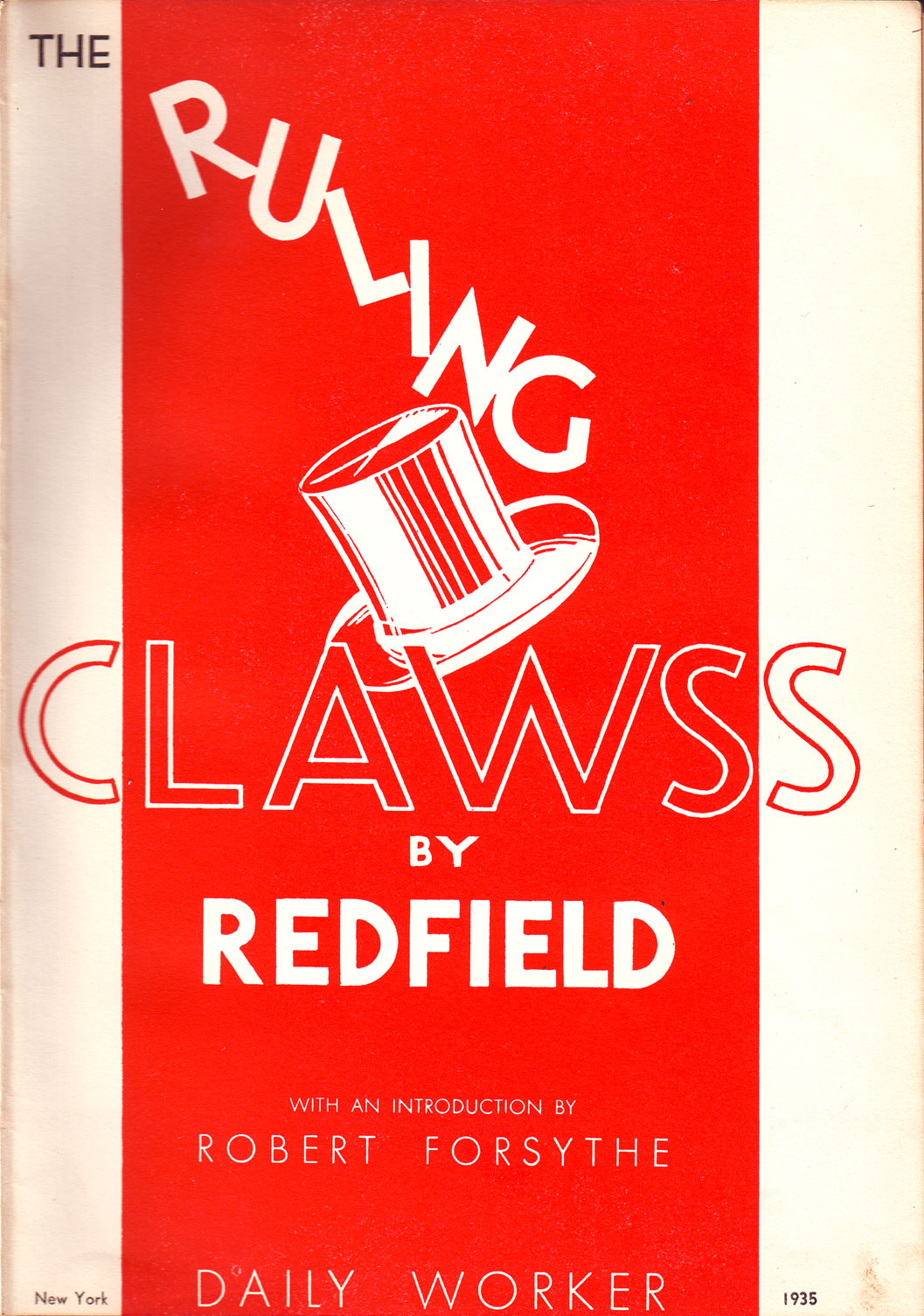
Redfield's The Ruling Clawss (1935): title pageWhile he was contributing to the New Yorker as Syd Hoff, he was also contributing to the Daily Worker and New Masses as A. Redfield — the pseudonym he adopted for his radical work.  The Ruling Clawss (Daily Worker, 1935) collects his cartoons originally published in the Communist daily.  Contrary to what all published biographies (except for the one in Julia Mickenberg’s and my Tales for Little Rebels) allege, Hoff’s first collection of cartoons was not Feeling No Pain (Dial, 1944).  His first such collection — and, in fact, his first published book — was The Ruling Clawss.  Here are a few selections.

Redfield's The Ruling Clawss (1935): "I wish mother would let me live like that for six months so I could write a novel."

Hoff mocks this bourgeois “artist” as a voyeur with no understanding of true suffering.

Redfield's The Ruling Clawss (1935): "... we who turn the wheels of industry ..."

This wealthy, well-fed speaker attempts to align himself with the workers.  He’s also oblivious to how thoroughly he is failing.  The workers’ stony expressions make that failure quite clear to us, though.

Redfield's The Ruling Clawss (1935): "Anybody who says there's starvation in America ought to have his head examined."

If you tuned in to Fox News during the presidency of George W. Bush, you would have heard sentiments similar to those expressed above.

Redfield's The Ruling Clawss (1935): "Give him a nickel, sweetheart. After all, you made a couple of million on the war."

In what may be the most acid cartoon in The Ruling Clawss, Hoff aims at those who profit from war, but remain indifferent to its human costs.

Redfield's Ruling Clawss (1935): "I'm against unemployment insurance — it would make people lazy"

Hoff attacks the still-current conservative argument that suffering is somehow ennobling or motivating.  Only someone who has never suffered could make such a claim.

Redfield's Ruling Clawss (1935): "Aren't you exaggerating just a little bit, Mr. Redfield?"

In “Social Satire,” an essay by Hoff (as Redfield) included as an afterword, the artist argues that most contemporary satirists are not sharp enough: “Today we have a new group of satirists who, at the same time that they bite the bourgeoisie, use only their lips, but not their teeth” (180).  He singles out Peter Arno, Otto Soglow (The Little King), Harold Gray (Little Orphan Annie), Sidney Smith (The Gumps), Chester Gould (Dick Tracy), and Percy Crosby (Skippy) for particular criticism.  He praises only Art Young, “the greatest satirist of his day.”  Everyone else falls short.  They “are talented and funny, but . . . their comedy is all too often a whitewash for people and conditions that, in reality, are not funny” (183).

Hoff (1912-2004) was something of a renaissance man in the field of cartooning.  He wrote syndicated comic strips, satirical cartoons (both with and without teeth), children’s books, and even a 400-page illustrated history of political cartooning.  All told, he was the author, illustrator, or author-illustrator of over 100 books.  Only a few of those books betray the political commitment of his youth — notably, Gentleman Jim and the Great John L (1977) and Boss Tweed and the Man Who Drew Him (1978).  The latter book is about Thomas Nast, another satirist who — like Hoff — created art that, sometimes, sunk sharp teeth into the powerful.

Redfield's Ruling Clawss (1935): left endpaper Redfield's Ruling Clawss (1935): right endpaper

Related posts:

Comments (27)