Archive for August, 2010

Crockett Johnson: A Quiet Man

I’m posting another Crockett Johnson artifact to commemorate the completion of the latest (and, I hope, final) round of revisions to The Purple Crayon and a Hole to Dig: The Lives of Crockett Johnson and Ruth Krauss (forthcoming from UP Mississippi, 2012). I just finished this evening.

One of the greatest challenges in writing the Crockett Johnson half of the biography is that he lacked any autobiographical impulse. Krauss wrote roughly 150 pages about herself; Johnson wrote none.  She was effusive; he was reticent.  This letter, which Marcia Ascher kindly shared with me, is a case in point:

Crockett Johnson, letter from 6 March 1943

Asked for details about his life, Johnson suggests that she look at a recent Newsweek article or quote from a fictional character — Barnaby’s loquacious con artist of a fairy godfather, Mr. O’Malley. Granted, he is responding to a ten-year-old fan’s query for her school project; he may not have had time to compose a full autobiography. Still, this sort of self-effacing response is typical of Johnson. You might say that his succinct, minimalist aesthetic extends even to casual self-expression.

If you did, you would be partially correct. When he’s writing satirically, he can approach a verbosity of O’Malley-esque proportions.  I’ll post an example of that some other time.

Comments (4)

The Art of PowerPoint: A User’s Guide

You’ve all seen the PowerPoint as slide show.  Or the PowerPoint as data dump, overloaded with text.  Or the PowerPoint as exactly what the person is saying, word-for-word.  These all give PowerPoint a bad name. They are all abuses of a medium capable of much more creative and nuanced expression.

I learned this from watching Scott McCloud give a talk.  If you’ve never seen McCloud give a talk, then you need to watch the 17-minute video below.  So, please go ahead.  I’ll wait.

McCloud does maximalist PowerPoints (though he actually uses Apple’s Keynote and not the Microsoft product).  Visually dense and carefully paced, McCloud’s images form the movie to his spoken narrative.  Think of a documentary film: it does not simply display the words.  It provides something complimentary which may or may not include text.  That’s what McCloud is doing here.

I suspect he’s learned from animation because in many of his sequences, he uses repetition with a difference.  That is, if slide 1 has picture A, slide 2 has picture A and picture B, slide 3 has picture A and picture B and picture C.  And so on.  When you click from 1 to 2, you appear to have added picture B.  When you click from 2 to 3, you appear to have added picture C.  But you haven’t: you’ve simply repeated the earlier image with a difference.

I don’t know if he achieves his results this way, but in my McCloudian PowerPoints I work backwards: I create the final image of the sequence first, and then make (say) eight copies.  Go back and remove items — 1 item from slide seven, 2 items from slide six, 3 items from slide five, and so on.  Then, when you run the sequence forward, you appear to be adding pieces that form a coherent whole in slide eight.  If you do it this backwards way, then you can more easily achieve a clean layout.  Here are three slides from my Annotated Cat presentation:

3 slides from Philip Nel's Annotated Cat PowerPoint

Though I tend to say that I learned everything I know about PowerPoint from Scott McCloud, that’s not entirely true.  When I’m working in the maximalist style (as I often do), he’s my muse.  But his style of PowerPoint is very dense, and very labor-intensive.  Either when I’m short on time or when I simply want to change the tempo, I’ll also do minimalist work.  I learned this style from Kathleen Fitzpatrick.  You simply take a key word or phrase and put it up on the screen, in a sans-serif font at about 44-points or so.  She favors black text on a white background.  I favor white text on black because I prefer black backgrounds generally. (With white backgrounds, you’re conscious that you’re looking at a big box projected on a screen; with black ones, the text and images float in space, with no box.)  But either style would work.  The key is to stick to just a few words.  No more than two or three, tops.

There’s much more to say about PowerPoint aesthetics.  For example, I favor clean transitions — usually a quick fade.  If a different transition will work, then I may use something more dramatic or silly.  But I don’t want the gadgetry to get in the way of what I have to say.  And that’s key — you want the PowerPoint to aid your narrative.  It might offer counterpoint (as Stephen Colbert does in the Colbert Report’s “The Word” segments).  It might offer a complimentary image or a contradictory one.  It might be a word or phrase of your written text.  But it should never, never simply repeat exactly what you’re saying.  PowerPoint is an artistic medium.  Use it well.

Comments (2)

Ruth Krauss, mind-reader?

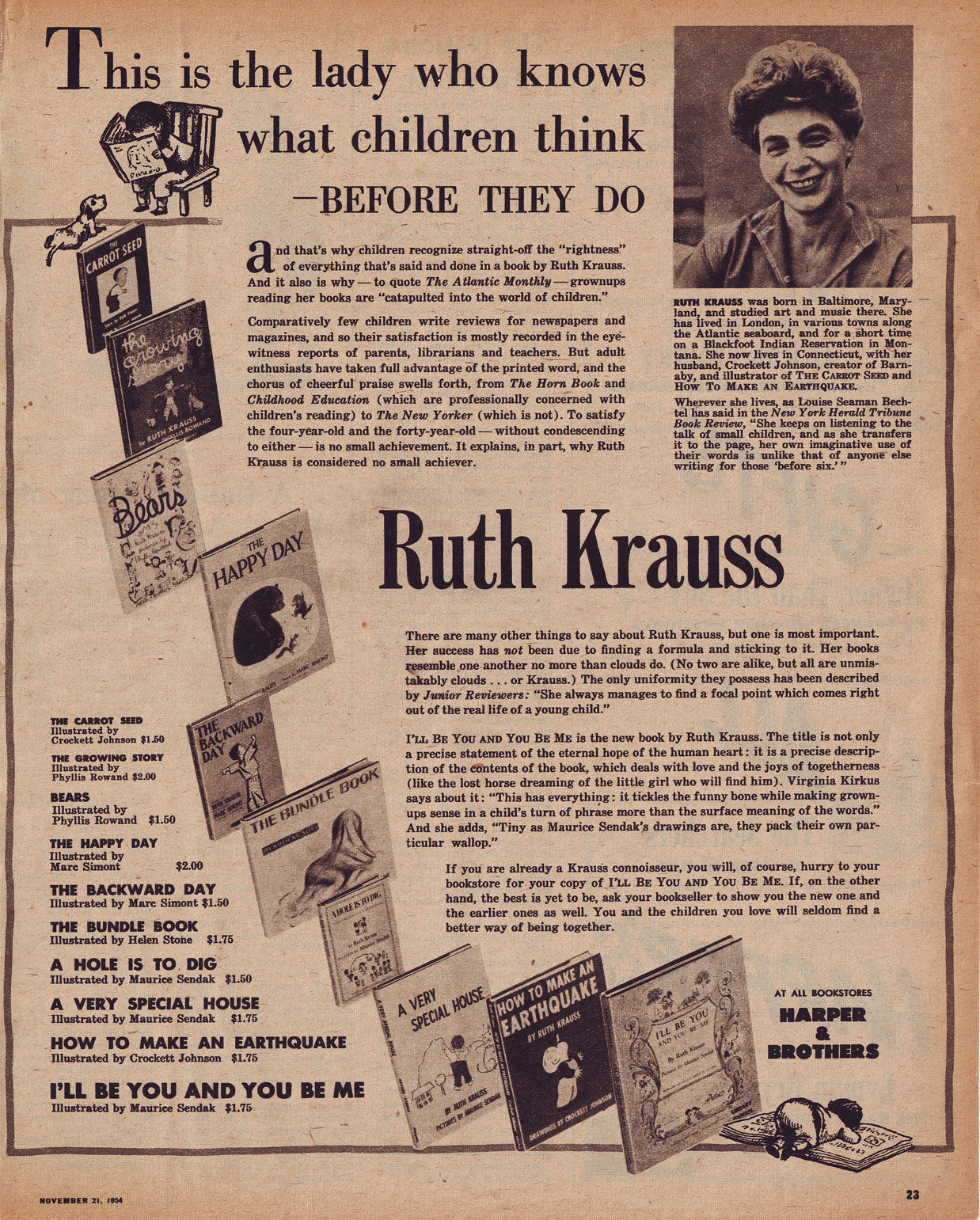
Ruth Krauss: Harper advertisement, 1954
Is it just me, or does “This is the lady who knows what children think — BEFORE THEY DO” sound like the tag line for a horror movie?  You will be relieved to know that Ruth Krauss could not read children’s minds. But she was an excellent and sympathetic listener. In her earliest work, she was able to imagine herself into the mind of a child. By the time of The Bundle Book (1951), she was getting her ideas from children themselves. They played, and she wrote down what they said. Or they told her stories, and answered her questions. The best-selling A Hole Is to Dig (1952) is the most famous example of this technique, but she relied on it for other works you see pictured here — A Very Special House (1953), How to Make an Earthquake (1954), and I’ll Be You and You Be Me (1954).

Old advertisements are fun to read. I especially like how this one praises Krauss as unique: “Her success has not been due to finding a formula and sticking to it. Her books resemble one another no more than clouds do.” At this stage of her career, that claim, though overstated, nonetheless carries some truth. Within a few years, she would begin to recycle ideas — Monkey Day (1957) borrows from I’ll Be You and You Be Me, Open House for Butterflies (1960) offers a variant on the premise of A Hole Is to Dig.

But being constantly original is very hard work. In any case, by the late 1950s, she had decided to become a poet. She still wrote for children, but reserved more of her creative energy for verse. However, when this ad appeared (21 November 1954) she was at her creative peak as a children’s author — having just published the third of her eight collaborations with Maurice Sendak. So, as the ad says, “Ruth Krauss is … no small achiever.” Oh, and, of course: “hurry to your bookstore for a copy.”  Go on.  I know you want to hurry there … because I know what you think BEFORE YOU DO.

Comments (1)

He Was a Teen-age Harold: Crockett Johnson’s High School Cartoons

During the ten years it’s taken me to write The Purple Crayon and a Hole to Dig: The Lives of Crockett Johnson and Ruth Krauss (forthcoming in 2012), I’ve gathered far more material than I can fit in the book.  From time to time, I’ll post here some of what I could not include.

Long before he thought up Harold and the Purple Crayon (1955) and Barnaby (1942-1952), Crockett Johnson was drawing cartoons. As a freshman at Newtown High School, Johnson — whose real name was David Johnson Leisk — became one of the artists for The Newtown H.S. Lantern. Indeed, he may have been one of the founders of this thrice-annual magazine. I have been unable to locate a copy of its first issue, but its second lists David Leisk is as one of three artists on the editorial staff. Published in March 1921, the Lantern’s second issue includes what may be the first published cartoon by Crockett Johnson.

That and two other high school cartoons will appear in the book, but this one will not:

Crockett Johnson, "Love Thy Neighbor," cartoon from the Newtown H.S. Lantern, Dec. 1921

David Leisk (Crockett Johnson), Newtown H.S. Lantern, December 1921

Published during the fall semester of his sophomore year, Johnson — a.k.a. David Leisk (note the signature of the cursive D transposed onto a cursive L) — conveys a bemused skepticism towards loving one’s neighbor.  The 15-year-old sophomore dryly reminds us not to “forget the little freshman who is still as green as ever” because, you know, Leisk is now a full year older than those freshmen.

Since we are heading into the start of a new term, here is David Leisk, now a high school senior, drawing a portrait of a freshman student:

David Leisk (Crockett Johnson), cover for Newtown H.S. Lantern, October 1923

David Leisk (Crockett Johnson), Newtown H.S. Lantern, October 1923

As readers of his adult work will note, he’s not yet developed the crisp cartoon minimalism that will become the hallmark of his style. But all aspiring cartoonists and illustrators have to start somewhere….

Finally, I’ve started Facebook groups for both Crockett Johnson and Ruth Krauss.  If you’re on Facebook, stop by.

Leave a Comment

“Too Bad His Duck Is So Crazy”: Tim Egan, Seriously Funny

Tim Egan: from first page to Friday Night at Hodges' Cafe

This is from the opening page of Tim Egan’s Friday Night at Hodges’ Café (1994).  It has one of my favorite lines in children’s literature: “Too bad his duck is so crazy.” The deadpan absurdity of that statement always cracks me up.  That said, when you look at the duck strutting on the counter, Hodges’ watchful eye angled towards him, you realize that the duck may indeed be a bit eccentric. “Everybody likes the duck,” our narrator tells us on the next page. “He’s just a little different. Sometimes he throws ice cream on the floor just to watch it smoosh. He’s also been known to dive into raspberry tarts, and, on occasion, he kicks strawberries across the room.”

And so begins the first of Tim Egan’s dozen picture books, to which he has recently added the Dodsworth easy reader series — three so far, each of which co-stars that crazy duck!

Tim Egan, cover to Burnt Toast on Davenport StreetEgan’s picture books have received good reviews, but he’s never yet won a major children’s book award.  Actually, I don’t think he’s ever won any children’s book award.  Which is simply wrong.  So, I thought I would write a little bit about him, in the hopes that more people learn of his work.  (For the record: I don’t know Mr. Egan.  I’m merely a fan.)

Most of his characters are anthropomorphic animals — cows, pigs, dogs, etc. who walk upright, wear clothes, speak in complete sentences.  Egan likes to have a little fun blurring the categories between people and animals.  The dog protagonists — Arthur and Stella Crandall — of Burnt Toast on Davenport Street (1997) dress well, and live in a beautifully furnished house.  They behave like humans.  Yet, beneath an illustration of Stella sitting on the couch and Arthur adjusting the TV set’s antenna, Egan writes, “Arthur and Stella were happy dogs.  They lived at 623 Davenport Street and had lived there for many years.  They spent their days doing what most dogs do.  Eating, walking, and sleeping.”  Near the end of the book, when the Crandalls are happy, “They both smiled and wagged their tails.”  Egan slyly reminds us that, though they dress and act like people, they retain their doggy natures.

His matter-of-fact presentation of silly situations makes these books work so well.  The tone recalls James Marshall’s George and Martha stories. There’s a joke there, but Marshall and Egan let it develop from the story. They trust that you’ll find things funny. George pours Martha’s pea soup into his loafers so he doesn’t have to confess his dislike of pea soup.  In Egan’s Chestnut Cove (1995), “You can usually find Mrs. Lark strolling along the Cliffside with her pig, Eloise.  And sometimes you might see the Ferguson family having somersault races in the town square.”  On the next page, Egan reports, “Mrs. Ferguson wins most of the time.”

Tim Egan, cover to Roasted PeanutsMany of his stories have a moral, but he always handles the lesson with subtlety and humor.  In Roasted Peanuts (2006), Sam (a horse) gets chosen for the local baseball team, the Grazers.  Yes, Grazers.  (As the illustrations show, cows also play on this team.)  Anyway, Sam gets chosen, but his best friend Jackson (a cat) does not: although he throws “really far and with great accuracy,” he’s slow, and can’t hit or catch well.  For Sam, playing on the Grazers without his friend, the joy goes out of the game, and he doesn’t play well… until Jackson gets a job selling peanuts in the stands.  He is so good at accurately throwing the peanut-packets that the crowd enjoys his performance as much as the game itself (where Sam is now playing much better).  OK, my summary fails to get across the nuances of the story, but my point is that its lessons are not heavy-handed.  It’s a tale of friendship, of finding your own talent, and of throwing peanuts far.  Really far.  (63 rows is Jackson’s record.)

Tim Egan, cover to Serious FarmEach of Egan’s stories feels both slightly familiar and completely original.  On the familiar side, the picture books of both Marshall and William Steig come to mind — animal characters with distinct personalities, the suggestion of a moral.  And on the original side, there’s the unlikely premise of each story.  In Serious Farm (2003), Farmer Fred (a human character!) seems to lack a sense of humor.  The animals try to make him laugh.  The plot complication in Chestnut Cove begins with a watermelon competition sponsored by King Milford.  In The Pink Refrigerator (2007), Dodsworth’s motto is “Try to do as little as possible”… until he meets a pink fridge that starts to give him ideas.

Where does Egan get his ideas?  He told Contemporary Authors, “My writing process consists of sitting in an overstuffed chair and staring at a notebook, hoping something will happen. When it doesn’t, I get more coffee. When it does, I write.”1 Next time you’re looking for a good story to go with your coffee, why not pick up some Tim Egan books? You’ll find them on the shelves by the overstuffed chair, right next to the watermelons.

——————————————

1. “Tim Egan.” Contemporary Authors Online. Detroit: Gale, 2006. Literature Resource Center. Web. 3 Aug. 2010.

Comments (4)

Dark Sarcasm in the Classroom: A Back-to-School Mix

Dark Sarcasm in the Classroom: A Back-to-School MixFor those of you in the northern hemisphere, August and September mark the beginning of the fall term — or, at least, they do if you are or have been a student, a parent/guardian of a student, or a teacher.  This mix is for you.  And, yes, I know that I’ve omitted the Beach Boys’ “Be True to Your School,” and Crosby, Stills, Nash, & Young’s “Teach Your Children” — to say nothing of the Mighty Mighty Bosttones’ “Old School off the Bright,” Neneh Cherry and Michael Stipe’s “Trout,” and John McCutcheon’s “Kindergarten Wall.”  The idea here is to mix newer songs and older ones, less-known songs with popular ones.  You know Sam Cooke’s “Wonderful World,” but you might not know Brenda Holloway’s “Play It Cool, Stay in School.”  You know Pink Floyd, but perhaps have missed Polka Floyd.  Finally, while I include as much music as I can fit, a mix CD holds exactly 79 minutes and 45 seconds.

Having said all that, if I’ve omitted your favorite school-themed song, feel free to comment below.  I will make more mixes, and I like learning about songs I may not know.  Perhaps I can include your idea on a future mix?  Indeed, I have another “education” themed mix-in-progress that focuses specifically on language.  Perhaps I might include it there.

1)    Fall Is Just Something Grownups Invented The Hives (2007)      2:40

UK bonus track from the HivesBlack and White Album, which deserved to be a much more commercially successful record.  It has also been used for promos on the Cartoon Network.

2)    Illiterate City Divide & Kreate [Jackson 5 vs. Guns n' Roses] (2007)      2:10

The Jackson 5 meets Guns n’ Roses.  From the masher-upper known as Divide & Kreate.

3)    Wonderful World Sam Cooke (1960)      2:05

Written by Barbara Campbell a.k.a Sam Cooke, Lou Adler, and Herb Alpert.  Appears on many Sam Cooke collections.  It arrives here via The Man and His Music.

4)    The Mayor of Simpleton XTC (1989)      3:58

From Oranges & Lemons.  One of many XTC songs that should have been a huge hit … but wasn’t.  It reached #72 on the US Hot 100, #46 in the UK, and #42 in Canada.

5)    Rock ‘n’ Roll High School Ramones (1979)      2:18

From the soundtrack to Roger Corman’s Rock ‘n’ Roll High School (1979); also appears on Ramones Mania. A different version is on End of the Century (1980), produced by Phil Spector.  Though Spector’s production makes for a much more dense sound than Ramones fans might expect, the album yielded some great tracks — “Do You Remember Rock ‘n’ Roll Radio?”, and a cover of the Ronettes’ “Baby, I Love You.”

6)    The Happiest Days of Our Lives Polka Floyd (2009)      1:23

Because you’ve always wanted to hear this done as a polka, haven’t you?  Of course you have.  Check out the Polka Floyd website for more polka’d up covers of the Waters-Gilmour-Mason-Wright-Barrett oeuvre.

7)    Another Brick in the Wall Part 2 Polka Floyd (2009)      4:55

No, I do not have two Polka Floyd songs on this mix.  As anyone familiar with The Wall knows, the former track runs right into this one.  Indicative of Polka Floyd’s attention to detail, the band even does the deep breath that begins “Mother” (the next track on the original record).

8)    Birth, School, Work, Death The Godfathers (1987)      4:08

From the Godfathers’ album of the same name; also appears on the band’s “best of” collection.  One of the greatest songs the 1980s, it ought to be better known than it is.

9)    Lack of Knowledge Violent Femmes (1991)      1:55

Appears on Why Do Birds Sing?, the fine Femmes record that brought you “American Music,” “Out the Window,” and a cover of Culture Club‘s “Do You Really Want to Hurt Me?”

10)  Stress Jim’s Big Ego (2000)      4:13

From the caffeinated mind of Jim Infantino.  This song is on the Jim’s Big Ego album Noplace Like Nowhere.

11)  Going Back to School The Fleshtones (2008)      2:54

Still going strong, after 30 years.  Appears on Take a Good Look!

12)  School Days Chuck Berry (1957)      2:42

From the Great Twenty-Eight, but also appears on many other collections.

13)  Homework The Bicycles (2006)      3:38

From the band‘s excellent debut, The Good, The Bad & The Cuddly.

14)  (You’re So Square) Baby I Don’t Care Elvis Presley (1957)      1:54

Though I’m sure it appears on other collections, I have it on The Other Sides: Worldwide Gold Award Hits Vol. 2

15)  Hip to Be Square Huey Lewis & The News (1986)      4:05

The second single from the band‘s album Fore! A #3 hit, but not the biggest hit off of the record. “Stuck with You” and “Jacob’s Ladder” both hit #1.

16)  Stay in School Otis Redding (1967)      1:14

A rarity until it appeared on The Otis Redding Story (1987), Atlantic’s excellent 3-CD collection of Redding‘s work.  As Rob Bowman‘s well-researched liner notes report, the song “was cut of the Stax promotion-only album also entitled Stay in School, recorded halfway through 1967 and sent to grade school libraries across the United States.  Most major Stax artists including Carla Thomas, Eddie Floyd, William Bell, Sam & Dave and the Mar-Keys contributed brief speaking cameos encouraging children to continue their education.  Typically Otis took things one step further improvising a brief song on the spot, accompanying himself on acoustic guitar and overdubbing the Mar-Key horns later on.”  This album is worth buying in its physical form — Bowman’s notes are wonderfully detailed.

17)  Play It Cool, Stay in School Brenda Holloway (1966)      2:30

Appears on The Complete Motown Singles, Vol. 6: 1966.

18)  Old School Danger Doom feat. Talib Kweli (2005)      2:40

This collaboration between Danger Mouse and MF Doom (and others) appears on The Mouse and the Mask.  As you probably know, Danger Mouse later gained fame as half of the duo Gnarls Barkley.

19)  NiteStalker Afrika “Baby Bam” (1998)      1:53

Appears on the collection Subterranean Hitz Vol. 2.

20)  Lesson 6 – The Lecture Jurassic 5 (1999)      5:31

The greatest “Lesson” song inspired by mash-up pioneer Steinski‘s many lessons.  From the EP Jurassic 5.

21)  Put It to the Test They Might Be Giants (2009)      1:42

From They Might Be GiantsHere Comes Science! — the fourth in their excellent series of children’s records.  I highly recommend buying the CD-DVD combo for each.  No! (the band’s first children’s album) is just a CD, but the other three all can be purchased with a DVD.  The videos are excellent.

22)  Growing Pains The Peenbeets (2002)      0:54

This cover of the television sit-com‘s theme appears on the Peenbeets‘ final album, The Peenbeets Get Cancelled.  While listening, you will enjoy the song more if do your best to forget that this show launched the career of Kirk Cameron.

23)  We’re Going to Be Friends The White Stripes (2001)      2:22

From White Blood Cells, whose single “Fell in Love with a Girl” (and brilliant Michel Gondry video) launched the White Stripes into the mainstream.

24)  First Day of School Brian Dewan (1998)      2:22

The brother of artist-illustrator Ted Dewan, Brian Dewan works in many media.  He has created visual art, such as the cover to They Might Be Giants’ Lincoln (1988).  He has invented a variety of electronic musical instruments.  He’s also written and recorded some albums, such as The Operating Theatre, on which the above track appears.

25)  Suspended from Class Camera Obscura (2004)      3:46

From the band‘s album Underachievers Please Try Harder.

26)  Homework Al Perkins & Betty Bibbs (1965)      2:20

I’ll confess that I don’t know much about this record.  I first heard the J. Geils Band‘s cover of the song — it’s the first track on side two of the band’s 1970 debut album.  This, however, is the original version.

27)  Home Schooled Patrizia & Jimmy (1974)      2:33

The Numero Group produces beautiful compilations of largely forgotten music.  This particular track is from Home Schooled: The ABCs of Kid Soul.  The liner notes (by Rob Sevier, Ken Shipley, and Tom Lunt) tell us that “Longtime Los Angeles artist and producer Jimmy Robins cut the kid positive message record in 1974 with a friend of a friend’s daughter.  Under Patrizia’s confident vocal, Robins puts on a Hammond funk clinic, adding his hoarse yelp where necessary, yet sill manages to give the pre-teen the kind of space demanded in the song.  With rap still a half decade off, the track failed to resonate with kids, or the parents it hoped to sway.”

28)  Because We’re Kids Columbia Pictures Studio Orchestra, cond. Morris Stoloff; Tommy Rettig, vocal (1953)      1:40

From the live-action musical, The 5,000 Fingers of Dr. T.  With script and lyrics by Dr. Seuss, the film starred Tommy Rettig (who later played Jeff on TV’s Lassie) as Bart Collins, a reluctant piano student who falls into a nightmare about a totalitarian conductor, the maniacal Dr. Terwilliker (played by Hans Conried).  He is forcing 500 children (including Bart) to play his massive piano.  Serious fans of Dr. Seuss will enjoy this B film’s Seussian surrealism, enlivened by Seuss’s sets and lyrics.  When I showed it to my Seuss class, most of my students were unable to appreciate its campy appeal.  But I like it.

29)  Free To Be… You and Me The New Seekers (1972)      3:15

From the classic children’s record Free to Be… You and Me.  There’s also a book and a TV special — the latter features the talents of Alan Alda, Harry Belafonte, Mel Brooks, Roberta Flack, Michael Jackson, Kris Kristofferson, and the New Seekers (who perform the title track).

Comments (5)